If you’ve ever been asked to write a reference letter and felt completely stuck, you’re not alone. Even seasoned managers can freeze when faced with a blank page and the pressure of describing someone’s strengths in a way that actually gets them hired, accepted into a program, or approved for a loan. A solid reference letter template can cut that anxiety in half — not by making all letters sound identical, but by giving you a reliable framework you can personalize fast. This guide walks you through what makes a reference letter work, when to pull out a template, and how to customize it so the result sounds like you, not a form letter.
What A Reference Letter Template Actually Is
A reference letter template is a pre-structured draft that outlines the core sections of a strong recommendation. It’s not a fill-in-the-blank form you send without thought. Instead, it gives you the logical flow — opening, body paragraphs, closing — along with placeholder text for the specific details that make each letter unique. Think of it as a skeleton you hang real examples and honest observations on. The best templates include prompts like “[How long you’ve known the person]” or “[A specific story that shows a key skill]” rather than generic praise. They help you remember what information hiring managers, admissions officers, or landlords actually want to see, so you don’t accidentally leave out something important.
When To Use A Reference Letter Template
Templates shine in situations where speed and accuracy both matter. Job references are the most common, but they’re far from the only place a simple framework prevents rambling. You might use one when a former intern asks for a LinkedIn recommendation overnight, when a neighbor needs a character reference for a rental application, or when a student you mentored is applying for a scholarship. Templates also help when you’re writing multiple letters in a single week and need to keep each one distinct without starting from scratch every time. If you’re dealing with a more transactional document — say, a formal service agreement sample — that’s a different piece of writing entirely. A reference letter has one job: to genuinely vouch for someone. The template just gets you there faster.
Key Pieces Every Reference Letter Must Include
- Your relationship and credibility. State who you are, how you know the person, and for how long. Without that context, your recommendation carries no weight.
- Specific strengths and anecdotes. Avoid laundry lists of adjectives. Pick two or three qualities and back each one with a short, concrete example.
- Relevant context for the reader. If the letter is for a project management job, don’t spend half the text on their cooking skills. Tailor the evidence to what the reader cares about.
- A clear, confident closing. End with a direct statement of recommendation and an offer to provide more information if needed.
- Your contact details. A phone number and email lend credibility and signal that you stand behind every word.
How To Write A Reference Letter Step By Step
The following steps assume you’ve already agreed to write the letter and know the recipient’s target audience. Grab your favorite template, then follow this sequence:
- Confirm the basics. Write down the person’s full name, the position or opportunity they’re applying for, and the deadline. Ask them for a copy of their resume and any details about what the reader will value most.
- Open with your connection. Start with a line like, “I’m pleased to recommend Mia Chen for the senior analyst role at Horizon Tech.” Immediately establish your authority by noting your title, how you supervised or worked with them, and the time frame.
- Choose your strongest proof point first. Lead with the one quality that sets this person apart. If they solved a persistent team problem under pressure, describe it in two or three sentences. Concrete stories beat generic adjectives every time.
- Add a second, complementary example. Show a different skill — maybe leadership, reliability, or technical savvy — so the reader sees a well-rounded person, not a one-trick performer.
- Address the future. Help the reader envision the person in the new role. A sentence like, “I’d trust Ravi to handle client negotiations with the same calm diligence he brought to our toughest accounts” connects past performance to future potential.
- Close with warmth and an invitation. Write something like, “I’m happy to answer any follow-up questions at [phone] or [email].” Then sign it.
Realistic Reference Letter Templates You Can Edit
These are not stiff corporate scripts. They’re starting points you can and should tweak so the final letter reflects your actual experience with the person. The phrases in brackets are your cues to insert real details.
Professional reference for a job applicant: “Dear [Hiring Manager], I’m writing to enthusiastically recommend [Name] for the [Position] role at [Company]. I supervised [Name] for [length of time] at [Previous Company], where they served as [Role]. One moment that stands out: during the [specific project or crisis], [Name] stepped in and [action], which resulted in [measurable outcome]. On a daily basis, they showed [key skill] and [another skill] that directly shaped our team’s productivity. I’m confident they’ll bring that same level of dedication to your group. Please feel free to contact me at [phone] or [email] if I can elaborate.”
Academic reference for a student or graduate applicant: “To the Admissions Committee, I’ve had the pleasure of teaching [Name] in [course name] during [semester/year]. Among roughly [number] students I’ve taught, [Name] ranks in the top [percentage] for [specific skill, e.g., analytical writing or lab work]. For example, their final project on [topic] demonstrated original thinking when they [what they did]. Beyond the classroom, [Name] contributed to [activity or campus role] with [quality]. I recommend them for your [program] without hesitation. Reach me at [email] if you need further insight.”
Character reference for housing or volunteer position: “To Whom It May Concern, I’ve known [Name] as a neighbor and volunteer in our community for [number] years. During that time, I’ve seen them handle [situation] with patience and integrity. When our community garden flooded, [Name] organized a repair crew and even communicated with the city on behalf of our block — all unpaid, just because they care. They’re reliable, respectful, and the kind of person who leaves any space better than they found it. I give my strongest recommendation. Please call me at [phone] if you’d like to hear more.”
While a reference letter builds trust on a personal level, a seller-to-buyer letter serves a different purpose — it walks a client through a transaction. If your writing task lands closer to that territory, you’ll want a structure built for persuasion, not endorsement.
Common Reference Letter Mistakes That Undermine Your Recommendation
Even with a template in hand, it’s easy to slip into patterns that make the letter weaker than it should be. Vague language is the biggest offender. Saying someone is “a hard worker with a great attitude” sounds like a thousand other letters. Tie that claim to a moment where they worked late to fix a data error that saved the department $20,000. Another common slip: writing too long. A two-page letter rarely holds a reader’s attention better than one tight page. Also, don’t repeat the person’s resume — the letter should add color, not restate bullet points. Mentioning irrelevant flaws, even with good intentions, can backfire harshly. A reference letter is not the place for balanced performance reviews. If you can’t honestly praise someone without caveats, it’s better to decline gracefully than to write something lukewarm. And finally, forgetting to proofread the person’s name or pronouns signals carelessness that reflects badly on both of you.
How To Customize A Template Without Losing Your Voice
The real value of a template is speed, not sameness. Start by reading the blank template aloud and noting which sections feel wooden when you try to fill them in. Then rewrite those phrases in your own speaking voice. If you’d never use the word “exemplary” in conversation, swap it for “outstanding” or “truly impressive.” Change sentence lengths — mix a short, punchy line with a longer, story-driven one. Insert a personal detail that only you would know, like a shared inside joke about a tough project or the way the person handled a difficult client. Even small tweaks, like replacing “[Add closing]” with a line you actually say (“All the best,” instead of “Sincerely,”) make the letter feel personal. If you need to write a difficult letter — say, a termination warning — the tone and structure change completely. That type of document requires a precise, formal approach that a reference template won’t provide. For purely supportive letters though, the goal is to sound like a human being who genuinely knows the applicant.
One final layer of customization: match the letter’s energy to the industry. A recommendation for a graphic designer can show a touch more personality than one for a financial compliance role. Adjust the template headings if needed, but never invent achievements. If you find yourself stretching the truth, pause and revisit whether you’re the right person to write this letter. And if you need to express sympathy rather than endorsement — for instance, when someone has lost a loved one — you’ll find more appropriate condolence letter samples that prioritize comfort over credentials.
Influencer collaboration templates can also teach you a thing about personalization, because a pitch that feels mass-produced usually gets ignored. The same principle applies here: a reference letter that reads like a cookie-cutter formula won’t open doors. Your honest, specific language will.
Grab one of the templates above, fill in the brackets with real stories, and read it aloud to check the tone. Then hit send knowing you gave someone a genuine boost that no AI generator could fake.
Document Structure & Example Models
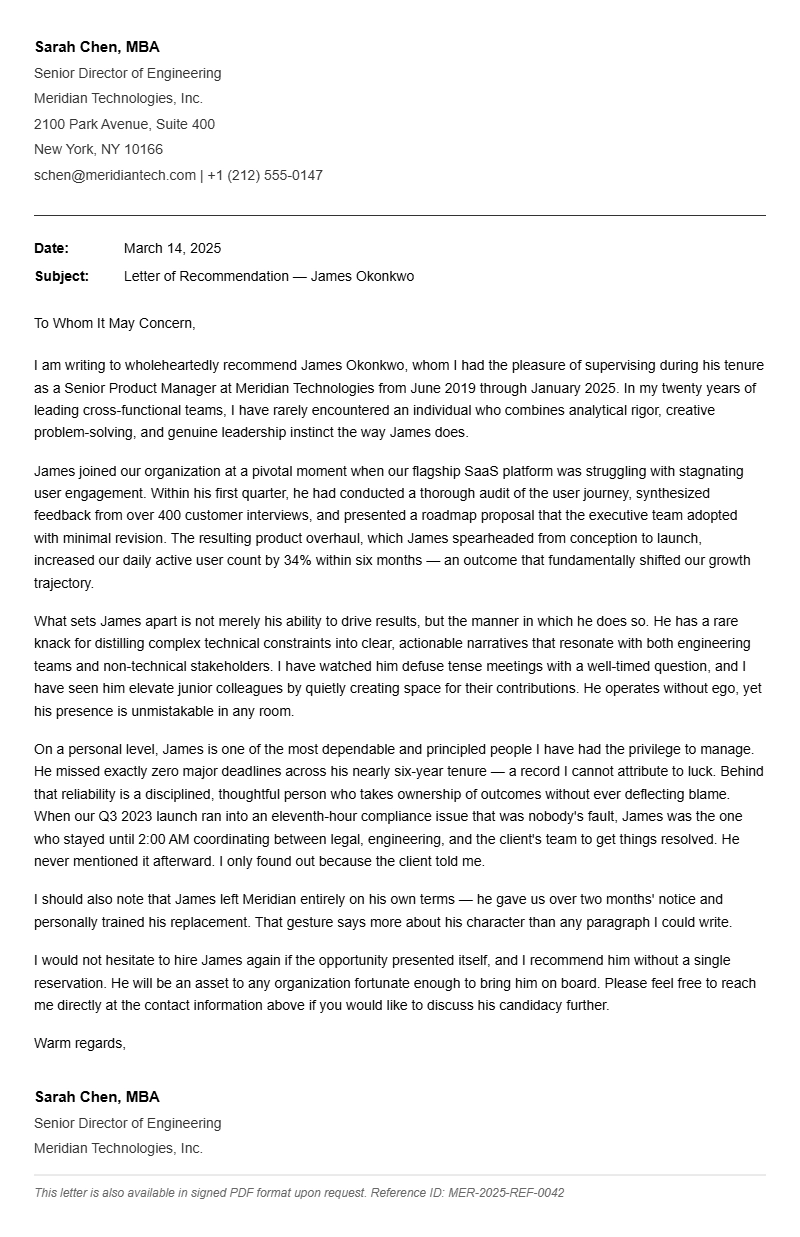
General Employment Reference Letter
Date: _______________
To Whom It May Concern:
I am writing to wholeheartedly recommend [Full Name] for any professional opportunity they choose to pursue. I had the pleasure of working alongside [Name] for over [number] years at [Company Name], where they served as [Job Title]. During this period, I witnessed firsthand their exceptional dedication, sharp problem-solving skills, and unwavering professionalism.
What sets [Name] apart is their ability to manage complex projects while maintaining a calm, solution-oriented demeanor. They consistently exceeded performance targets and built strong relationships with colleagues and clients alike. On more than one occasion, I turned to them as a sounding board for critical decisions, and their judgment never disappointed.
I firmly believe that [Name] would be an invaluable asset to any team. Please feel free to contact me if you require further insight.
Sincerely,
[Your Name]
[Your Title]
[Email] | [Phone]
Academic Recommendation for University Applicant
To the Admissions Committee:
It is my distinct pleasure to recommend [Student Name] for admission to your undergraduate program. I taught [Student Name] in two advanced courses—[Course A] and [Course B]—during the [Year] academic year, where they distinguished themselves as one of the top performers in a highly competitive cohort.
[Student Name] demonstrates an intellectual curiosity that goes well beyond the syllabus. Their research paper on [Topic] was both original and meticulously argued, earning the highest mark in the class. Moreover, they actively contributed to seminar discussions, often elevating the dialogue with thoughtful questions and cross-disciplinary connections.
Beyond academics, [Student Name] is a natural leader who organized study groups and mentored incoming students. Their integrity and empathetic nature make them a respected presence on campus. I am confident they will thrive in a challenging university environment and make meaningful contributions.
Please do not hesitate to reach out if I can provide additional perspective.
Best regards,
[Professor’s Name]
Professor of [Department]
[University Name]
Character Reference Letter for Tenant
To Whom It May Concern:
I am writing this character reference for [Tenant’s Name], whom I have known personally for over five years. I believe that [Tenant’s Name] would make an excellent tenant for any property.
During the time I have known [Tenant’s Name], they have consistently demonstrated a high level of responsibility and respect for property. Their current home is always well-maintained, clean, and organized. I have seen how promptly they address maintenance issues and how carefully they treat the property, as if it were their own. Furthermore, [Tenant’s Name] is financially disciplined; I am aware that they have always paid their rent and bills on time, without exception.
As a neighbor, [Tenant’s Name] is considerate and friendly, maintaining a quiet and respectful environment. They are honest, trustworthy, and a person of strong moral character. I have no hesitation recommending them as a reliable and ideal tenant.
Sincerely,
[Your Full Name]
[Your Address]
[Contact Information]
Volunteer Reference Letter
To the Selection Committee:
I am delighted to offer this reference for [Volunteer’s Name], who served as a dedicated volunteer at [Organization Name] from [Start Date] to [End Date]. Throughout their time with us, [Volunteer’s Name] displayed an extraordinary commitment to our mission and to the community we serve.
Initially, [Volunteer’s Name] took on [specific task], but quickly grew to handle more complex responsibilities, including coordinating food drives and training new volunteers. Their ability to connect with people from all walks of life was exceptional, always showing empathy and patience even under stressful conditions. I was particularly impressed by their initiative in launching a weekend tutoring program for young learners, an effort that continues to benefit dozens of children today.
[Volunteer’s Name] is punctual, hardworking, and brings a positive energy that lifts the entire team. I would not hesitate to welcome them back in any capacity and highly recommend them for any volunteer or professional role that values compassion and reliability.
Warm regards,
[Supervisor Name]
[Title]
[Organization Name]
Freelancer Recommendation Letter
To Whom It May Concern:
I am pleased to recommend [Freelancer’s Name], who completed a [project type] for [Company Name] as an independent contractor between [Start Date] and [End Date]. Working with [Freelancer’s Name] was a seamless experience from start to finish.
Our project required [brief description of work, e.g., a complete website redesign with tight turnaround]. [Freelancer’s Name] not only delivered ahead of schedule but also exceeded our quality expectations. Their communication was consistently prompt and clear, providing regular updates and listening carefully to our feedback. When an unexpected technical challenge arose, they presented multiple viable solutions and implemented the fix within hours.
What truly distinguishes [Freelancer’s Name] is their blend of technical mastery and business acumen. They understood our brand vision immediately and translated it into a polished final product. I received numerous compliments from our internal stakeholders on the results.
I would confidently hire [Freelancer’s Name] again and recommend them for any freelance or consulting engagement. Please contact me if you need further details.
Best regards,
[Client Name]
[Title, Company]
Internship Performance Reference Letter
To Whom It May Concern:
It gives me great satisfaction to write this reference for [Intern’s Name], who interned with [Department/Team] at [Company] from [Start] to [End]. Throughout the internship, [Intern’s Name] displayed a remarkable willingness to learn and a proactive attitude that set them apart.
During their time with us, [Intern’s Name] assisted with [key tasks, e.g., market research, data entry, content creation], consistently delivering error-free work under tight deadlines. They eagerly took on additional responsibilities, volunteering to help plan a client workshop and later presenting findings directly to senior management. Their ability to grasp complex concepts quickly was impressive, and they weren’t afraid to ask insightful questions that showed deep engagement.
Beyond technical skills, [Intern’s Name] is a natural team player. Colleagues appreciated their cheerful demeanor and readiness to support others, even during high-pressure periods. I am confident they will bring the same dedication and positive energy to any future role. I give [Intern’s Name] my unreserved recommendation.
Sincerely,
[Supervisor Name]
[Designation]
Professional Colleague Recommendation Letter
To the Hiring Manager:
I have had the distinct pleasure of working closely with [Colleague’s Name] for nearly [number] years at [Company], where we collaborated on numerous cross-functional teams. While I was not their supervisor, I can attest to their exceptional professional qualities from a peer perspective.
[Colleague’s Name] is the kind of teammate who elevates every project. During our joint work on [specific initiative, e.g., a product launch], I saw how they seamlessly coordinated between design, engineering, and sales, ensuring everyone stayed aligned and motivated. Their ability to simplify complex problems and propose creative solutions saved the project countless hours. Just as importantly, they are a generous mentor, often spending time helping junior team members develop their skills without seeking recognition.
Interpersonally, [Colleague’s Name] is approachable, honest, and deeply respected across the organization. They handle pressure with grace and always follow through on commitments. I genuinely believe that any company would be fortunate to have them, and I recommend [Colleague’s Name] without reservation.
Kind regards,
[Your Name]
[Your Title]
Graduate School Recommendation Letter
To the Graduate Admissions Committee:
I am writing to strongly endorse [Student’s Name] for admission to your [Master’s/PhD] program in [Field]. I taught [Student’s Name] in two upper-level seminars—[Seminar A] and [Seminar B]—and supervised their undergraduate thesis, so I have had extensive opportunity to evaluate their academic potential.
The intellectual drive [Student’s Name] brings to their work is exceptional. Their thesis, which explored [Thesis Topic], demonstrated a mastery of theoretical frameworks while offering fresh insights that could shape future research. The resulting paper was publishable quality and is currently under revision for a peer-reviewed journal—a rare achievement for an undergraduate. In class, they consistently contributed original interpretations and handled critique with maturity and openness.
Moreover, [Student’s Name] possesses the patience and rigor required for long-term research. I observed their meticulous lab work and ethical approach to data collection. Combined with their collaborative spirit, I am confident they will become a productive scholar and a valued member of your academic community. I give my highest recommendation.
Please feel free to contact me for further discussion.
Sincerely,
[Professor’s Name], PhD
Department of [Department]
[University]
Personal Character Reference for Court
To the Presiding Judge:
I am writing this character reference on behalf of [Defendant’s Name], whom I have known for [number] years as a [relationship, e.g., neighbor, friend, community member]. I am aware of the charges before this court and wish to offer my perspective on [his/her/their] character.
Throughout our long acquaintance, I have consistently known [Defendant’s Name] to be a person of honesty, kindness, and integrity. [He/She/They] has always been a reliable presence in our community, volunteering as [example, e.g., a youth soccer coach] and regularly helping elderly neighbors with errands. On a personal level, [Defendant’s Name] has shown genuine remorse for the situation and has taken proactive steps toward betterment, including [mention specific steps, e.g., attending counseling].
I fully understand the seriousness of the matter, but based on everything I have witnessed, I believe this incident does not define [Defendant’s Name]’s character. [He/She/They] is committed to making amends and rebuilding trust. I respectfully ask the court to consider [his/her/their] overall good character when determining the appropriate resolution.
Respectfully,
[Your Full Name]
[Address]
[Contact Number]
Teacher Recommendation Letter for Student
To the Scholarship Selection Committee:
I am honored to recommend [Student’s Name] for the [Scholarship Name]. I have taught [Student’s Name] for three years—covering [Subject 1], [Subject 2], and serving as the advisor for the [Club/Activity]—and have seen extraordinary growth and dedication.
In the classroom, [Student’s Name] consistently ranks among the top 5% of students. What truly distinguishes them, however, is their curiosity: they regularly pursue independent research, bringing in articles and ideas that go beyond the curriculum. Their final project in [Subject], which examined [Topic], was so insightful that I often cite it as an example for future classes. Outside of academics, [Student’s Name] led community service initiatives, organizing a successful food and clothing drive that engaged over 200 students.
Despite personal challenges, [Student’s Name] maintains remarkable resilience and a positive outlook that inspires peers. They are a born leader who listens before acting, and their moral compass is unquestionable. I have no doubt they will excel in their studies and continue to make a difference. I give my absolute highest recommendation.
Please do not hesitate to contact me for any additional information.
Warmly,
[Teacher’s Name]
[Subject] Teacher
[School Name]