Moving out of a rental property involves more than just packing boxes and handing over keys. One of the most important steps many tenants forget is sending a proper move out notice letter to their landlord or property manager. This simple document protects your interests, ensures you get your security deposit back, and keeps your rental history clean. If you’ve been searching for move out notice letter samples to guide you through writing your own, you’re in the right place. I’ll walk you through everything you need to know, with practical examples you can adapt for your situation.
What Is a Move Out Notice Letter?
A move out notice letter is a written communication you send to your landlord or property management company to formally notify them that you intend to vacate the rental unit. It’s not just a courtesy—it’s often a legal requirement spelled out in your lease agreement. This letter confirms your departure date, provides your forwarding address, and sometimes explains your reasons for leaving.
Think of it as the rental equivalent of giving two weeks’ notice at a job. You’re respecting the terms of your agreement while protecting yourself from disputes down the road. Many landlords won’t release your security deposit without written documentation of your move-out date, so this letter serves as your paper trail.
If you’re also dealing with other rental documentation, you might find our rent increase letter templates helpful for understanding how landlords communicate about housing matters, which gives you perspective on what landlords typically expect in written tenant correspondence.
When Do You Need to Send a Move Out Notice?
Most standard leases require 30 days’ notice before moving out, though some states or individual lease agreements might specify 60 days, especially for month-to-month tenancies. You generally need to send this letter when:
- Your lease term is ending and you don’t plan to renew
- You’ve decided to break your lease early (with landlord approval)
- You’re on a month-to-month rental agreement and want to leave
- Your landlord has asked you to vacate
- You’re selling a property you’re renting out
The timing matters more than most people realize. Send your notice too late, and you could be liable for an extra month’s rent. Send it too early, and you might confuse your landlord about when you’re actually leaving. The sweet spot is usually 30 days before your intended move-out date, but always check your specific lease terms first.
Key Components of a Move Out Notice Letter
Your letter doesn’t need to be lengthy, but it should include several essential elements to be effective. Here’s what every move out notice should contain:
Your Basic Information
Include your full name, the property address (both the rental unit address and your current mailing address if different), and your phone number or email. This ensures your landlord can reach you if questions arise after you’ve moved out.
Clear Statement of Intent
State plainly that you are giving notice to vacate the property. Something like “I am writing to inform you of my intent to vacate the rental unit located at [address] on or before [date].” Don’t bury this in vague language—make your intention unmistakable.
Move Out Date
Specify the exact date you plan to be completely moved out and return the keys. This gives your landlord a clear timeline for scheduling inspections and preparing for new tenants.
Forwarding Address
Your landlord needs to know where to send your security deposit refund and any final correspondence. Include a reliable address where you’ll actually receive mail for at least the next six months.
Request for Inspection
It’s smart to ask for a pre-move-out inspection. This lets you address any potential issues before you leave, potentially saving your security deposit. Phrase it politely: “I would appreciate the opportunity to schedule a move-out inspection to address any concerns before my departure.”
Thank You and Contact Information
A brief thank-you for the tenancy, followed by your contact details, wraps up the letter professionally. You might also ask about the process for returning keys and retrieving your deposit.
Step-by-Step Guide to Writing Your Notice Letter
Now let me walk you through the actual process of creating your letter, step by step. I’ll share what I recommend based on helping hundreds of tenants navigate this situation.
Step 1: Review Your Lease First
Before you write anything, pull out your lease and find the termination clause. This section tells you exactly how much notice you must give and any specific format requirements. Some leases require notice be sent via certified mail; others accept emails. Knowing this prevents your notice from being invalid simply because of a technicality.
Step 2: Choose Your Format
You can write this as a formal letter printed and mailed, or as a professional email if your lease permits electronic communication. For documentation purposes, I usually recommend printed letters sent via certified mail with return receipt requested. This gives you proof your landlord received it on a specific date. However, email works fine if your lease explicitly allows it and you save the sent message as your record.
Step 3: Write the Actual Letter
Start with the date and your landlord’s name and address at the top, just like a business letter. Then move into the body of the letter using the components I outlined earlier. Keep your tone professional but friendly—you might need a reference from this landlord someday, so don’t burn bridges over a routine letter.
Step 4: Proofread Carefully
Double-check all dates, addresses, and names. A typo in your move-out date could create confusion or even cost you money if the landlord interprets it differently. Read it out loud to catch awkward phrasing.
Step 5: Send It and Keep Records
Mail your letter and keep a copy for yourself, including the postal receipt. If emailing, send it to yourself as well and save both versions in a dedicated folder. You want documentation that you sent the notice on a specific date.
If you’re handling multiple rental-related documents, having a system for organizing letters and templates helps. Our collection of pickup authorization letter templates demonstrates how to create clear, professional correspondence that you can adapt for various rental situations.
Move Out Notice Letter Samples and Templates
Let me give you several examples you can adapt based on your specific situation. These are real-world templates that work for most standard rental situations.
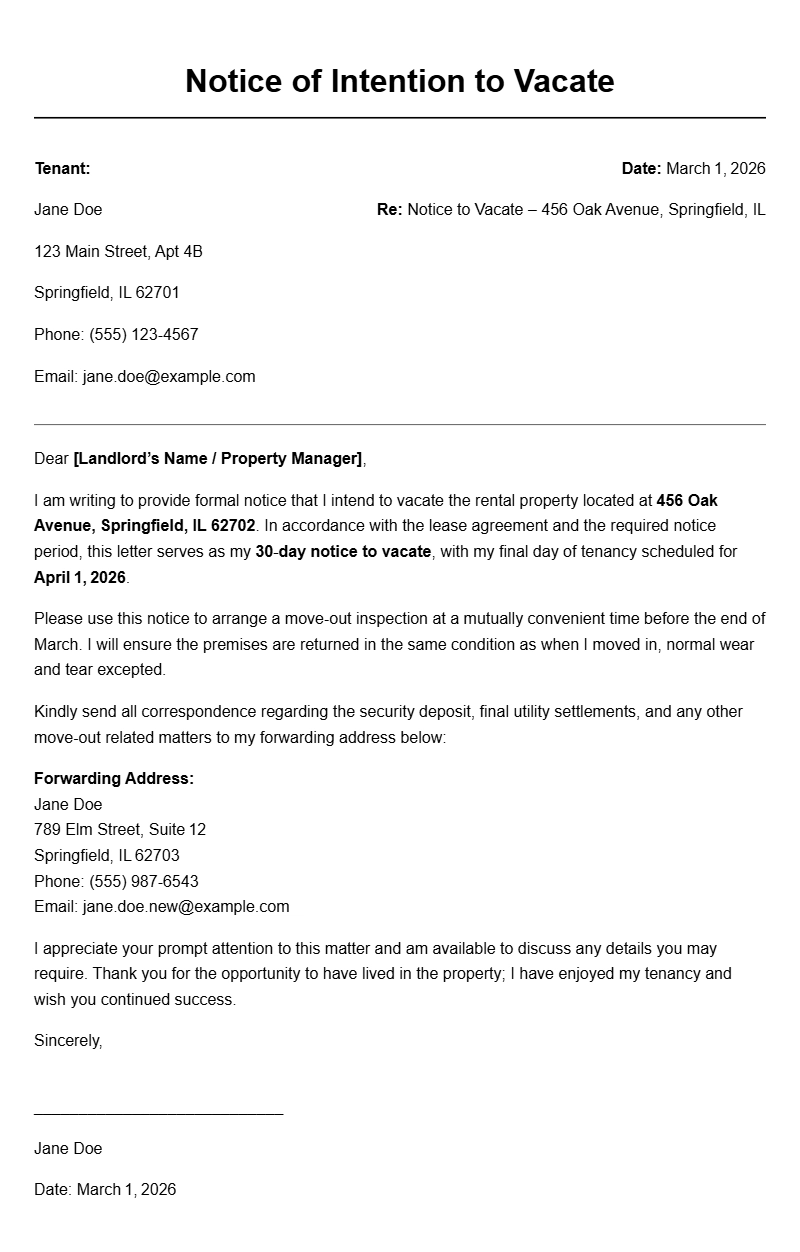
Standard 30-Day Notice Template
[Your Name]
[Your Current Address]
[City, State ZIP]
[Phone Number]
[Email Address]
[Date]
[Landlord’s Name]
[Landlord’s Address]
[City, State ZIP]
Dear [Landlord’s Name],
I am writing to provide formal notice of my intent to vacate the rental property located at [Property Address]. My last day in the unit will be [Date], which satisfies the [30/60]-day notice requirement as specified in my lease agreement.
I will return all keys, garage openers, and access cards to you on or before my move-out date. My forwarding address is [Forwarding Address], and you can reach me at [Phone Number] or [Email] if needed.
I kindly request a move-out inspection prior to my departure so I can address any concerns and ensure the property is left in good condition. Please let me know what date and time works best for you.
Thank you for the opportunity to rent this property. I have enjoyed living here and will leave it clean and in good condition.
Sincerely,
[Your Signature]
[Your Printed Name]
Early Lease Termination Notice Sample
If you need to break your lease early, your letter needs to be more detailed. Here’s how to handle that situation:
I am writing to formally notify you of my need to vacate the rental property at [Address] before the end of my lease term. My intended move-out date is [Date], which is [X] days from today.
I understand this may be outside the standard lease terms, and I want to work with you to make this transition as smooth as possible. I am aware that I may be responsible for [early termination fees/remaining rent until a new tenant is found/lost rent during the notice period], and I am prepared to discuss these terms with you.
I have been an excellent tenant for [X] years, always paying rent on time and maintaining the property well. I hope we can reach an agreement that works for both of us.
Month-to-Month Termination Sample
For month-to-month arrangements, your letter can be more straightforward:
This letter serves as my official 30-day notice to terminate my tenancy at [Address]. I will be moving out on [Date] and will return all keys at that time.
Please send my security deposit and any final billing to [Forwarding Address] within the timeframe required by [State] law.
I have enjoyed renting from you and would happily recommend you to other tenants in the future.
Common Mistakes to Avoid
Based on questions I receive repeatedly, here are the most frequent errors people make when writing move out notice letters:
- Forgetting to date the letter: Without a clear date, there’s ambiguity about when you sent notice. Always include the date near the top of the letter.
- Vague move-out dates: “Sometime in March” doesn’t cut it. Specify an exact date like “March 15, 2024.”
- Not keeping copies: I’ve seen tenants lose disputes because they couldn’t prove they sent the notice. Always keep a copy.
- Verbal notices: Never rely on telling your landlord in person or over the phone. Always follow up in writing, even if you discussed it verbally.
- Wrong notice period: Sending 30 days’ notice when your lease requires 60 can cost you an extra month of rent. Double-check before sending.
- Forgetting your forwarding address: Include it even if you think you’ll know your new address. Things change, and you don’t want your deposit sent to the old unit.
If you’re transitioning between rental situations and need to write other correspondence, our internship application letter templates offer good examples of professional letter structure that translate well to rental communications.
Tips for Customizing Your Letter
While templates give you a starting point, your letter should reflect your specific situation. Here are ways to make it more effective:
Match Your Lease Type
Fixed-term leases require different language than month-to-month agreements. If you’re breaking a lease early, acknowledge your awareness of potential consequences. If you’re ending a month-to-month tenancy, cite the proper notice period required in your jurisdiction.
Include State-Specific Language
Many states have specific legal requirements for security deposit returns. Including language like “Please return my security deposit within the [30/21] days as required by [State] law” reminds your landlord of their obligations without being confrontational.
Reference Lease Clause Numbers
If your lease specifies certain procedures for termination, reference the relevant clause in your letter. This shows you understand your obligations and makes your notice harder to dispute.
Document the Property Condition
Consider attaching a brief inventory of the unit’s condition or referencing any move-in inspection report you’ve kept. This protects you if disputes arise about deposit deductions later.
Offer to Help Find a Replacement Tenant
If you’re breaking a lease early, offering to help find a qualified replacement tenant demonstrates good faith and may reduce any penalties you face. This is especially valuable in tight rental markets.
For more guidance on professional correspondence, our collection of university to student letter samples includes useful examples of how to maintain a professional tone while being helpful and accommodating.
What Happens After You Send the Notice?
Sending your notice is just the beginning. After your letter arrives, expect the following:
- Your landlord will typically schedule a move-out inspection
- You’ll arrange a time to return keys and settle any final payments
- Your landlord has a legally required period (often 21-45 days depending on your state) to return your security deposit with an itemized statement of any deductions
- Final utility bills will be settled, with you responsible for services up to your move-out date
Keep all correspondence and receipts in a dedicated folder. If your deposit doesn’t arrive within the legally mandated timeframe or if you receive deductions you disagree with, you’ll need this documentation to dispute the outcome.
Final Thoughts
A move out notice letter isn’t complicated, but it does require attention to detail and proper timing. The good news is that once you understand what to include and follow the steps I’ve outlined, you can write one in under fifteen minutes. Keep a copy for your records, send it with enough lead time to satisfy your lease requirements, and follow up to ensure your security deposit comes back to you properly.
If you find yourself needing to write performance reviews or other professional correspondence in your work life, our performance review letter templates offer additional professional writing frameworks that complement the communication skills needed for tenant-landlord interactions.
The key is keeping communication clear and documented. Your landlord is more likely to work with you cooperatively when you demonstrate professionalism and respect for the rental process. Good luck with your move, and don’t forget to change your address with the post office and update any subscriptions or accounts tied to your old address.
Document Structure & Example Models