Whether you’re a first-time landlord navigating your first rent adjustment or someone who’s been managing rental properties for years, getting the rent increase letter right matters more than most people realize. A poorly worded letter can damage tenant relationships, create unnecessary tension, or even create legal problems you didn’t anticipate. A well-crafted letter communicates your decision clearly while maintaining the professional rapport you’ve built with your tenants.
This guide walks you through everything you need to write an effective rent increase letter, including ready-to-use templates you can customize for your specific situation. You’ll find practical examples, common pitfalls to avoid, and tips for making the letter feel personal rather than generic.
What Is a Rent Increase Letter and Why Landlords Use One
A rent increase letter is a formal written notice from a landlord to a tenant informing them that the monthly rent will change. It serves several purposes beyond simply announcing a number change. First, it creates a documented record that the tenant received proper notice, which matters if disputes arise later. Second, it gives the tenant time to prepare financially or ask questions before the change takes effect. Third, it sets a professional tone that distinguishes your rental business from informal arrangements.
Many landlords skip the formal letter and just tell tenants verbally or send a quick text. This approach often backfires. Without written documentation, you have no proof of what was communicated or when. Tenants may claim they didn’t know about the increase, or they might contest the timing. A written letter protects both you and your tenant by establishing clear expectations.
For property owners managing multiple units, a standardized letter also saves time while ensuring consistency across your portfolio. You can have templates ready and simply adjust the specific details for each situation.
When You Should Send a Rent Increase Letter
The timing of your notice matters almost as much as the content. Most jurisdictions require landlords to provide advance notice before any rent increase takes effect, typically 30 to 60 days depending on local laws. Even if your area doesn’t have strict requirements, giving adequate notice shows respect for your tenant’s planning ability.
Consider sending the letter when your lease renewal date approaches. This gives you the opportunity to present the new terms alongside the renewal option. Alternatively, you might send it mid-tenancy if you’ve decided on an annual adjustment and your lease allows for it. Many landlords send letters 60 to 90 days before the intended effective date, which provides plenty of buffer for the tenant to respond or negotiate.
The letter should always precede any rent change, never announce a change that takes effect in less than the legally required notice period. If you’re uncertain about your local requirements, check with a local landlord association or legal resource. Some areas have specific rules about how and when rent increases can be implemented.
Key Components Every Rent Increase Letter Should Include
Effective rent increase letters share common elements that make them clear, professional, and legally sound. Here is what to include:
- Your contact information — Include your name, property address, and preferred contact method so the tenant knows exactly who sent the letter.
- Tenant information — State the tenant’s name and the rental unit address to ensure there’s no confusion about which property is affected.
- Current rent amount — Specify the existing monthly rent to avoid any ambiguity about which figure is changing.
- New rent amount — State the proposed rent clearly, including the exact dollar amount and when it takes effect.
- Effective date — Include the specific date when the new rent begins, giving at least the minimum required notice period.
- Reason or context — Briefly explain why you’re adjusting rent, whether it’s market rates, property improvements, or cost increases. This isn’t legally required but helps tenants understand your position.
- Response options — Invite the tenant to discuss concerns or ask questions. This keeps communication open and often prevents misunderstandings.
- Signature and date — Sign and date the letter to establish when it was issued.
Including these elements creates a complete record that protects you while clearly communicating your intentions to the tenant.
How to Write a Rent Increase Letter (Step-by-Step)
Writing a rent increase letter doesn’t have to be complicated. Follow these steps to create a professional, effective notice.
Step 1: Check your local requirements first. Before you write anything, research the legal requirements in your area. Some states and cities have specific rules about notice periods, what must be included, and even caps on how much you can increase rent. Knowing these requirements keeps you compliant and prevents costly mistakes.
Step 2: Gather your information. You’ll need your current rent amount, your proposed new rent, the effective date, your tenant’s name, and the property address. Having all this ready keeps the writing process smooth and prevents errors in the final letter.
Step 3: Choose your tone carefully. This is where many landlords struggle. You want to be professional without sounding cold or threatening. Think about how you’d phrase this conversation in person. A straightforward but respectful tone works better than formal legal language that feels impersonal.
Step 4: Write the opening statement. Start by stating the purpose of the letter directly. Something like “I am writing to inform you of an upcoming adjustment to your monthly rent” works well. Get to the point without unnecessary preamble.
Step 5: Present the specific details. Clearly state the current rent, the new rent, and the effective date. Use a simple format that makes these numbers easy to find. Some landlords use a small table here for clarity, though a clean paragraph works just as well.
Step 6: Add context if appropriate. If you have reasons for the increase, briefly mention them. For example, you might reference comparable rental rates in the area, improvements you’ve made to the property, or increased operating costs. Keep this section brief and factual rather than defensive.
Step 7: Invite dialogue. End the core content by encouraging the tenant to reach out with questions or concerns. This small addition often prevents tension and gives the tenant an opportunity to discuss the change before it takes effect.
Step 8: Sign and date. Include your signature, printed name, and the date you sent the letter. Keep a copy for your records.
Rent Increase Letter Templates You Can Customize
The following templates cover different scenarios you might encounter. Adapt them to match your specific situation and local requirements.
Standard Annual Rent Increase Notice
This template works well when you’re increasing rent at lease renewal time and want to provide adequate notice.
Dear [Tenant Name],
I want to let you know that the monthly rent for your unit at [Property Address] will be increasing from $[Current Rent] to $[New Rent] effective [Date].
This adjustment reflects current market conditions and helps ensure I can continue maintaining the property to the standards you expect. The new rent will be due starting on [Effective Date], and I am providing this notice more than [Number] days in advance as required.
If you have any questions about this change or would like to discuss your tenancy, please feel free to contact me at [Your Phone/Email]. I am happy to talk through any concerns you might have.
Thank you for being a valued tenant. I appreciate the opportunity to continue renting to you.
Sincerely,
[Your Name]
[Date]
Mid-Lease Rent Increase Notice
Use this template when circumstances require a rent change during an active lease term, assuming your lease allows for this.
Dear [Tenant Name],
As discussed regarding your rental at [Property Address], I am formally confirming that the monthly rent will increase from $[Current Rent] to $[New Rent] beginning [Date].
While I recognize this comes during your current lease term, [brief reason such as “significant increases in property taxes and insurance” or “necessary repairs that have impacted operating costs”], I want to provide you with as much notice as possible.
Please let me know if you have any questions or would like to discuss this further. I value having you as a tenant and want to find a solution that works for both of us.
Sincerely,
[Your Name]
[Date]
Post-Improvement Rent Increase
This template works when you’ve made significant upgrades to the property and want to explain the rent adjustment in that context.
Dear [Tenant Name],
I am writing to inform you that the rent for your unit at [Property Address] will increase from $[Current Rent] to $[New Rent] effective [Date].
Over the past [time period], I have completed several improvements to this unit, including [specific improvements such as new appliances, updated flooring, or improved heating system]. These upgrades enhance your living experience and help maintain the property’s value. The adjusted rent reflects these investments while remaining competitive with similar properties in the area.
If you have questions about the improvements or the rent adjustment, please contact me at [Your Phone/Email]. I am happy to discuss this further.
Sincerely,
[Your Name]
[Date]
Common Mistakes to Avoid in Rent Increase Letters
Several recurring errors can undermine an otherwise well-intentioned rent increase letter. Watch out for these problems.
Giving insufficient notice. This is the most common mistake. Always check your local laws and build in extra time when possible. Sending the letter with exactly the minimum required notice leaves no margin for delays in delivery.
Using vague language. Phrases like “your rent will be going up soon” or “we need to discuss an adjustment” create ambiguity. Specify exact amounts and dates so there’s no room for misunderstanding.
Making it sound threatening. Avoid language that implies consequences if the tenant doesn’t comply. Sentences like “you must accept these terms” or “failure to pay will result in action” create antagonism and rarely improve outcomes.
Forgetting to sign or date. An unsigned letter looks informal and creates questions about authenticity. Always sign and date your communications, and keep a copy for your records.
Not explaining the reason at all. While you’re not obligated to justify your decision, a brief explanation often helps tenants accept the change more readily. They may still disagree, but understanding your perspective reduces friction.
Including personal attacks or complaints. Even if there have been issues with the tenant, the rent increase letter is not the place to address them. Keep the letter focused on the business matter at hand.
Tips for Customizing Your Rent Increase Letter
A template provides a solid foundation, but personalizing it makes the communication more effective and less like a form letter.
Start by addressing the tenant by name rather than using generic “Dear Tenant” or “To Whom It May Concern.” This small touch shows you view them as a person rather than just a rental transaction.
If you’ve had a positive relationship with the tenant, acknowledge it briefly. A sentence like “I appreciate your consistent timely payments over the past two years” reinforces goodwill without being sycophantic.
Be honest about the reason for the increase, even if it’s simply “market rates have increased.” Tenants generally accept that landlords need to stay competitive, and transparency builds trust.
Consider offering something in return when possible. If you’re raising rent, you might mention upcoming maintenance or improvements you’ll be completing. This shows you’re invested in the property and the tenant’s experience.
When customizing the template, maintain the structure that makes letters effective. Don’t cut essential elements like the effective date or your contact information just because they seem obvious. Clarity should always take priority over brevity.
If you’re managing several properties and sending multiple letters, personalize each one with the correct unit number, tenant name, and specific rent amounts. A generic letter that clearly wasn’t customized will feel impersonal and may frustrate tenants.
A Quick Note on Legal Compliance
While this guide focuses on writing effective rent increase letters, legal requirements vary significantly by location. Some areas have rent control ordinances that limit increases to certain percentages or require specific justification. Others have strict notice requirements with penalties for non-compliance.
If you haven’t already, research the landlord-tenant laws specific to your city or state before sending any rent increase notice. Local landlord associations often provide guidance, and legal aid organizations sometimes publish free resources for small landlords. When in doubt, consult a real estate attorney familiar with your local regulations.
Beyond legal requirements, treating your tenants with respect through clear, thoughtful communication typically leads to better outcomes for everyone involved.
Sample Documents for Multiple Use Cases
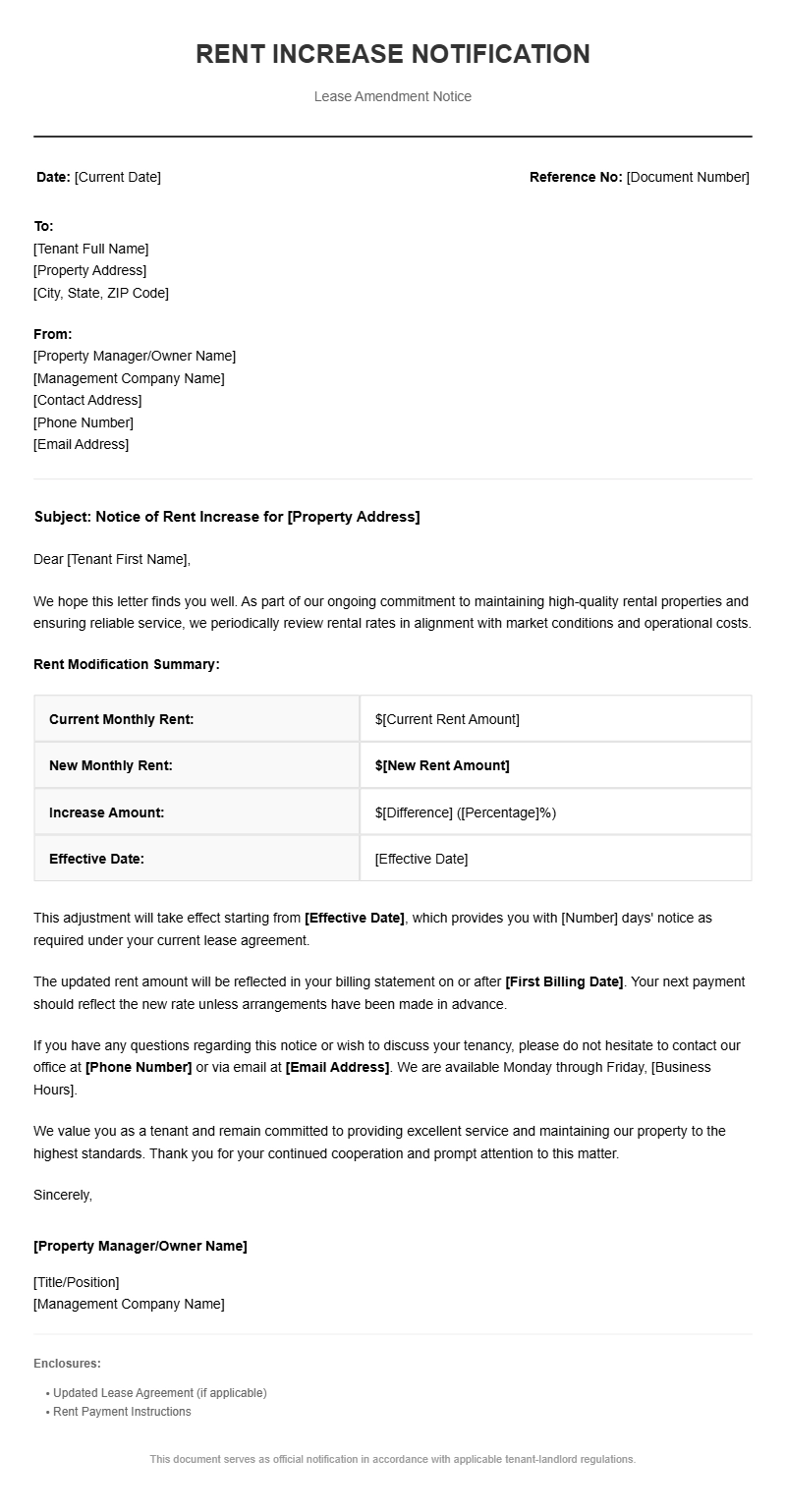
Annual Rent Increase Notice – Residential Lease Renewal
Date: 25 March 2026
From: [Landlord Name]
Address: …
… etc
Annual Rent Increase Notice – Residential Lease Renewal
Date: 25 March 2026
From: ABC Realty
456 Maple Avenue
Springfield, IL 62701
Phone: (555) 123‑4567
Email: leasing@abcrealty.com
To: Ms. Sarah Jensen
789 Oak Street, Unit 2B
Springfield, IL 62702
Subject: Notice of Rent Increase – Lease Renewal
Dear Ms. Jensen,
We hope this message finds you well. As your current lease agreement is set to expire on 30 April 2026, we would like to inform you of a modest increase in your monthly rent for the upcoming renewal period. The adjustment reflects the latest cost‑of‑living index and comparable market rates in our locality.
Please find the details of the rent change below:
| Current Monthly Rent | New Monthly Rent | Effective Date | Reason |
|---|---|---|---|
| $1,500 | $1,575 | 1 May 2026 | Annual adjustment per CPI |
The new rent will be due on the first day of each month starting 1 May 2026. If you have any questions or wish to discuss the renewal terms, please contact us at the phone or email listed above.
We appreciate your tenancy and look forward to continuing our partnership.
Sincerely,
David Carter
Property Manager, ABC Realty
Commercial Property Rent Increase Notification
Date: 27 March 2026
From: XYZ Commercial Leasing Ltd.
200 Business Park Drive, Suite 400
Metro City, NY 10001
Phone: (212) 555‑0199
Email: leasing@xyzcommercial.com
To: Greenleaf Design Studio, Inc.
55 Innovation Way, Floor 3
Metro City, NY 10002
Subject: Rent Increase Notice – Commercial Lease Renewal
Dear Ms. Rivera,
As we approach the end of your current lease term on 30 April 2026, we are required to provide you with a rent adjustment notice as per the terms of your agreement. After reviewing operating costs and market leasing rates, a moderate increase has been determined.
The updated rent figures are as follows:
| Current Monthly Rent | New Monthly Rent | Effective Date | Reason |
|---|---|---|---|
| $4,200 | $4,450 | 1 May 2026 | Market adjustment and operating cost increase |
Please ensure the new rent is deposited by the first business day of each month. Should you require any clarification or wish to discuss alternative arrangements, feel free to contact us.
Thank you for your continued partnership.
Sincerely,
James Holloway
Senior Leasing Manager, XYZ Commercial Leasing Ltd.
Rent Increase Letter After Property Improvements
Date: 28 March 2026
From: Horizon Homes LLC
78 Serenity Lane
Portland, OR 97201
Phone: (503) 555‑7823
Email: info@horizonhomes.com
To: Mr. Ethan Brooks
12 River View Court, Apt 4
Portland, OR 97202
Subject: Rent Increase Notice – Property Upgrades Completed
Dear Mr. Brooks,
We are pleased to inform you that several improvements have been completed in your building over the past quarter, including a new roof, upgraded plumbing, and energy‑efficient windows. These enhancements have increased the property value and, consequently, the monthly rent will be adjusted accordingly.
The new rent schedule is outlined below:
| Current Monthly Rent | New Monthly Rent | Effective Date | Reason |
|---|---|---|---|
| $1,200 | $1,350 | 1 June 2026 | Recent property improvements and enhanced amenities |
The increase will be reflected in the rent due on 1 June 2026. If you have any concerns or would like to discuss the changes, please do not hesitate to contact us.
We value your tenancy and hope these upgrades enhance your living experience.
Sincerely,
Laura Nguyen
Property Manager, Horizon Homes LLC
Rent Increase Notice with Move-Out Option
Date: 29 March 2026
From: Pinnacle Property Management
300 Summit Blvd, Suite 150
Austin, TX 78701
Phone: (512) 555‑8341
Email: leasing@pinnaclepm.com
To: Ms. Clara Okafor
88 Sunset Drive, Unit 5
Austin, TX 78702
Subject: Rent Increase Notice – Option to Vacate
Dear Ms. Okafor,
We are writing to notify you that, effective 1 July 2026, the monthly rent for your apartment will increase from $1,100 to $1,200. This adjustment aligns with the rising costs of maintenance and property taxes in our area.
You have the following options:
- Accept the new rent and continue your tenancy under the updated terms.
- Provide written notice of intent to vacate by 1 May 2026 if you prefer not to renew.
The updated rent details are:
| Current Monthly Rent | New Monthly Rent | Effective Date | Reason |
|---|---|---|---|
| $1,100 | $1,200 | 1 July 2026 | Cost‑of‑living adjustment and market rates |
Please let us know your decision by the date indicated above. We are happy to discuss any questions you may have.
Thank you for your tenancy.
Sincerely,
Robert Martinez
Leasing Coordinator, Pinnacle Property Management