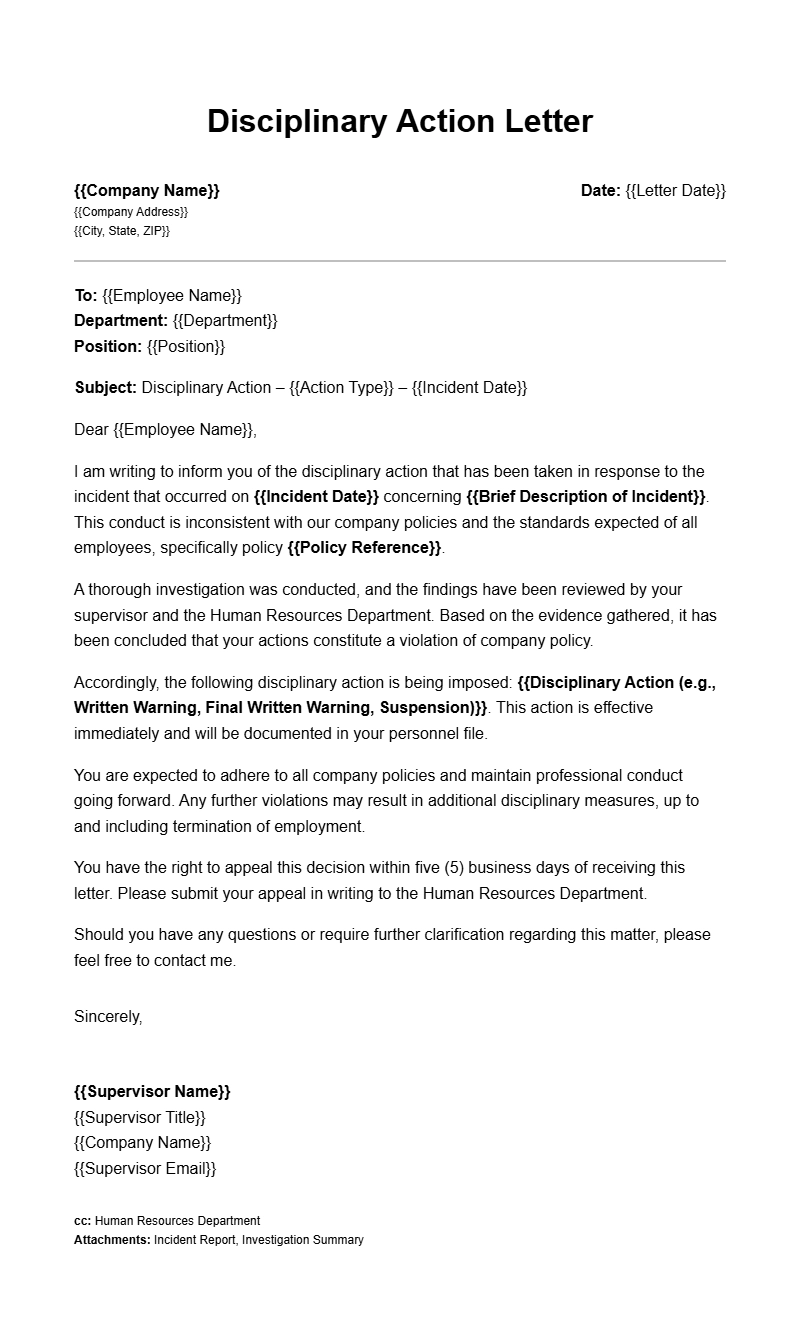
Writing a disciplinary action letter is one of those tasks that most managers dread. You’re not just documenting a problem—you’re setting the tone for how an employee responds and potentially how your organization handles similar situations going forward. Getting it right matters, and having a solid disciplinary action letter template in your toolkit makes the whole process less intimidating.
What Is a Disciplinary Action Letter Template
A disciplinary action letter template is a pre-structured document that managers and HR professionals use to communicate formal warnings, performance issues, or policy violations to employees. Rather than starting from scratch each time, these templates provide a framework that ensures you cover all the necessary elements while still allowing room for customization based on your specific situation.
These templates typically include sections for describing the issue, referencing company policies, outlining expected improvements, and explaining potential consequences. They serve as official records that can be referenced later if the situation escalates or if you need to demonstrate consistent application of workplace policies.
When to Use a Disciplinary Action Letter
Not every performance conversation requires a formal disciplinary action letter. These documents come into play when you’ve already had informal conversations that haven’t produced results, or when the issue is serious enough to warrant immediate formal action.
Common situations that call for a disciplinary action letter include repeated tardiness despite previous warnings, failure to meet performance targets after coaching, violation of workplace safety rules, inappropriate workplace behavior, breach of company policies, or insubordination. The key indicator is that you’re moving beyond coaching and into formal documentation territory.
If you’re dealing with a cleaner-to-client situation where performance issues have persisted, you might find it helpful to review cleaner-to-client letter samples for similar communication approaches. Similarly, tenant-to-property manager letter samples demonstrate how formal written communication works in other professional relationships.
Key Components of an Effective Disciplinary Action Letter
Every disciplinary action letter needs several essential elements to be effective and legally defensible. Missing one of these can weaken your document or create ambiguity about what was communicated.
Header and Employee Information
Start with clear identification: the employee’s name, position, department, and the date of the letter. Include the name of the person issuing the letter and their title. This establishes an official paper trail.
Statement of Purpose
Open with a clear statement that this is a formal disciplinary action. Something like “This letter serves as formal documentation of a disciplinary action regarding…” sets the right tone immediately.
Description of the Issue
Be specific about what happened. Instead of vague statements like “your performance has been unsatisfactory,” reference particular incidents, dates, and observable facts. If an employee was late five times in two weeks, say that. If they missed a project deadline that affected a client, name the project and the impact.
Policy Reference
Connect the behavior to specific company policies or handbook sections. This shows the employee that action is being taken consistently according to established rules, not arbitrarily. “This behavior violates Section 4.2 of our employee handbook regarding attendance” carries more weight than a general statement.
Expected Improvement
State clearly what the employee needs to do differently going forward. Include specific, measurable expectations with timelines where possible. Don’t assume the employee knows what “improvement” looks like—spell it out.
Consequences of Continued Issues
Be clear about what happens if the behavior continues. Progressive discipline typically means this is a first step, with additional consequences outlined for repeated violations. Be honest about what those consequences actually are.
Employee Acknowledgment
Include space for the employee’s signature to confirm receipt of the letter. This protects both parties—it confirms the employee received the communication and shows they were given opportunity to respond.
Step-by-Step Guide to Writing Your Disciplinary Action Letter
Now that you understand what goes into a disciplinary action letter, here’s how to actually write one that hits the mark.
Step 1: Gather Your Facts
Before you write anything, collect documentation. Review any previous conversations, prior warnings, attendance records, performance reviews, or incident reports. You need accurate dates, specific examples, and supporting evidence. Writing the letter when you’re frustrated or rushed leads to vague language that won’t hold up.
Step 2: Choose the Right Template Level
Disciplinary actions range from verbal warnings to termination. Match your letter to the severity and the employee’s history. A first-time minor issue gets a different letter than a repeated violation. Using a mandatory meeting notice letter template can help you schedule the disciplinary meeting itself, while the actual disciplinary documentation requires its own approach.
Step 3: Write the Description Section
Use objective, factual language. Describe behaviors, not personalities. Instead of “you’ve been careless,” write “on March 15th and March 18th, inventory counts showed discrepancies that traced back to items processed by your station.” Stick to what you can prove.
Step 4: Connect to Policy
After describing the issue, immediately reference the relevant policy. This creates a logical bridge that shows the employee exactly why their action constitutes a violation. Check your employee handbook for the exact wording and section numbers.
Step 5: Define Clear Expectations
This is where many letters fall short. Don’t just say “improve your performance.” State exactly what success looks like: “We expect you to arrive ready to work by 8:00 AM for your scheduled shifts, with no more than one tardy occurrence per 30-day period.” Make it measurable.
Step 6: Outline the Path Forward
Explain what happens next. Will there be a follow-up meeting? A performance review period? What are the next consequences if the behavior continues? Employees need to understand that this is a structured process, not a one-time event.
Step 7: Review for Tone and Legality
Read it aloud. Does it sound accusatory or defensive? Does it give the employee space to improve, or does it feel like you’re already firing them? Have HR or your legal team review it if there’s any question about liability. A poorly worded letter can create more problems than it solves.
Disciplinary Action Letter Template Examples
Here’s a practical example of a first written warning for attendance issues that you can adapt for your situation:
Example Template: First Written Warning – Attendance
Date: [Date]
Employee Name: [Employee Name]
Position: [Job Title]
Department: [Department]
Issued By: [Manager Name], [Title]
This letter serves as formal documentation of a first written warning regarding attendance violations.
On [specific dates], you arrived after your scheduled start time of [time]. Specifically, you were tardy on [date 1], [date 2], and [date 3]. These occurrences took place during a [time period] when attendance was particularly critical due to [reason if applicable].
This conduct violates Section [X.X] of our Employee Handbook, which requires employees to maintain regular and punctual attendance as a condition of employment.
We expect you to arrive at your workstation ready to begin work by [scheduled time] for all assigned shifts. Going forward, any additional tardy occurrences within a [30/60/90]-day period will result in further disciplinary action, up to and including termination.
A follow-up meeting is scheduled for [date] to review your attendance during the probationary period.
Your signature below confirms receipt of this letter and discussion of its contents. It does not necessarily indicate agreement with its contents.
Employee Signature: _________________ Date: _____
Manager Signature: _________________ Date: _____
For more formal letter structures, you might find franchise request letter templates useful for understanding how legal and business contexts shape formal documentation.
Common Mistakes to Avoid
Even well-intentioned managers make errors that weaken their disciplinary letters or create unnecessary complications. Watch out for these pitfalls:
- Using Vague Language: “Your attitude needs to change” is meaningless. What attitude? What would different look like? Specificity is your friend.
- Focusing on Personality Instead of Behavior: You can’t discipline someone for being “difficult” or “negative.” You can discipline them for specific actions that violated policy.
- Forgetting to Reference Policy: Without a policy connection, the discipline looks arbitrary. Always tie the behavior to a specific handbook section or documented rule.
- Inconsistent Treatment: If you’ve overlooked similar behavior from other employees, this letter could be challenged. Consistency matters.
- Threatening Consequences You Can’t Deliver: Don’t write “this will result in immediate termination” if that’s not actually your policy. Be accurate about real consequences.
- Failing to Document the Discussion: The letter itself is just part of the record. Document that the meeting actually happened and what was discussed.
- Using Emotional Language: Phrases like “I’m very disappointed” or “You’ve let the team down” add nothing legally and can make the letter sound personal rather than professional.
Tips for Customizing Your Disciplinary Action Letter
Every situation is unique, and your letter should reflect that. Here’s how to adapt templates to your specific needs:
Consider the Employee’s History
A first-time offense gets a different tone than a third warning. Adjust your language accordingly. A first warning might emphasize opportunity and support; a final warning should be unambiguous about consequences.
Account for Cultural or Language Considerations
If the employee’s primary language isn’t English, consider whether they fully understand the letter’s contents. Some organizations provide translated versions or have HR representatives present to explain in person.
Match the Severity to the Response
Minor issues deserve measured language. Serious violations—safety policy breaches, harassment, theft—warrant stronger language and clearer consequences. Your letter should reflect the actual gravity of the situation.
Include Support Resources
If relevant, offer something beyond just “don’t do this again.” If attendance is the issue and you know the employee is struggling with childcare, pointing them toward your employee assistance program shows you’re being reasonable while still holding them accountable.
Keep Records Consistent
Develop a standard format for all disciplinary letters in your organization. This makes it easier to spot patterns across employees and demonstrates equitable treatment if anyone questions your processes.
Making the Process Work for Your Organization
A disciplinary action letter template is only as good as the process surrounding it. The letter itself is a tool—a written record of a conversation that should ideally happen face-to-face. Use these templates to ensure consistency and legal compliance, but don’t let them replace genuine management engagement with your team.
The best outcomes from disciplinary action happen when employees clearly understand what’s expected, what they did wrong, and what they need to do differently. Your letter should support that conversation, not replace it. Take time to prepare, be specific in your documentation, and follow through on whatever commitments you make in the letter.
If your organization doesn’t already have a clear disciplinary policy, that’s worth developing before you need to use these templates. An outsourcing agreement letter structure might give you ideas about how formal agreements and clear expectations work in other professional contexts. Clear documentation protects both employers and employees—and it all starts with a well-written disciplinary action letter.
Practical Document Examples