Getting the wording right on a demotion notice letter matters more than most managers realize. The difference between a letter that feels like a dead end and one that keeps a valuable employee engaged often comes down to a few careful choices in phrasing, structure, and tone. I’ve reviewed dozens of these letters over the years, and the ones that work best share a common trait: they treat the employee like a person facing a real change, not a case file being processed.
If you’re looking for demotion notice letter samples, you’re probably either managing a restructuring, dealing with a performance situation, or helping an employee who requested a step back in their career. Whatever brought you here, this guide walks through everything you need to write or customize a letter that communicates clearly and respects everyone involved.
What a Demotion Notice Letter Actually Is
A demotion notice letter is a formal written confirmation sent to an employee when their position, title, or responsibilities are being reduced. It documents the change officially, records the new terms of employment, and gives the employee something to reference later. Unlike a casual conversation that might get misremembered over time, this letter creates a clear record both parties can point to.
It covers the basic facts—who, what, when, why—but also sets expectations going forward. That last part gets overlooked surprisingly often. A good demotion letter doesn’t just announce a change; it explains what the new situation looks like and what support, if any, the company will provide.
When a Demotion Notice Letter Gets Used
These letters show up in several different scenarios, and understanding which situation you’re dealing with shapes how you approach the letter itself.
Performance-based demotions come up when an employee has struggled in a higher role and both sides agree (or the company decides) that moving to a lower position makes sense. The letter here needs to acknowledge the transition without making the employee feel like they’ve been publicly shamed.
Restructuring or role elimination happens when positions get cut or merged, and sometimes the only option is moving someone down rather than out. In these cases, the letter should emphasize that the change reflects business needs, not personal failure.
Disciplinary demotions occur when a serious behavior issue leads to reduced responsibility as an alternative to termination. These letters require extra care around tone—firm but not punitive, clear but not humiliating.
Employee-initiated demotions are less common but do happen. Someone might request fewer responsibilities for personal reasons, or prefer a demotion over losing their job entirely during tough times. Here the letter feels more like a confirmation than an announcement.
Key Components Every Demotion Notice Letter Needs
Before looking at samples, it helps to know what elements belong in these letters. Missing one of these pieces can create confusion or legal complications down the road.
Header and Employee Information
The top of the letter needs the company name, the date, and the employee’s full name and position. This might seem basic, but it grounds the document and makes it feel official rather than like a casual email.
Clear Statement of the Change
State directly what is changing: the title, the department, the reporting structure. Use plain language. “Your position is being changed from Senior Marketing Manager to Marketing Coordinator, effective March 1” tells the employee exactly what they need to know without leaving room for interpretation.
Effective Date
Always include when the change takes effect. If there’s a transition period or a notice period involved, spell that out. Employees need to plan their lives, and vague timelines cause unnecessary anxiety.
Explanation of the Reason
You don’t need to write an exhaustive justification, but the employee deserves to understand why this is happening. A sentence or two explaining the business reason or the circumstances that led to this decision prevents the employee from filling in the blanks themselves—usually with worse assumptions than reality.
New Compensation Details
If the demotion affects salary, benefits, or perks, specify the new figures or reference the attached compensation plan. Don’t leave salary changes implied or vague. This is one of the most common sources of post-demotion disputes.
Acknowledgment Section
The letter should include a place for the employee to sign and date, confirming they’ve received and understood the notice. This protects the company and gives the employee a moment to process before signing.
Space for Questions or Discussion
Let the employee know who they can talk to about this change. Names, contact information, and a brief note that questions are welcome removes the “one-way communication” feeling that makes demotion letters feel cold.
Step-by-Step: Writing a Demotion Notice Letter
Here’s how I approach writing these letters when I’m helping a client, step by step.
Step 1: Know your purpose. Before writing anything, identify exactly what this letter needs to accomplish. Are you informing, confirming, documenting? The tone shifts depending on whether this is a disciplinary measure or an employee-requested change.
Step 2: Gather the specifics. Collect the exact job titles, salary figures, effective dates, and the name of the person delivering the news. Vague letters happen when people write from memory instead of pulling current HR records.
Step 3: Start with the facts. Open with the core announcement—what is changing and when. Don’t bury the lede. Employees read these letters looking for the bottom line first.
Step 4: Add context without overexplaining. One or two sentences explaining why this is happening gives the employee something to work with. Avoid lengthy explanations that make the letter feel like a defense.
Step 5: Detail the new terms. New title, new salary, new reporting structure—list them clearly. Use the employee’s actual job title going forward, not a vague description.
Step 6: Include next steps. Who do they contact with questions? Is there a review period coming? When will they hear about the next steps? Give them a path forward, even if that path is simply “talk to your manager.”
Step 7: End professionally. A simple closing statement about wishing them well in their new role feels better than ending abruptly with a signature block. The last line sets the tone for how the relationship continues.
Demotion Notice Letter Samples
Sample 1: Performance-Based Demotion
This template works when an employee has struggled in their current role and management has decided a lateral or downward move serves everyone better. The tone here balances honesty with respect.
[Company Name]
[Date]
Dear [Employee Name],
This letter confirms the change in your position, as discussed in our meeting on [date]. Your role is being adjusted from [Current Title] to [New Title], with an effective date of [date].
Based on feedback received over the past several months and our assessment of recent performance reviews, we believe this change better aligns your current strengths with the demands of the role. We appreciate the contributions you have made and want to support your continued growth within the organization.
Your new salary will be [amount] annually, paid on the same schedule as currently. Your benefits will remain unchanged. You will report to [Manager Name] in the [Department] department.
We understand this may raise questions, and we encourage you to discuss any concerns with [HR Contact Name] or your direct supervisor. If you would like to schedule a follow-up conversation, please reach out to [contact information].
Please sign below to confirm receipt of this letter.
________________________________
Employee Signature Date
________________________________
Company Representative Date
Sample 2: Restructuring-Related Demotion
When business changes force a position reduction, employees often feel less personal blame if the letter clearly connects the change to organizational needs rather than individual failure.
[Company Name]
[Date]
Dear [Employee Name],
As part of our organizational restructuring announced in [month/year], certain positions are being consolidated or modified. We are writing to inform you of how this affects your current role.
Effective [date], your position will change from [Current Title] to [New Title]. This change reflects the new structure of our [department] operations. Your salary will be adjusted to [amount] annually.
We want to be transparent about the reasons for this change. The reorganization affects multiple roles across the company, and this decision was not made lightly. We value the work you have done and see this transition as a way to keep you contributing to our team during this period of change.
Please contact [HR Representative] at [contact information] if you have questions about the new structure or your role within it. We are also offering [brief description of any support, retraining, or transition assistance].
Your signature below confirms you have received this notice. You are not required to agree with the change to sign this form.
________________________________
Employee Signature Date
Sample 3: Employee-Requested Demotion
When an employee initiates the request, the letter reads more like a confirmation and can be slightly warmer in tone. The structure stays formal, but the language reflects that this was a choice, not an imposition.
[Company Name]
[Date]
Dear [Employee Name],
Following your request on [date] to move to a less demanding role, we are pleased to confirm the details of your position change.
Effective [date], you will transition from [Current Title] to [New Title]. Your salary will change to [amount] annually, and you will report to [Manager Name]. Your benefits will remain as described in the employee handbook.
We appreciate you communicating your needs openly, and we are glad we can accommodate this request. Please let us know if your circumstances change or if you would like to discuss your new role further.
________________________________
Employee Signature Date
Common Mistakes to Avoid
Looking at demotion letters that created problems, a few patterns show up repeatedly.
Using clinical or punishing language. Phrases like “due to your failure to perform” or “as a result of your inadequacy” make the letter feel like a punishment rather than a transition. Even in disciplinary cases, the goal should be clarity, not humiliation.
Leaving compensation vague. “Your pay will be adjusted accordingly” is not acceptable. Employees need exact numbers. Vague compensation language causes anxiety and sometimes triggers disputes.
Skipping the “why.” Some managers worry that explaining the reason gives employees ammunition to argue. But without explanation, employees often assume the worst—sometimes imagining they’ve been fired in all but name. A brief, honest explanation prevents that spiral.
Forgetting acknowledgment lines. Without a signature block, you have no proof the employee received or understood the notice. That creates problems if the employee later claims they were blindsided.
Sending it without a conversation first. A letter arriving unexpectedly, without any prior discussion, damages trust immediately. The letter should follow a face-to-face or video meeting where the employee already knows what’s coming.
Making it too long or too dense. Employees in this situation are often anxious. Long paragraphs with dense legal language make it harder for them to understand what’s actually changing. Keep sentences short and structure clear.
Tips for Customizing Your Letter
The templates above are starting points. Here’s how to adapt them to your specific situation.
If you’re dealing with a union employee or someone under an employment contract, check your collective bargaining agreement or contract language first. Some agreements specify exactly what language must appear in demotion notices, and failing to follow those requirements can create legal exposure.
For managers in regulated industries, you may need to add language about compliance with internal policies or regulatory requirements. The letter doesn’t need to explain the regulations—just acknowledge that the change was made in accordance with them.
When the demotion involves a senior executive, the letter might include language about board approval, severance terms, or non-compete clauses. These situations often require legal review before the letter goes out.
If you’re transitioning someone to a role in a different department, mention who their new supervisor will be and when they’ll meet to discuss the change in reporting structure. Ambiguity about reporting relationships creates friction.
Consider adding a brief note about performance review timing. If the employee’s next review will happen in three months as a check-in on their adjustment to the new role, mention that. It shows you’re not just moving them down and forgetting about them.
For companies that offer career development resources, including a sentence about access to training or mentorship helps soften the tone. Even if you can’t offer much, acknowledging that the employee has a path forward matters.
Making the Process Human
The letter itself is just one part of how a demotion gets handled. Managers who do this well follow up after the letter with regular check-ins, clear expectations for the new role, and genuine openness to feedback. The letter sets the tone, but the relationship afterward determines whether the employee stays engaged or starts looking for another job the moment they get a better offer.
If you’re handling a demotion situation, remember that how you communicate during this transition shapes everything that comes after it. The letter should be clear, honest, and respectful—not defensive, not punitive, and not so vague that it leaves the employee guessing about what happened or what happens next.
For other employment documentation needs, you might find our return authorization letter templates useful if you’re dealing with equipment or property transfers, or our NDA agreement templates if confidentiality considerations come into play during the transition. Our collection of job offer letter templates also covers situations where demotions are paired with revised offers.
Sample Documents for Multiple Use Cases
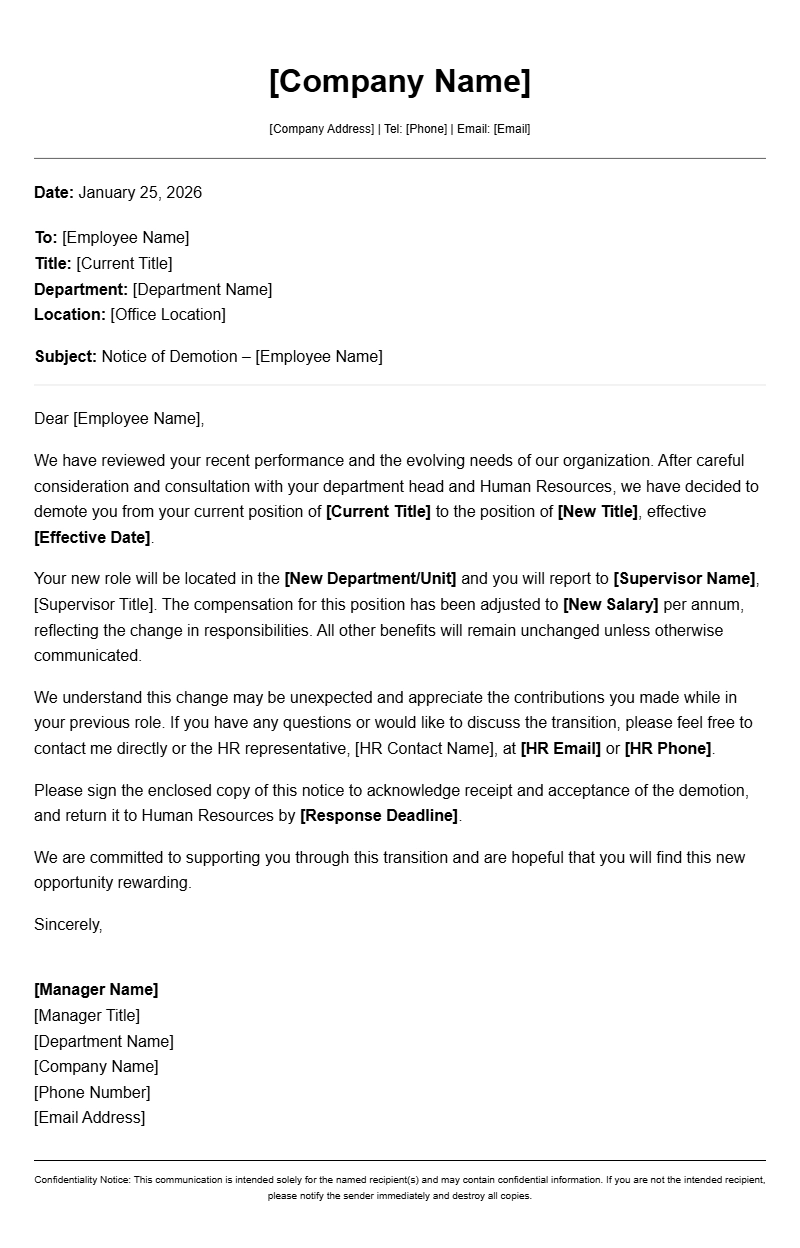
Standard Demotion Notice – Performance-Based
Dear [Employee Full Name],
We regret to inform you that, after a thorough review of recent performance evaluations, your current position as Senior Analyst within the Finance Department will be terminated effective April 15, 2026. The decision has been made to reassign you to the role of Junior Analyst, reflecting the findings that recent outputs have not consistently met the standards required for the senior level.
This demotion is intended to provide you with an opportunity to improve your skills and regain the expertise needed for advancement. You will receive the following adjustments:
- Base salary reduced to $52,000 per annum, aligned with the new role.
- Continued eligibility for the company’s health and retirement benefits.
- Access to a dedicated mentoring program to support your professional development.
Please acknowledge receipt of this notice by signing the enclosed form and returning it to Human Resources by April 8, 2026. If you have any questions or wish to discuss the transition plan, contact our HR representative, [HR Name], at hr@company.com.
We value your contributions and hope you will take advantage of the support offered to help you succeed in your new role.
Demotion Notice Due to Organizational Restructuring
Dear [Employee Name],
As part of a strategic realignment of our Operations Division, the company has decided to consolidate management layers, resulting in a redundancy of certain senior positions. Consequently, your current role of Operations Manager will be reclassified to Operations Supervisor starting May 1, 2026.
This change reflects ourneed to maintain an efficient structure while preserving job stability for our workforce. The decision was based on a comprehensive analysis of workload distribution and future operational goals, not on individual performance.
Your updated compensation package will be as follows:
| Item | Detail |
|---|---|
| New Title | Operations Supervisor |
| Salary | $58,000 per annum |
| Benefits | Unchanged from previous plan |
| Reporting To | Regional Director |
You are invited to attend a transition meeting on April 25, 2026 to discuss the new responsibilities and any concerns. Please confirm your attendance by contacting hr@company.com.
We appreciate your understanding and continued dedication to our organization.
Voluntary Demotion Request – Employee’s Own Request
Dear [Employee Name],
We acknowledge your recent request to be demoted from your current position of Senior Product Designer to the role of Associate Product Designer. After reviewing the rationale you provided—seeking a better work‑life balance and reduced stress—we fully support this transition.
Your new position will take effect on June 1, 2026. The following adjustments apply:
- Annual salary adjusted to $48,000, reflecting the lower grade.
- Retention of health, dental, and vision benefits.
- Continued participation in the company’s professional development webinars.
You will retain a seat on the product evolution team, allowing you to contribute at a level aligned with your personal goals while remaining a valuable member of the department.
To formalize this change, please sign the enclosed Demotion Agreement and return it to Human Resources by May 15, 2026. Should you have any questions, do not hesitate to reach out to hr@company.com.
We appreciate your proactive approach to managing your career path.
Demotion Notice for Medical Reasons – Fitness for Duty
Dear [Employee Name],
Following a detailed assessment by our occupational health team and a review of recent medical reports, it has been determined that you are currently unable to perform the essential functions of your position as Lead Technician. In accordance with our Fitness‑for‑Duty policy, we are transitioning you to the role of Technician II, which accommodates your medical limitations.
This demotion is effective July 10, 2026 and will remain in place until a further medical clearance is obtained. The changes include:
| Aspect | Current | Adjusted |
|---|---|---|
| Position | Lead Technician | Technician II |
| Salary | $65,000 | $55,000 |
| Benefits | Full package | Full package (adjusted work schedule) |
| Duties | Supervising a team | Technical support and diagnostics |
We encourage you to provide any updated medical documentation so we can evaluate further opportunities for reinstatement. Please contact HR at hr@company.com for assistance with scheduling follow‑up assessments.
Your well‑being is a priority, and we are committed to supporting you through this period.
Demotion Notice with Salary Adjustment
Dear [Employee Name],
We are writing to inform you of a change in your employment status within the Customer Success Department. After an internal analysis of role responsibilities and market compensation data, your position of Senior Customer Success Manager will be reclassified to Customer Success Manager, effective August 1, 2026.
This adjustment aligns your role’s duties with the updated organizational structure and ensures competitive pay levels. Consequently, your compensation will be updated as follows:
- Base salary reduced to $58,500 per annum.
- No change to your eligibility for performance bonuses (adjusted to the new grade).
- Continued enrollment in the company’s health and retirement plans.
Your new responsibilities will focus on direct client engagement and resolution of Tier‑2 support tickets, while strategic account planning will be handled at the senior level.
Please review the attached job description and indicate your acknowledgment by signing the enclosed document, returning it to Human Resources no later than July 25, 2026. For any questions, please contact hr@company.com.
We value your contributions and look forward to your continued success in this capacity.
Demotion Notice for Compliance or Regulatory Reasons
Dear [Employee Name],
Please be advised that, due to recent changes in industry regulatory requirements, certain certifications are now mandatory for the role of Compliance Analyst. After an assessment, it has been determined that you do not currently hold the required Certified Regulatory Compliance Professional (CRCP) credential, which is essential for the position.
Consequently, you will be temporarily reassigned to the role of Compliance Associate effective September 15, 2026. This demotion will remain in effect until you obtain the required certification and re‑qualify for the higher role.
The adjustments are:
| Item | Details |
|---|---|
| New Title | Compliance Associate |
| Salary | $50,000 per annum (adjusted from $62,000) |
| Benefits | Maintained |
| Required Action | Complete CRCP certification within 12 months |
We support your professional development and will provide access to relevant training courses and exam preparation resources. Please confirm receipt of this notice by signing the enclosed form and returning it to Human Resources by September 8, 2026.
Demotion Notice for Behavioural or Conduct Issue
Dear [Employee Name],
After an internal investigation into recent incidents of policy violations and a review of your conduct record, senior management has decided to demote you from Team Lead – Sales to Sales Representative, effective October 1, 2026.
The decision follows a series of documented breaches of the company’s code of conduct, including unauthorized expense claims and failure to adhere to client confidentiality protocols. This demotion is intended to emphasize accountability and provide an opportunity for you to demonstrate improved professional behavior.
The revised employment terms are:
- Salary reduced to $45,000 per annum.
- Loss of eligibility for the quarterly leadership bonus.
- Continued health and retirement benefits unchanged.
You will be required to complete a mandatory Ethics Re‑training Program within 30 days of this notice and to undergo a six‑month probationary period, during which your conduct will be monitored.
Please sign the enclosed demotion acknowledgment form and return it to Human Resources by September 24, 2026. Should you wish to discuss this matter further, contact hr@company.com.
Demotion Notice for Departmental Policy Update
Dear [Employee Name],
We are writing to inform you of an upcoming change to the organizational structure of the Marketing Division. As part of a new strategic plan, the role of Senior Marketing Specialist will be consolidated into the role of Marketing Specialist, with revised responsibilities focusing on digital execution rather than strategic planning.
Effective November 1, 2026, your position will be adjusted as follows:
- New title: Marketing Specialist.
- Annual salary: $55,000 (previously $62,000).
- Continuation of all existing health, dental, and retirement benefits.
- Participation in monthly strategy briefings, where you will contribute at a supportive level.
This adjustment is designed to align departmental functions with the company’s long‑term growth objectives. A comprehensive transition plan will be provided during a briefing on October 20, 2026. Please confirm your attendance by responding to hr@company.com.
We appreciate your flexibility and ongoing commitment to the marketing team.
Demotion Notice for Failure to Meet Certification Requirements
Dear [Employee Name],
Our organization requires that all employees holding the title of Senior IT Analyst maintain current Certified Information Systems Security Professional (CISSP) status. A recent audit revealed that your certification has lapsed, and you have not completed the necessary continuing education credits to renew it.
Since the senior role cannot be performed without a valid CISSP credential, you will be reassigned to the position of IT Analyst effective December 1, 2026. This demotion will remain in effect until you successfully renew your certification and provide proof to Human Resources.
Details of the new role include:
| Item | New Status |
|---|---|
| Title | IT Analyst |
| Salary | $58,000 per annum (adjusted from $70,000) |
| Certification Deadline | Renewal must be completed within six months |
| Support Offered | Access to exam prep resources and study groups |
Please sign the demotion acknowledgment form and return it to Human Resources by November 24, 2026. Should you have questions regarding the renewal process, contact hr@company.com.
Demotion Notice with Reassignment to a Different Division
Dear [Employee Name],
We are informing you of a change in your employment status due to recent budgetary constraints affecting the Research and Development (R&D) Department. In order to preserve core R&D functions, the senior scientist position you currently hold will be restructured, and you will be reassigned to the Technical Support Division as a Support Technician effective January 15, 2027.
This change reflects the organization’s priority to maintain critical support services while ensuring efficient resource allocation. The new role will involve:
- Providing technical assistance to internal and external clients.
- Participating in troubleshooting and resolution of product issues.
- Collaborating with the R&D team on knowledge transfer as needed.
Your compensation will be adjusted to $50,000 per annum, with continued eligibility for health and retirement benefits. A transition plan, including training sessions on the support ticketing system and product knowledge, will be delivered during a one‑week orientation starting January 8, 2027.
Please acknowledge receipt of this notice by signing the enclosed form and returning it to Human Resources by January 7, 2027. For any queries, contact hr@company.com.
We thank you for your flexibility and look forward to your contributions in the new role.