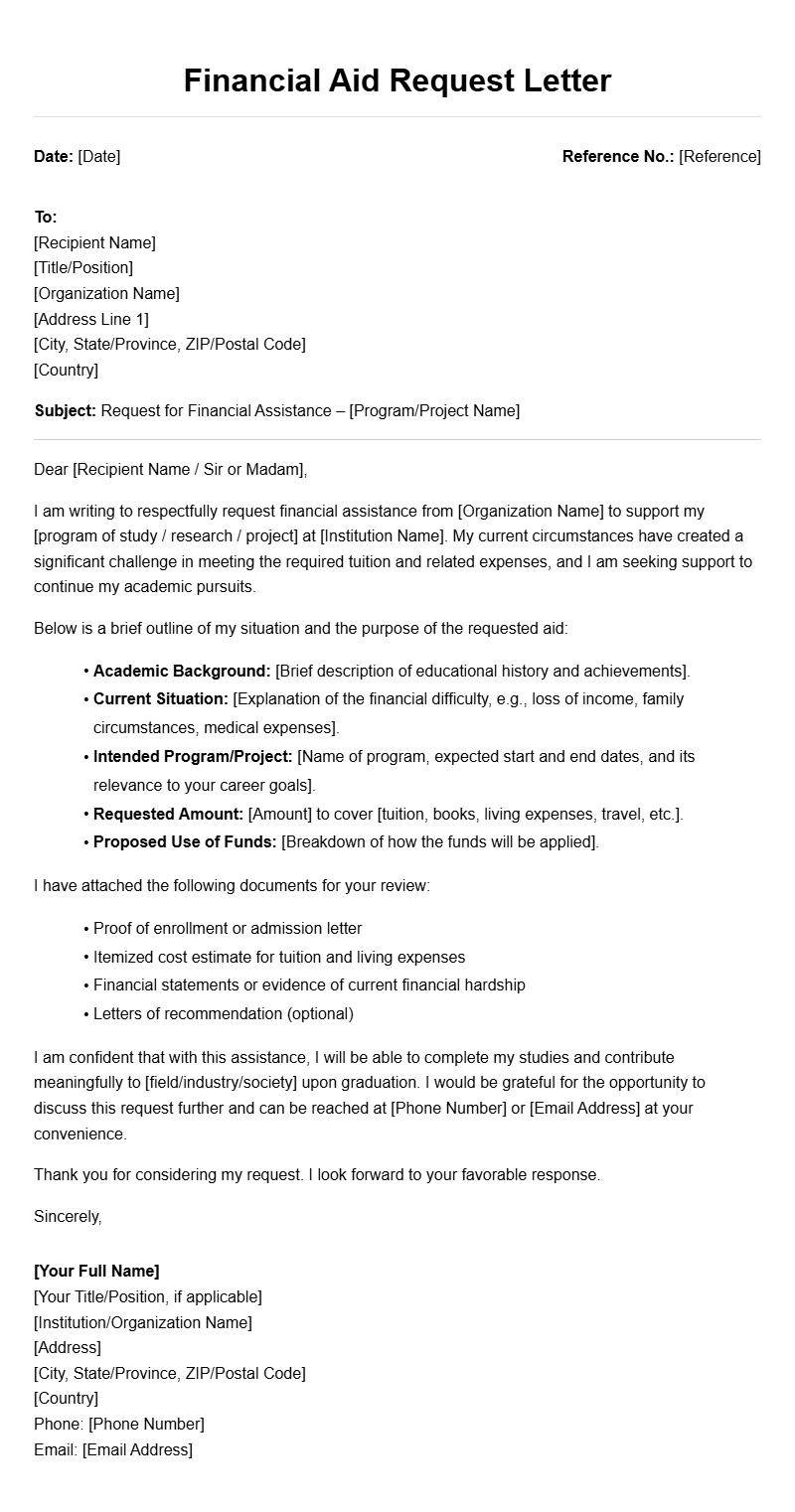
When a sudden medical bill, a tuition gap, or an unexpected family emergency leaves you short on cash, sending a clear and respectful financial aid request letter can open the door to help. Many organizations, schools, and community funds have specific application processes, but the first step is usually a written request that explains who you are, why you need assistance, and how the funds will be used. This guide walks you through the purpose of such a letter, the essential parts to include, a step‑by‑step writing process, and an editable template you can adapt for your own situation.
What Is A Financial Aid Request Letter?
A financial aid request letter is a short, formal document you send to a potential donor, school administrator, nonprofit, or employer to ask for money or fee waivers. It differs from a simple thank‑you note because it makes a direct ask and provides context for the request. The tone is polite, factual, and focused on the specific need, whether that’s covering tuition, purchasing equipment, or handling a personal crisis.
When Do You Need One?
You might write this type of letter when you are:
- Applying for a scholarship or grant that requires a personal statement of need.
- Requesting a tuition payment plan or fee reduction from a college.
- Asking a nonprofit for emergency assistance after a disaster.
- Seeking employer‑sponsored aid for certification or training.
- Approaching a community fund for help with medical expenses.
If you are also preparing a sponsorship package for an event, you may find our sponsorship confirmation letter template useful for outlining the benefits you offer in return.
Key Components Of A Strong Request Letter
Before you start writing, gather the pieces that make a request convincing and easy to read. The table below lists the sections most reviewers expect to see.
Essential Sections
| Section | What to Include |
|---|---|
| Header | Your name, address, phone, email, and the date. |
| Recipient Info | Name, title, organization, and full mailing address. |
| Subject Line | Clear phrase like “Request for Financial Aid – [Your Name]”. |
| Introduction | Who you are, your current role or situation, and the purpose of the letter. |
| Need Explanation | Brief, factual description of why the aid is needed, including any supporting details (e.g., medical report, tuition statement). |
| Use of Funds | Specific items or costs the money will cover. |
| Closing | Thank‑you statement, availability for follow‑up, and a polite ask for a response. |
| Signature | Your handwritten signature (if printed) and typed name. |
Keeping each part concise helps reviewers quickly scan for the information they need.
Step‑By‑Step Guide To Writing Your Letter
- Gather supporting documents. Collect any bills, tuition statements, medical receipts, or budget outlines that prove the need.
- Address the right person. If possible, find a specific name and title rather than using “To Whom It May Concern.” A targeted greeting shows you’ve done your research.
- Open with a brief intro. State your name, your affiliation (student, employee, community member), and the exact amount or type of aid you’re requesting.
- Explain the need. Use concrete numbers and a short narrative. Avoid emotional exaggeration; stick to facts that illustrate urgency.
- Detail how the funds will be used. List the line items (e.g., “Fall semester tuition – $3,200”, “medical supplies – $450”).
- Show appreciation. Acknowledge the reviewer’s time and any guidelines they may have shared.
- Include next steps. Mention that you’re happy to provide additional documentation or discuss the request further.
- Proofread. Check for typos, ensure the formatting looks clean, and verify that all contact details are correct.
Editable Template And Example
Below is a generic financial aid request letter template you can copy, paste into a word processor, and fill in the bracketed sections.
Your Name
Your Address
City, State ZIP
Email Address
Phone Number
Date
Recipient Name
Recipient Title
Organization
Address
City, State ZIP
Subject: Request for Financial Aid – [Your Name]
Dear [Recipient Name],
I am a [your role, e.g., sophomore at XYZ University] writing to request financial assistance in the amount of [exact amount] to cover [specific expense, e.g., spring semester tuition and related fees]. The total cost for this term is [amount], and I have already secured [any other funding, scholarships, or personal contributions] toward that total, leaving a gap of [remaining amount].
The shortfall is due to [brief reason, e.g., unexpected medical expenses for my father’s surgery]. Attached you will find copies of the hospital bill and a budget outline showing how the additional funds will be allocated.
If approved, the money will be used to pay the university directly for tuition and to purchase required textbooks. I am committed to completing my degree and plan to contribute to [community service, research, or future volunteering] as a way of giving back.
Thank you for considering my request. I am available at your convenience for a phone call or meeting to discuss further details.
Sincerely,
[Your Signature]
Your Typed Name
If you need a different format for a related communication, our designer‑to‑client letter samples show how to structure creative project proposals while maintaining a professional tone.
Common Mistakes To Avoid
- Sending a vague request without specific dollar amounts or purpose.
- Using a generic greeting like “Dear Sir/Madam” when a name is available.
- Failing to attach required supporting documents.
- Over‑explaining personal hardships in an emotional tone instead of focusing on facts.
- Including irrelevant personal history that does not relate to the request.
- Neglecting to proofread, which can lead to errors that undermine credibility.
For more tips on clear, respectful written communication, see our guide to employee warning letter samples—the same principles of concise, factual language apply.
Tips For Customizing The Template
- Match the reader’s language. If you’re writing to a school’s financial aid office, use terms like “grant,” “scholarship,” or “award.” If you’re contacting a nonprofit, you might refer to “emergency assistance” or “community support.”
- Add a personal touch. Include a brief story that connects your need to your goals, but keep it factual.
- Use official letterhead if you represent an organization; this adds legitimacy.
- Keep the length to one page. Reviewers often skim, so each paragraph should deliver a clear point.
- Follow up politely. If you haven’t received a response after two weeks, send a brief email thanking them again and asking about the status.
When you need to keep donors informed about ongoing projects, a stakeholder update letter template can help you communicate progress and reinforce trust.Ready-to-Use Document Samples