Writing a grant request letter feels overwhelming at first if you have never done it before. You know you need money for your project, but putting those words together in a way that convinces a funder to part with their cash is a different skill altogether. That is exactly why seeing actual grant request letter samples makes such a difference. You get to see how other people laid out their case, what details they included, and how they kept the whole thing readable. This guide walks you through everything you need to write your own without copying a template exactly.
What Is a Grant Request Letter
A grant request letter is a formal letter you send to a foundation, corporation, or government agency asking them to fund a specific project or program. It acts as your introduction and your pitch in one document. Funders rarely give money without seeing a written request first, and that request almost always follows a recognizable structure. Grant request letter samples show you what that structure looks like in practice, so you can adapt it to your own situation instead of starting from a blank page.
When Do You Need to Write One
You write this kind of letter when you are applying for competitive or pass-through funding. Nonprofit organizations use them for program grants. Researchers use them to request funding for academic projects. Small businesses sometimes use them when applying for innovation grants or community development funds. Even schools and religious organizations write grant request letters when they need money for facility upgrades or new programming. Basically, any time you are asking an institution for money that does not need to be repaid, you will likely need to submit one of these letters.
Key Components of a Grant Request Letter
Looking at various grant request letter samples, you start to notice they all contain the same basic building blocks. Here is what belongs in your letter.
The Opening Paragraph
Your first paragraph should name your organization, state clearly that you are seeking funding, and identify the specific project or program you want funded. Keep it short. Readers at funding agencies are reviewing many letters, so they decide quickly whether to keep reading. Give them the essential facts upfront.
Problem Statement or Need
This section explains why your project matters. You describe the issue you are addressing, back it up with data or real stories where possible, and show that the need is genuine and documented. Funders want to know they are solving a real problem, not just supporting a nice idea.
Project Description
Here you explain exactly what you plan to do with the money. Include your goals, the activities involved, the timeline, and who will benefit. The clearer you are here, the easier it is for the funder to imagine the project succeeding. Vague descriptions kill grant applications because reviewers cannot evaluate something unclear.
Budget Overview
Grant request letter samples almost always include some mention of money. You do not need to submit a full budget spreadsheet, but you should summarize the total cost, how much you are requesting, and what the funds will cover. If you have other sources of matching funds, mention those too because it shows your project has broader support.
Organizational Background
Grant reviewers want to know your organization can actually pull this off. Include a brief history, your mission, and relevant past achievements. If your team has done similar work before, mention specific results. This builds credibility without sounding like you are bragging. Just stick to facts that relate directly to the project.
The Closing
Wrap up by explaining what the funder can expect next. Thank them for their consideration, indicate you are happy to provide more information, and include your contact details. Some letter writers also invite the funder to visit their site, which can be a nice touch if it makes sense for your project.
Step-by-Step Guide to Writing Your Letter
Follow this process whether you are drafting your first grant request or refining one you have submitted before.
Step 1: Research the Funder First
Before you write a single word, look at what each funder actually funds. Many organizations only support specific causes, geographic areas, or types of programs. Sending a letter asking for arts funding to an environmental foundation wastes your time and theirs. Read their guidelines, past funded projects, and mission statements. Adjust every letter to match what that particular funder cares about.
Step 2: Choose One Project Per Letter
It might be tempting to describe several projects in one letter, but this usually dilutes your message. Funders respond better to a focused, specific request. If you genuinely have two separate projects that fit their criteria, write two separate letters unless their guidelines explicitly say to combine them.
Step 3: Draft the Problem Statement First
Many writers start with the introduction, but your letter will be stronger if you write the problem statement first. Get the need clearly on paper, then figure out how to frame the rest of the letter around solving that problem. This keeps everything cohesive throughout the document.
Step 4: Write a Direct but Compelling Introduction
After you know your problem and project, go back and write the opening paragraph. State your organization name, what you do, what you need, and what the money will accomplish. Keep it under five sentences. If your opening feels weak, look at how grant request letter samples handle this part and notice how they lead with specifics rather than generic enthusiasm.
Step 5: Build the Budget Summary
Create a simple table in your working document listing the major cost categories and amounts. Then translate that into a clear narrative sentence or two for the letter itself. For example, instead of dumping a spreadsheet into the text, write something like “The requested funds will cover staff salaries for three months, purchase of supplies, and venue rental for twelve community workshops totaling $34,000 of our $50,000 project budget.”
Step 6: Proofread and Simplify
Read your letter aloud. If you stumble over any sentence, rework it. Check for jargon that an outsider might not understand. Confirm that every paragraph serves a purpose. Remove any sentences that do not add new information. Grant reviewers appreciate clear writing because they review so many documents per day.
Grant Request Letter Template Examples
Here are two editable templates based on real grant request letter samples. Adjust the placeholder text to match your own situation.
Template 1: Basic Grant Request Letter
[Organization Name]
[Address]
[City, State ZIP]
[Date]
[Funder Name]
[Funder Organization]
[Address]
[City, State ZIP]
Dear [Funder Representative or Grant Committee],
Our organization [brief description of who you are] respectfully requests [dollar amount] in grant funding from [Funder Name] to support [project name]. This project will [one sentence explaining what the project does and who it serves].
[City/Region] currently faces [describe the problem or need with specific data or observation]. Our project directly addresses this issue by [explain your solution]. We will achieve [specific measurable goals] over a [timeframe] period.
The total project budget is $[total amount]. We are requesting $[amount] from your organization. The remaining funds come from [list matching funds or in-kind contributions support].
[Organization Name] has [relevant experience or past achievements]. Past projects include [1-2 specific examples with outcomes]. This track record demonstrates our capacity to manage this grant successfully.
We welcome the opportunity to provide additional details or arrange a site visit. Please contact [Name] at [phone number] or [email address]. Thank you for considering our request.
Sincerely,
[Your Name]
[Title]
[Organization Name]
Template 2: Community Program Grant Request
[Your Organization Letterhead]
[Date]
To the [Funder Foundation] Grants Committee:
The [Your Organization Name], a nonprofit serving [community or population], requests $[amount] to expand our [program name] initiative. This program currently serves [number] participants each week and has demonstrated [specific outcome or result]. With this funding, we can extend services to [new number] additional individuals over the next [timeframe].
Our community faces [specific challenge such as youth unemployment, food insecurity, or lack of afterschool care]. Current resources reach only [percentage] of those in need. Data from [source] shows that [relevant statistic supporting the need]. This gap affects [who is affected and in what way].
The requested grant will enable us to [describe 2-3 specific activities the funding will support]. We project serving [number] more [type of participants] per month, with measurable outcomes in [specific area such as employment placement, school attendance, or nutritional health].
Budget breakdown:
- Personnel costs: $[amount]
- Program supplies and materials: $[amount]
- Facility expenses: $[amount]
- Evaluation and reporting: $[amount]
- Total project cost: $[amount]
Founded in [year], [Your Organization] has operated [brief specific programs or services]. Our staff includes [relevant credentials or experience]. We have successfully managed grants from [previous donors or agencies] and maintain clean financial records available upon request.
Please direct questions to [Your Name], [Title], at [contact information]. We look forward to discussing how this partnership can address [specific community need] in [your city or region].
Respectfully,
[Signature]
[Printed Name and Title]
Common Mistakes to Avoid
Looking at what goes wrong in grant applications helps just as much as studying successful examples. Here are the errors that show up most often in grant request letter samples of poor quality.
Vague Project Descriptions
Letters that say things like “we will help the community” without specifying what that means get discarded quickly. Funders need numbers, timelines, and concrete activities. If your description could apply to almost any project, it is too vague.
Ignoring Funder Guidelines
Every funder posts specific requirements. Page limits, format rules, required attachments, deadlines. Failing to follow these shows the reviewer that you either did not pay attention or do not take instructions seriously. It only takes a few extra minutes to check, but it makes a major difference.
Asking for Vague Amounts
Do not just write “we need funding” without stating a dollar figure. Fund decision-makers need to know exactly how much you are requesting and why that number matters. A clear, defensible budget shows you have thought through the actual cost of running your project.
Focusing on Your Organization Instead of the Problem
Grant reviewers care more about the problem you are solving than your own organizational history. Your past achievements matter, but only in proportion to how they show you can actually deliver results on the new project. Keep the spotlight on the need and your solution, not just on yourself.
Typos and Formatting Problems
A single glaring typo can undermine an otherwise solid application. Have a colleague read your letter before you send it. Check that your formatting stays consistent, especially if you are copying between programs. A letter that looks sloppy signals a project that might be managed sloppily too.
Tips for Customization
The template you choose should be starting material, not a form to fill out exactly as written. Here is how to customize your grant request letter for different situations.
For First-Time Grant Applicants
If you have never received a grant before, emphasize your organizations capacity in other ways. Include partnerships with established groups, relevant staff credentials, or strong community support. Funders sometimes take a chance on newer organizations with strong community ties if the project description is especially clear and compelling.
For Repeat Grant Seekers
If you are applying to the same funder again, reference your previous grant explicitly. Mention what you accomplished with the earlier funding, how you reported results, and why continued support makes sense. Funders like building relationships with organizations that deliver consistent results.
For Very Small Budgets
When your request is under $5,000, you do not need elaborate budgets or lengthy narratives. Keep the letter to one page. Focus on the problem, the solution, and why a smaller amount makes a big difference for your specific work. Many funders have micro-grant programs designed exactly for this scale.
For Large Institutional Requests
Requests over $50,000 often require additional documents, letters of support from partners, or detailed work plans. In your letter, reference these attachments and make it clear you can provide full documentation if needed. Structure your letter as the executive summary of a larger package, not as the complete application.
Final Thoughts on Writing Your Grant Request Letter
The best grant request letters succeed because they treat the funder as a real person who wants to know where their money goes and whether it will make a difference. You do not need fancy language to write a good one. You need honesty about the problem, a clear plan to address it, and respect for the readers time by staying organized and specific.
Use the templates above as a framework, but replace every placeholder with real information about your actual project. Read your letter one more time before sending it and ask yourself whether a stranger would understand exactly what you are asking for, why it matters, and how you plan to make it work.
Ready-to-Use Document Samples
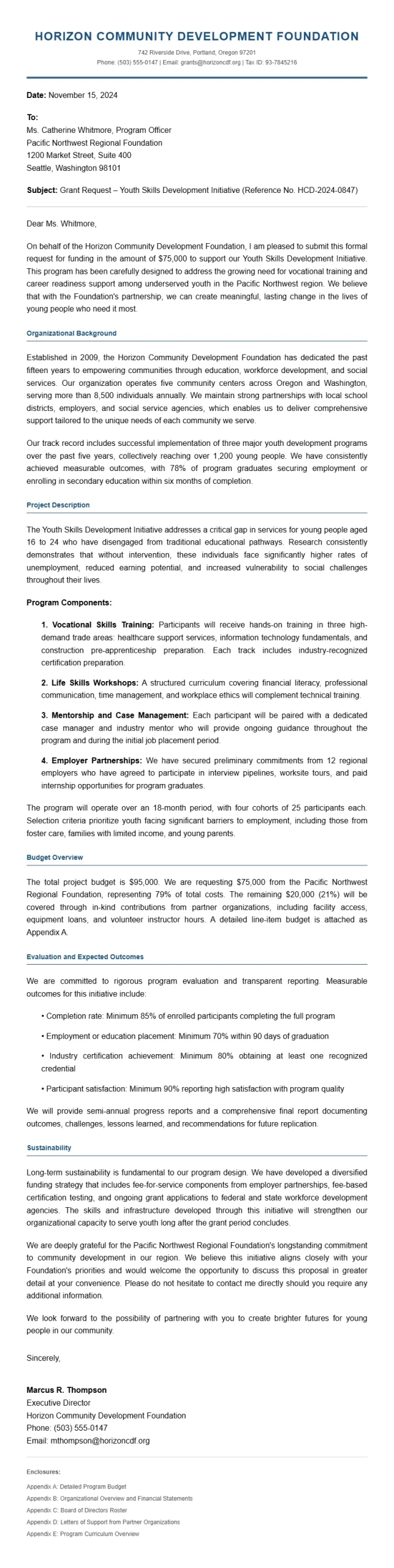
Project Development Grant Request – Renewable Energy Initiative
Date: 25 January 2026
\n
Grant Review Committee…