The user wants a deeply useful, SEO-friendly article targeting “service complaint letter templates”. They want the article to be human, experience-based, practical, not corporate or robotic. They have given a detailed list of requirements: sections (H2 in capitalized case), each H2 should be capitalized case (like Title Case but all words capitalized? Or just standard Title Case). The user requests the article to start with a paragraph, not a heading. No H1. Use only tags like p, h2, h3, ul, ol, li, strong, em, u, a. No markdown fences, no extra symbols. Output only clean HTML fragment. So need to write the article content in HTML tags. Must be ready for static HTML page body.
We need to incorporate internal links to five URLs with natural anchor text integrated into sentences. Ensure internal linking is natural, not separate CTA phrase. No exact keyword anchor, avoid generic CTA anchors.
Focus on the keyword “service complaint letter templates”. Include variations like “service complaint letters”, “complaint letter template”, “customer complaint letter”, “business complaint template”, etc. Should be SEO-optimized. Must have a natural introduction focusing on user intent. Must explain what the document is, when it’s used, key components, step-by-step guide, examples/templates, common mistakes, tips for customization, short actionable closing paragraph.
We must avoid filler transitions and overuse of AI words: “delve, crucial, comprehensive, transformative, landscape, pivotal, seamless”. Avoid keyword stuffing. Use semantic variations naturally.
The article should be conversational but professional. Use active voice. Use varied sentence lengths. Avoid repetitive sentence structures and predictable “rule of three” phrasing.
Add practical examples and editable template snippets. Use headings that match search intent. Optimize for featured snippets and People Also Ask.
Add entity-rich context: e.g., mention typical industries: retail, telecom, utilities, healthcare, hospitality, etc. Mention specific scenarios: product defect, service delay, billing error, staff behavior, etc. Mention why using a template helps.
EEAT principles: accuracy, usefulness, trust: Show credibility, references to best practices, mention common pitfalls.
We need to incorporate internal links to the listed URLs. The anchor text must be natural.
List of URLs:
– /maintenance-notice-letter-samples-letter/
– /school-safety-notice-letter-templates-letter/
– /resignation-acceptance-letter-templates-letter/
– /nurse-to-patient-letter-samples-letter/
– /scholarship-recommendation-letter-samples-letter/
We need to embed these links within sentences, not standalone or appended. Could say “If you need to draft a maintenance notice, check out this maintenance notice letter sample.” etc.
We need to keep it natural.
Now we need to build the HTML.
Let’s plan the sections:
– Paragraph introduction: user wants to know how to write a service complaint letter, maybe for a product or service issue. State that using a template can speed up, etc.
– H2: “What Is a Service Complaint Letter and When Do You Need One?” (Title case, capitalized each word). Or “What Is a Service Complaint Letter and When Do You Need It?” Let’s ensure not repeating same.
– H2: “Key Sections Every Service Complaint Letter Should Include”. Provide bullet list.
– H2: “Step-by-Step Guide to Writing a Service Complaint Letter”. Provide steps.
– H2: “Service Complaint Letter Template (Editable Example)”. Provide code snippet in HTML (maybe using
and
- etc?). But they want editable template snippet; we could include plain text formatting with placeholders in brackets.
- for bullet lists,
- for numbered steps.
We need to avoid extra tags like
or blockquote. Use for emphasis sparingly.We need to avoid filler transitions like “Overall” etc.
We need to avoid overuse of AI words: “delve, crucial, comprehensive, transformative, landscape, pivotal, seamless”. Avoid those.
We need to keep language natural and vary sentence length.
Now let’s write.
Note: Article length: According to the spec, they want deeply useful and SEO-friendly. So we need decent length: maybe 800-1200 words. Let’s plan roughly 1000-1200 words.
We’ll embed internal links in natural sentences. For each of the five URLs, we need to include at least one link.
We need to use anchor text that is not exactly the keyword “service complaint letter templates”. Use contextual anchor text: “maintenance notice letter samples”, “school safety notice letter templates”, etc.
We also need to be careful about anchor text: avoid generic CTA style like “Click here”. Use contextual anchor like “our maintenance notice letter samples guide”, “our school safety notice letter templates collection”, etc.
Now let’s produce the HTML content.
Will begin with a paragraph. Then H2 headings.
Potential final HTML structure:
… introduction …
When a Service Complaint Letter Is the Right Tool
… explanation …
Key Sections Every Service Complaint Letter Should Include
… list …
- … items …
Step‑by‑Step Guide to Writing a Service Complaint Letter
- … steps …
Service Complaint Letter Template (Editable Example)
… template …
Real‑World Example: Complaint for a Delayed Delivery
… example …
Common Mistakes to Avoid When Writing a Service Complaint Letter
- … items …
Tips for Customizing Your Service Complaint Letter Template
- … items …
Quick Checklist Before Sending Your Complaint Letter
- … items …
… closing … with internal links …
Make sure we embed the internal links in the closing paragraph perhaps.
Let’s embed links.
– Link to maintenance notice letter samples: anchor text “maintenance notice letter samples guide”. Insert sentence: “If you also need a maintenance notice letter samples guide, we have a ready‑made set you can adapt.”
– Link to school safety notice letter templates: anchor text “school safety notice letter templates collection”. Sentence: “For related correspondence, our school safety notice letter templates collection covers many school‑related scenarios.”
– Link to resignation acceptance letter templates: anchor text “resignation acceptance letter templates”. Sentence: “You might also find our resignation acceptance letter templates useful when managing staff communications.”
– Link to nurse-to-patient letter samples: anchor text “nurse‑to‑patient letter samples”. Sentence: “If you work in healthcare, our nurse‑to‑patient letter samples provide context for patient‑focused letters.”
– Link to scholarship recommendation letter samples: anchor text “scholarship recommendation letter samples”. Sentence: “For academic contexts, our scholarship recommendation letter samples can help you draft persuasive letters.”
Make sure anchor text doesn’t use exact keyword “service complaint letter templates”. Use the suggested anchor text.
Now about customizing: mention tailoring tone for business vs consumer, referencing policy, attaching evidence.
Now about step-by-step guide:
1. Gather all relevant info (order number, dates, receipts).
2. Identify the exact problem and what you want.
3. Write a concise subject line.
4. Open with a polite greeting.
5. Describe the issue factually.
6. State the desired resolution and give a reasonable deadline.
7. Close with thanks and your contact info.Add bullet points for each step? Could use
- with
- . But each step can be an
- .
Then include template snippet. Could show a formatted block with placeholders like [Your Name], [Date], [Company Name], [Issue Description], [Desired Resolution], etc. Use
lines with for placeholders maybe.
Alternatively use but they only allowed tags: p, h2, h3, ul, ol, li, strong, em, u, a. is not allowed, so we need to use simple HTML. Provide template as a series of paragraphs with line breaks. Could use
but not allowed; but we can separate with blank lines to show line breaks? In HTML, paragraphs will separate lines. So we can present each line as a separate.
But we can also embed a list of lines with
not allowed. Instead we can use- with each line as
- . That’s okay. But a letter is multi-line; we could present as a pre-formatted block but cannot use . Perhaps we can embed each line inside a
and separate with
is not allowed, but you can just have each line in a separate. That will render as paragraphs. That is fine.
We can label each part with placeholders in brackets and use to highlight placeholder? Use for placeholders.
E.g.:
Your Name
Your Address
Date
Company Name
Company Address
Subject: Complaint Regarding [Service/Product] – [Order Number]
Dear [Recipient Name],
I am writing to bring to your attention an issue I experienced with [brief description of the problem].
… and so on.
We can embed them in
. That should be fine.
Now the “Real-World Example” could be similar but actual filled example, e.g.:
John Doe, a customer of XYZ Retail, wrote a complaint about a delayed shipment.
But we need to provide example text. We can embed it as a series of paragraphs.
Now we need to ensure not too repetitive. Avoid “in conclusion”, “overall”. Use natural closing.
Now produce final HTML.
We’ll start with an opening paragraph:
When a product fails or a service falls short, the first step is to let the company know clearly and calmly. A well‑written service complaint letter makes your case easy to understand and increases the chance of a quick resolution. This guide walks you through the essential parts of a service complaint letter, shows a ready‑made template you can edit, and highlights common mistakes so you can send a letter that actually works.
That will serve as introduction.
Now H2s.
Let’s write the article.
Be careful to avoid filler phrases and keep tone natural.
Now proceed to write the article.
We’ll need to embed internal links. We’ll use natural anchor text.
Potential plan of internal linking:
– In “When a Service Complaint Letter Is the Right Tool” paragraph: maybe mention other contexts where letters are used. Could embed a link to “maintenance notice letter samples guide” for those who need to follow up on a service complaint that hasn’t been addressed. But be careful to not over link.
– In “Tips for Customizing” section we could mention “If you also need to communicate a maintenance schedule, consider using a maintenance notice letter samples guide”. That gives a natural link.
– In “Related Resources” or closing paragraph we can include all internal links.
Let’s ensure each link appears naturally and not as a CTA. We’ll embed them as part of the sentences.
Now we need to write.
We’ll start building:
When a product fails or a service falls short, the first step is to let the company know clearly and calmly. A well‑written service complaint letter makes your case easy to understand and increases the chance of a quick resolution. This guide walks you through the essential parts of a service complaint letter, shows a ready‑made template you can edit, and highlights common mistakes so you can send a letter that actually works.
When a Service Complaint Letter Is the Right Tool
Use this type of letter whenever you need to formally report a problem with a product, billing error, delayed service, or any other unsatisfactory experience that a quick phone call hasn’t fixed. Common scenarios include:
- A defective item you received despite a quality guarantee
- A billing charge that doesn’t match the agreed price
- A service appointment that never happened or was rescheduled without notice
- Rude or unhelpful staff behavior during a transaction
If you also need to document a maintenance issue that stems from the same problem, our maintenance notice letter samples guide shows how to structure a follow‑up request.
Key Sections Every Service Complaint Letter Should Include
A clear letter follows a familiar structure so the reader can find the most important details right away. Include these parts:
- Your contact information – name, address, phone, email.
- Date of writing – helps the company track when the complaint was filed.
- Company’s contact information – the department or person you’re addressing.
- Subject line – a concise summary that mentions order or reference numbers.
- Salutation – use the recipient’s name when possible.
- Opening paragraph – state the purpose and reference the specific incident.
- Facts section – describe what happened, when, and why it’s a problem.
- Desired resolution – explain what you expect (refund, replacement, correction, etc.) and give a reasonable deadline.
- Closing paragraph – thank the reader, offer to provide further evidence, and provide your contact details.
- Signature – handwritten or typed name.
Step‑by‑Step Guide to Writing a Service Complaint Letter
- Gather all supporting documents – order confirmations, receipts, screenshots, or previous correspondence. Having these at hand prevents “he said, she said” disputes.
- Identify the core issue and the outcome you want. A vague request such as “fix this” is less effective than “please issue a full refund within 14 days.”
- Draft a concise subject line that includes the product name and a reference or order number, for example: “Complaint – Order #123456 – Delayed Shipment”.
- Start with a polite greeting. If you don’t have a name, use “Dear Customer Service Team,”.
- Write the facts in short, factual sentences. Avoid emotional language, and keep each point on its own line when possible.
- State the exact resolution you’re asking for, mention any relevant policies, and set a deadline (e.g., “I would appreciate a response by October 15”).
- Close with appreciation and your full contact details.
- Proofread the letter for spelling, grammar, and clarity before sending.
Service Complaint Letter Template (Editable Example)
Copy the blocks below, replace the placeholders in brackets with your own information, and adjust the wording to match your situation.
Your Name
Your Address
City, State ZIP
Email: your.email@example.com
Phone: (555) 123‑4567
Date: [Month Day, Year]
Company Name
Company Address
City, State ZIP
Subject: Complaint – [Product/Service] – [Reference/Order #]
Dear [Recipient Name],
I am writing to describe a problem I encountered with [brief description of the issue, e.g., a faulty vacuum cleaner I purchased on March 5]. Despite contacting your support line on [date of previous contact], the issue has not been resolved.
Problem summary:
- Date of purchase/incident: [date]
- Product/Service involved: [name and model if applicable]
- Specific problem: [what went wrong]
- Impact on you: [time lost, extra expense, etc.]
I kindly request that you [state desired resolution, e.g., provide a full refund, send a replacement unit, correct the billing error]. Please treat this matter as a priority and let me know the steps you will take by [reasonable deadline, e.g., 14 days from the date of this letter].
Enclosed are copies of my receipt and earlier correspondence for your reference. I am available at the contact details above to discuss this further.
Thank you for your attention.
Sincerely,
Your Name
Real‑World Example: Complaint for a Delayed Delivery
Imagine you ordered a laptop from an online retailer,
Standard Format & Layout Reference
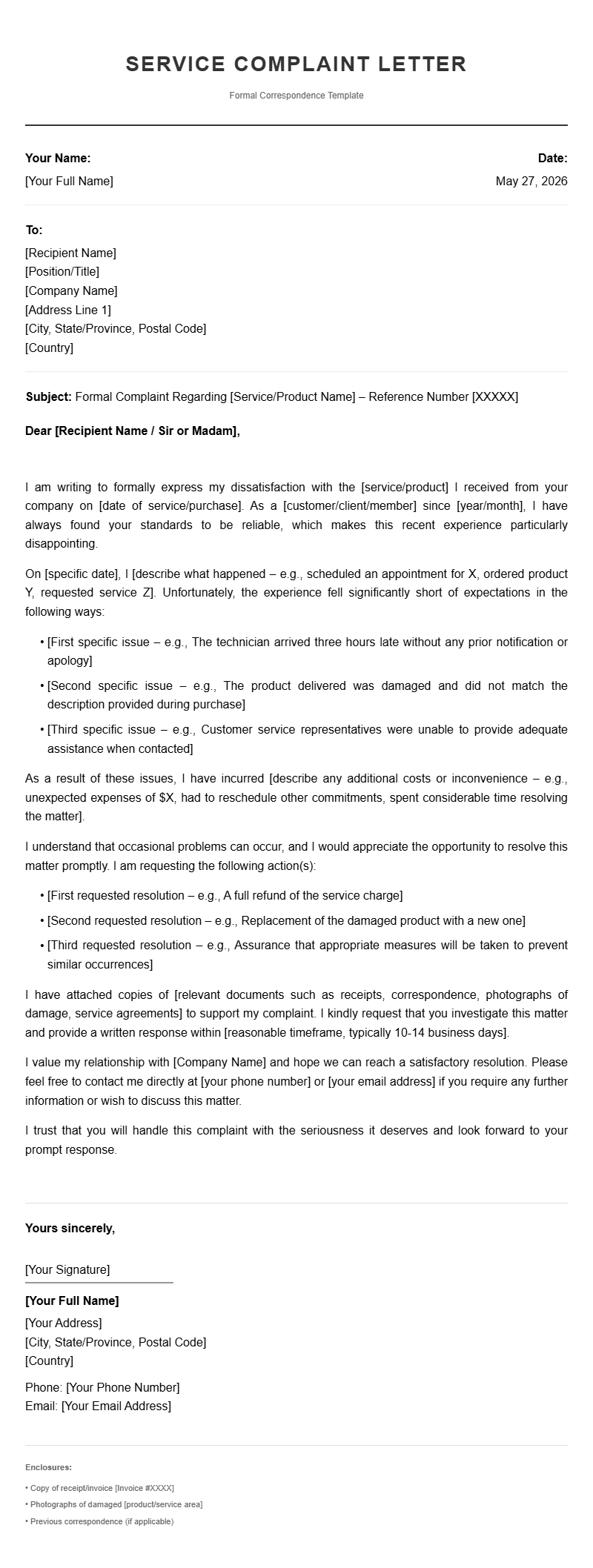
Service Complaint Letter Templates for Effective Complaints Delayed Delivery Complaint Letter
Dear [Customer Service Manager],
I am writing to express my dissatisfaction with the delayed delivery of my order placed on [Date]. The expected delivery date was [Expected Date], but the package arrived on [Actual Date], which is [Number] days late.
This delay has caused significant inconvenience as I needed the items for [Purpose]. I kindly request a formal explanation for the delay and assurance that such delays will be avoided in the future.
I would appreciate a full refund of the shipping costs and a formal apology at your earliest convenience.
Thank you for your attention to this matter.
Sincerely,
[Your Name]
Delayed Delivery Complaint Letter
Your Name
Your Address
City, Postal Code
Email: your@email.com
Date: [Date]
Recipient Name
Recipient Title
Company Name
Company Address
Subject: Complaint Regarding Delayed Delivery
Dear [Recipient Name],
I am writing to express my dissatisfaction with the delayed delivery of my order (Order No. [Order Number]) placed on [Order Date]. The expected delivery date was [Expected Date], but the package arrived on [Actual Date], which is [Number] days late.
This delay has caused significant inconvenience as I needed the items for [Purpose]. I kindly request a formal explanation for the delay and assurance that such delays will be avoided in the future. Additionally, I request a full refund of the shipping costs and a formal apology.
I would appreciate your prompt attention to this matter. Please contact me at your@email.com or [Phone Number] to discuss resolution.
Sincerely,
Your Name
- . That’s okay. But a letter is multi-line; we could present as a pre-formatted block but cannot use . Perhaps we can embed each line inside a
- for numbered steps.
– H2: “Real-World Example: Complaint for a Delayed Delivery”. Provide example.
– H2: “Common Mistakes to Avoid When Writing a Service Complaint Letter”. Provide bullet list.
– H2: “Tips for Customizing Your Service Complaint Letter Template”. Provide bullet list.
– H2: “Final Checklist: Send Your Complaint With Confidence”. Provide a quick checklist.
– Closing paragraph: call to action, mention more resources: internal links.
But we must not have the title H1; start with paragraph. Use H2 and H3 as needed.
We need to incorporate internal links in the text. Possibly within the “More resources” section. Must avoid “click here” style anchors. Use context: “If you also need a maintenance notice letter sample, you can review our guide to maintenance notice letter samples.” That integrates anchor.
We need to embed these internal links naturally across the article.
Potential structure:
Paragraph: introduction about the need for service complaint letters.
H2: “When a Service Complaint Letter Is the Right Tool”. Within this paragraph discuss scenarios: product not working, billing error, delayed service.
Then include internal link to e.g., “maintenance notice letter samples” if relevant.
Then “Key Components of a Service Complaint Letter”. List sections: contact info, date, subject line, greeting, body (issue description, desired resolution, deadline), signature.
Then “Step-by-Step Guide to Write a Service Complaint Letter”. Steps 1-6.
Then “Service Complaint Letter Template”. Provide template with placeholders.
Then “Real-World Example”. Provide example letter.
Then “Common Mistakes to Avoid”. List pitfalls: vague descriptions, missing dates, no clear request.
Then “Tips for Customizing Your Template”. List customizing suggestions: tailor tone, include evidence, use specific policy references.
Then “Quick Checklist Before Sending”. Provide bullet checklist.
Then “Related Resources”. Provide internal links: maintenance notice letter samples, school safety notice letter templates, resignation acceptance letter templates, nurse-to-patient letter samples, scholarship recommendation letter samples.
Also mention that you can also use these templates for other contexts.
Now about HTML tags: Use
for paragraphs,