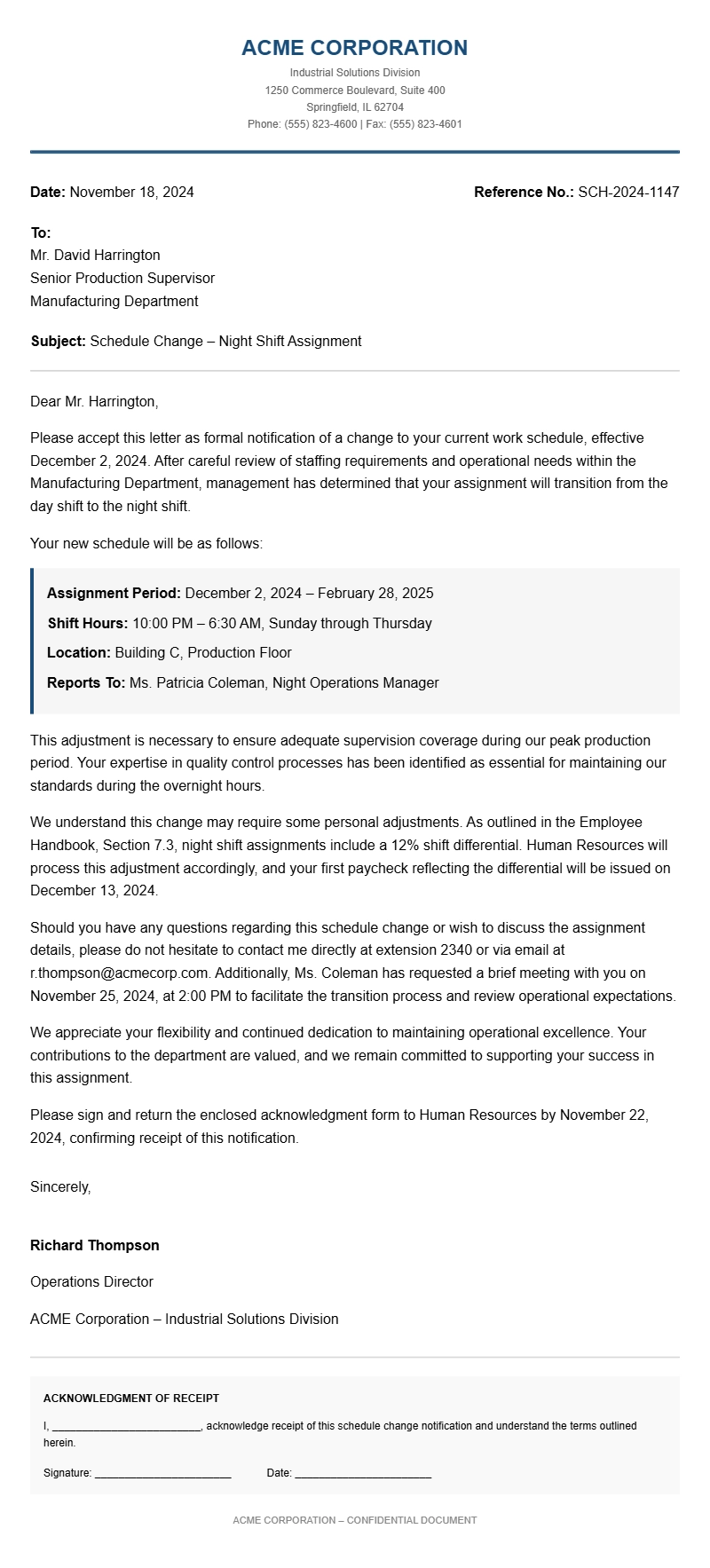
There comes a time in almost every workplace when schedules shift. Maybe a project deadline moved up, a client meeting got rescheduled, or your team just learned the office is switching to a four-day week. When these changes happen, you need to communicate them clearly—and that often means writing a schedule change letter.
I’ve helped dozens of managers and HR professionals put these letters together over the years, and I can tell you one thing: the difference between a schedule change letter that gets read and one that gets ignored often comes down to a few practical details. This guide walks you through everything you need to write a letter that actually works—complete with ready-to-use templates you can customize for your situation.
What Is a Schedule Change Letter?
A schedule change letter is a formal written notice informing employees, clients, or stakeholders about modifications to previously agreed-upon timelines, work hours, meeting times, or project deadlines. It’s not just about telling people something changed—it’s about doing so in a way that reduces confusion, maintains trust, and gives everyone enough time to adjust.
Unlike a casual email or a quick Slack message, a schedule change letter carries more weight. It creates a paper trail, sets clear expectations, and shows that you take the change seriously enough to communicate it properly. For HR departments and managers, this documentation matters when questions come up later about what was agreed upon and when.
When Should You Send a Schedule Change Letter?
Not every minor tweak requires a formal letter. Here’s a practical way to think about it: send a schedule change letter when the change affects someone’s committed time, work arrangement, or expectations that they already planned around.
Strong candidates for a schedule change letter include:
- Modifying an employee’s work schedule or shift times
- Rescheduling a project deadline that multiple people are counting on
- Changing meeting times that require travel or coordination
- Adjusting business hours that affect customer appointments
- Updating team availability windows or remote work schedules
On the other hand, sending a schedule change letter for every minor calendar tweak can feel overblown. If you’re just moving a 15-minute standup by ten minutes, a quick message works fine. Save the formal letter for changes that genuinely impact someone’s plans or commitments.
Key Components Every Schedule Change Letter Needs
After looking at dozens of effective schedule change letters, certain elements show up again and again. These aren’t just stylistic choices—they’re the parts that actually make the communication work.
Clear Subject Line or Opening Statement
Get to the point immediately. The recipient should know within the first sentence that this letter is about a schedule change. Something like “Update to Your Monday Work Schedule” or “Rescheduling of the Q3 Review Meeting” does the job without any ambiguity.
Specific Details of the Change
Include the what, when, and how long. If you’re changing Monday hours from 9 AM to 10 AM, say exactly that. Vague language like “we’re adjusting start times” leaves people guessing, which defeats the whole purpose of sending the letter in the first place.
The Reason Behind the Change
You don’t need to write a novel here, but a brief explanation helps recipients understand the context. Whether it’s business needs, client requirements, or operational adjustments, sharing the “why” makes the change feel more reasonable and less arbitrary.
Effective Date and Duration
Is this a permanent change, a temporary adjustment, or something with a specific end date? Make this clear so people can plan accordingly. “Starting next Monday” is better than “starting soon.” “Until further notice” is better than nothing.
Required Actions or Acknowledgment
If you need the recipient to do something—confirm receipt, adjust their calendar, discuss concerns with you—make that explicit. Don’t assume they’ll figure out what response, if any, you’re expecting from them.
Contact Information for Questions
Leave the door open. Someone might have a legitimate concern about the change, and they need to know how to reach you or your department. A simple “reach out to me at [email] if you have questions” takes two seconds to include and prevents a lot of back-and-forth confusion.
Step-by-Step Guide to Writing Your Schedule Change Letter
Let’s walk through the actual process of creating one of these letters, from blank page to finished product.
Step 1: Identify the Core Change
Before you write a single word, get crystal clear on what actually changed. What was the original schedule, what is it now, and when does the new arrangement take effect? If you’re unclear on these details, your letter will be unclear too. Jot down the specific times, dates, and scope of the change first.
Step 2: Know Your Audience
A letter to your direct reports looks different from a letter to a client or an external vendor. Are you writing to people who work for you, people who you work for, or people on the same level? This affects tone, level of formality, and how much flexibility you communicate. For example, an employee schedule change might offer some choice in the new arrangement, while a client meeting reschedule might simply announce the new time.
Step 3: Draft the Core Message
Lead with the change itself. Don’t bury the lead in three paragraphs of context. Get into what changed, when, and what it means for them. Then add context, explanation, and any required actions. Readers often skim these letters, so the most important information should come first.
Step 4: Review for Clarity and Tone
Read your draft as if you received it. Is it clear? Would you know exactly what changed and what you’re supposed to do? Is the tone respectful but direct? Avoid hedging language like “we might need to consider some adjustments” when you’ve already decided on a change. Be decisive while remaining considerate.
Step 5: Add Necessary Documentation
If this is a formal HR communication, make sure you’ve followed your organization’s protocol for schedule change letters. This might mean getting manager sign-off, using a specific template, or copying HR on the final version. Don’t skip this step—your letter needs to align with company policy to protect both you and your recipients.
Schedule Change Letter Templates You Can Use Today
Below are three practical templates covering the most common scenarios. I’ve kept these editable so you can plug in your specifics.
Template 1: Employee Schedule Change
Use this when you need to modify an employee’s work hours, shift times, or days off.
Dear [Employee Name],
This letter is to notify you of a change to your current work schedule, effective as of [date].
Your new schedule will be [specific days and times]. Your previous schedule was [original schedule].
This change is being made due to [brief reason: business needs, operational requirements, client demands, etc.]. The adjustment is expected to be [permanent / temporary / lasting until specific date].
If you have any concerns about this schedule change or need to discuss how it might affect your personal circumstances, please contact me at [email/phone] by [response deadline]. We are happy to explore solutions if the new schedule creates genuine hardship.
Please confirm receipt of this letter by [date] so we can update our records accordingly.
Sincerely,
[Your Name]
[Your Title]
Template 2: Meeting or Event Reschedule Notice
Use this when an important meeting, presentation, or team event needs to be moved.
Hello [Recipient(s)],
I need to inform you that [meeting/event name] has been rescheduled from its original time.
New date and time: [specific date and time]
Original date and time: [original date and time]
Location or video link: [location or link]
The reason for this change is [brief explanation]. I understand this may require some adjustment on your end, and I apologize for any inconvenience.
Please update your calendar accordingly. If you have a conflict with the new time, contact me at [email/phone] as soon as possible so we can explore alternatives.
Thank you for your flexibility.
[Your Name]
Template 3: Team-Wide Schedule Update
Use this for changes that affect multiple employees or an entire department.
Team,
I’m writing to inform you of an upcoming change to our team’s schedule, effective [date].
What’s changing: [describe the specific change clearly]
When it starts: [date]
Duration: [permanent / temporary with end date]
Why this is happening: [brief, honest explanation of business reasons]
What this means for you: [specific details about hours, days, expectations]
Questions or concerns? Reach out to me directly at [email] or stop by my office. If this change creates challenges for your personal situation, let’s talk—we can find a workable solution.
I’ll send a reminder closer to the start date. Thanks for your patience as we work through this adjustment.
[Your Name]
Common Mistakes to Avoid
I’ve seen schedule change letters go wrong in predictable ways. Here’s what to watch out for:
Being Vague About the Actual Change
Phrases like “adjusting our schedule” or “some changes to the timetable” don’t tell anyone anything useful. If Monday hours are now 10 AM instead of 8 AM, write exactly that. Ambiguity breeds confusion, and confused recipients will come back with questions you could have avoided entirely.
Forgetting the Effective Date
I’ve seen letters that clearly explain what changed but never specify when it takes effect. If you need people to start coming in at 9 AM instead of 8 AM, say “starting Monday, October 14th.” Don’t make recipients猜 when they should start following the new schedule.
Over-Apologizing or Being Defensive
Some writers feel so guilty about the disruption that they load the letter with apologies and hedging language. A simple “I apologize for any inconvenience” once is enough. Then move on to the facts. Over-apologizing makes the letter feel weak and can actually increase anxiety rather than reduce it.
Not Providing a Way to Respond or Ask Questions
Whatever you do, don’t make the letter feel like a one-way announcement with no recourse. Even if the change isn’t negotiable, people need to know they can ask questions or flag legitimate problems. Leaving out contact information makes the letter feel cold and authoritarian.
Using Corporate Jargon Instead of Plain Language
Phrases like “leveraging synergies” or “proactively realigning our operational framework” don’t belong in a schedule change letter. You’re telling people when to show up to work or when a meeting moved. Say it plainly.
Tips for Customizing Your Letter
These templates give you a solid starting point, but you’ll want to adjust them based on your specific situation. Here’s how to make each letter feel tailored and appropriate:
- Match the formality to the relationship. If you’re writing to someone who reports to you, you can be more direct. If you’re communicating with a client or external stakeholder, keep the tone slightly more formal and gracious.
- Add context when it helps. If the schedule change is temporary (like during a busy season), saying so can make it feel less like a permanent burden to the recipient.
- Be specific about the impact. If the change affects things like break times, lunch duration, or Friday off, make those details explicit. People plan their personal lives around work schedules, so they need the complete picture.
- Consider what the recipient needs to do next. If you need acknowledgment, confirmation, or some action from them, make that deadline clear and easy to find.
- Keep it short. Schedule change letters don’t need to be lengthy. A few well-organized paragraphs are more effective than a wall of text nobody will finish reading.
If you need help with other workplace correspondence, check out our collection of company-to-customer letter templates and timesheet correction letter templates for additional resources that work well alongside schedule change communications.
Making Your Schedule Change Letter Work for You
A good schedule change letter does more than just deliver information—it maintains trust even when you’re delivering news people might not want to hear. The key is being clear, specific, and considerate without over-explaining or apologizing excessively.
Use the templates above as a starting point, adjust them for your specific situation, and always include the essential details: what changed, when it takes effect, why it’s happening, and how to reach you with questions. When you get these elements right, your schedule change letters will be read, understood, and acted on—which is really the whole point.
For additional letter-writing resources, browse our workplace incident report templates, purchase order letter templates, and school fee reminder letter templates for more practical examples.
General Document Template Collection