You just found out a company mishandled your personal data. Maybe it was a data breach, an unauthorized sharing of your information, or a company that ignored your requests to delete your data. You’re frustrated and want to do something about it, but you’re not sure where to start. Writing a complaint letter about privacy violations can feel overwhelming, especially when you’re not sure what to include or how to structure it. That’s where a solid privacy complaint letter template comes in handy—it gives you a starting point so you’re not staring at a blank page.
What Is a Privacy Complaint Letter?
A privacy complaint letter is a formal written request you send to an organization when you believe they’ve violated your privacy rights or mishandled your personal information. Unlike a general complaint, this type of letter specifically addresses violations under privacy laws like GDPR, CCPA, HIPAA, or other data protection regulations that apply to your situation.
The letter serves a dual purpose. First, it documents your concern in writing so there’s a formal record. Second, it requests specific action from the organization—whether that’s deleting your data, providing an accounting of what they collected, or fixing whatever went wrong. If the company doesn’t respond adequately, your written complaint becomes evidence you can use when escalating to a regulatory authority or pursuing legal action.
When Should You Use a Privacy Complaint Letter?
You’d use this type of letter in several common scenarios. If a company experienced a data breach and exposed your information, you’d write to demand notification and clarification on what was compromised. When an organization continues emailing you or sharing your data after you requested they stop, that’s grounds for a complaint. If a business refused to honor your request to access, correct, or delete your personal information, a complaint letter puts them on notice.
Other situations include discovering that a company sold your data without consent, finding inaccuracies in how they processed your information, or feeling that their privacy practices don’t match what they promised in their policy. Basically, any time you believe an organization violated your privacy rights or failed to meet their legal obligations regarding your data, a complaint letter is the right first step.
Key Components of an Effective Privacy Complaint Letter
Getting the structure right matters. A vague, disorganized letter might get ignored or misunderstood. Here’s what you need to include:
- Your identifying information – Name, address, email, and any account numbers or customer IDs that help the organization locate your records.
- Clear description of the violation – What happened, when it occurred, and which privacy principle or law you believe was breached. Be specific rather than general.
- Supporting details – Attachments, screenshots, previous correspondence, or reference numbers that support your complaint.
- Specific requests – What exactly you want the company to do. Delete data? Stop a specific practice? Provide an explanation? Make the request concrete.
- Deadline for response – Give them a reasonable timeframe, typically 15 to 30 days, to acknowledge and address your complaint.
- Next steps if unresolved – Mention that you’ll escalate to the relevant regulatory authority if they don’t respond satisfactorily.
How to Write Your Privacy Complaint Letter
Here’s a step-by-step approach that works well in most situations.
Start by gathering your facts. Before you write anything, collect any evidence you have—emails from the company, screenshots of issues, dates of incidents, reference numbers from previous contacts. This preparation makes the writing process much smoother.
Open with a clear statement of purpose. Your first paragraph should state that you’re writing to file a formal privacy complaint and briefly identify the issue. Don’t bury the lead with lengthy pleasantries.
Then describe what happened in plain language. Avoid accusations or emotional language. Stick to facts: what occurred, when, and how it affected your privacy rights. If you’re referring to a specific regulation like GDPR Article 17 (right to erasure) or CCPA Section 1798.100, mention it by name so the reader knows you’re informed.
Next, state what you want them to do about it. Be specific. “I request that you delete all personal data you hold about me and confirm this deletion in writing within 30 days.” That’s clearer than “I want you to fix this problem.”
Close by noting that you’re prepared to escalate if needed. You don’t need to be aggressive here—just matter-of-fact. Something like “If I don’t receive a satisfactory response within 30 days, I intend to file a complaint with the relevant data protection authority.” This motivates action without being threatening.
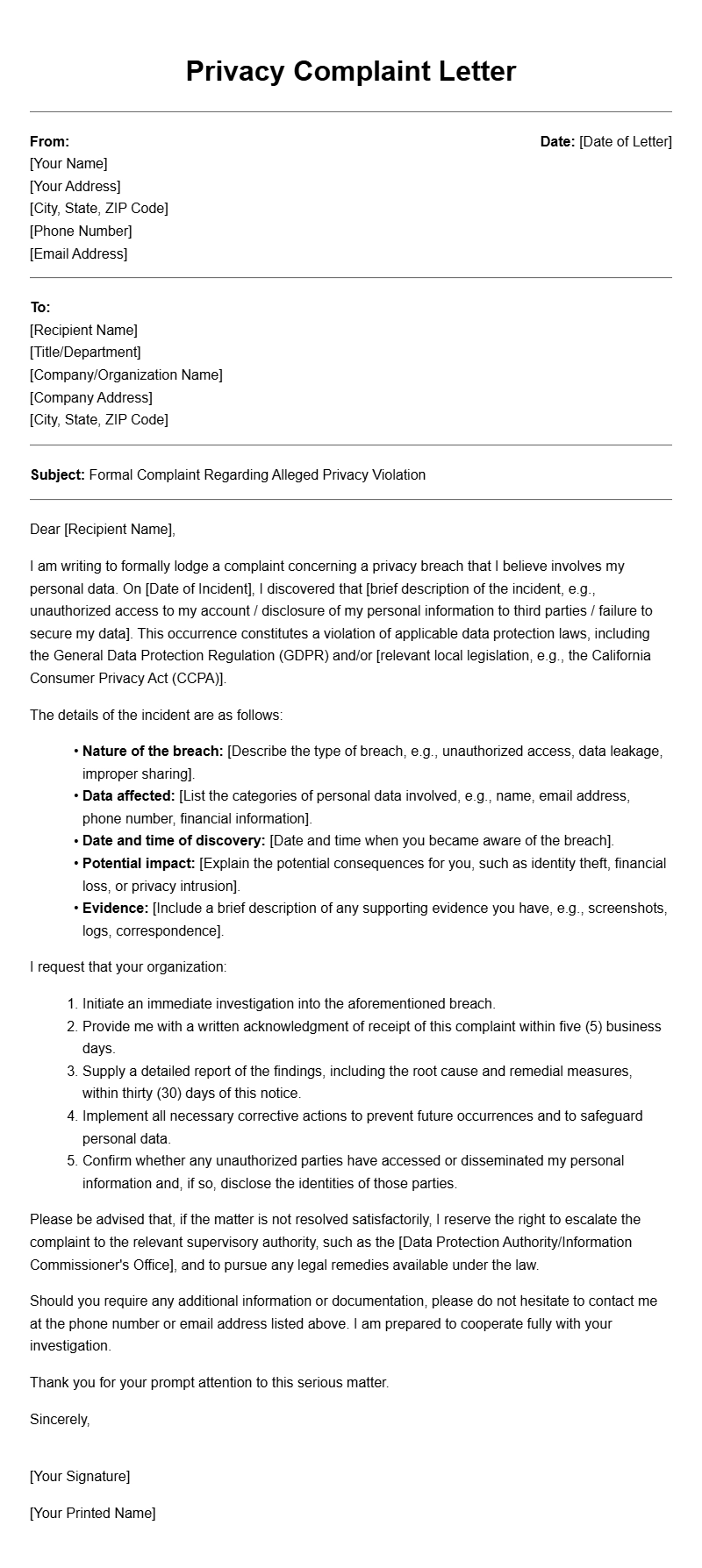
Privacy Complaint Letter Template
Here’s a template you can adapt for your situation. Replace the bracketed sections with your specific details.
[Your Name]
[Your Address]
[City, State, ZIP Code]
[Email Address]
[Phone Number]
[Date]
[Company Name]
[Company Address]
[City, State, ZIP Code]
Re: Formal Privacy Complaint – [Brief description, e.g., “Unauthorized Data Disclosure” or “Failure to Honor Deletion Request”]
Dear [Recipient’s Name or “Data Privacy Officer”],
I am writing to formally complain about [brief description of the issue]. On [specific date], [explain what happened in one or two sentences]. I believe this constitutes a violation of [applicable law or regulation, e.g., “my rights under the California Consumer Privacy Act” or “data protection principles outlined in Article 5 of the GDPR”].
[If relevant, add context about why this matters to you. For example: “I discovered this issue when I received a marketing email from a third party I never consented to share my information with.”]
I respectfully request that you [specific action you want, e.g., “immediately delete all personal data you hold associated with my account and provide written confirmation of this deletion” or “provide a complete accounting of all personal data you have collected about me and the entities with whom it has been shared”].
Please respond to this complaint in writing within 30 days. If I don’t receive a satisfactory response, I will file a complaint with [relevant authority, e.g., “the Office of the Privacy Commissioner of Canada” or “my state’s Attorney General”].
You may reach me at the contact information listed above or by email at [your email].
Sincerely,
[Your Signature]
[Your Printed Name]
If you need templates for other types of business correspondence, you might find our client-to-insurance-company letter samples helpful for similar formal communication structures.
Example: Complaint About a Data Breach
Here’s a more specific example showing how to adapt the template for a real scenario.
Maria noticed unusual charges on her credit card and discovered that a retailer she’d shopped with had experienced a security breach exposing customer payment information. She wanted to complain about the delayed notification. Her letter included:
“I am writing to formally complain about the data breach announced by your company on March 15, which I learned about only on April 3 when my bank flagged suspicious activity on my account. Despite my being a customer since 2019, I never received direct notification of this breach—only a vague statement on your website that I discovered by chance. Under Article 33 of the GDPR, I was entitled to notification “without undue delay” and certainly within 72 hours of becoming aware of the breach.
I request that you: (1) provide a complete account of what personal data was compromised in my case, including payment card information, address, and purchase history; (2) confirm what steps you’re taking to prevent future breaches; and (3) explain why customer notification was delayed beyond the legal requirement.
Please respond within 30 days. If no response is received, I will file a formal complaint with the Information Commissioner’s Office.”
That letter is specific, cites relevant regulations, and makes clear requests. It also establishes a deadline and mentions escalation without being hostile.
Common Mistakes to Avoid
When people write privacy complaints, several errors frequently undermine their effectiveness.
Being too vague is the biggest problem. “You violated my privacy” doesn’t tell them what happened or what you want. Specifics matter. Did they share your email with marketers? Sell your purchase history? Fail to delete your account after you requested it? Name the specific issue.
Another mistake is omitting your contact information. If they can’t easily reach you or identify your account, your complaint might get filed away without action. Include enough details for them to locate your records.
Avoid threatening legal action in the first letter unless you’re certain you want to pursue that route. Starting with “I’ll sue you” often makes the company defensive rather than cooperative. Save stronger language for escalation if needed.
Don’t forget to actually send it. Some people draft a complaint letter but never send it, or they email it without confirming receipt. Keep records of delivery—send it via email with read receipt, or use certified mail if you want proof of receipt that holds up if you need to escalate later.
Tips for Customizing Your Letter
Every situation is different, so tailor your letter accordingly.
If you’re dealing with a healthcare provider, mention HIPAA and what specifically was mishandled—whether it’s unauthorized disclosure of medical records, failure to provide access to your file, or issues with how they shared information with insurers.
For financial institutions or services, reference the specific Gramm-Leach-Bliley Act obligations or banking privacy regulations that apply to their handling of your data.
If you previously contacted them about this issue, mention those earlier attempts and include the dates. Reference numbers from previous communications help connect the dots.
When the violation involves your children’s data (COPPA applies here under 13 for online services), be especially clear about your authority as the parent or guardian to make these requests on their behalf.
For business-related complaints, you might find our guides on event organizer-to-sponsor letter templates or property manager-to-tenant letter templates useful for handling similar formal correspondence, though those cover different specific situations.
What Happens After You Send Your Letter
Most reputable organizations will acknowledge your complaint within a week or two and follow up with a substantive response within the timeframe you specified. If they don’t respond, or if their response doesn’t adequately address your concerns, your next step is contacting the relevant data protection authority in your jurisdiction.
In the United States, this might be your state Attorney General, the FTC for certain violations, or agency-specific regulators like HHS for healthcare privacy issues. In the EU, you’d contact the national Data Protection Authority. In Canada, it’s the Office of the Privacy Commissioner. These authorities can investigate complaints and impose penalties on organizations that violate privacy laws.
Keep copies of everything—your original letter, their responses, any supporting documentation. You’ll want this paper trail if you need to escalate further or pursue other remedies.
Final Thoughts
A well-written privacy complaint letter is often all it takes to get a company to take your concerns seriously and fix the issue. Organizations don’t want regulatory complaints on their records any more than you want to file one. Frame your letter clearly, make specific requests, give them a deadline, and follow through if they don’t respond. Your personal information is worth protecting—knowing how to formally assert that right matters in today’s data-heavy world.
Sample Documents for Multiple Use Cases