Whether you’re helping a family member navigate the citizenship process or you need to write a support letter for a friend’s application, finding solid examples to work from can save you hours of frustration. This guide walks you through what makes a strong citizenship support letter, offers practical templates you can adapt, and explains where many applicants go wrong when drafting these documents. If you’re new to this process, thinking of it as writing a detailed character reference—like something you’d provide for a lease application, but with more weight—helps set the right expectations.
What Is a Citizenship Support Letter?
A citizenship support letter is a written statement from someone who knows the applicant well and can speak to their character, conduct, and integration into the community. U.S. Citizenship and Immigration Services (USCIS) doesn’t require these letters, but applicants often include them to strengthen their case, particularly when seeking naturalization waivers or addressing character concerns that appear in the record.
Think of it as your chance to put a human face on an application that would otherwise be processed through forms and databases. Immigration officers review thousands of cases—your letter gives them personal context that numbers and dates simply cannot convey.
When Are Support Letters Actually Needed?
Most citizenship applicants don’t need these letters at all. Their applications stand on their own merits through the standard naturalization process. However, support letters become particularly valuable in a few specific situations.
Sections Where Character Evidence Helps:
- Waiver requests — If an applicant needs to excuse a prolonged absence from the U.S. or a period of unemployment, a support letter explains circumstances behind those gaps.
- Good moral character concerns — Minor traffic violations, old arrests, or financial issues sometimes require context that the applicant themselves can’t easily provide.
- Community ties — Long-term residents applying after extended travel abroad can benefit from letters emphasizing their strong connections to American society.
- Sponsorship scenarios — Some family-based immigration paths include provisions where existing citizens vouch for incoming family members.
If you’re unsure whether your situation warrants a support letter, review your specific requirements or consult with an immigration attorney. Sending unsolicited documents sometimes creates more questions than it answers.
Key Components a Strong Support Letter Must Include
After reviewing dozens of these letters—both successful and rejected—several elements consistently separate the helpful ones from the unhelpful clutter that USCIS officers simply skip over.
The Basic Structure:
- Header with your contact information — Your full name, address, phone number, and email appear at the top so officials can reach you if needed.
- The date — Write out the full date (Month Day, Year format) as you’d see in any formal business letter.
- USCIS designation — Address it to the appropriate office: “U.S. Citizenship and Immigration Services” or the specific lockbox facility handling the application.
- Applicant identification — Clearly state the beneficiary’s full legal name and A-number (if they have one from previous applications).
- Your relationship to the applicant — Explain how you know them, how long you’ve known them, and in what capacity.
- Substantive body paragraphs — Specific examples of good character, community involvement, and observation of U.S. laws.
- Your signature and contact information — Handwritten signature with printed name, title if applicable, and all contact details again.
What Makes the Body Paragraphs Count:
Vague praise doesn’t help anyone. Statements like “He is a good person” or “She deserves citizenship” read as empty assertions without evidence. Instead, focus on concrete observations that demonstrate behaviors USCIS cares about.
Strong letters mention specific activities—volunteering at a local food bank, coaching youth sports, serving on a neighborhood association board. They cite observable facts—punctual attendance at work, timely bill payments,守法守法 (law-abiding behavior). They convey personal knowledge gained through direct interaction over months or years, not favorable impressions formed from casual acquaintance.
Step-by-Step Writing Guide
Here’s how to approach drafting your letter if you’re starting from scratch. This process works whether you’re supporting a spouse, parent, long-time friend, or employee.
Step 1: Establish Your Qualification to Write
Before putting pen to paper (or fingers to keyboard), honestly assess your connection to the applicant. The strongest letters come from people who have interacted with the applicant regularly over an extended period—typically two years or longer. If you’ve known the person for six months through a professional context, that’s worth mentioning, but recognize its limitations compared to a decade-long friendship.
Step 2: Gather Specific Examples
Jot down three to five real instances that demonstrate the qualities you want to highlight. Ask yourself: What has this person done that shows they contribute positively to their community? Have I observed them handling difficult situations with integrity? Do they maintain steady employment and family responsibilities?
For example, rather than saying “She’s a great neighbor,” you might write: “During the winter storm last December, I watched Maria organize a snow-clearing rotation for our street and personally checked on elderly neighbors twice daily until the plows arrived.”
Step 3: Write a Direct Opening
State immediately why you’re writing and whom you’re supporting. Don’t bury the lede or pad the introduction with pleasantries.
Instead of: “I am writing this letter to provide support for my friend because I believe she deserves citizenship…”
Try: “I am writing to attest to the good moral character of Yuki Tanaka, whom I have known as a neighbor and friend for the past seven years, in support of her naturalization application.”
Step 4: Develop Substantive Paragraphs
Organize your letter into focused paragraphs, each addressing a specific aspect of the applicant’s character. Group similar observations together rather than scattering unrelated details.
Consider organizing around themes: professional conduct, community involvement, family relationships, and守法 behavior. Within each theme, provide at least one specific example with enough detail that a stranger reading the letter could picture the situation.
Step 5: Close with Credibility
End by reaffirming your confidence in the applicant’s character and your willingness to be contacted for follow-up questions. Include your actual contact information—this isn’t a private letter, and you should expect it to be verified.
Editable Citizenship Support Letter Templates
Use these templates as starting points. The brackets indicate where you insert your specific information. Every letter should be customized to reflect your actual knowledge of the applicant.
Template 1: For a Long-Term Friend or Neighbor
[Your Full Name]
[Your Street Address]
[City, State ZIP]
[Phone] | [Email]
[Date]
U.S. Citizenship and Immigration Services
[Appropriate Lockbox Address]
RE: Letter of Support for [Applicant’s Full Legal Name]
To Whom It May Concern:
I am writing to provide my wholehearted support for [Applicant’s Name], whom I have known for [number] years as [relationship: friend, neighbor, community member]. I am a [your profession/role] at [organization or self-employed], and I have had regular contact with [Applicant’s Name] through [context: neighborhood gatherings, community events, regular social interaction].
During the time I have known [Applicant’s Name], I have observed the following qualities that demonstrate good moral character and strong attachment to American community life:
[First paragraph with specific example about professional conduct, volunteer work, or community participation]
[Second paragraph with specific example about family relationships, responsible behavior, or interaction with neighbors]
[Third paragraph with specific example about observance of laws, reliability, or other relevant observation]
I have complete confidence in [Applicant’s Name]’s integrity and commitment to responsible citizenship. If you require additional information or wish to discuss this application further, please contact me at the information provided above.
Sincerely,
[Your Handwritten Signature]
[Your Printed Name]
Template 2: For an Employer
[Company Name]
[Company Address]
[City, State ZIP]
[HR Contact Phone] | [HR Email]
[Date]
U.S. Citizenship and Immigration Services
[Appropriate Lockbox Address]
RE: Letter of Support for [Applicant’s Full Legal Name]
To Whom It May Concern:
I am writing on behalf of [Company Name] to confirm the employment of [Applicant’s Name] and to provide my assessment of their character as part of their naturalization application.
[Applicant’s Name] has been employed with our company as a [job title] since [start date], demonstrating consistent punctuality, professional conduct, and adherence to workplace policies. Their performance reviews reflect [brief, positive assessment].
Beyond their professional responsibilities, I have observed [Applicant’s Name] displaying qualities consistent with good citizenship, including [specific examples: participating in company volunteer programs, treating colleagues with respect, demonstrating honesty in their work].
This documentation is provided voluntarily based on my direct supervisory experience with this employee. Please contact our HR department at the above information should you require verification of employment or additional context.
Respectfully,
[Supervisor’s Handwritten Signature]
[Supervisor’s Printed Name]
[Title]
Template 3: For Addressing Specific Concerns
Use this template when the applicant needs to address a specific issue—such as a past incident, prolonged absence, or other complication—in their naturalization record.
[Your Full Name]
[Your Address]
[Phone] | [Email]
[Date]
U.S. Citizenship and Immigration Services
[Appropriate Lockbox Address]
RE: Letter of Support for [Applicant’s Full Legal Name], A-Number [if known]
To Whom It May Concern:
I am writing to provide context regarding [Applicant’s Name], whom I have known for [duration] in my capacity as [your role/relationship]. I understand that the naturalization application may raise questions about [the specific concern: their absence from the United States between 2019-2021 / a minor offense from 2018 / periods of unemployment], and I wish to offer relevant information.
Regarding [brief description of the concern being addressed]:
[Explain the circumstances clearly, focusing on what you personally observed or know to be true. Avoid speculation or legal conclusions—stick to facts within your direct knowledge.]
From my perspective during this time, [Applicant’s Name] demonstrated [relevant positive behaviors or character traits] and [explain any reformed behavior or demonstrated growth].
Please feel free to contact me for clarification or additional information.
Sincerely,
[Your Signature]
[Your Printed Name]
Common Mistakes That Weaken These Letters
Even well-intentioned supporters sometimes undermine the application they’re trying to help. Here’s what to avoid:
Generic Language That Could Apply to Anyone
“He is honest, hardworking, and friendly.” This sentence tells the officer nothing useful. Any applicant could have any person write against this description. Ground your observations in specific, personal detail.
Addressing Legal Conclusions
Don’t write things like “She has never broken any laws” unless you can actually verify it. You might genuinely believe you know your friend’s entire history, but saying so with certainty when you can’t possibly know everything creates problems. Instead, describe your direct observations: “In the four years I’ve known James, I’ve never witnessed him engage in any illegal activity, and all interactions I’ve observed have shown respect for rules and regulations.”
Making the Letter Too Long
One to two pages typically provides enough substance without overwhelming the reviewer. Immigration officers process many applications daily—three-page letters filled with filler content get skimmed rather than read thoroughly.
Failing to Sign the Letter
This sounds obvious but happens frequently. An unsigned letter lacks the authenticity that makes it useful. Sign it in blue ink if submitting a physical copy, or ensure your digital signature is properly applied.
Using Templates Without Customization
Officers can spot template-generated letters immediately. Remove any template language that doesn’t accurately describe your actual relationship with or observations of the applicant. Every sentence should reflect genuine knowledge.
Including Unverifiable Claims
If you’re claiming someone volunteers 20 hours weekly at the community center, make sure they actually do. USCIS can and does verify statements made in support letters.
Tips for Customizing Your Letter Effectively
Personalization transforms a weak template into a compelling document. Here’s how to make yours genuinely helpful.
Match Your Voice to Your Relationship
A letter from an employer should sound professional and formalized. A letter from a longtime friend can maintain a warmer, more informal tone while still being substantive. The key is readability—not stiff formality that sounds like you copied it from a legal form.
Include Numbers When Possible
Quantifiable details carry weight. “He volunteers at the animal shelter three Saturdays each month” reads stronger than “He volunteers regularly.” “She’s been employed continuously for five years” hits harder than “She has stable work.”
Connect to Community Institutions
When applicants have formed genuine connections to American civic life, that signals exactly what naturalization processes aim to recognize. Mention church membership, sports league participation, union involvement, school activities with children—anything that shows integration.
Reference Specific Time Periods
Tie your observations to concrete dates or ranges. Saying “During the past three years” or “Since moving to our neighborhood in 2019” gives the officer temporal grounding that strengthens credibility.
Proofread Carefully
Errors in your support letter reflect poorly on both you and the applicant. Take an extra five minutes to check spelling, grammar, and the accuracy of names and dates before finalizing.
Frequently Asked Questions
Can anyone write a support letter for a citizenship applicant?
Technically yes, but letters carry more weight when written by U.S. citizens who have known the applicant for an extended period, ideally two years or more. Writers should have direct, personal knowledge of the applicant’s character and not rely on hearsay or second-hand information.
How many support letters should a citizenship application include?
Quality matters more than quantity. Two or three strong letters from people with significant knowledge of the applicant typically serve better than eight or ten generic ones. Focus on letters from writers who can provide substantive, verifiable detail.
Should support letters be notarized?
Not required, but some writers choose to have their signatures notarized for added credibility. A notary public can verify the identity of the person signing. This adds formality without being necessary for the letter to be effective.
Can family members write support letters?
Yes, family members can write these letters. However, if you’re a close family member whose perspective might be considered biased, having supporting letters from non-family sources strengthens the overall application.
Where should support letters be sent?
Include them with the applicant’s regular submission package, either sent to the USCIS lockbox facility handling their case or submitted through the online portal if filing electronically. Don’t send them separately, as they may not be matched to the correct file.
Final Thoughts
A well-crafted citizenship support letter bridges the gap between dry application forms and the lived reality of who an applicant actually is. Your job as the writer isn’t to advocate or persuade—it’s to accurately describe what you’ve personally observed so that immigration officers can make informed decisions based on human context.
Take time to gather real examples. Write clearly and specifically. Proofread before sending
Template Variations & Sample Formats
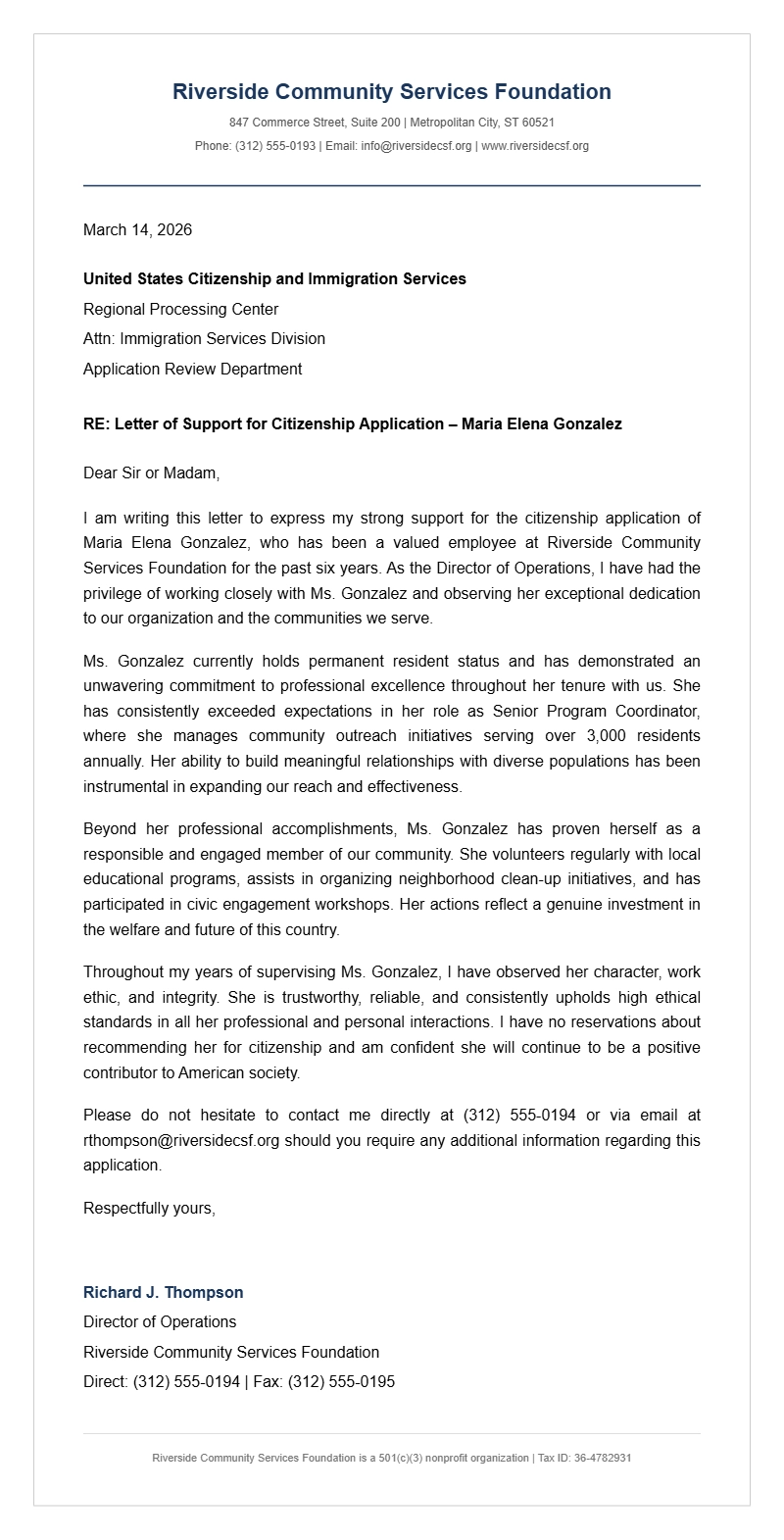
Employer Support Letter for Citizenship Application
Date: May 25, 2026
To: Immigration Officer, Citizenship Section
U.S. Citizenship and Immigration Services
Subject: Support Letter for Citizenship Application – Maria L. Santos
Dear Sir/Madam,
I am writing to express my strongest support for the citizenship application of Maria L. Santos, who has been a valued member of our team at Brightfield Technologies for the past six years. As her direct supervisor, I can attest to her exceptional work ethic, professionalism, and unwavering commitment to the organization’s goals.
During her tenure as Senior Software Engineer, Maria has consistently delivered high‑quality projects, demonstrating technical expertise and innovative problem‑solving skills. Her collaborative nature and willingness to mentor junior staff have greatly contributed to a positive workplace culture. Beyond her technical abilities, Maria has shown genuine interest in community outreach, leading several volunteer initiatives that reflect her dedication to social responsibility.
I have no doubt that Maria will continue to be an asset to the United States as a citizen, contributing her skills and character to the broader society. I respectfully request favorable consideration of her application.
Sincerely,
David R. Hernandez
Director of Engineering
Brightfield Technologies
Phone: (555) 123‑4567
Email: d.hernandez@brightfield.com