Whether you’re a landlord who needs to quickly write a solid reference for a departing tenant, or a property manager assisting a former renter with their next application, you’re probably looking for a straightforward tenant reference letter template that does the job without sounding cookie-cutter. This guide gives you a ready-to-use template, explains exactly what to include, and walks you through writing one that holds up under scrutiny.
What Is a Tenant Reference Letter and When Do You Need One?
A tenant reference letter is a written statement from a previous landlord confirming that a person rented from you, paid on time, and kept the property in good shape. Property managers, real estate agents, or individual landlords typically send it directly to a prospective landlord as part of a rental application.
You usually need one when a tenant applies for a new rental. Some landlords also request it for mortgage applications, while international visa applications sometimes ask for proof of stable housing. In short, it’s a short-term document with long-term consequences for the tenant, so accuracy matters.
Key Sections Every Tenant Reference Letter Should Include
Cutting corners here leads to rejected applications or unnecessary follow-up questions. A complete reference letter has these parts:
- Landlord or property manager name and contact details – full name, phone number, email address
- Date the letter was written
- Tenant’s full name and current address
- Rental period – start and end dates
- Property address – the actual unit or house rented
- Monthly rent and payment behavior – whether it was always on time, occasionally late, etc.
- Property condition notes – general state at move-out versus move-in
- Reason for leaving – lease ended, tenant relocated, etc.
- Recommendation statement – would you rent to this person again?
- Signature – handwritten or digital, with printed name
Each of these works together to give the new landlord a clear picture. If you skip the payment history or vague the recommendation, the letter loses its value. For more examples of how formal letters are structured across industries, see our employment cancellation letter samples.
How to Write a Tenant Reference Letter Step by Step
Follow these steps to produce an accurate, professional letter in under ten minutes.
Step 1: Gather the Tenant’s Details First
Before you touch the template, confirm the tenant’s full legal name, the rental unit address, and the exact move-in and move-out dates. Errors here cause red flags in background checks.
Step 2: Pull Your Records
Check your lease agreement, any rent payment ledgers, and move-in/move-out inspection reports. Specific data — like “paid $1,200 on the first of every month for 26 months” — beats vague praise like “always paid on time.”
Step 3: Fill in the Template
Drop the verified data into the template sections below. Don’t just copy-paste old text; adjust the tone if the new landlord uses different terminology or if you know the tenant is applying for a higher-end property.
Step 4: Add One Specific Example
One concrete detail strengthens the letter more than general adjectives. For instance: “When the dishwasher broke in March 2023, James reported it within 24 hours and followed up twice until we scheduled a repair.” That shows responsibility.
Step 5: Sign and Date
Print, sign in blue ink if possible, and scan. If you’re emailing, attach the PDF or use a digital signature tool that matches your usual email practices.
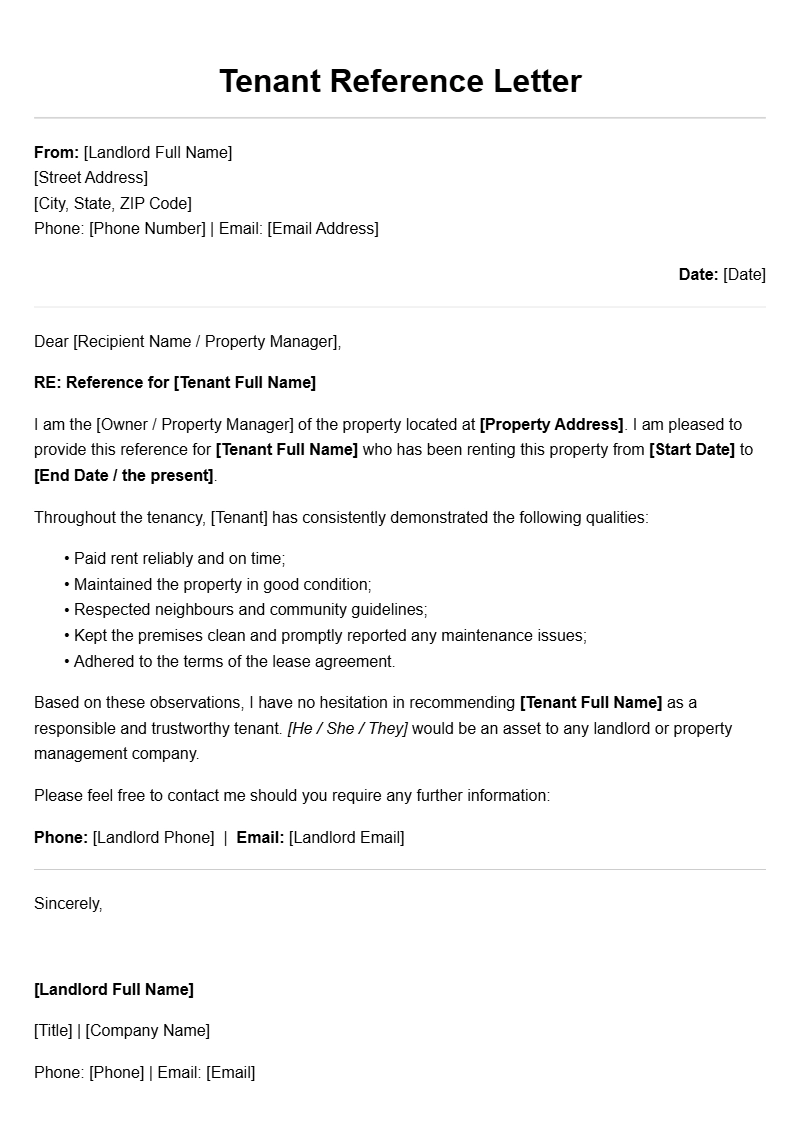
Tenant Reference Letter Template (Editable)
Use this as a starting point. Replace the bracketed sections with your specific information.
[Your Name or Property Management Company Name]
[Your Address]
[City, State, ZIP Code]
[Phone Number] | [Email Address]
[Date]
To Whom It May Concern,
I’m writing to confirm that [Tenant Full Name] rented the property located at [Property Address] from [Move-In Date] to [Move-Out Date]. The monthly rent was $[Amount], and [Tenant Name] paid it reliably throughout the tenancy.
During the move-out inspection on [Date], I found the property in good condition, consistent with normal wear and tear. [Tenant Name] left the keys and parking pass as agreed.
[Optional: Add one specific example of tenant responsibility, as mentioned above.]
I recommend [Tenant Name] without reservation and would happily rent to them again. Please feel free to contact me at [Phone Number] or [Email] if you need further details.
Sincerely,
[Your Signature]
[Your Printed Name]
Customize the wording based on the situation. If the tenant was decent but had one late payment, it’s better to be honest — “generally paid on time, with one instance of a 10-day delay in August 2023 that was promptly resolved” — than to leave a false impression.
Common Mistakes to Avoid in Tenant Reference Letters
- Vague language – “Good tenant” means nothing without specifics. State what made them good.
- Missing or incorrect dates – An agent running a background check will flag date discrepancies immediately.
- Not verifying information – Double-check payment records before stating “always paid on time.”
- Overly short letters – One paragraph reads as lazy. Two or three solid paragraphs strike the right balance.
- Forgetting contact information – If the prospective landlord cannot reach you, the letter becomes useless.
If you want to see how precise wording works in other letter types, our student warning notice letter templates show how detailed language prevents misunderstandings in formal landlord communications.
Tips for Customizing Your Template
One template does not fit every situation. Here’s how to adjust it:
Match the Tenant’s Next Level
If the tenant is moving into a luxury apartment, use slightly more formal phrasing. For a shared house, casual language works fine. The tone should signal that you’re a professional who understands context.
Include an Honest but Positive Recommendation
If the tenant was imperfect — say, two late payments in three years — frame it constructively. “Sarah resolved all arrears within two weeks of each notification” is better than ignoring the issue or sounding apologetic.
Keep It to One Page
Landlords review dozens of applications. Your reference letter should be concise enough to read in under a minute. Every sentence should add value.
Use Professional Letterhead When Possible
If you manage properties under a company name, letterhead adds credibility. It signals that you’re not just a neighbor writing a favor but someone with professional oversight.
For additional guidance on writing various formal letters, our employee relocation letter samples illustrate how to structure professional correspondence for different contexts.
Get Your Tenant Reference Letter Done Right
Writing a tenant reference letter takes less time than you think if you have the right structure. Use the template above, plug in your records, add one specific example, and sign it. That single page could be the deciding factor in your former tenant getting the home they want. If you need other letter templates for business or personal use, explore our weekly business update letter samples for more options.
Editable Document Format Examples