You’re standing at the airport check-in counter, your child beside you, when the agent asks for documentation. Your stomach drops. You thought your ex-spouse’s verbal agreement would be enough. It isn’t. Without a properly prepared travel consent letter, your international trip with your kid could get derailed before you even board.
I’ve seen this scenario play out in real time, and it’s more common than most parents realize. Whether you’re a solo parent taking a child abroad, a grandparent traveling with grandchildren, or navigating co-parenting arrangements, a travel consent letter isn’t optional paperwork—it’s your boarding pass to actually getting where you need to go.
This guide walks you through everything you need to know about travel consent letter templates: what they are, when you actually need one, what must be in them, and how to write one that actually works when it matters most.
What Is a Travel Consent Letter?
At its core, a travel consent letter (sometimes called a letter of consent for minor travel) is a written statement from a parent or legal guardian giving permission for a child to travel with another adult or alone. It’s not a legal custody document—it’s a specific-purpose letter that says “yes, I give permission for my child to travel this way.”
Think of it as a trust document. You’re establishing, on paper, that you authorize this specific travel arrangement. Airlines, immigration officers, and border agents use it to verify that no parental abduction is occurring and that both custodial parents have agreed to the trip.
The letter doesn’t replace custody orders. If you have sole custody, you still need the document in case someone challenges your authority at a checkpoint. If you share custody, the letter becomes even more critical because it demonstrates both parents approved the travel plan.
When Do You Actually Need One?
The short answer: whenever a child is traveling without both legal parents or guardians present. Here’s how that breaks down in real situations:
- One parent taking a child internationally without the other parent
- Grandparents traveling with grandchildren (even within the same family, this matters)
- Aunt, uncle, or family friend accompanying a child
- Child traveling solo on flights (most airlines require this regardless of domestic or international routes)
- Child traveling with someone whose last name differs from the child’s
- Blended families where step-parents are involved
A practical example: Sarah takes her son Ethan to visit relatives in Canada. Her husband (Ethan’s stepfather) isn’t accompanying them. Even though Sarah has full custody, the border agent may question why a man and boy are traveling together with different last names. A consent letter from Sarah’s ex-husband (Ethan’s biological father, who retains visitation rights) clarifies that everyone is on the same page.
Domestic flights within the U.S. generally don’t require consent letters, but international travel almost always does. Some countries, particularly in Latin America and parts of Europe, require notarized letters even for one parent traveling with a child domestically. When in doubt, check the specific country’s entry requirements before your trip.
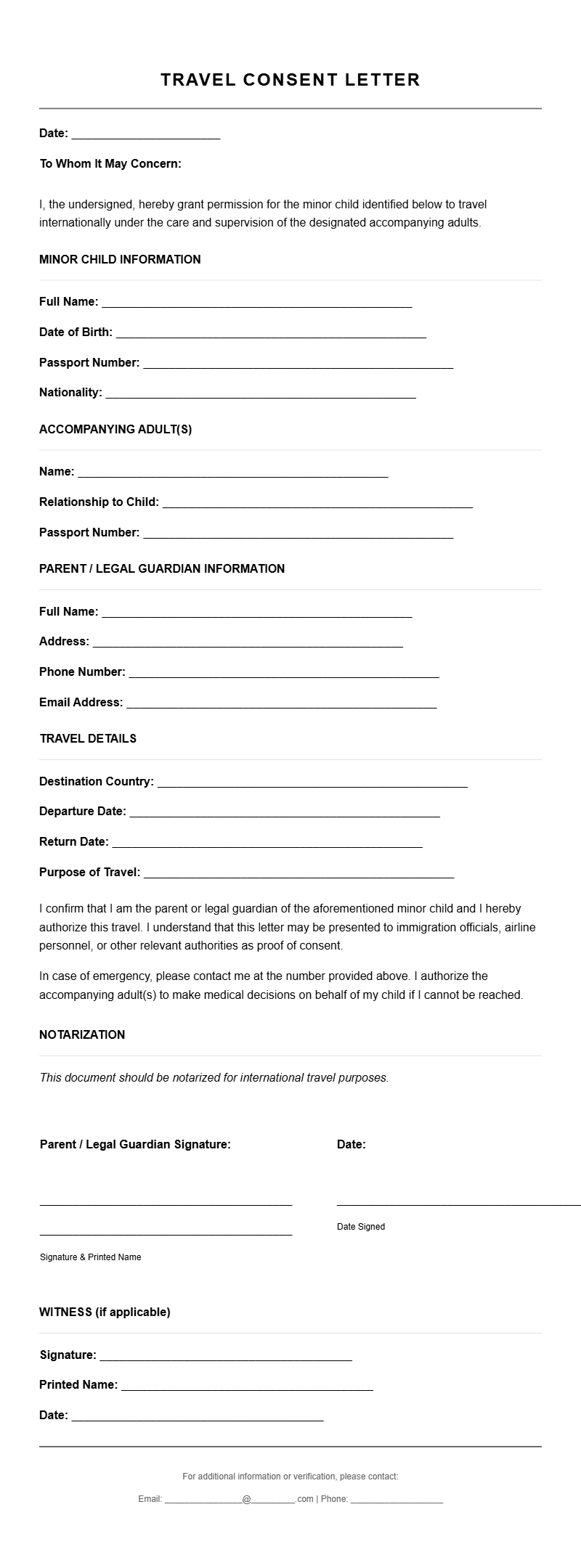
Key Components Your Template Must Include
Skip any template that doesn’t cover these essentials. A consent letter without these elements won’t hold up at immigration checkpoints.
Child Information
- Full legal name (as it appears on the passport)
- Date of birth
- Passport number (if international)
- Nationality
Travel Details
- Destination country/countries
- Departure and return dates
- Specific cities or regions the child will visit
- Purpose of travel (vacation, family visit, medical)
Guardian Information
- Full name of the parent granting consent
- Current address and contact information
- Relationship to the child (mother, father, legal guardian)
- Passport or ID number
Accompanying Adult Information
- Full legal name of the person the child is traveling with
- Their relationship to the child
- Contact details
- Passport information
Consent Statement
This is the heart of the letter. It must clearly state that the parent grants permission for the child to travel with the named adult, during the specified dates, to the specified destination. It should also include language acknowledging that the parent understands the child will be traveling internationally.
Signature Block
- Printed name of signing parent
- Signature (handwritten, not electronic)
- Date of signing
- Notarization (required for many countries—see below)
Step-by-Step: Writing Your Letter
Here’s how to build your letter from scratch. Follow these steps in order, and you’ll end up with a document that actually works.
Step 1: Gather Your Information
Before you write anything, collect: child’s passport details, your passport or ID, the traveling companion’s details, your travel itinerary, and contact information for the non-traveling parent. Missing information is the #1 reason consent letters get rejected.
Step 2: Choose Your Template Structure
Decide whether you need a single-parent consent letter (one parent granting permission) or a dual-parent consent letter (both parents agreeing). If the other parent is unavailable or uncooperative, you may need legal counsel rather than just a template—some situations require court orders.
Step 3: Fill in the Blanks Carefully
Use your template but treat every field as important. Don’t abbreviate city names. Don’t guess at passport numbers—verify them against the actual documents. Errors here can invalidate the entire letter at a checkpoint.
Step 4: Add Specific Destination Details
Vague letters get questioned. Instead of writing “European vacation,” write “Paris, France and Barcelona, Spain from June 15 through June 28.” Specificity signals legitimacy to border agents reviewing your paperwork.
Step 5: Get It Notarized
Most countries require notarization. Contact your local notary (banks, law offices, and UPS stores typically offer this service). Both parents should sign in front of the notary if possible. If one parent cannot be present, some jurisdictions allow the signature to be notarized separately, but verify this requirement with your destination country’s embassy.
Step 6: Make Copies
Create at least three copies: one for your travel folder, one to leave with the non-traveling parent, and one stored digitally in cloud storage. If you lose the original during travel, a copy can help in many situations.
Template Examples You Can Adapt
Use these as starting points. Customizing to your exact situation matters more than finding the “perfect” template.
Template 1: One Parent Traveling with Child
I, [YOUR FULL NAME], born [DATE OF BIRTH], residing at [YOUR ADDRESS], am the parent/guardian of [CHILD’S FULL NAME], born [CHILD’S DOB], passport number [PASSPORT NUMBER].
I grant permission for [CHILD’S FULL NAME] to travel internationally with [ACCOMPANYING ADULT’S FULL NAME], who is [RELATIONSHIP: e.g., the child’s aunt / my partner / the child’s grandparent]. The trip will begin on [START DATE] and end on [RETURN DATE]. The destination is [COUNTRY/CITIES].
During this period, [ACCOMPANYING ADULT’S NAME] has full authority to make emergency decisions regarding [CHILD’S NAME]’s health, safety, and welfare.
I confirm that I have sole legal custody of [CHILD’S NAME] OR that the other parent, [OTHER PARENT’S NAME], is aware of and consents to this travel.
[YOUR SIGNATURE]
[YOUR PRINTED NAME]
[DATE]
Notarized and signed in my presence,
[NOTARY SIGNATURE AND STAMP]
[NOTARY DATE]
Template 2: Grandparent Traveling with Grandchild
This letter serves as formal consent for [GRANDPARENT’S FULL NAME] to travel internationally with their grandchild, [CHILD’S FULL NAME], born [DOB], passport number [PASSPORT].
The trip目的地 [DESTINATION] is scheduled from [START DATE] through [END DATE]. The purpose is [PURPOSE: family visit / vacation].
We, [PARENT 1 NAME] and [PARENT 2 NAME], the legal parents of [CHILD], hereby grant unrestricted permission for [GRANDPARENT] to accompany [CHILD] on this trip. We release any liability and confirm our full awareness of the travel arrangements.
[SIGNATURES OF BOTH PARENTS]
[DATES]
[NOTARY]
Common Mistakes to Avoid
These errors sink consent letters faster than anything else:
Mismatched names: If your child’s passport shows “Jonathan Michael Smith,” don’t write “Jon Smith” in the consent letter. The discrepancy triggers immediate scrutiny.
Missing dates: “Soon” isn’t a date. “During summer” isn’t a date. Write exact dates: “July 15, 2024 through July 30, 2024.”
Vague destination language: “Europe” isn’t specific enough. Write each country and city you’re visiting.
No emergency contact info: Border agents want to know they can reach someone if issues arise. Include a working phone number for the non-traveling parent.
Skipping notarization: Many countries reject non-notarized letters outright. If your destination requires one (and most do), get it notarized. It’s typically $10-20 and takes 15 minutes.
Outdated templates: If you downloaded a consent letter template five years ago, double-check that it reflects current requirements. Countries update their entry documentation regularly.
There’s also the mistake of treating consent letters as interchangeable with custody agreements. Your template won’t override a custody order. If your ex has specific travel restrictions written into your divorce agreement, the consent letter doesn’t erase those restrictions. In complex custody situations, consult an attorney before relying on a template alone.
Tips for Customizing Your Letter
Your specific situation shapes how you should adjust any template:
For divorced or separated parents: Include language that confirms both parents have seen the itinerary and agree to the travel plan. If one parent has visitation rights but no travel authority, get their explicit written consent even if it feels redundant.
For international adoptions: Your adoption decree may serve as your primary authority document, but many countries still want a supplemental consent letter from the adopting parent confirming the child’s travel. Include your adoption paperwork copy in your travel documents.
For medical emergencies: Add specific language authorizing the traveling adult to consent to medical treatment if your child is injured or becomes ill. Without this, a grandparent might find themselves unable to authorize urgent care.
For frequent travelers: If your child travels regularly with a specific guardian (for example, to visit grandparents in another country multiple times per year), you can create a long-term consent letter that covers multiple trips within a defined period (like one year). Just ensure each trip is documented separately within the letter.
For single parents with limited info: If you genuinely don’t know where the other biological parent is, you may need court documentation establishing sole custody rather than a consent letter. Your template can’t solve a legal custody gap.
Beyond the Letter: Other Documents You Might Need
A consent letter isn’t a standalone solution. Depending on your situation, you may also need:
- Birth certificate (original or certified copy)
- Custody agreement or court order if applicable
- Death certificate if one parent is deceased
- Affidavit of identity for parents with name discrepancies
- Invitation letter from hosts at destination
- Travel insurance documentation
If you’re using different documents for different purposes (like template letters for other correspondence or need documentation for legal purposes), keep each type organized separately in your travel folder. Mixing up documents at the airport creates unnecessary delays.
Some countries also require an affidavit from the non-traveling parent confirming they have no objections. This is more formal than a basic consent letter and may require legal review. Check your destination country’s specific requirements at least two months before departure.
Making It Happen
Don’t let document issues derail your travel plans. If you have an upcoming trip with your child and any complexity in your family situation—shared custody, remarriage, deceased parent, international destination—pull together your consent letter now. Give yourself time to get it notarized, make copies, and keep the original in your carry-on.
A well-prepared consent letter takes an hour to draft and costs less than $30 to notarize. That’s a small investment against the alternative: being turned away at the airport or detained at immigration on arrival.
Start with the templates above, customize them to your exact details, and verify against your destination country’s requirements. When in doubt, contact the embassy or consulate of your destination country directly—they can confirm exactly what documentation they’ll accept.
Safe travels.
Practical Document Examples