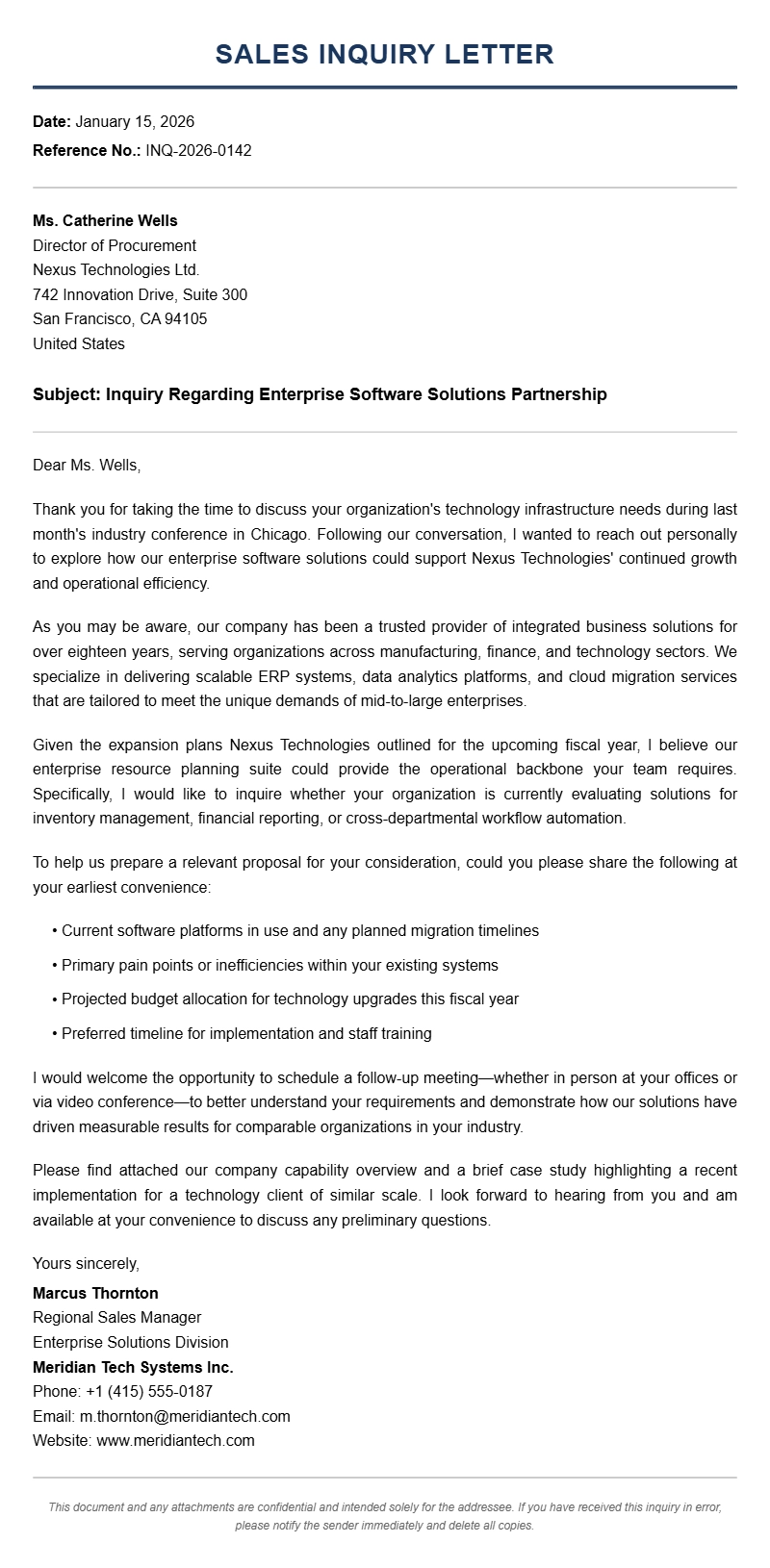
If you’ve ever stared at a blank screen trying to figure out how to reach out to a potential client, you’re not alone. Crafting a sales inquiry letter that actually gets read—and gets a response—takes more than just filling in a template. It requires understanding what makes prospects tick, what information they need, and how to present your offer without sounding pushy or desperate.
In this guide, you’ll find real-world examples, editable templates, and practical tips that you can start using today. Whether you’re a sales rep, a small business owner, or someone just learning the ropes, these sales inquiry letter samples will save you time and help you write messages that convert.
What Is a Sales Inquiry Letter?
A sales inquiry letter is a written communication sent to potential customers or clients to introduce your products or services, express interest in working with them, and gather information about their needs. Unlike a sales pitch that pushes a product, an inquiry letter asks questions and opens a dialogue. Its goal is to start a conversation, not close a deal on the spot.
These letters can be sent via email, traditional mail, or even through professional messaging platforms. The format has evolved over the years, but the core principle remains the same: show genuine interest in the recipient’s challenges and position yourself as a helpful resource rather than a salesperson.
When Should You Send a Sales Inquiry Letter?
You’d send a sales inquiry letter in situations where you want to:
- Reach out to a new prospect you’ve identified through research or referrals
- Follow up after a trade show, conference, or networking event
- Introduce your services to a company that’s facing a specific challenge you can solve
- Request a meeting or phone call to discuss potential collaboration
- Respond to a request for proposal (RFP) or invitation to bid
- Reconnect with past clients about new offerings
The key is timing. Send your letter when you have something genuinely valuable to offer and when the recipient is likely to be open to hearing from you. Cold outreach to a random list rarely works; targeted, well-researched letters do.
Key Components of an Effective Sales Inquiry Letter
Before diving into examples, let’s look at the building blocks that make a sales inquiry letter work:
The Subject Line or Opening
Your first sentence sets the tone. If you’re sending email, the subject line determines whether your message gets opened. For physical letters, your opening paragraph must grab attention immediately. Avoid generic openers like “I wanted to reach out to you.” Instead, lead with something specific and relevant to the recipient.
Personalization and Relevance
Generic letters get ignored. Each inquiry should show that you’ve done your homework. Reference the recipient’s business, recent achievements, specific challenges, or mutual connections. This takes extra time, but it dramatically increases response rates.
Clear Value Proposition
Answer the question: “Why should this person care?” State plainly what you offer and how it solves a problem they likely face. Don’t bury this in jargon or vague promises.
A Specific Ask
Don’t leave the reader guessing about what you want. Ask for something concrete: a 15-minute call, a response to two questions, a meeting next month. Specific requests are easier to fulfill than vague invitations.
Professional Closing
End with gratitude, your contact information, and a gentle reminder of the value you’re offering. Keep it short—don’t add unnecessary fluff just to hit a word count.
Step-by-Step Guide to Writing Your Sales Inquiry Letter
Follow these steps to create letters that get responses:
Step 1: Research Your Prospect
Spend five to ten minutes learning about the person and company you’re reaching out to. Check their LinkedIn profile, company website, recent news articles, and any public statements about challenges or goals. The more you know, the more personalized your letter can be.
Step 2: Define Your Goal
What do you want to happen after they read your letter? Maybe it’s a discovery call, a product demo, or simply permission to send more information. Be clear about your objective so you can structure your letter accordingly.
Step 3: Draft the Opening
Start with something specific to them. Mention a recent event, a common challenge, or something you noticed about their business. This signals that your letter isn’t a mass template.
Step 4: Introduce Yourself and Your Offer
Briefly explain who you are and what you offer. Focus on benefits, not features. Explain how your solution addresses the challenge you mentioned in the opening.
Step 5: Make Your Ask
State exactly what you’re requesting. Keep it reasonable—asking for an hour-long meeting is a bigger commitment than asking for a 10-minute phone call. Make it easy to say yes.
Step 6: Proofread and Refine
Read your letter out loud. Does it sound natural? Are there any typos or awkward phrases? Have someone else review it if possible. Small errors can undermine your credibility.
Sales Inquiry Letter Samples and Templates
Below are several examples tailored to different situations. You can adapt these templates to fit your industry and target audience.
Sample 1: Initial Outreach to a New Prospect
Subject: Quick question about [Company Name]’s growth strategy
Hi [Name],
I noticed that [Company Name] recently expanded into the [relevant market or region]. Scaling operations like that often comes with challenges in [specific area—logistics, customer service, etc.].
I’m [Your Name], and I work with companies like yours to solve exactly those kinds of problems. We’ve helped businesses in [their industry] reduce [specific pain point] by as much as [percentage] in the past year.
I’d love to share what we’ve learned and see if there’s a fit for collaboration. Would you have 15 minutes sometime this week for a quick call?
Thanks for your time,
[Your Name]
[Your Title]
[Phone Number]
[Email Address]
Sample 2: Follow-Up After a Conference or Event
Hi [Name],
It was great meeting you at [Event Name] last week. I enjoyed our conversation about [specific topic you discussed].
As promised, I’m sending over some information about [your product/service] that might be useful given your interest in [challenge they mentioned]. We recently helped [similar company] achieve [specific result], which seems relevant to the goals you described.
If you’re open to it, I’d like to schedule a brief call to explore how we might support [Company Name]’s objectives. Are you available on [date/time options]?
Looking forward to hearing from you.
Best regards,
[Your Name]
Sample 3: Inquiry About Partnership Opportunities
Dear [Name],
I follow [Company Name]’s work in [specific area] and have been impressed by your recent projects. Our company, [Your Company], specializes in [what you do], and I see natural opportunities for us to collaborate on [specific type of project or client].
We’ve worked with companies like [examples] to deliver [specific outcomes], and I believe a partnership could bring value to both our clients and our teams.
Would you be open to a conversation about potential collaboration? I’m happy to work around your schedule for a brief introductory call.
Thank you for considering this opportunity.
Sincerely,
[Your Name]
[Contact Information]
Common Mistakes to Avoid
Even good sales professionals make these errors. Watch out for them:
- Being too vague. Statements like “We help companies improve efficiency” don’t tell the prospect anything useful. Be specific about the problems you solve and the results you’ve achieved.
- Focusing entirely on yourself. Your letter should be about them, not you. Use “you” and “your company” more often than “I” and “we.”
- Asking for too much. Requesting a detailed demo or lengthy meeting in your first letter often leads to silence. Start small—a short call or a simple response to a question.
- Ignoring formatting. Long paragraphs without breaks are hard to read. Use white space, bullet points, and short sentences to make your letter scannable.
- Forgetting a call to action. If you don’t tell the reader what to do next, most won’t do anything. End with a clear, specific request.
If you’ve written a formal complaint before and want to review how other types of business letters are structured, our guide on formal complaint letter templates offers additional formatting insights that apply here too.
Tips for Customizing Your Sales Inquiry Letters
Every industry and every prospect is different. Here’s how to adapt these templates to your specific situation:
Research Industry-Specific Language
Use terminology your prospect understands. A letter to a healthcare administrator should sound different from one sent to a retail manager. Learn the buzzwords and pain points that matter in their world.
Adjust Your Tone
Younger startups might respond better to casual, conversational language. Large corporations or government entities often expect more formal correspondence. Match your tone to the audience.
Include Social Proof
Add a brief mention of a relevant client, a statistic, or a credential that builds trust. Don’t overdo it—one or two solid proof points are enough.
Test Different Approaches
What works for one prospect may not work for another. Keep track of your open rates and responses, then adjust your approach based on data. A/B testing subject lines or opening sentences can yield significant improvements over time.
Follow Up Strategically
Many sales inquiry letters go unanswered on the first try. Send a polite follow-up one week later, referencing your original message. Keep it short and offer to resend the information if they missed it.
For more on following up effectively, see our article on meeting follow-up letter samples that cover timing, tone, and structure for different scenarios.
Making Your Letters Work for You
Sales inquiry letters aren’t about clever writing or fancy vocabulary. They’re about showing up with genuine value, communicating clearly, and making it easy for prospects to respond. Use the samples and strategies in this guide as a starting point, then adapt them to your voice, your industry, and your specific goals.
The more personalized and specific your letters are, the better they’ll perform. Start with one well-researched inquiry, track your results, and refine your approach as you go.
And if you need to handle other types of business correspondence—say, confirming details after a job offer or documenting a customer complaint—browse our collection of job confirmation letter samples and customer complaint letter templates for practical examples you can customize.
Template Variations & Sample Formats