Every manager reaches that point where a verbal conversation isn’t enough anymore. The employee keeps showing up late, missing deadlines, or crossing lines that impact the team. You know you need something in writing, but the thought of drafting a disciplinary warning letter from scratch feels overwhelming. Maybe you’ve searched for “disciplinary warning letter templates” because you need something you can customize quickly without sounding like a robot or creating legal liability. You’re not alone in this. Writing these letters is one of the trickier management tasks because they need to be firm yet fair, specific yet professional, and documentation that actually protects your organization if things escalate.
In this guide, I’ll walk you through what makes a disciplinary warning letter effective, when you should use one, the essential sections to include, and practical templates you can adapt for your workplace. I’ve seen dozens of these letters over the years, and the difference between one that works and one that creates more problems often comes down to a few key choices.
What Is a Disciplinary Warning Letter?
A disciplinary warning letter is a written record that documents an employee’s violation of workplace policies, expectations, or performance standards. Unlike a casual conversation or verbal warning, this letter creates an official paper trail that demonstrates the employer took the issue seriously and gave the employee clear notice about what needs to change.
These letters serve multiple purposes. They communicate expectations in concrete terms. They give employees something concrete to reference. And they protect the organization legally by showing a pattern of documented warnings if termination becomes necessary down the road. Think of it as the bridge between informal feedback and formal disciplinary action like suspension or termination.
The key word here is “template” because starting from zero every time wastes energy you could spend on actually managing the situation. A good template gives you structure, ensures you don’t forget important sections, and helps you maintain consistency across different situations.
When Should You Issue a Disciplinary Warning Letter?
Not every workplace slip-up needs a formal letter. Here’s a practical framework for deciding when a written warning makes sense:
- After verbal warnings haven’t worked — If you’ve had conversations about an issue and behavior continues, a written record becomes necessary.
- For serious policy violations — Things like insubordination, harassment, theft, or safety violations often warrant immediate written documentation even as first offenses.
- When you need clear documentation — If you anticipate the situation might lead to termination, promotion decisions, or legal challenges, paper trails matter.
- For performance issues that require improvement plans — Written warnings often accompany performance improvement plans because they formalize expectations.
If you’re dealing with a first-time minor issue, a detailed conversation might suffice. But when patterns emerge or violations are significant, that’s when you reach for a template.
Key Components of an Effective Disciplinary Warning Letter
A letter that actually works contains several non-negotiable sections. Skip any of these and you risk ambiguity, legal exposure, or letters that don’t achieve their purpose.
Header Information
This includes the date, employee name, job title, department, and your own name and title. Getting these details right matters because sloppy header information can create confusion about who received the warning and when.
Clear Subject Line
State plainly that this is a formal written warning. Something like “Re: Formal Written Warning – Attendance Violation” tells the reader immediately what the document is.
Incident Description
Be specific about what happened. Include dates, times, locations, and witnesses if relevant. Vague descriptions like “your behavior has been unacceptable” don’t help anyone. Instead: “On March 14th and March 21st, you arrived more than 45 minutes late to your shift without notifying your supervisor.” Specificity makes the warning actionable.
Policy Reference
Connect the behavior to a specific company policy or expectation. “This violates Section 4.2 of the Employee Handbook regarding punctuality” gives the employee context and shows the warning isn’t arbitrary.
Expected Improvement
State clearly what needs to change. Vague goals like “improve your attitude” create disputes. Concrete targets like “arrive ready to work by 8:00 AM for all scheduled shifts” give employees something measurable to achieve.
Consequences of Continued Violation
Explain what happens if improvement doesn’t happen. “Failure to meet these expectations within 30 days may result in further disciplinary action, up to and including termination” makes consequences clear without being threatening.
Employee Acknowledgment
Include a signature line where the employee acknowledges receipt. This isn’t about getting them to agree with the warning—it’s about proving they received it. You might note: “Employee signature below confirms receipt of this warning but does not necessarily indicate agreement with its contents.”
Space for Employee Response
Give employees the chance to add their perspective. A brief statement like “Employee comments (if any):” followed by lines for writing shows the process respects their voice.
How to Write a Disciplinary Warning Letter: Step-by-Step
Here’s how to approach drafting one when you need it, whether you’re using a template or starting fresh.
Step 1: Gather the Facts
Before writing anything, confirm the details. What exactly happened? When did it happen? Who witnessed it? What does your policy say about this behavior? Rushing to write a letter based on incomplete information leads to inaccurate documentation that can undermine your case if challenged.
Step 2: Choose the Warning Level
Disciplinary warnings typically fall into categories: first written warning, second written warning, or final written warning. Using our promotion announcement letter templates as a reference point, you can see how organizations often have parallel processes for positive documentation too. For negative documentation, match the warning level to the severity and history. A first offense of minor issues might warrant a first warning. Repeated or serious violations justify stronger language.
Step 3: Draft the Incident Section
Write in objective, factual terms. Describe what you observed or documented, not your interpretations or emotions about the situation. Instead of “you’ve been careless and disrespectful,” write “you submitted three client reports after the agreed deadline during the past month, causing delays in the billing cycle.”
Step 4: Connect to Policy
Reference the specific handbook section, policy number, or company expectation being violated. This grounds your warning in established rules rather than personal judgment, which matters if the employee challenges the warning later.
Step 5: State the Improvement Required
Be specific about what success looks like. If the issue is attendance, specify exact expectations. If it’s quality of work, define measurable standards. If it’s behavior, describe the acceptable alternative clearly.
Step 6: Outline Consequences
Be honest about what happens if the employee doesn’t improve. Don’t threaten termination for minor issues, but do be clear that failure to change will lead to escalation. “Continued violation of this policy will result in further disciplinary action, up to and including termination” works. Vague warnings without consequences rarely motivate change.
Step 7: Include Acknowledgment Section
Prepare space for the employee’s signature and any comments they want to add. This completes the documentation and gives the employee agency in the process.
Step 8: Review and Customize
Before finalizing, read the letter as if you’re the employee. Would you understand exactly what you did wrong? Would you know exactly what changes are expected? Would you feel treated fairly? If the answer to any of these is no, revise until it passes that test.
Disciplinary Warning Letter Template Examples
First Written Warning Template – Attendance
Use this template when addressing punctuality or attendance issues that haven’t responded to verbal counseling:
Date: [Insert Date]
Employee Name: [Insert Name]
Position: [Insert Title]
Department: [Insert Department]
Supervisor: [Insert Your Name]
RE: Formal Written Warning – Attendance Policy Violation
This letter serves as a formal written warning regarding your repeated failure to maintain scheduled work hours.
Incident Description:
On February 8th, you arrived at 9:47 AM for your scheduled 8:00 AM shift. On February 12th, you arrived at 10:15 AM. On February 19th, you did not arrive until 11:30 AM. These tardies occurred despite previous verbal discussions about the importance of punctuality on January 25th and February 5th.
Policy Reference:
Your attendance pattern violates Section 3.1 of the Employee Handbook, which requires all employees to report to their workstations at the scheduled start time unless prior approval has been obtained.
Expected Improvement:
You are expected to arrive at your workstation by 8:00 AM for all scheduled shifts, beginning immediately. Any deviation from your schedule must be pre-approved by your direct supervisor at least 24 hours in advance except in cases of sudden illness or emergency.
Consequences:
Failure to meet these attendance expectations within the next 30 days will result in further disciplinary action, which may include a second written warning, suspension, or termination of employment.
Acknowledgment:
Your signature below confirms receipt of this written warning and understanding of the expectations outlined above. It does not indicate agreement with the contents.
Employee Signature: _________________________ Date: _________
Supervisor Signature: _________________________ Date: _________
Employee Comments (optional):
Final Written Warning Template – Performance
Use this template when dealing with ongoing performance issues that have already resulted in prior warnings:
Date: [Insert Date]
Employee Name: [Insert Name]
Position: [Insert Title]
Department: [Insert Department]
Supervisor: [Insert Your Name]
RE: Final Written Warning – Performance Expectations
This letter constitutes your final written warning regarding continued performance deficiencies.
Incident Description:
Despite receiving a written warning on January 15th regarding your quarterly sales targets, your performance has not improved. For Q1, you achieved 67% of your target quota, down from 78% in the previous quarter. Your manager documented six instances between January 15th and March 15th where you failed to complete required follow-up calls with prospective clients.
Policy Reference:
These performance failures violate Section 5.4 of the Company Handbook, which states that employees who consistently fail to meet established performance metrics will be subject to progressive disciplinary action.
Expected Improvement:
You must meet the following conditions within the next 60 days:
- Achieve a minimum of 90% of your monthly sales quota for April and May
- Complete all required client follow-up communications within 24 hours of initial contact
- Attend all scheduled coaching sessions with your direct manager
Consequences:
This is your final written warning. Failure to demonstrate sustained improvement meeting the expectations above will result in termination of your employment with [Company Name].
Acknowledgment:
Your signature below confirms receipt of this final written warning.
Employee Signature: _________________________ Date: _________
Supervisor Signature: _________________________ Date: _________
Employee Comments:
Written Warning for Policy Violation – Workplace Conduct
Use this template when addressing behavioral or conduct issues that violate workplace standards:
Date: [Insert Date]
Employee Name: [Insert Name]
Position: [Insert Title]
Department: [Insert Department]
Supervisor: [Insert Your Name]
RE: Written Warning – Workplace Conduct Policy
This letter serves as a written warning regarding your conduct during the incident described below.
Incident Description:
On March 5th at approximately 2:30 PM in the break room, you were involved in a verbal altercation with a coworker, [Colleague Name]. Multiple employees reported that you raised your voice, used profanity directed at the coworker, and refused to disengage when asked to step away by the shift supervisor. This confrontation lasted approximately 8 minutes and disrupted operations in the adjacent workspace.
Policy Reference:
Your behavior violates Section 7.2 of the Employee Handbook, which prohibits disruptive conduct and requires employees to maintain professional behavior during work hours. It also violates Section 7.5, which specifically prohibits the use of profanity when communicating with colleagues.
Expected Improvement:
You are expected to:
- Maintain professional conduct in all workplace interactions
- Refrain from using profanity when addressing colleagues
- Comply immediately with supervisor requests to disengage from conflict situations
You are also required to complete the workplace civility training module within the next 14 days.
Consequences:
Any future incidents involving disruptive conduct or failure to maintain professional workplace behavior will result in escalated disciplinary action, up to and including termination.
Acknowledgment:
Your signature confirms receipt of this written warning.
Employee Signature: _________________________ Date: _________
Supervisor Signature: _________________________ Date: _________
Employee Comments:
Common Mistakes to Avoid in Disciplinary Warning Letters
Having reviewed many of these letters over the years, I’ve noticed patterns in what makes them ineffective or even counterproductive. Here are the mistakes to sidestep:
Being Too Vague
Phrases like “your behavior has been unsatisfactory” leave employees guessing about what specifically needs to change. Every claim needs a concrete example. “On March 8th, you were 90 minutes late to the client meeting without notifying anyone” beats “you’ve been unprofessional” every time.
Overloading with Irrelevant Details
While specificity matters, don’t turn the letter into a long narrative about the employee’s entire history. Stick to the incident or pattern that warrants the warning. Bringing up issues from two years ago muddies the water and looks retaliatory.
Using Emotional Language
Avoid words like “unacceptable,” “disappointing,” or “appalling” that carry emotional weight. Stick to factual descriptions. “You missed three project deadlines this month” beats “your negligent attitude toward deadlines is unacceptable.”
Failing to Connect to Policy
If you don’t reference a specific policy or handbook section, the warning can seem arbitrary. Employees (and employment tribunals) rightfully question discipline that appears to come from nowhere. Always anchor the violation to an established expectation.
Not Following Your Own Process
If your company handbook says verbal warnings come before written warnings for certain violations, follow that sequence. Skipping steps creates legal vulnerability and employee resentment. Similarly, if you have a progressive discipline policy, adhere to it consistently.
Forgetting the Acknowledgment Section
Some managers get so focused on drafting the warning itself that they forget to include a signature line. Without acknowledgment, you have no proof the employee received the document. That’s a significant gap in your documentation.
Making Promises You Can’t Keep
Don’t write “if you improve, this will be removed from your file” unless you’re certain that’s true and
Practical Document Examples
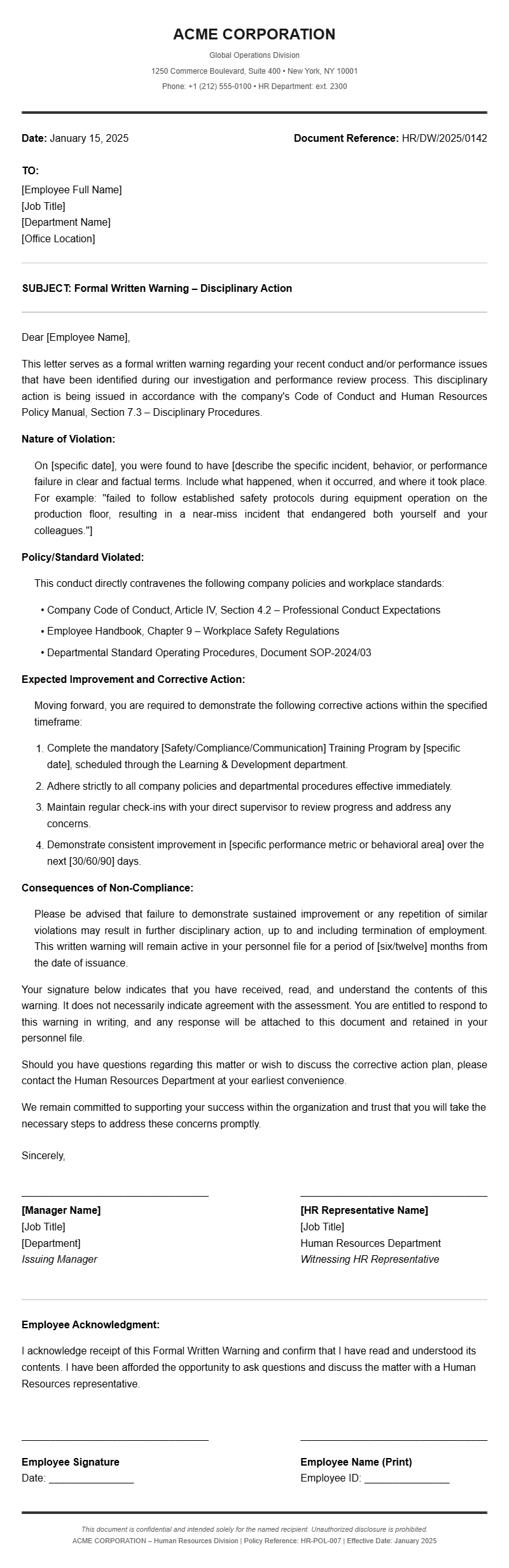
First Written Warning – Excessive Tardiness
Subject: First Written Warning – Excessive Tardiness
\n
Date: January 25, 2026
\n
To: [Employee Name] – [Employee ID]
\n
From: [Supervisor Name] – [Department Manager]
\n
CC: Human Resources Department
\n
\n
| Field | Details |
|---|---|
| Incident Date(s) | January 12, 15, and 22, 2026 |
| Time of Arrival | Between 9:15 am – 9:40 am |
| Policy Violated | Employee Handbook, Section 4.2 – Punctuality |
| Witnesses | Team Lead J. Doe, HR Representative L. Smith |
\n
\n
Dear [Employee Name],
\n
This letter serves as a formal first warning regarding repeated tardiness that has impacted team operations. Our records indicate that you arrived late on three occasions within a thirty‑day period, contrary to the company’s expectation that all employees be present at the scheduled start time.
\n
Expected Improvement:
\n
- \n
- Begin each workday no later than the scheduled start time.
- Notify your supervisor at least 30 minutes in advance if a delay is unavoidable.
- Maintain a punctuality record of at least 95 % for the next three months.
\n
\n
\n
\n
Consequences:
\n
Failure to meet the above expectations may result in further disciplinary action, up to and including termination of employment.
\n
Please sign the acknowledgment below and return it to Human Resources by January 30, 2026. If you have questions, contact the HR department directly.
\n
\n
Sincerely,
\n
[Supervisor Name]
[Title] – [Department]
\n
\n
Acknowledgment:
\n
I, ________________________, acknowledge receipt of this warning and have discussed it with my supervisor.
\n
Employee Signature: ________________________ Date: ________________________
First Written Warning – Insubordination
Subject: First Written Warning – Insubordination
\n
Date: February 2, 2026
\n
To: [Employee Name] – [Employee ID]
\n
From: [Manager Name] – [Department]
\n
CC: Human Resources Department
\n
\n
| Field | Details |
|---|---|
| Incident Date | January 28, 2026 |
| Incident Description | Refused to follow a direct instruction from the supervisor to complete a required safety check before operating equipment. |
| Policy Violated | Employee Handbook, Section 5.1 – Obedience to Supervisors |
| Witnesses | Supervisor R. Patel, Colleague A. Jones |
\n
\n
Dear [Employee Name],
\n
This letter constitutes a formal first warning for insubordination. On the cited date, you deliberately ignored a lawful and reasonable instruction from your supervisor, which compromised both personal safety and operational compliance.
\n
Expected Improvement:
\n
- \n
- Comply promptly with all legitimate directives from supervisory staff.
- Seek clarification through the proper channel if you believe an instruction is unsafe or unclear.
- Complete any required safety training within the next 30 days.
\n
\n
\n
\n
Consequences:
\n
Any recurrence of similar behavior may result in a second warning, suspension, or termination, depending on the severity of the incident.
\n
Please sign the acknowledgment below and return it to Human Resources by February 9, 2026. If you have concerns about this warning, discuss them with your manager or HR.
\n
\n
Sincerely,
\n
[Manager Name]
[Title] – [Department]
\n
\n
Acknowledgment:
\n
I, ________________________, acknowledge receipt of this warning and have discussed it with my supervisor.
\n
Employee Signature: ________________________ Date: ________________________