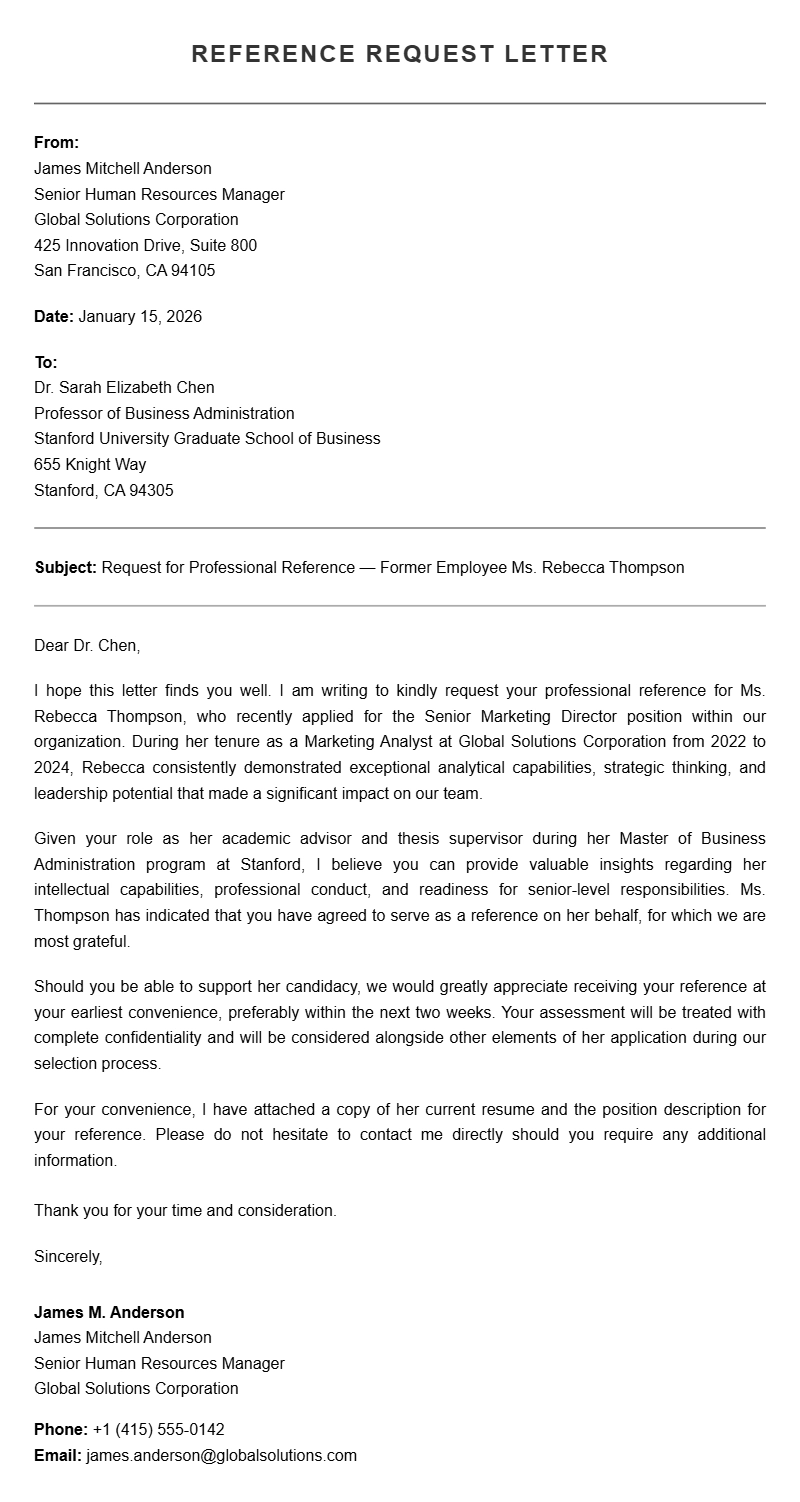
When you’re job hunting or applying to graduate programs, asking someone to vouch for your abilities can feel awkward—especially if you’re not sure how to frame the request. A reference request letter gives you a professional way to ask contacts to support your application. Getting this right matters because referees who feel respected and informed write stronger, more specific recommendations. Below, you’ll find practical guidance, real-world examples, and editable templates you can adapt in minutes.
What Is a Reference Request Letter?
A reference request letter is a note you send to a former manager, professor, colleague, or client asking them to serve as a reference for a job or academic opportunity. Unlike a simple verbal ask, this letter provides context about the role you’re pursuing, highlights specific experiences you’d like them to address, and sets clear expectations about timelines. It makes the referee’s job easier, which usually results in a better reference for you.
These letters typically go to people who already know your work well. You might request references from supervisors you’ve reported to, professors who supervised research projects, or clients who can speak to your professional skills. The goal is to make it effortless for them to say yes and to give them what they need to write something genuine and helpful.
When Do You Need One?
You’ll typically send a reference request letter in a few specific situations. First, when applying for a new job and the employer asks for professional references, you need to confirm each person’s willingness and provide them with relevant details. Second, when applying to graduate school or professional programs that request recommendation letters from mentors or supervisors. Third, when pursuing promotions, certifications, or other opportunities where third-party endorsement strengthens your application.
You don’t need one for every job application—some positions don’t require references at the initial application stage. Wait until an employer specifically requests them, or until you’ve identified the strongest contacts to approach. Asking too early in the process puts unnecessary pressure on your references and yourself.
Key Components of an Effective Reference Request
Every strong reference request includes several essential elements. Leaving these out means your contact might decline or submit a vague, unhelpful reference.
- Polite opening: Acknowledge that you’re asking for a favor and express appreciation for their time.
- Context about the opportunity: Describe the role, organization, and why you’re interested so your reference can tailor their comments.
- Specific experiences to highlight: Remind them of particular projects, achievements, or qualities they witnessed firsthand.
- Timeline and process: Tell them when the reference is due and how it will be submitted (online form, email, etc.).
- Contact information and willingness check: Give them a way to reach you and make it clear they can decline if the timing doesn’t work.
A reference request that includes these elements shows respect for your contact’s time and sets everyone up for success.
Step-by-Step Writing Guide
Here’s how to craft a reference request that gets positive responses.
Step 1: Choose the right people. Before writing anything, confirm that your potential references are comfortable recommending you and have enough recent context about your work. A reference from five years ago who barely remembers you won’t write a strong letter.
Step 2: Personalize for each contact. Even if you’re applying to similar positions, avoid sending identical letters. Reference specific projects you worked on together or qualities that make each person particularly relevant to your application.
Step 3: Provide context about the role. Include the job title, company description, and a few key qualifications you’re highlighting. This helps your reference connect their knowledge of you to what the employer is looking for.
Step 4: Mention specific examples. If you led a successful product launch under a professor’s supervision, remind them. If you improved a client’s workflow as a consultant, bring it up. These details make recommendations concrete rather than generic.
Step 5: Clarify logistics. State the deadline, submission method, and whether they need to complete a form, write a letter, or simply respond to a phone call. The easier you make this, the better.
Step 6: Express gratitude and offer reciprocity. Thank them sincerely and let them know you’re happy to help them in return. This keeps the relationship mutually beneficial.
Reference Request Letter Templates
Below are three templates you can customize for different situations. Replace the bracketed text with your specific details.
Template 1: Professional Reference for a Job Application
Dear [Manager’s Name],
I hope you’re doing well. I’m currently applying for [Job Title] positions at [Company Name or Industry], and I’m reaching out to ask if you’d be willing to serve as a professional reference for me.
I’m particularly interested in roles that build on my experience with [specific skill or project you worked on together]. Since you supervised my work on [project name], I believe you could speak to my abilities in [relevant area] and my approach to [relevant work style or value].
If you’re able to help, the employer typically requests references through [email/online form/another method] within the next [timeframe]. I can send you the job description and any other details that would be helpful.
Of course, if this timing doesn’t work for you, I completely understand. Please let me know either way, and thank you for considering my request.
Best regards,
[Your Name]
[Phone Number]
[Email Address]
Template 2: Academic Reference for Graduate School
Dear [Professor’s Name],
I’m writing to ask if you’d be willing to write a letter of recommendation supporting my application to [Program Name] at [University]. I’ve really valued my time in your [course name or research project], and I think you could speak to my readiness for advanced study in [field].
The program focuses on [brief description], and I’m hoping to [specific career or research goal]. I’d love for your letter to address my [analytical skills/research experience/ability to work independently]—areas where you saw my work firsthand.
The application deadline is [date], and recommendations are submitted through [portal URL or email]. I’ve attached my resume and a copy of my statement of purpose for your reference.
I’m grateful for your consideration and happy to meet to discuss further if that would be helpful. Thank you for your time.
Sincerely,
[Your Name]
[Student ID or Program]
[Email Address]
Template 3: Client Reference for Freelance or Consulting Work
Hi [Client Name],
I’ve enjoyed working with you on [project description], and I wanted to update you on my plans. I’m pursuing new opportunities and would appreciate your support as a professional reference.
If you’re comfortable vouching for my work, prospective clients often ask about my ability to [specific skill—deadline management, creative problem-solving, client communication]. Your experience working with me on [specific deliverable] would be relevant here.
Would you be open to receiving a call or email from someone inquiring about my recent consulting work? If so, I’ll send over details when I have a specific request. And if now isn’t a good time, please just let me know—I’m happy to connect with you later.
Thanks so much for the great working relationship we’ve built.
Best,
[Your Name]
Common Mistakes to Avoid
Many reference requests fall flat because of avoidable errors. Here’s what to watch out for:
Being vague about the role. Saying “I’m applying for some opportunities and need a reference” wastes your contact’s time. They can’t tailor their recommendation if they don’t know what you’re targeting.
Forgetting to ask permission. Never list someone as a reference without asking first. They may have concerns about giving a strong recommendation, and you’d rather know before you’re mid-process.
Providing no context or reminders. If it’s been months or years since you worked together, don’t assume your contact remembers specific details. A quick summary helps them write a concrete, compelling letter.
Missing deadlines. Give your references at least two weeks’ notice when possible. Rushing them increases stress and reduces the quality of their input.
Not following up with gratitude. After the reference is submitted, thank your contact again. Let them know the outcome when possible—this strengthens your professional relationship for future needs.
Tips for Customizing Your Letter
The templates above work as starting points, but personalizing each letter makes a significant difference. Here are practical ways to tailor your requests:
Match the formality to the relationship. A former professor you worked with closely might appreciate a warmer, more conversational tone than a distant corporate manager. Gauge the relationship and adjust accordingly.
Reference recent accomplishments. If you’ve recently completed a notable project or achieved something relevant, mention it. This keeps your reference current and fresh.
Connect to the specific job requirements. Pull keywords from the job posting and subtly reference how your experience aligns. Your reference can then echo these points in their own letter.
Include supporting documents. Attaching your resume, the job description, or a personal statement gives your reference all the context they need in one place.
For more guidance on professional correspondence, you might find our articles on school volunteer letter samples and supplier to client letter templates helpful. These cover similar professional tones and structures you can apply here.
Final Thoughts
A well-crafted reference request respects your contact’s time while giving them the tools to write a strong, specific recommendation. Personalize each letter, provide clear context about the opportunity, and always give enough lead time. These small efforts often determine whether your reference is merely adequate or genuinely compelling.
Practical Document Examples