When you’re behind on your mortgage payments, the letters and documents you send to your lender can feel overwhelming. One of the most important documents you might need is a mortgage hardship letter—a personal letter explaining your financial difficulties to your loan servicer. Writing this letter from scratch is tough when you’re already stressed about money, which is why many people search for mortgage hardship letter templates to use as a starting point.
The good news is that you don’t need perfect writing skills to create an effective hardship letter. What matters most is honesty, clarity, and including the right information your lender needs to understand your situation. This guide walks you through everything you need to know about writing one, with practical examples and editable templates you can adapt to your circumstances.
What Is a Mortgage Hardship Letter?
A mortgage hardship letter is a written explanation you provide to your lender when you’re experiencing financial difficulties that affect your ability to make payments. It accompanies your application for mortgage assistance programs, loan modifications, forbearance, or other loss mitigation options.
Lenders don’t expect these letters to be polished essays. They want to understand what happened to you, how it impacted your finances, and what your current situation looks like. The letter gives your loan servicer human context behind the numbers in your financial statements.
When Would You Need a Hardship Letter?
You’ll typically need to write one of these letters when requesting:
- A loan modification to change your loan terms
- Forbearance or temporary payment relief
- A short sale to sell your home for less than you owe
- Deed in lieu of foreclosure
- Payment plans to catch up on missed payments
- Interest rate reductions or principal forgiveness programs
If you’ve recently lost income, faced unexpected medical bills, gone through a divorce, or dealt with any situation that created a significant financial burden, a hardship letter helps your lender understand you’re not simply choosing not to pay.
Key Components of an Effective Hardship Letter
Most lenders look for several specific elements when they review hardship documentation. Including these sections makes your letter more likely to support your case for assistance.
1. Opening Statement
Start by identifying yourself and stating your intent clearly. Include your name, loan number (if known), and the type of assistance you’re requesting.
2. Explanation of the Hardship
Describe what caused your financial difficulties. Be specific about events and dates. Common reasons include job loss, reduced hours, medical emergencies, divorce, death of a co-borrower, or natural disasters.
3. Impact on Your Finances
Explain how the hardship affected your income and expenses. You don’t need to share every financial detail, but give your lender enough information to understand the scope of the problem.
4. Current Financial Situation
Describe where you are now financially. Are you currently employed? What income do you have coming in? What expenses do you have?
5. Your Request
Clearly state what type of assistance you’re asking for and why you believe it’s the right solution for your situation.
6. Commitment to the Property
If you want to keep your home, say so. Lenders want to know you’re motivated to resolve the situation and stay in the property if possible.
Step-by-Step Guide to Writing Your Hardship Letter
Here’s how to approach writing your letter, step by step.
Step 1: Gather Your Information
Before you start writing, collect the details you’ll need. Know the approximate dates when your hardship began, what event caused it, and your current income versus expenses. Having this information ready makes the writing process much smoother.
Step 2: Be Honest and Specific
Don’t exaggerate or invent hardships. Lenders often verify information, and dishonesty can disqualify you from assistance programs. At the same time, don’t minimize your struggles. If medical bills drained your savings, say so. If your hours were cut significantly, provide those numbers.
Step 3: Keep It Concise But Complete
Aim for one to two pages. Your lender reviews many of these letters, so respect their time by being thorough without being repetitive. Every paragraph should add new information or context.
Step 4: Focus on What They Need to Know
Write for your audience—your loan servicer. They need to understand the cause, timing, and impact of your hardship, plus your current situation and what you’re asking for. Avoid tangents about unrelated financial struggles or philosophical statements about the economy.
Step 5: Proofread Before Sending
Read your letter out loud before you send it. Catch spelling errors, awkward phrasing, and sentences that don’t make sense. If possible, have someone else read it too.
Mortgage Hardship Letter Templates
Below are several templates you can adapt for different situations. Fill in the bracketed information with your specific details.
Template 1: Job Loss or Reduction in Income
[Your Name]
[Your Address]
[City, State ZIP]
[Phone Number]
[Email Address]
[Date]
[Lender Name]
[Lender Address]
[City, State ZIP]
Re: Request for Mortgage Assistance – Loan Account #[Your Account Number]
Dear Loan Servicer,
I am writing to request mortgage assistance on my home at [Property Address]. My loan is currently in [ delinquent status/borrower’s current status], and I am seeking options to bring my account current.
In [month/year], I was [laid off from my position at (company name)/had my hours reduced from 40 to 25 per week]. This loss of income has made it impossible for me to continue making my mortgage payments of $[amount] per month. Since that time, I have been [actively job searching, working part-time, etc.].
My current household income is approximately $[monthly amount], which comes from [employment/ unemployment benefits/other sources]. My monthly expenses total approximately $[amount], leaving very little margin for housing costs.
I am requesting [a loan modification/forbearance/a payment plan] to help me [keep my home/get back on track]. I am committed to finding a solution and would like to discuss options that might work for my situation.
Please contact me at [phone number] or [email] to discuss available assistance programs. Thank you for your consideration.
Sincerely,
[Your Signature]
[Your Printed Name]
Template 2: Medical or Health-Related Hardship
[Your Name]
[Your Address]
[City, State ZIP]
[Phone Number]
[Email]
[Date]
[Lender Name]
[Lender Address]
[City, State ZIP]
Re: Hardship Request – Account #[Your Account Number]
Dear Sir or Madam,
I am writing to request consideration for mortgage assistance due to a serious medical situation. I own the property at [property address] and have a loan account ending in [last four digits].
In [month/year], I was diagnosed with [condition], which required [surgery/extended hospitalization/ongoing treatment]. I was unable to work for approximately [time period], resulting in a significant loss of income. Additionally, my medical expenses totaled over $[amount], depleting our savings and putting us behind on our mortgage.
Currently, I am [recovering/returning to work gradually]. My income has resumed at approximately $[monthly amount], but I am still working to catch up on missed payments while managing ongoing medical costs of $[amount] per month.
I am requesting a review of my loan for [forbearance/loan modification/other program] to help stabilize my finances. I want to keep my home and am committed to working with you to find a solution.
Please let me know what documentation you need from me and what options might be available. I can be reached at [phone] or [email].
Respectfully,
[Your Signature]
[Your Printed Name]
Template 3: Divorce or Separation
[Your Name]
[Your Address]
[City, State ZIP]
[Phone]
[Email]
[Date]
[Lender Name]
[Lender Address]
Re: Mortgage Assistance Request Due to Divorce – Account #[Your Number]
To Whom It May Concern,
I am requesting mortgage assistance for the property at [address]. My loan is currently delinquent, and the delinquency is the result of my divorce, which was finalized in [month/year].
Prior to the divorce, my spouse handled the mortgage payments. As part of the divorce settlement, I [received the property and now bear sole responsibility for payments/am in the process of selling the property]. Unfortunately, the transition has created financial strain as I adjust to a single income of approximately $[amount] per month.
My current monthly income is $[amount], and my essential expenses total approximately $[amount]. The difference makes it difficult to cover the mortgage payment of $[amount].
I am seeking [a loan modification with a lower payment/a temporary forbearance/a payment plan]. I am determined to maintain ownership of this property and believe I can do so with some temporary assistance while I stabilize my finances.
Please contact me to discuss available options. I can be reached at [phone] or [email].
Thank you for your time and consideration.
Sincerely,
[Your Signature]
[Your Printed Name]
Common Mistakes to Avoid
These errors can weaken your hardship letter or even result in your request being denied.
- Being vague about the hardship. Saying “I fell behind due to financial problems” doesn’t help your lender understand your situation. Be specific about what happened and when.
- Making excuses or blaming others. Focus on the facts of what happened, not on placing blame. Your lender wants to see that you’re taking responsibility and moving forward.
- Forgetting to include your account information. Your letter needs to be connected to your loan. Include your account number and property address prominently.
- Asking for a specific solution you may not qualify for. It’s fine to express a preference, but ask for a “review of available options” rather than demanding one specific program. Your lender will determine what you qualify for.
- Writing an overly emotional letter. While lenders understand these situations are stressful, focus on facts rather than emotional appeals. Show the logical case for why you need assistance.
- Sending it without supporting documents. Your hardship letter should be accompanied by proof of income, bank statements, and other financial documentation your lender requires.
Tips for Customizing Your Letter
Every financial situation is different. Here’s how to adapt these templates to your specific circumstances.
Be Specific About Numbers
If you can share concrete numbers without overwhelming your letter, do so. “My income dropped from $5,000 to $2,800 per month” is more helpful than “my income decreased significantly.”
Mention Future Plans
If your hardship is temporary, explain how you expect your situation to improve. If you recently started a new job, say when you began and what your expected income will be. This gives your lender confidence that assistance will result in successful repayment.
Include Relevant Dates
When did the hardship begin? When did you lose or regain income? Lenders look at timelines to understand whether your situation is likely to improve and how much assistance you might need.
Show You’re Acting Responsibly
If you’ve taken steps to reduce expenses, picked up additional work, or otherwise tried to improve your situation, mention this. It demonstrates to your lender that you’re committed to resolving the problem.
Match Your Letter to Your Request
If you’re asking for a short sale because you can no longer afford the home, be honest about that. If you’re requesting a loan modification because you believe you can afford the modified payment, focus on your commitment to staying in the home and your ability to make payments going forward.
What Happens After You Submit
After you send your hardship letter with supporting documentation, your loan servicer will review your request. This typically takes two to four weeks, though it varies by lender. During this time, avoid making late payments if possible and keep making whatever payments you can afford.
If approved, your lender will contact you with options. If denied, ask specifically why and whether you can provide additional documentation or appeal the decision. Some homeowners find it helpful to consult a HUD-approved housing counselor, who can review their situation and help them communicate more effectively with their servicer.
Final Thoughts
A mortgage hardship letter doesn’t need to be perfectly written—it needs to be honest, clear, and complete. Take your time with it, use the templates above as a starting point, and personalize them with your specific situation. The more your lender understands what you’re going through, the better they’ll be able to work with you toward a solution.
If you’re unsure what type of assistance to request, call your lender and ask what options are available based on your situation. Many servicers have programs specifically designed to help homeowners avoid foreclosure, and your letter is the first step in accessing those programs.
Document Structure & Example Models
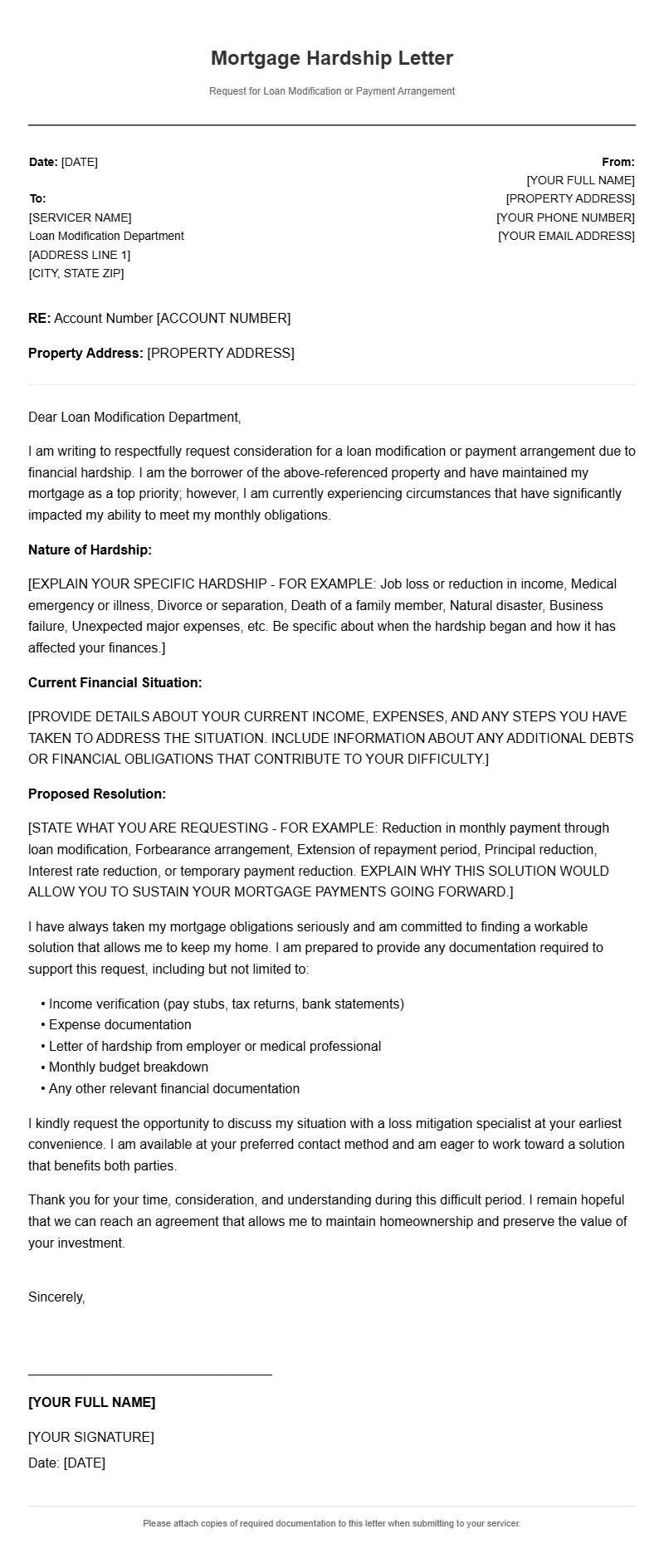
Mortgage Hardship Letter – Job Loss
Dear…