If you’re reading this, you’re probably dealing with something difficult right now. Maybe someone at work has been making your days unbearable, or perhaps your child is coming home upset because of what’s happening at school. Either way, you’re looking for a way to put it into writing, and that’s a smart move. A well-written complaint letter creates a paper trail that actually means something—whether you’re dealing with HR, school administration, or anyone else who needs to take action.
What Is a Bullying Complaint Letter?
A bullying complaint letter is a formal written document that describes specific incidents of harassment, intimidation, or abusive behavior and requests action from the appropriate authority. It’s not just a way to vent your frustrations—it’s a tool that helps the recipient understand exactly what happened, when it happened, and why it matters. The best complaint letters stick to facts while painting a clear picture of the situation.
This type of letter serves as the foundation for any formal investigation. Without a written record, verbal complaints often get lost in the shuffle or become a case of “he said, she said.” When you put it in writing, you’re creating something tangible that forces the recipient to acknowledge the issue and respond.
When Should You Use a Bullying Complaint Letter?
You should consider writing a complaint letter when the behavior you’re experiencing goes beyond occasional rudeness or one-time incidents. Documented, repeated patterns of bullying warrant a formal letter. Here are the situations where this approach makes the most sense:
- You’ve already tried speaking with the person directly and the behavior continues
- You’re reporting to HR, a manager, or school administration for the first time
- You need to create a legal record of the harassment
- The bullying has started affecting your work performance, attendance, or grades
- You want to request specific action like an investigation or mediation
If you’re not sure whether what you’re experiencing qualifies as bullying, think about whether you’d feel comfortable if someone else witnessed it. If the answer is no, that’s usually a sign the behavior crosses a line.
Key Components of an Effective Complaint Letter
Every strong complaint letter contains the same essential elements. Missing one of these pieces can weaken your case significantly.
The Header and Addressing
Your letter needs to be addressed to the right person and include the appropriate context. For workplace complaints, this typically means your HR department or direct supervisor. For school settings, it’s usually the principal or designated compliance officer. Include your own contact information so the recipient can follow up with you.
A Clear Subject Line or Opening
Get straight to the point. Something like “Formal Complaint Regarding Harassment by [Person’s Name]” tells the reader exactly what to expect. Don’t make them guess—busy HR managers and principals appreciate directness.
Specific Incident Details
This is the heart of your letter. For each incident you describe, include:
- The exact date and time
- Where it happened (specific location)
- What was said or done (use their exact words when possible)
- Who else was present
Vague descriptions like “they’re always making my life difficult” don’t help anyone. Specific, factual accounts give the recipient something concrete to investigate.
Impact Statement
Explain how the behavior has affected you. This could include decreased productivity, anxiety, missed workdays, or declining grades. Concrete impacts make the situation harder to dismiss.
Requested Action
State clearly what you’d like to happen next. Do you want an investigation? Mediation between you and the other party? A change in reporting structures? Be specific, but also be reasonable.
Step-by-Step Guide to Writing Your Letter
Here’s how to approach the actual writing process, starting with preparation and moving through to submission.
Step 1: Gather Your Materials First
Before you write a single word, collect everything you have. This includes incident dates you’ve tracked, any emails or messages that support your account, relevant policies from your employee handbook or student handbook, and names of potential witnesses.
Step 2: Draft a Rough Chronology
Write out all incidents in date order without worrying about polished language. Getting the timeline straight first makes the actual letter easier to write and ensures you don’t forget important details.
Step 3: Write the Opening Statement
State your purpose immediately. Something like: “I am writing to formally report ongoing harassment by my coworker, Jane Smith, which has occurred over the past three months and is negatively impacting my ability to work effectively.”
Step 4: Build the Body with Specific Incidents
Walk through your chronology, selecting the most significant examples. You don’t need to list every single incident—focus on patterns and the most egregious examples that illustrate the overall behavior.
Step 5: Describe the Impact
Connect the behavior to real consequences. Use specifics: “My sales numbers dropped 30% in Q3” or “I was absent six times last month, the most I’ve ever missed.”
Step 6: Request Specific Action
End with what you want to happen. “I request a formal investigation into this matter and a meeting to discuss potential solutions.”
Step 7: Review and Proofread
Read it aloud. Have someone else read it. Check for typos and make sure your tone stays professional even when describing frustrating situations.
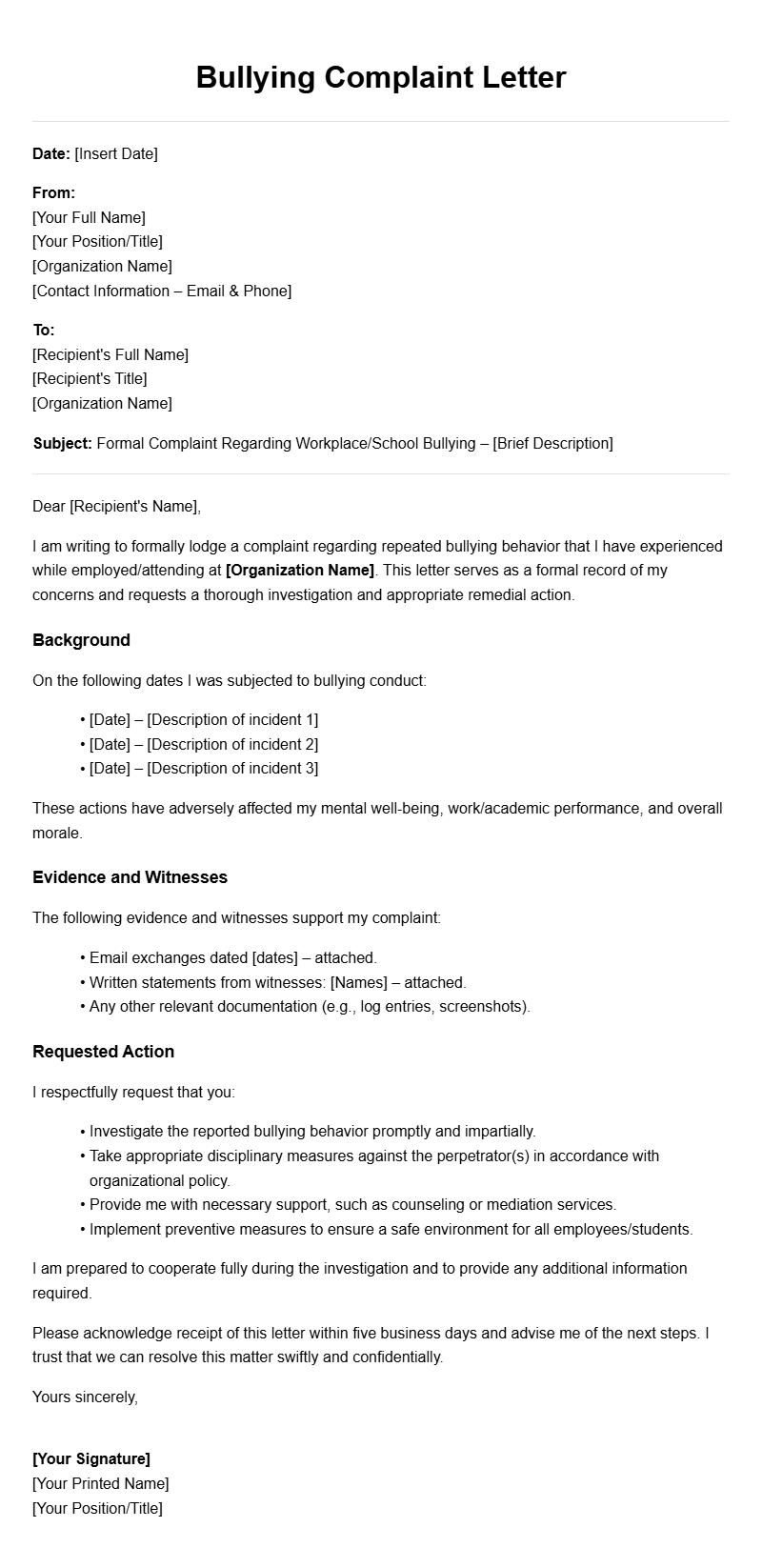
Editable Template Examples
Use these templates as starting points. Fill in your specific details and adjust the tone based on your situation.
Workplace Bullying Complaint Letter Template
Subject: Formal Complaint of Harassment – [Your Name]
To: [HR Manager Name or HR Department]
From: [Your Name]
Date: [Current Date]
Re: Formal Complaint Regarding Workplace Bullying
I am writing to formally report ongoing bullying behavior by [person’s name] in their role as [their position]. This behavior has been occurring since approximately [start date] and has significantly impacted my work environment and job performance.
The following incidents are examples of the pattern of behavior I am reporting:
Incident 1: On [specific date], at approximately [time], [describe exactly what happened—words used, actions taken, where it occurred]. [Witness names, if applicable] were present during this incident.
Incident 2: On [specific date], at approximately [time], [describe what happened].
Incident 3: On [specific date], [describe what happened].
As a result of this behavior, I have experienced [describe impacts: difficulty concentrating, decreased productivity, anxiety, physical symptoms, etc.]. I have also [if applicable: consulted with EAP, spoken with my supervisor, attempted to address directly].
I respectfully request that this matter be investigated promptly and that appropriate action be taken to ensure a safe working environment. I am available to discuss this further at your convenience and can be reached at [your contact information].
Thank you for your attention to this serious matter.
Sincerely,
[Your Name]
[Your Title]
[Employee ID, if applicable]
School Bullying Complaint Letter Template
To: [Principal’s Name or School Administrator]
From: [Parent/Guardian Name or Student Name]
Date: [Current Date]
Re: Formal Complaint Regarding Bullying of Student [Child’s Name]
I am writing to report bullying behavior directed at my child, [student’s name], who is in [grade level] at [school name]. This behavior has been ongoing since [approximate start date] and is affecting their academic performance and emotional wellbeing.
The following incidents illustrate the pattern we have observed:
Incident 1: On [date], during [time/period], [describe what happened—include exact words used by the bullies if known]. This occurred at [location]. Our child reported that [witnesses, if any] were present.
Incident 2: On [date], [describe the incident].
Incident 3: On [date], [describe the incident].
As a result of this treatment, our child has [describe impacts: declining grades, reluctance to attend school, anxiety, changes in behavior, etc.]. We have [if applicable: contacted the teacher, attempted to reach the other student’s parents, etc.].
We request that the school investigate this matter according to its anti-bullying policies and take appropriate action to protect our child. We have reviewed the school’s bullying policy [reference handbook/page number] and believe this situation meets the criteria outlined there.
We would appreciate a meeting to discuss this matter and review the steps the school will take. Please contact us at [your phone number] or [your email].
Sincerely,
[Your Name]
[Contact Information]
Common Mistakes to Avoid
These errors weaken complaints and sometimes cause them to be dismissed entirely.
- Using emotional language instead of factual descriptions: Saying “they’re a terrible person who enjoys making others suffer” feels cathartic but doesn’t help your case. Stick to describing what they did, not who they are.
- Being too vague: “They’ve been mean to me for months” gives the recipient nothing to act on. Dates, specific incidents, and concrete examples make your complaint credible.
- Including unverified claims: Only report what you witnessed personally or received directly. Don’t pass along secondhand gossip as fact.
- Waiting too long to document: Incidents fresh in your memory are more accurate. Waiting weeks or months to write your complaint makes it harder to recall specific details.
- Not following proper channels: Check your employee handbook or school handbook for the correct reporting procedure. Skipping steps can delay action.
- Threatening legal action in the letter: Save that card for later if needed. Opening with threats puts people on the defensive and reduces cooperation.
Tips for Customizing Your Letter
These adjustments help your letter feel genuine rather than like a generic form submission.
Match Your Environment
A complaint to a small nonprofit might be less formal than one to a large corporation. Use your workplace or school’s culture as a guide. When in doubt, err on the side of professionalism.
Reference Specific Policies
If you’ve reviewed your employee handbook or student code of conduct, mention it. Something like “According to Section 4.2 of the employee handbook, this behavior violates our workplace dignity policy” shows you’ve done your homework and strengthens your position.
Name Names Accurately
Double-check the spelling of every name you include. Using the wrong name for your harasser or the HR representative you spoke with creates unnecessary confusion.
Use Direct Quotes When Possible
If someone said something particularly damaging, quote them directly: “During our team meeting on March 15, my supervisor stated that I was ‘too stupid to handle this project.'” Direct quotes are powerful because they’re difficult to dispute.
Keep Your Tone Professional Throughout
Even if you’re furious about what’s happened, your letter shouldn’t show it. A measured, factual tone is more persuasive and harder to dismiss as an overreaction.
After You Submit Your Letter
Sending the letter is just the beginning. Take these steps to protect yourself going forward.
- Keep a copy of everything you submit, including delivery confirmation
- Follow up within the timeframe they indicate you should expect a response
- Document any incidents that occur after your complaint is filed
- Record names and dates of any conversations related to your complaint
- If you don’t receive a response, follow up with a brief email asking about the status
A well-crafted bullying complaint letter won’t automatically solve your problem, but it does put the wheels in motion. You’ve taken a difficult situation and turned it into something concrete that someone has to acknowledge and address. That takes guts. Whatever happens next, you’ve done your part to create a record and advocate for yourself or your child.
Document Examples & Template Samples