When a student, employee, or family member needs to miss school or work, a quick note explaining the absence often isn’t enough. Many institutions require a formal absence letter—a documented explanation that goes into records and serves as proof that the absence was legitimate. Whether you’re writing because of illness, a family emergency, or an approved appointment, having the right template saves time and ensures you hit all the necessary details.
The challenge most people face isn’t knowing what to say—it’s knowing how formal to be, what information to include, and how to structure it so it actually gets accepted without follow-up questions. This guide walks through everything you need, including ready-to-use templates you can adapt for your situation.
What Is A Class Absence Letter?
A class absence letter is a formal written explanation submitted to a school, college, or educational institution documenting why a student missed one or more classes. It differs from a casual text or email because it creates an official record. Schools use these letters to track attendance patterns, verify legitimate absences, and distinguish between excused and unexcused absences.
The letter typically comes from the student themselves, a parent or guardian (if the student is a minor), or occasionally a medical professional or employer if the absence relates to their services. Think of it as your documented explanation—something that sits in your file and protects you if attendance becomes an issue later.
Some institutions accept emails; others require printed, signed copies. Check your school’s attendance policy before submitting to know which format they prefer.
When You Need A Class Absence Letter
Not every missed class requires a formal letter. Most schools distinguish between absences that need documentation and those that don’t. You typically need a letter when:
- You’ve missed multiple consecutive days and the school requests an explanation
- The absence is due to illness and your school requires medical documentation
- You missed class for a legitimate reason (medical appointment, family emergency, court appearance) and want it marked as excused rather than unexcused
- Your attendance is already flagged and you need to explain specific absences
- You’re requesting an exception to attendance policy for a documented reason
- The school requires formal notice for planned absences (like a family trip)
If you’re unsure whether your situation requires a letter, ask your instructor, academic advisor, or the registrar’s office. It’s better to submit one than to have an absence counted against you unnecessarily.
Key Components Of An Effective Absence Letter
A solid absence letter includes specific information in a logical order. Here’s what should be there:
- Your identifying information—name, student ID, and the class or section number
- Date of the letter—when you’re writing it
- Specific date(s) of absence—exactly which class or classes you missed
- Clear reason—brief, honest explanation without oversharing personal details
- Supporting details if applicable—doctor’s note reference, appointment confirmation, or other relevant context
- Acknowledgment of the absence—show you understand the impact and take it seriously
- Your signature—handwritten if submitted in print, typed if email
The tone should be respectful and straightforward. You’re not apologizing excessively or making excuses—you’re providing factual information so the school can make an informed decision about how to mark your absence.
How To Write A Class Absence Letter Step By Step
Step 1: Start with proper formatting
Put your name and contact information at the top left, followed by the date. Skip a line, then add the recipient’s details (instructor name, department, or registrar’s office). Keep margins at one inch and use a readable font like Arial or Times New Roman at 11 or 12 point size.
Step 2: Use a professional greeting
Address the letter to the specific person if you know who reviews absences. If not, “Dear [Instructor Name]” or “To Whom It May Concern” works. Avoid casual greetings like “Hi” or “Hey.”
Step 3: State your purpose immediately
Open with a clear sentence: “I am writing to formally notify you of my absence from [class name/number] on [specific date].” Don’t bury the reason in a longer paragraph. Make it obvious what the letter is about in the first or second sentence.
Step 4: Explain the reason briefly
Provide enough detail so the school understands the absence was legitimate, but don’t overshare. “I was ill and unable to attend” is sufficient. You don’t need to describe symptoms. If it’s a medical appointment, you can mention “a scheduled medical appointment” without listing what kind. If it’s a family emergency, “a family emergency requiring immediate attention” is appropriate.
Step 5: Reference any supporting documentation
If you have a doctor’s note, work excuse, or other proof, mention it: “I am attaching a doctor’s note documenting this absence” or “A copy of my appointment confirmation is included with this letter.” This strengthens your credibility.
Step 6: Acknowledge responsibility and next steps
Show that you’re taking your attendance seriously. You might write: “I understand the importance of attendance and have already obtained notes from classmates for the material covered. I will complete any missed assignments by [date].” This tells the school you’re not using the absence as an excuse to fall behind.
Step 7: Close professionally
Use “Sincerely,” “Respectfully,” or “Thank you for your consideration,” followed by your full name. If printing, leave space for your handwritten signature above your typed name.
Class Absence Letter Templates You Can Use
Template 1: General Illness Absence
Use this when you were sick and missed one or more classes:
[Your Name]
[Your Address]
[Your Email]
[Your Phone Number]
[Date]
[Instructor Name]
[Department/Course Number]
[School Name]
[School Address]
Dear [Instructor Name],
I am writing to formally notify you of my absence from [Course Name/Number] on [date(s)]. I was unable to attend due to illness and have attached a doctor’s note documenting my medical condition during this period.
I understand the importance of regular attendance and have already connected with classmates to obtain notes from the lectures I missed. I will complete any assigned work by [specific date] and am prepared to discuss any material I need to review.
Thank you for your understanding.
Sincerely,
[Your Name]
Template 2: Medical or Dental Appointment
Use this for a scheduled appointment you couldn’t avoid:
[Your Name]
[Your Address]
[Your Email]
[Your Phone Number]
[Date]
[Instructor Name]
[Department/Course Number]
[School Name]
[School Address]
Dear [Instructor Name],
I am writing to notify you of my absence from [Course Name/Number] on [date]. I had a scheduled medical appointment that could not be rescheduled and required me to miss class that day.
I have attached a copy of my appointment confirmation as documentation. I will ensure that I obtain all materials and notes from class and will not fall behind on upcoming assignments.
I appreciate your understanding.
Sincerely,
[Your Name]
Template 3: Family Emergency or Urgent Matter
Use this when circumstances beyond your control required your immediate attention:
[Your Name]
[Your Address]
[Your Email]
[Your Phone Number]
[Date]
[Instructor Name]
[Department/Course Number]
[School Name]
[School Address]
Dear [Instructor Name],
I am writing to formally notify you of my absence from [Course Name/Number] on [date(s)]. Due to a family emergency that required my immediate attention, I was unable to attend class.
I understand this was an unplanned absence and appreciate your consideration. I am committed to staying current with coursework and will reach out if I need any clarification on material covered during my absence.
Thank you for your understanding.
Sincerely,
[Your Name]
Template 4: Multiple Absences With Documentation
Use this when you’ve been absent for several days and have supporting documentation:
[Your Name]
[Your Address]
[Your Email]
[Your Phone Number]
[Date]
[Instructor Name / Registrar’s Office]
[Department]
[School Name]
[School Address]
Dear [Recipient],
I am writing to request that my absences from [Course Name/Number] on [dates] be marked as excused. I was absent due to [brief reason: illness/medical treatment/family emergency], and I have attached supporting documentation including a doctor’s note dated [date].
I recognize the impact of these absences on my coursework and have taken steps to catch up. I have reviewed all lecture notes, completed outstanding assignments, and met with [instructor name/tutor] to ensure I understand the material covered during my absence.
I appreciate your consideration of this request and my commitment to maintaining good attendance going forward.
Sincerely,
[Your Name]
Student ID: [Your ID]
Common Mistakes To Avoid
Being too vague about the reason
Don’t write “I had personal reasons” or “something came up.” Schools need to understand whether the absence was legitimate. Be specific enough that they can categorize it properly—illness, appointment, emergency, etc.
Writing too much detail or oversharing
The opposite problem: don’t describe your symptoms in graphic detail or share deeply personal family information. Keep it factual and professional. “I was ill” is enough; “I had severe stomach issues and couldn’t leave the bathroom” is too much.
Submitting the letter too late
Send your absence letter within 48 hours of returning to class, or follow your school’s specific timeline. Waiting weeks to explain an absence looks suspicious and may not be accepted.
Forgetting to include specific dates
Don’t write “I was absent last week.” Write “I was absent on Monday, October 14 and Tuesday, October 15.” Vague dates make it harder for the school to verify and mark your absence correctly.
Not including identifying information
Always include your full name, student ID, and the specific class or section number. Without this, your letter might get lost or attached to the wrong student’s file.
Making excuses or over-apologizing
You’re not asking for forgiveness; you’re providing documentation. Avoid language like “I’m so sorry for being irresponsible” or “I feel terrible about this.” Stay neutral and factual. You can acknowledge the absence without excessive apology.
Submitting without proof when proof exists
If you have a doctor’s note, appointment confirmation, or other documentation, include it or reference it clearly. Schools are more likely to accept absences when there’s supporting evidence.
Tips For Customizing Your Letter
Check your school’s attendance policy first
Different institutions have different requirements. Some want letters emailed to instructors; others want them submitted to a registrar’s office or attendance coordinator. Some require specific forms instead of letters. Knowing the process saves you from submitting something in the wrong format.
Use the instructor’s preferred contact method
If your syllabus lists an email address, use that. If the school has an online portal for attendance issues, use that. Respect how they prefer to receive communications.
Adjust tone based on your school’s culture
A large university registrar’s office expects a more formal letter. A small classroom with an instructor you know well can be slightly less formal, though still professional. Read the room and adjust accordingly.
Keep it to one page
Your absence letter should be concise—typically three to five short paragraphs. Schools don’t need a lengthy explanation. Get to the point, provide necessary details, and close.
Personalize the template with actual details
Don’t submit a template that still has brackets like [Your Name]. Fill in every detail completely. This shows you took the time to do it properly, not that you copied and pasted without thinking.
Proofread before submitting
A letter with spelling or grammar errors looks careless and undermines your credibility. Read it aloud, check for typos, and have someone else review it if possible. A simple error can make an otherwise legitimate absence seem less credible.
Keep a copy for your records
If you print and deliver the letter, make a photocopy. If you email it, save the sent message. You may need proof later that you submitted the letter if there’s a discrepancy in your attendance record.
What If Your School Uses An Online Attendance System?
Many schools now use learning management systems like Canvas, Blackboard, or Brightspace where you can report absences directly. If your school offers this option, use it—it’s often faster than a written letter and creates an automatic timestamp. However, you may still need to follow up with a formal letter if the system doesn’t allow you to upload supporting documentation like a doctor’s note.
Check whether your school requires both the online report and a formal letter, or if one is sufficient. When in doubt, contact your academic advisor or the registrar’s office.
Absence Letters For Different Situations
If you’re handling an attendance warning letter, the tone shifts slightly—you’re responding to a formal concern rather than simply reporting an absence. That requires more detail about how you plan to improve attendance going forward.
For other professional or formal situations, you might need different types of letters. For example, if you’re relocating and need to notify people of your new situation, an office relocation notice letter follows similar formatting principles but serves a different purpose.
The core principles of clear communication, specific details, and professional tone apply across all formal letters. Whether you’re explaining a class absence or handling other institutional communication, the structure remains consistent.
When To Escalate Beyond A Simple Letter
If you’re repeatedly absent and a single letter isn’t resolving the issue, you may need to meet with your academic advisor or dean of students. Some situations—chronic illness, mental health challenges, or significant family issues—require more support than a letter can provide. Schools often have resources like medical leaves of absence or accommodations for students facing ongoing challenges.
If your absences are due to work conflicts or other ongoing issues, address this proactively with your instructor or academic advisor rather than submitting letter after letter. They can often help you find solutions like changing sections, adjusting deadlines, or accessing other support.
Final Thoughts
A well-written absence letter takes 15 minutes and protects your academic record. The key is being specific about dates, clear about your reason, and professional in tone. Use the templates provided, customize them with your actual information, and submit promptly with any supporting documentation you have. Most schools are reasonable about legitimate absences—they just need documentation to verify them. Keep it simple, keep it honest, and you’ll have an absence properly recorded instead of marked as unexcused.
Ready-to-Use Document Samples
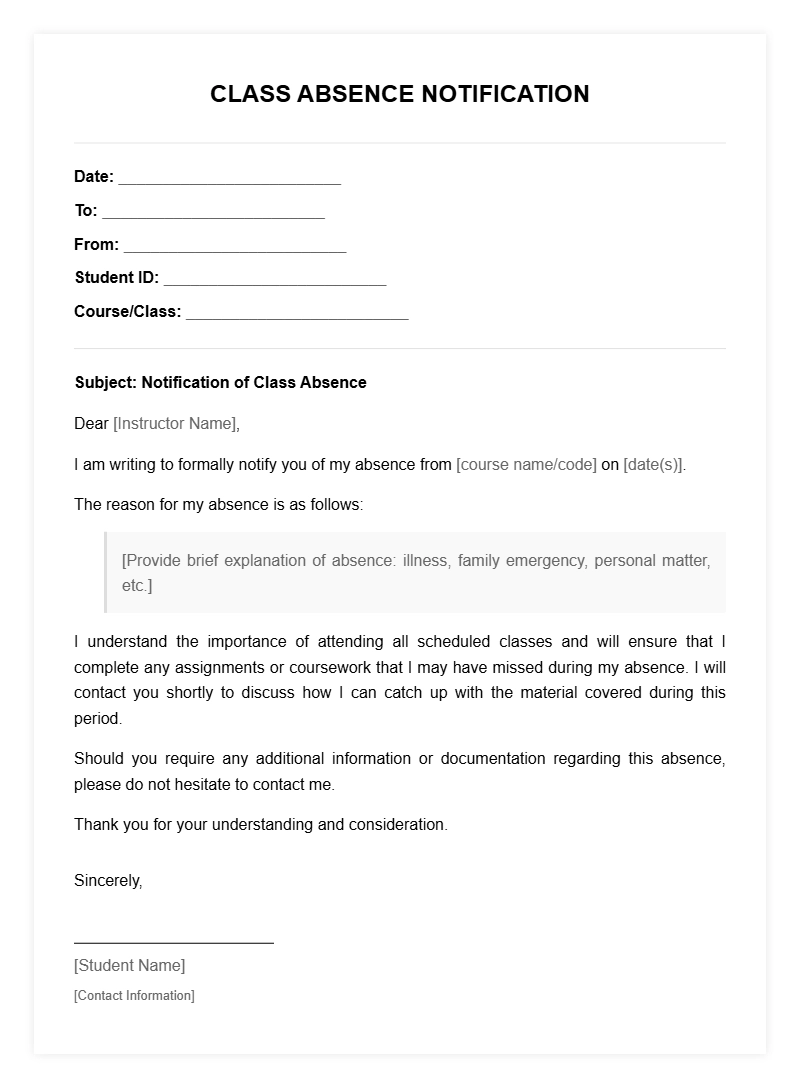
Student Medical Absence Letter
Dear [Instructor Name],
I am writing to inform you of my absence from [Course Name] on [Date]. Due to a medical appointment that could not be scheduled outside of class hours, I was unable to attend the lecture.
I have obtained the necessary documentation from my healthcare provider and am attaching it to this letter for your records. I understand the importance of regular attendance and have made arrangements to obtain class notes from a classmate and review any materials posted on the course portal.
Should there be any assignments or announcements I missed during this session, please let me know at your earliest convenience. I am committed to keeping up with the coursework and will complete any work assigned during my absence within the agreed timeframe.
Thank you for your understanding and consideration regarding this matter.
Sincerely,
[Student Name]
[Student ID]
[Contact Information]
Family Emergency Class Absence Notice
Dear [Teacher/Professor Name],
I am writing to formally notify you of my absence from [Subject/Course] on [Date(s)]. An unexpected family emergency required my immediate attention, and I was unable to attend class.
The situation has since been resolved, and I have now returned to my regular schedule. I understand that this absence may have resulted in missed lessons and assignments. I would appreciate receiving information about:
- Key topics covered during the missed session
- Any homework or projects assigned
- Upcoming deadlines relevant to my coursework
- Whether additional support or tutoring is recommended
I am fully committed to catching up on the material and will contact you within the next two days to discuss how I can best make up the work. Please advise on the most convenient time for you to discuss this matter.
Thank you for your understanding during this difficult time.
Best regards,
[Name]
[Class/Course Code]
Work Commitment Class Absence Letter
Dear [Instructor Name],
I am writing to request acknowledgment of my absence from [Course Name] on [Date]. Due to an unexpected work commitment that required my presence during class hours, I was unable to attend.
I recognise that balancing employment with academic responsibilities can be challenging, and I take my studies seriously. I have taken the following steps to minimise the impact of my absence:
- Notified my employer in advance about my academic commitments to prevent future conflicts
- Reviewed the course syllabus to identify the topics covered during my absence
- Connected with classmates to obtain comprehensive notes
- Reviewed all posted materials and supplementary resources
If there were any quizzes, tests, or significant assignments due on that date, please inform me of the procedure for making up this work. I am available to discuss any concerns regarding attendance patterns and would welcome suggestions on how to better manage my schedule.
Thank you for your consideration.
Respectfully,
[Student Name]
[Contact Details]
Mental Health Day Absence Letter
Dear [Professor/Teacher Name],
I am writing to inform you of my absence from [Course Name] on [Date]. I took this day to prioritise my mental health and wellbeing, which I recognise as essential to my academic success and overall performance.
I have reviewed the course materials available online and connected with peers to understand what was covered during my absence. I am fully aware of any upcoming assessments or deadlines and have planned my schedule accordingly to complete all outstanding work.
I believe that taking proactive steps to manage my mental health enables me to engage more effectively with my studies. Should you require any documentation or wish to discuss academic accommodations that might support my ongoing success in this course, I am happy to arrange a meeting at your convenience.
I remain committed to maintaining good attendance going forward and appreciate your understanding regarding this matter.
Sincerely,
[Student Name]
[Student ID]
[Email Address]
Scheduled Court Appearance Absence Letter
Dear [Instructor Name],
I am writing to formally notify you of my absence from [Course/Class] on [Date] due to a scheduled court appearance. This is a legal obligation that I cannot defer or reschedule.
I have attached a copy of the court notice to this letter as documentation. I understand the importance of regular class attendance and have made comprehensive arrangements to stay current with the course material:
| Action Taken | Details |
|---|---|
| Notes | Arranged with [Classmate Name] to provide detailed notes |
| Materials | Will review all posted slides and readings |
| Assignments | Will submit any work by the original deadline |
| Follow-up | Available to discuss any missed content |
Please let me know if there are any specific requirements or procedures I should follow regarding this absence. I appreciate your understanding and cooperation.
Yours sincerely,
[Name]
[Contact Information]
University Sporting Event Absence Letter
Dear [Course Instructor],
I am writing to inform you of my absence from [Course Name] on [Date]. I will be representing the university at [Sporting Event/Competition], which has been approved by the university athletics department.
I have attached the official documentation from the athletics office confirming my participation and the dates of the event. To demonstrate my commitment to maintaining academic progress, I have:
- Completed all assigned readings in advance
- Submitted any work that was due before my absence
- Arranged with a classmate to record the lecture or collect detailed notes
- Reviewed the course syllabus to identify key topics that will be covered
- Scheduled time to review all materials immediately upon my return
I understand that representing the university is a privilege and comes with the responsibility to remain academically engaged. I am committed to ensuring that this absence does not negatively impact my academic standing or performance in this course.
If you have any concerns or require additional information, please do not hesitate to contact me.
Thank you for your consideration.
[Student Name]
[Student ID]
Bereavement Absence Letter
Dear [Instructor Name],
I am writing to inform you of my absence from [Course Name] on [Date(s)] due to the death of [Relationship to Deceased]. I am currently grieving this loss and am unable to focus on academic work at this time.
I have included a copy of the death notice with this letter for your records. I understand that this is a significant absence and am committed to fulfilling all academic obligations. However, I may require some flexibility with deadlines over the coming weeks as I navigate this difficult period.
I will contact you within [timeframe] to discuss the following:
- Specific assignments I missed during my absence
- Possible extensions on upcoming work, if necessary
- Any support services available through the university
- A realistic timeline for catching up on coursework
I appreciate your compassion and understanding during this time of loss. I remain committed to my studies and will make every effort to stay on track with the course requirements.
Respectfully,
[Student Name]
[Contact Information]
Doctor's Appointment Absence Letter
Dear [Teacher/Professor Name],
I am writing to notify you of my absence from [Subject/Course] on [Date]. I had a scheduled appointment with my healthcare provider that could not be rescheduled to accommodate class hours.
I am attaching the appointment confirmation from my doctor’s office as documentation of this absence. I have taken the following measures to ensure I do not fall behind:
- Reviewed the course schedule to understand the topic covered
- Downloaded all available lecture materials from the course portal
- Requested notes from a classmate who attended the session
- Noted any announcements or assignments I may have missed
If there are any in-class quizzes or important assessments that took place during my absence, please advise me on the procedure for making up this work. I am available to meet with you during office hours if you would like to discuss any concerns.
Thank you for your understanding and support.
Sincerely,
[Name]
[Class Code]
[Phone Number]
Extended Illness Absence Letter
Dear [Instructor Name],
I am writing to inform you that I have been absent from [Course Name] on [Dates] due to a significant illness. I have been under medical care and was advised by my healthcare provider to rest and recover before returning to my normal activities.
I have attached medical documentation confirming my illness and the recommended period of absence. I recognise that this extended absence may impact my understanding of recent course material and my ability to complete certain assignments on schedule.
I would like to schedule a meeting with you to discuss the following:
| Topic | Details Required |
|---|---|
| Missed Content | Summary of key topics and readings |
| Assignments | List of work due during my absence |
| Assessments | Information about upcoming tests or exams |
| Accommodations | Possible deadline extensions or support |
I am committed to catching up on all missed work and maintaining my academic progress. Thank you for your patience and support during my recovery.
Best regards,
[Student Name]
[Student ID]
Transportation Issue Absence Letter
Dear [Course Instructor],
I am writing to notify you of my absence from [Course Name] on [Date]. Due to unexpected transportation difficulties, I was unable to reach campus in time for class. Despite making every effort to arrange alternative transport, I was unable to attend the session.
I understand that attendance is important and take my academic responsibilities seriously. This situation was beyond my control, and I have already taken steps to prevent similar occurrences in the future, including:
- Arranging a backup transportation method for future use
- Adjusting my commute schedule to include additional travel time
- Identifying alternative routes to campus
I have accessed the course materials online and obtained notes from classmates regarding the content covered during my absence. If there were any in-class activities, discussions, or assessments that I missed, please provide details so I can address any gaps in my learning.
I appreciate your understanding regarding this one-time occurrence and assure you that I am committed to maintaining consistent attendance going forward.
Sincerely,
[Student Name]
[Contact Details]