A principal recommendation letter is one of the most important documents a student can collect during their academic journey. Whether you’re applying to colleges, graduate programs, scholarships, or competitive high schools, a strong letter from your principal carries real weight. The challenge is that many principals write dozens of these letters each year, so your job is to make it easy for them to write something meaningful about you—and to give them the right template or framework to work from.
This guide walks you through what a principal recommendation letter actually is, when you need one, what makes it effective, and how to approach the process so you get a letter that genuinely supports your application.
What Is A Principal Recommendation Letter?
A principal recommendation letter is a formal document written by a school principal on your behalf. It’s typically addressed to an admissions committee, scholarship board, or hiring organization and speaks to your character, academic performance, leadership, and overall contribution to the school community.
Unlike a teacher recommendation letter, which focuses on classroom performance and subject-specific strengths, a principal’s letter offers a broader institutional perspective. The principal has observed you across multiple contexts—assemblies, discipline records, extracurricular involvement, interactions with staff, and overall school culture fit. This gives their endorsement a different kind of credibility.
The letter is usually one to two pages, written on official school letterhead, and signed by the principal. It becomes part of your formal application materials and is typically submitted directly to the receiving institution.
When Do You Need A Principal Recommendation Letter?
You’ll typically need a principal recommendation letter in these situations:
- College or university applications (especially for competitive schools)
- Graduate school or professional program applications
- Scholarship applications
- Private school admissions
- International school applications
- Leadership program or honors program applications
- Employment applications for professional positions
- Transfer applications between schools
Some applications specifically request a recommendation from school administration rather than teachers. When they do, that’s your signal to approach the principal rather than settling for another teacher letter.
Key Components Of A Strong Principal Recommendation Letter
A well-structured principal recommendation letter includes these essential elements:
Opening Paragraph
The principal introduces you by name, your grade level or position, and the length of time they’ve known you. They also state the purpose of the letter clearly—what position or program you’re applying for.
Academic Performance And Intellectual Engagement
This section covers your grades, course rigor, classroom participation, and intellectual curiosity. It’s not just about being a good student; it’s about how you approach learning and challenges.
Character And Personal Qualities
Here the principal speaks to your integrity, reliability, work ethic, and how you treat others. This is where they mention specific incidents or observations that reveal who you are as a person.
Leadership And Contribution To School Community
This addresses your involvement in clubs, sports, volunteer work, student government, or other activities. It shows how you’ve made the school better and influenced peers positively.
Specific Examples And Anecdotes
Rather than generic praise, strong letters include concrete moments—a time you showed resilience, helped a struggling peer, overcame an obstacle, or demonstrated maturity and judgment.
Comparison To Peers
Many principals include context about where you stand relative to other students they’ve worked with. This helps admissions committees understand your standing in your class or school.
Closing Statement
The letter ends with a clear endorsement and an invitation for the recipient to contact the principal with questions. The tone should be warm but professional.
How To Request A Principal Recommendation Letter
Asking for a recommendation letter the right way matters. Principals are busy, and a thoughtful request gets a better response than a last-minute ask.
Make The Request In Person Or Via Email
Don’t assume the principal will write your letter just because you ask. Schedule time to speak with them directly, or send a professional email explaining what you need. Face-to-face is always stronger because it gives them a chance to ask questions and shows you’re serious.
Give Plenty Of Notice
Request your letter at least three to four weeks before your deadline. If you’re applying to multiple schools, mention that upfront so the principal can write a general letter that works across applications.
Provide Context And Materials
Don’t expect the principal to remember everything about you. Provide a brief one-page summary that includes:
- Your full name and grade
- The schools or programs you’re applying to
- Application deadlines
- Key achievements, awards, or activities relevant to the application
- Your GPA, test scores, or other relevant metrics
- A short paragraph about why you’re interested in the program or school
- Any personal challenges you’ve overcome or unique circumstances they should know about
Make Submission Easy
Provide the principal with specific instructions on where and how to submit the letter. If it’s an online portal, walk them through it. If it needs to be mailed, provide the address and deadline. The easier you make it, the more likely they’ll complete it on time.
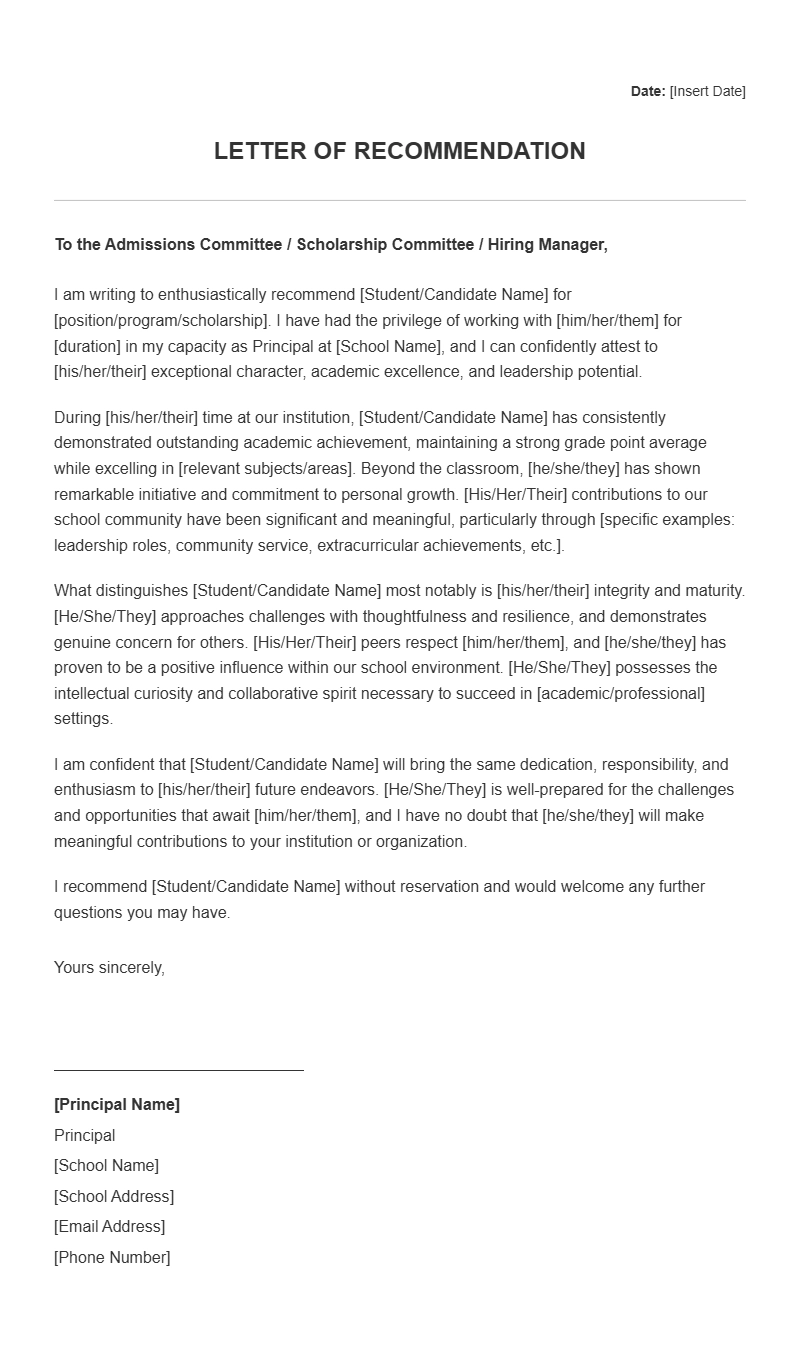
Principal Recommendation Letter Template
Here’s a template that principals can use as a starting point. It’s structured to hit all the key elements while allowing for personalization:
[School Letterhead]
[Date]
[Admissions Committee/Scholarship Committee/Recipient Name]
[Institution Name]
[Address]
Dear [Committee Name/Recipient]:
I am writing to enthusiastically recommend [Student Name] for [Program/Position/School Name]. [He/She/They] has been a student at [School Name] for [number] years, and I have had the privilege of knowing [him/her/them] both in the classroom and throughout our school community.
[Student Name] is an exceptional student with a genuine commitment to academic excellence. In [his/her/their] time here, [he/she/they] has maintained a [GPA] while taking [challenging courses/AP classes/honors courses]. What sets [him/her/them] apart is not just [his/her/their] strong grades, but [his/her/their] genuine curiosity and willingness to engage deeply with difficult material. [He/She/They] has demonstrated this through [specific example—a project, research, contribution to class discussion].
Beyond the classroom, [Student Name] has shown remarkable character and integrity. [He/She/They] is reliable, respectful, and genuinely considerate of others. [Include specific anecdote that illustrates character—a time they helped someone, showed leadership, overcame a challenge, or demonstrated maturity].
[Student Name] has been actively involved in [list activities/clubs/sports/volunteer work]. Through [specific activity], [he/she/they] has demonstrated [leadership quality/commitment/impact]. For example, [brief specific example of contribution or achievement].
In my experience working with hundreds of students, [Student Name] ranks in the top [percentage]% in terms of [character/leadership/academic engagement/overall contribution]. [He/She/They] has the qualities necessary to thrive at [Program/School Name] and to make meaningful contributions to your community.
I recommend [Student Name] without reservation. Please feel free to contact me if you have any questions.
Sincerely,
[Principal Name]
[Title]
[School Name]
[Contact Information]
This template provides structure while leaving room for specific details about the student. Principals should customize every section with concrete examples rather than filling in generic praise.
Writing A Stronger Principal Recommendation Letter: Step By Step
If you’re a principal writing these letters, here’s how to approach each section thoughtfully:
Step 1: Gather Specific Information About The Student
Before you write, collect details. Review their transcript, attendance record, discipline history, and involvement in school activities. If you don’t know the student well personally, ask them to provide the context sheet mentioned earlier. This isn’t cheating—it’s being thorough.
Step 2: Open With A Clear Statement Of Purpose
Name the student, state how long you’ve known them, and specify what they’re applying for. This immediately orients the reader and establishes your credibility as someone who can speak to the student’s qualifications.
Step 3: Make Academic Claims Specific
Instead of “She is a strong student,” write “She has maintained a 3.8 GPA while taking five AP courses, and her performance in AP Calculus and AP Literature demonstrates particular strength in analytical thinking.” The specificity makes the endorsement credible.
Step 4: Include At Least One Concrete Anecdote
Generic statements blend together. A specific moment—something the student said, did, or overcame—makes the letter memorable. For example: “When a family crisis forced him to miss three weeks of school in sophomore year, he not only caught up on missed work but improved his grade in the class by the end of the semester. That resilience is characteristic of who he is.”
Step 5: Address Character Through Behavior, Not Adjectives
Don’t just say the student is “kind” or “responsible.” Show it: “She regularly tutors younger students without being asked, and I’ve observed her patience with students who struggle—she doesn’t just give answers but walks them through the thinking process.”
Step 6: Provide Context About Their Standing
Help the reader understand what makes this student stand out. “In my fifteen years as principal, I’d estimate that fewer than 5% of students demonstrate this level of initiative and intellectual curiosity” gives the admissions committee a meaningful comparison point.
Step 7: Close With Genuine Endorsement
End with a clear statement of support. “I recommend [Student] without hesitation” or “I am confident [Student] will thrive in your program and contribute meaningfully to your community.” Avoid hedging language that weakens your recommendation.
Real-World Examples Of Effective Recommendation Letter Sections
Here are actual-sounding passages that work well in principal recommendation letters:
Example 1: Academic Engagement
“Marcus has earned a 3.9 GPA while taking a rigorous course load that includes AP Physics, AP U.S. History, and Honors English. What impresses me most is his approach to learning. When he struggled with calculus early in the year, rather than accepting a lower grade, he attended tutoring sessions twice a week and ultimately earned an A-. He doesn’t just want good grades—he wants to understand the material.”
Example 2: Character Through Anecdote
“Last year, a freshman in our school was dealing with significant family issues and began withdrawing from classes. Sarah, who didn’t know this student, noticed her sitting alone at lunch and made an effort to include her. Over several months, Sarah’s friendship and encouragement helped this student re-engage with school. Sarah never mentioned it to me—I learned about it from the student’s counselor. That kind of quiet compassion speaks volumes about her character.”
Example 3: Leadership Impact
“As captain of the debate team, Jamal transformed the program from a small club with minimal school visibility into a recognized competitive team. He recruited new members, organized practice schedules, and mentored younger debaters. More importantly, he created a culture where students felt safe taking intellectual risks. The team grew from 8 to 22 members, and three of our newer debaters have already won regional competitions.”
Example 4: Overcoming Challenges
“Elena came to us as a junior transfer student from a different school system. Rather than struggle in silence, she proactively reached out to teachers, joined study groups, and asked for help when she needed it. Within one semester, she had adapted to our curriculum and was earning A’s and B’s. Her willingness to be vulnerable and ask for support, combined with her determination, demonstrates maturity beyond her years.”
Common Mistakes To Avoid When Writing Principal Recommendation Letters
Even well-intentioned principals sometimes write letters that undermine their own purpose. Watch out for these pitfalls:
Being Too Generic
The phrase “excellent student” could describe hundreds of applicants. Replace vague praise with specifics. Instead of “She is a natural leader,” write “She led the school’s sustainability initiative, which reduced our cafeteria waste by 40% and inspired similar programs in two neighboring schools.”
Overusing Superlatives
Calling every student “exceptional” and “outstanding” dilutes the impact. Reserve strong language for truly distinguishing qualities. A letter that describes a student as “very good” in most areas but “exceptional” in leadership is more credible than one that uses “exceptional” throughout.
Making Comparisons That Lack Context
Saying a student is “the best I’ve seen in ten years” sounds exaggerated if you don’t explain what that means. Better: “In my twenty-three years as principal, I’ve worked with approximately 4,000 students. This student ranks in the top 2% in terms of intellectual curiosity and independent thinking.”
Focusing Only On Academics
Admissions committees want to know about the whole person. If the letter is only about grades and test scores, it misses an opportunity to speak to character, resilience, and how the student contributes to community.
Including Irrelevant Details
Stick to information that matters for the application. The student’s height, appearance, or family background (unless relevant to understanding their circumstances) doesn’t belong in a recommendation letter.
Hedging Or Expressing Doubt
Phrases like “I think she might be ready” or “He could potentially succeed” undermine your recommendation. If you’re recommending someone, commit to it. If you have serious doubts, it’s better to decline writing the letter.
Writing In Overly Formal Or Flowery Language
A recommendation letter should sound professional but human. Avoid purple prose or pretentious vocabulary. Write like you’re speaking to a colleague—clear, direct, and genuine.
Customizing Your Principal Recommendation Letter For Different Applications
While you might use the same general template for multiple applications, each letter should reflect the specific program or school the student is applying to.
For College Applications
Focus on academic readiness, intellectual curiosity, and how the student will contribute to campus community. Reference the college’s values or programs if relevant: “Given [School’s] emphasis on undergraduate research, I believe Marcus’s demonstrated initiative in independent projects would serve him well.”
For Scholarship Applications
Emphasize financial need (if relevant to the scholarship), work ethic, and how the student has overcome obstacles. Scholarships often prioritize students who show exceptional determination and drive.
For Graduate Or Professional Programs
Speak to maturity, professional judgment, and readiness for advanced work. Include examples of the student taking on responsibility or demonstrating sophisticated thinking. If you know them from high school but they’re applying to graduate school, acknowledge the time gap but speak to qualities that are likely to have developed further.
For International Schools Or Programs
If the student is applying to a program with specific values or a particular educational philosophy, show how the student aligns with those values. For example, if applying to a service-learning focused program, highlight community involvement and commitment to social responsibility.
You don’t need to rewrite the entire letter each time. Instead, adjust the opening to reference the specific program and tweak relevant sections to emphasize qualities that program values most.
What To Do If You Can’t Write A Strong Recommendation Letter
Sometimes a principal realizes they don’t know a student well enough to write a meaningful letter, or they have concerns about recommending them. Here’s how to handle it:
If you don’t know the student well, be honest about it. Tell them that while you’re happy to help, they might get a stronger letter from a teacher who knows them better. If they insist, write a letter that’s honest about the limits of your knowledge: “While I have not had extensive direct contact with [Student] in the classroom, I have observed [him/her/them] in school settings and can speak to [specific observations].”
If you have significant concerns about recommending a student, decline politely. You might say, “I appreciate you thinking of me, but I don’t feel I can write a letter that would genuinely support your application. I’d recommend asking [Teacher Name] instead, as they know your work more closely.” A lukewarm or negative recommendation letter hurts a student far more than no letter at all.
How Students Can Help Their Principal Write A Better Letter
If you’re a student seeking a principal recommendation letter, here’s how to set your principal up for success:
Request Early And In Person
Show respect for their time by asking well in advance. A face-to-face conversation is more effective than an email, and it gives the principal a chance to get a sense of your personality and motivation.
Provide A One-Page Summary
Create a clear, concise summary that includes your key achievements, activities, and the programs you’re applying to. Make it easy for the principal to understand what makes you distinctive.
Be Honest About Your Relationship
If the principal doesn’t know you well, acknowledge it. Ask if they feel comfortable writing the letter, and if so, offer to meet with them to discuss your background and goals. This isn’t pushy—it’s helpful.
Provide Submission Instructions
Include the exact deadline, the submission method (online portal, email, mailed envelope), and any specific formatting requirements. Remove barriers to completion.
Send A Thank-You Note
After the principal writes your letter, send a handwritten thank-you note. It takes five minutes and shows genuine gratitude. This matters more than you might think.
Principal Recommendation Letters For Different Contexts
While this guide focuses primarily on academic applications, principals sometimes write recommendation letters for other purposes.
For employment or internship applications, the letter should speak to work ethic, reliability, and professional maturity. It might reference leadership roles or how the student has handled responsibility. This is similar to a teacher employment letter in structure but comes from an administrative perspective.
For volunteer program applications or service opportunities, emphasize the student’s character, commitment to community, and track record of follow-through. Admissions teams for these programs want to know the student will show up and contribute meaningfully.
For transfer applications between schools, the principal’s letter provides important context about the student’s standing and potential. It might address why the student is seeking a transfer and why they’re likely to thrive in a new environment.
The core structure remains the same across contexts—specific examples, clear endorsement, and meaningful detail—but the focus shifts based on what the receiving organization cares about most.
The Difference Between A Principal And Teacher Recommendation Letter
You might wonder when to ask for a principal letter versus a teacher letter. They serve different purposes.
A teacher recommendation letter speaks to academic performance in a specific subject, classroom engagement, and intellectual development. It’s detailed about how a student thinks and learns within a particular discipline. If you need to demonstrate subject-specific strength, a teacher letter is often more powerful.
A principal recommendation letter offers a broader institutional perspective. It addresses character, leadership, overall contribution to school community, and how a student is perceived by administration. It carries weight because principals work across the entire school and have seen the student in multiple contexts. Some applications specifically request a principal letter for this reason—they want that broader view.
If an application asks for a “recommendation from school administration,” that’s a signal to approach the principal or another administrator rather than a teacher. If it simply asks for a recommendation and doesn’t specify, you have flexibility. Choose the recommender who knows you best and can speak most specifically to your strengths.
For major applications like college admissions, you might include both a teacher letter and a principal letter. They complement each other—the teacher speaks to academic excellence in a specific subject, and the principal speaks to your broader impact and character.
Red Flags In A Principal Recommendation Letter
If you receive a draft recommendation letter from your principal and notice any of these issues, ask them to revise:
- Vague language (“He is a good student”) instead of specific examples
- Statements that sound generic enough to apply to many students
- Negative or lukewarm tone that doesn’t clearly endorse you
- Factual errors (wrong GPA, misspelled school name, incorrect program you’re applying to)
- Information that’s outdated or doesn’t reflect your current standing
- Hedging language that expresses doubt (“might be able to,” “could potentially”)
- Irrelevant personal details that don’t support your application
You have the right to ask for revisions. Frame it positively: “I noticed this detail isn’t quite accurate—could we update it?” Most principals are happy to make corrections that strengthen the letter.
Submitting Your Principal Recommendation Letter
Once the letter is written, make sure it gets where it needs to go.
If the application has an online portal for recommendations, provide the principal with the link and clear instructions. Many systems allow recommenders to upload documents directly, which is the easiest method. If the portal requires a special login or code, provide that too.
If the letter needs to be mailed, provide a stamped envelope addressed to the correct institution. Make it as frictionless as possible.
For applications that accept email submissions, confirm the email address and any specific formatting requirements. Some institutions want the letter as an attachment; others want it pasted directly into an email.
Check your application status regularly to confirm the letter was received. If the deadline is approaching and the letter hasn’t arrived, follow up with the principal politely. “I wanted to check in about the recommendation letter—the deadline is next week. Is there anything I can help clarify or any technical issues I can troubleshoot?”
Why A Strong Principal Recommendation Letter Matters
Admissions committees and scholarship boards see thousands of applications. Most students have strong grades. Many have impressive test scores. What differentiates applications is often the quality of supporting materials—including recommendation letters.
A principal recommendation letter that’s specific, detailed, and genuinely endorsing can be the factor that moves your application from the “maybe” pile to the “yes” pile. It signals that you’ve made an impression on school leadership, that you contribute to your community beyond the classroom, and that adults who know you well believe in your potential.
Conversely, a generic or lukewarm letter can hurt your chances. Admissions officers can tell the difference between a letter written with care and one dashed off as an obligation.
The investment in requesting the letter early, providing context, and expressing genuine gratitude pays off. You’re not just getting a document to submit—you’re getting a credible advocate for your application.
Final Thoughts On Principal Recommendation Letters
A principal recommendation letter works best when it’s a collaboration. Students should approach the process thoughtfully, providing context and removing barriers. Principals should invest time in writing something specific and genuine rather than relying on templates and generic praise.
The letter isn’t just about getting into a program or winning a scholarship. It’s a moment where school leadership formally recognizes and endorses a student’s potential. That matters—both for the application and for the student’s confidence moving forward.
If you’re a student, start the process early and be specific about what you’re applying for. If you’re a principal, take the time to write something that reflects the actual student in front of you, not a generic version of “excellent student.” The specificity and genuine endorsement make all the difference.
For additional reference on professional communication, you might explore employee farewell letter templates to understand how formal letters are structured across different contexts, or review teacher employment letter samples to see how educational professionals frame recommendations in different scenarios.
Common Document Templates & Previews
Principal Recommendation Letter for University Admission
Dear Admissions Committee,
I am writing to recommend Sarah Mitchell for admission to your institution. As Principal of Westfield High School for the past eight years, I have had the privilege of observing Sarah’s academic performance, character, and contribution to our school community.
Sarah consistently demonstrates exceptional intellectual curiosity and academic rigour. She maintains a GPA of 3.9 and has excelled particularly in advanced mathematics and sciences. Beyond her classroom achievements, she has shown remarkable initiative by establishing our school’s first environmental sustainability club, which now has over 120 active members.
Key strengths include:
- Outstanding analytical and problem-solving abilities
- Natural leadership and collaborative spirit
- Commitment to community service and social responsibility
- Resilience and adaptability in challenging situations
Sarah’s contributions extend beyond academics. She has served as Student Council Vice President and regularly volunteers at the local literacy centre. Her peers regard her with genuine respect, and staff members frequently comment on her maturity and thoughtfulness.
I have no hesitation in recommending Sarah for your programme. She possesses the intellectual capacity, personal integrity, and motivation to make significant contributions to your academic community and beyond.
Yours sincerely,
Dr. James Richardson
Principal, Westfield High School
Principal Recommendation Letter for Employment Position
To the Hiring Manager,
I am delighted to recommend Michael Chen for the position of Senior Project Manager at your organisation. Michael served as a teacher and later as Head of Department at our institution for six years, and I have closely observed his professional capabilities and work ethic.
Michael has consistently demonstrated exceptional organisational skills and the ability to manage complex initiatives with multiple stakeholders. During his tenure, he successfully led the redesign of our entire curriculum framework, coordinating efforts across fifteen departments and managing a budget of £180,000. The project was completed on schedule and received commendation from our Board of Governors.
Notable competencies:
- Strategic planning and project execution
- Team leadership and conflict resolution
- Budget management and resource allocation
- Communication and stakeholder engagement
- Adaptability and innovation in problem-solving
Michael’s approach to challenges is systematic and solutions-focused. He builds strong relationships with colleagues and has a genuine commitment to supporting team development. His attention to detail, combined with his ability to see the bigger picture, makes him an invaluable asset to any organisation.
I recommend Michael without reservation for your team.
Sincerely,
Patricia Okonkwo
Principal, Riverside Academy
Principal Recommendation Letter for Scholarship Application
Dear Scholarship Selection Committee,
I am writing to strongly support the scholarship application of Emma Rodriguez. As Principal of Central High School, I have reviewed the applications of hundreds of students, and Emma represents the calibre of student who truly merits your investment.
Emma faces significant financial constraints, yet she has maintained a 3.8 GPA while working part-time and caring for her younger siblings. Her determination and resilience are extraordinary. She has participated actively in our debate team, achieved first place in the regional science fair, and maintained perfect attendance throughout her secondary education.
Why Emma deserves this scholarship:
| Category | Achievement |
|---|---|
| Academic Performance | Top 2% of cohort; Advanced courses in STEM |
| Financial Need | Family income below regional threshold |
| Community Impact | Volunteer tutor for ESL students |
| Character | Integrity, compassion, and maturity |
Emma possesses not only intellectual capability but also the character and motivation that distinguish truly exceptional students. She will undoubtedly make meaningful contributions to your institution and to society.
I recommend her most enthusiastically.
Best regards,
Dr. Helen Thompson
Principal, Central High School
Principal Recommendation Letter for Teaching Position
Dear Recruitment Team,
I am writing to recommend David Okafor for the Teaching position in your English Department. David worked as a supply teacher and then permanent staff member at our school for four years, and I have directly supervised his professional development and classroom performance.
David brings genuine passion for literature and language to his teaching. His lessons are engaging, well-structured, and demonstrate clear learning objectives. Students consistently rate him highly for his clarity, fairness, and enthusiasm. Examination results in his classes have improved significantly, with pass rates increasing from 72% to 88% over two years.
Professional strengths:
- Excellent subject knowledge with contemporary teaching approaches
- Strong classroom management and student engagement
- Commitment to differentiation and inclusive practice
- Collaborative approach to curriculum development
- Dedication to professional development and reflection
Beyond the classroom, David has contributed meaningfully to whole-school initiatives. He developed our Creative Writing Club, which has produced two published anthologies of student work. He mentors newly qualified teachers and regularly shares innovative practice with colleagues.
David combines technical competence with genuine care for student development. He would be an excellent addition to your department.
Yours sincerely,
Margaret Foster
Principal, Northside Secondary School
Principal Recommendation Letter for Graduate School Application
To the Graduate Admissions Committee,
I am pleased to recommend Priya Patel for admission to your Master’s programme in Public Health. Priya was an outstanding student in our school and has maintained contact with me regarding her academic and professional aspirations.
During her secondary education, Priya demonstrated exceptional analytical abilities and a genuine commitment to understanding complex social issues. She completed an independent research project on health disparities in underserved communities, which showed sophisticated understanding of epidemiological principles and policy implications. Her work was presented at a regional education conference.
Since leaving school, Priya has worked as a Health Education Officer with a non-governmental organisation, where she has gained practical experience in programme design and community engagement. Her colleagues describe her as thoughtful, innovative, and deeply committed to making a difference.
Key attributes for graduate study:
- Strong quantitative and qualitative research skills
- Intellectual curiosity and critical thinking
- Practical experience in health promotion
- Cross-cultural competence and sensitivity
- Clear sense of purpose and professional direction
Priya possesses the intellectual foundation, practical experience, and genuine motivation to excel in your programme and to make meaningful contributions to public health.
I recommend her most enthusiastically.
Sincerely,
Dr. Kwame Asante
Principal, Metropolitan High School
Principal Recommendation Letter for Student Exchange Programme
Dear Exchange Programme Coordinator,
I am writing to recommend Lucas Fernandes for participation in your international student exchange programme. Lucas is an exemplary student who would represent our school with distinction and benefit tremendously from this opportunity.
Lucas is a mature, responsible young person with strong interpersonal skills and genuine intellectual curiosity about different cultures and perspectives. He has demonstrated maturity in handling challenges, including overcoming initial language barriers in our school community. His language abilities are strong, and he is actively learning Mandarin Chinese as an additional skill.
Lucas has shown particular interest in understanding global environmental sustainability initiatives. He initiated a school-wide recycling project and has researched waste management practices in different countries. An exchange experience would deepen his understanding and broaden his perspective on these important issues.
Qualities that make Lucas an ideal exchange student:
- Adaptability and openness to new experiences
- Responsibility and reliability
- Respect for different cultures and values
- Strong academic standing (GPA 3.7)
- Excellent communication and social skills
- Genuine enthusiasm for learning
Lucas will engage meaningfully with his host community and return with enhanced understanding and maturity. I recommend him without reservation.
Best regards,
Dr. Isabelle Moreau
Principal, International Secondary School
Principal Recommendation Letter for Leadership Programme
To the Programme Directors,
I am writing to recommend Aisha Okonkwo for your prestigious Young Leaders Development Programme. Aisha has demonstrated exceptional leadership qualities throughout her time at our school and is an ideal candidate for this initiative.
Aisha has served as Head Girl for the past year, a position she has fulfilled with remarkable maturity, vision, and effectiveness. She has spearheaded several significant projects, including a comprehensive review of our school’s anti-bullying policies, which has resulted in measurable improvements in school climate and student wellbeing. Her approach combines inclusive consultation with decisive action.
What distinguishes Aisha is her genuine concern for others and her ability to inspire peers to take positive action. She has established a peer mentoring scheme that has supported over 80 younger students in their transition to secondary school. She listens carefully, communicates clearly, and demonstrates integrity in all her dealings.
Leadership competencies demonstrated:
- Strategic thinking and vision-setting
- Inclusive decision-making and consultation
- Emotional intelligence and empathy
- Initiative and follow-through
- Communication and public speaking
- Integrity and ethical commitment
Aisha has the potential to become an influential leader in her generation. Your programme would benefit from her participation, and she would undoubtedly contribute meaningfully to your cohort.
I recommend her most highly.
Yours sincerely,
Dr. Robert Mwangi
Principal, Excellence Academy
Principal Recommendation Letter for Apprenticeship Programme
Dear Apprenticeship Programme Manager,
I am writing to recommend James Wilson for your Engineering Apprenticeship Programme. James has completed his secondary education with us and demonstrates the practical aptitude, reliability, and enthusiasm that would make him an excellent apprentice.
James has consistently excelled in practical and technical subjects. In GCSE examinations, he achieved Grade 8 in Physics and Grade 8 in Design Technology. More importantly, he demonstrates genuine interest in understanding how things work and in solving practical problems. He has spent considerable time in our school workshop and has completed several independent projects that show real creativity and technical competence.
Beyond technical skills, James possesses the personal qualities essential for apprenticeship success. He is reliable, punctual, and takes pride in his work. He works well with others and responds positively to feedback. He has demonstrated maturity in taking responsibility for his own learning and development.
Relevant experience and qualities:
- Strong performance in STEM subjects
- Practical hands-on experience with tools and equipment
- Problem-solving mindset and creative thinking
- Reliability and professional attitude
- Willingness to learn and develop new skills
- Good communication and teamwork abilities
James is well-prepared for apprenticeship and will make a reliable, motivated team member. I recommend him enthusiastically.
Sincerely,
Susan Blackwell
Principal, Riverside Technical College
Principal Recommendation Letter for Special Needs Support
Dear Educational Support Services,
I am writing to provide a principal’s recommendation regarding Oliver Chen in support of his application for additional educational support services. Oliver is a conscientious student who faces genuine challenges that have impacted his academic progress and would benefit significantly from tailored support.
Oliver was diagnosed with dyslexia in Year 7. Despite this challenge, he demonstrates remarkable determination and has made consistent progress. With current support measures in place, his reading comprehension has improved substantially. However, his written expression remains significantly below age-related expectations, which affects his performance across the curriculum.
Oliver’s teachers report that he is highly motivated and engaged when material is presented in formats that suit his learning style. His verbal contributions in class discussions are thoughtful and articulate, demonstrating strong conceptual understanding. The disparity between his oral and written abilities clearly reflects his specific learning difficulty rather than lack of knowledge or ability.
Current support and identified needs:
| Area | Current Support | Additional Need |
|---|---|---|
| Reading | Text-to-speech software | Continued monitoring |
| Writing | Extended time in exams | Assistive technology training |
| Organisation | Planner support | Study skills coaching |
Oliver would benefit from enhanced specialist support to help him develop compensatory strategies and maximise his considerable potential.
Yours sincerely,
Dr. Eleanor Walsh
Principal, Inclusive Learning Academy
Principal Recommendation Letter for Athletic Scholarship
Dear Athletic Scholarship Committee,
I am delighted to recommend Sophia Rodriguez for your university athletic scholarship programme. Sophia is an outstanding athlete who combines exceptional sporting talent with academic excellence and genuine character.
Sophia competes at regional level in both netball and athletics, achieving impressive results that demonstrate her dedication and athletic ability. She was selected for the regional netball squad and has represented our school at inter-school championships for three consecutive years. Her personal best in the 800 metres has improved significantly each season, reflecting her commitment to continuous development.
What distinguishes Sophia is that she has achieved this sporting success whilst maintaining strong academic performance. She maintains a GPA of 3.6 and has never allowed sporting commitments to compromise her schoolwork. She demonstrates the discipline, time management, and mental resilience that characterise truly committed athletes.
Athletic and personal profile:
- Regional-level competition in multiple sports
- Consistent improvement and personal goal achievement
- Strong academic performance alongside sporting commitment
- Leadership role as Sports Captain
- Excellent conduct and team-oriented approach
- Maturity and professionalism in all contexts
Sophia possesses both the athletic talent and the character to represent your institution with distinction. She would be an excellent addition to your athletic programme and your university community.
I recommend her most highly.
Best regards,
Michael Thompson
Principal, Westmont Secondary School