If you’re facing a student disciplinary hearing, you’re probably feeling uncertain about what to expect and how to respond. A disciplinary hearing letter is a formal document that outlines alleged violations, the hearing details, and your rights throughout the process. Whether you’re a student, parent, or educator, understanding how to write or respond to this letter makes a real difference in how the situation unfolds.
The stakes feel high because they are. A disciplinary hearing can affect academic records, enrollment status, and future opportunities. That’s why having a clear, well-structured letter matters—it sets the tone for fair communication and protects everyone involved.
What Is A Student Disciplinary Hearing Letter?
A student disciplinary hearing letter is an official notification sent by a school or educational institution to a student (and usually their parents or guardians) when a conduct violation has been reported. It’s not the same as a casual warning or informal chat with administration. This is a formal document that initiates a structured process.
The letter serves several purposes at once. It informs the student of specific allegations, explains what policy or rule was allegedly broken, and provides details about when and where the hearing will take place. It also outlines the student’s rights during the process—like the right to bring a representative, present evidence, or request a postponement.
Schools use these letters to create a paper trail that demonstrates due process. From a legal standpoint, this protects the institution. From a practical standpoint, it protects the student by ensuring they’re not blindsided and have time to prepare their response.
When Schools Send Disciplinary Hearing Letters
These letters go out after an initial investigation suggests a student violated conduct policies. The timing varies depending on the severity of the alleged violation and school procedures.
Common situations that trigger a hearing letter include:
- Academic misconduct like plagiarism or cheating on exams
- Attendance violations or repeated truancy
- Bullying, harassment, or threats against other students
- Physical altercations or violence on campus
- Drug or alcohol possession
- Theft or property damage
- Violation of technology or social media policies
- Insubordination or disrespect toward staff
Most schools have a specific window—usually 5 to 10 business days—between sending the letter and holding the actual hearing. This gives students and families time to gather documents, prepare statements, and arrange for representation if needed.
Key Sections In A Disciplinary Hearing Letter
A properly written letter includes distinct sections that serve different functions. Understanding each one helps you know what to expect and how to respond.
Opening And Identification
The letter starts with the date, the student’s name, and their ID number (if applicable). It clearly states this is a formal notice of a disciplinary hearing. No ambiguity here—the recipient knows immediately what they’re dealing with.
Statement Of Allegations
This section describes the specific conduct violation. Good letters include the date and location of the alleged incident, what rule or policy was violated, and a brief factual description of what happened. Vague letters create problems, so institutions should be specific: “On October 15, 2024, at approximately 2:30 PM in the library, you were observed copying answers from another student’s exam paper” is much clearer than “academic dishonesty was reported.”
Hearing Details
The letter specifies the date, time, and location of the hearing. It names the hearing officer or panel members if possible. It explains whether the hearing will be in-person, virtual, or hybrid. This section might also mention whether the hearing is open or closed to observers.
Rights And Procedures
This part outlines what the student can do during the hearing. It typically includes the right to bring a parent, guardian, or advocate; the right to present evidence or witnesses; the right to respond to the allegations; and the right to review any evidence the school plans to present. Some letters also mention appeal procedures.
Required Actions Or Documents
The letter may ask the student to submit written statements, character references, or documentation before the hearing. It specifies deadlines and where to submit materials. It might also request confirmation of attendance or notification of any scheduling conflicts.
Contact Information
The letter ends with the name and contact details of the hearing coordinator or administrator overseeing the process. This is the person students and families contact with questions or scheduling issues.
How To Write A Student Disciplinary Hearing Letter
If you’re an administrator, teacher, or staff member tasked with drafting this letter, follow a structured approach. The goal is clarity, accuracy, and fairness.
Step 1: Gather All Relevant Information
Before writing anything, collect the investigation file. Review witness statements, incident reports, timestamps, and any physical evidence. Confirm the student’s correct legal name, ID number, and contact information. Double-check the alleged policy violation against the student handbook or conduct code. You need all the facts straight before putting pen to paper.
Step 2: Use Neutral, Factual Language
Write what happened, not your interpretation of what it means. Say “the student was observed with a vaping device in the bathroom” rather than “the student was caught breaking rules.” Avoid emotional language, judgmental words, or assumptions about intent. Stick to observable facts that can be verified.
Step 3: Specify The Policy Violated
Reference the exact section of the student handbook or conduct code. Include the policy number if one exists. Quote the relevant rule if it helps clarify the violation. This prevents disputes about whether the student actually violated a stated policy.
Step 4: Be Clear About Hearing Logistics
Give exact dates and times. Specify a location with a room number or building name. If the hearing is virtual, provide the platform and login details or a link. Explain how long the hearing typically lasts so families can plan accordingly. If the student needs to bring anything (like their student ID or specific documents), say so explicitly.
Step 5: Explain Rights In Plain Language
Don’t assume families understand the legal framework. Explain that the student can bring a parent or advocate. Explain that they can present their version of events. Explain that they can provide character references or supporting documents. Use simple sentences rather than legal jargon.
Step 6: Include A Response Deadline
Ask the student or family to confirm attendance and submit any advance materials by a specific date. This helps the hearing officer prepare and prevents last-minute complications.
Step 7: Proofread And Have Someone Review It
Typos and grammatical errors undermine the letter’s credibility. Have another administrator or staff member review it for accuracy, tone, and completeness. Check that names and dates are correct. Verify that all contact information works.
Student Disciplinary Hearing Letter Template
Here’s a practical template you can adapt to your situation:
[School Name]
[Address]
[Phone Number]
Date: [Insert Date]
To: [Student Name] and [Parent/Guardian Name]
[Address]
RE: Notice of Student Disciplinary Hearing
Dear [Student Name] and [Parent/Guardian Name],
This letter notifies you that [Student Name] is required to attend a disciplinary hearing to address an alleged violation of [School Name]’s Student Conduct Code.
Alleged Violation:
On [Date], at approximately [Time], in/at [Location], [Student Name] allegedly [specific description of conduct]. This conduct violates Section [X] of the Student Conduct Code, which states: “[Quote relevant policy].”
Hearing Details:
Date: [Date]
Time: [Time]
Location: [Building/Room Number or Virtual Platform]
Hearing Officer: [Name and Title]
Duration: Approximately [X] minutes
Your Rights:
You have the right to:
- Bring a parent, guardian, or advocate to the hearing
- Present your version of events and respond to the allegations
- Present witnesses or character references who can speak on your behalf
- Review any evidence the school will present
- Ask questions about the evidence presented
- Request a postponement if you have a legitimate scheduling conflict
Required Actions:
Please confirm your attendance and submit any supporting documents (written statements, character references, or evidence) by [Date] to [Contact Name] at [Email/Phone].
If you have questions or need to reschedule due to a documented conflict, contact [Hearing Coordinator Name] at [Email] or [Phone] by [Date].
Sincerely,
[Administrator Name]
[Title]
[School Name]
Real-World Example: Academic Misconduct Hearing Letter
Here’s how this looks in practice for a cheating allegation:
Date: November 8, 2024
To: Marcus Johnson and Patricia Johnson
142 Elm Street
Springfield, IL 62701
RE: Notice of Disciplinary Hearing – Academic Misconduct
Dear Marcus and Patricia,
This letter notifies you that Marcus Johnson is required to attend a disciplinary hearing regarding an alleged violation of Lincoln High School’s Academic Integrity Policy.
Alleged Violation:
On November 5, 2024, during the Biology midterm exam (2:00–3:30 PM, Room 204), Marcus Johnson allegedly copied answers from another student’s exam. This conduct violates Section 4.2 of the Student Handbook: “Students shall not copy, plagiarize, or use unauthorized resources during examinations. Violation may result in a failing grade and disciplinary action.”
Hearing Details:
Date: November 15, 2024
Time: 3:00 PM
Location: Main Office, Conference Room B
Hearing Officer: Dr. Sarah Chen, Dean of Students
Expected Duration: 45 minutes
Your Rights:
Marcus and his family have the right to bring a parent, guardian, or advocate; present his perspective on what happened; provide character references or documentation; and review the evidence the school will present, including the exam papers and witness statements.
What We Need From You:
Please submit any written statement or supporting materials by November 12, 2024, at 4:00 PM. Email materials to sarah.chen@lincolnhigh.edu or deliver them to the main office.
If you need to reschedule or have questions, contact Dr. Chen at (217) 555-0142 or sarah.chen@lincolnhigh.edu.
Sincerely,
Dr. Sarah Chen
Dean of Students
Lincoln High School
Example: Behavioral Misconduct Hearing Letter
Here’s another template for a non-academic violation:
Date: October 22, 2024
To: Jamal Williams and Robert Williams
876 Oak Avenue
Atlanta, GA 30303
RE: Notice of Disciplinary Hearing – Conduct Violation
Dear Jamal and Robert,
This letter notifies you that Jamal Williams is required to attend a disciplinary hearing regarding an alleged violation of Westside Middle School’s Bullying and Harassment Policy.
Alleged Violation:
On October 18, 2024, Jamal Williams allegedly posted insulting and demeaning comments about another student on social media, specifically on Instagram, calling the student names and making threats. This conduct violates Section 5.1 of the Student Code of Conduct: “Bullying, harassment, or threatening behavior—whether in-person or online—is prohibited and will result in disciplinary action up to and including suspension.”
Hearing Details:
Date: October 29, 2024
Time: 2:15 PM
Location: Westside Middle School, Counselor’s Office
Hearing Officer: Mr. James Rodriguez, Assistant Principal
Expected Duration: 30–45 minutes
Your Rights:
Jamal and his family have the right to bring a parent, guardian, or student advocate; tell their side of the story; present witnesses or character references; and review any evidence, including screenshots of the social media posts and statements from affected students.
What We Need From You:
Please confirm attendance and submit any written response or supporting materials by October 26, 2024. Send materials to james.rodriguez@westsidems.edu or drop them off at the main office.
To reschedule or ask questions, contact Mr. Rodriguez at (404) 555-0189.
Sincerely,
Mr. James Rodriguez
Assistant Principal
Westside Middle School
Common Mistakes To Avoid When Writing These Letters
Using vague or accusatory language. Don’t write “the student behaved inappropriately.” Write “the student was observed pushing another student down the stairs.” Specificity protects everyone.
Forgetting to include hearing logistics. If the student doesn’t know the time or location, they can’t attend. Always include exact details. If you’re using a virtual platform, provide the link or access code in the letter itself, not in a follow-up email.
Failing to explain rights clearly. Families unfamiliar with school procedures won’t know what to expect. Spell out what the student can and cannot do. Use plain language, not legal terminology.
Making the letter sound punitive before the hearing. The letter should be neutral and informational, not judgmental. The hearing hasn’t happened yet. Avoid phrases like “we know you did this” or “you violated this policy.” Say “you allegedly” or “you are accused of.”
Not giving enough advance notice. Five business days is the bare minimum. Ideally, give 7–10 days so families have time to gather documents and arrange work schedules. Shorter timelines invite complaints about unfair process.
Omitting contact information or response procedures. If families don’t know how to confirm attendance or submit materials, the process breaks down. Be explicit about deadlines, email addresses, and phone numbers.
Ignoring school policy or legal requirements. Different states and school districts have different rules about notice periods, hearing procedures, and documentation. Check your local regulations before drafting the letter. When you’re writing a letter related to student conduct, you might also find it helpful to review student conduct letter samples that reflect your district’s standards.
Tips For Customizing The Template To Your School
The templates above are starting points. Here’s how to make them fit your specific situation:
Add your school’s letterhead and official formatting. Use your actual school name, address, phone number, and logo. This reinforces that this is an official document from a recognized institution.
Reference your actual conduct code sections. Don’t use generic policy language. Pull the exact wording from your student handbook. If your handbook doesn’t have numbered sections, create them or reference the page number where the policy appears.
Adjust the hearing timeline to match your procedures. If your school always schedules hearings within 7 days, say so. If you need 10 days, adjust accordingly. Be consistent across all letters.
Name the actual hearing officer. Whenever possible, identify the specific administrator who will conduct the hearing. If you don’t know yet, use a placeholder like “[Hearing Officer Name]” and fill it in before sending.
Specify what evidence you’ll present. If you’re bringing witness statements, exam papers, video footage, or other evidence, mention it. This gives the student and family a chance to prepare counterarguments.
Include information about appeals or next steps. After the hearing, what happens? Can the student appeal the decision? Is there a superintendent review process? Include this information so families understand the full process.
Translate the letter if your community includes non-English speakers. If your school serves families who speak Spanish, Vietnamese, Somali, or other languages, provide the letter in those languages too. This ensures everyone understands their rights.
What Students And Families Should Know When They Receive This Letter
If you’re on the receiving end of a disciplinary hearing letter, remember that this is a formal process designed to give you a fair chance to respond. Don’t ignore it or assume it will go away.
Read the letter carefully. Understand exactly what you’re accused of and when the hearing will happen. Gather any documents or evidence that supports your side of the story—text messages, emails, photos, or witness contact information. Write down what actually happened from your perspective. If you need to bring a parent, guardian, or advocate, arrange that in advance.
Show up on time. Being late or not showing up at all makes things worse. If you genuinely cannot attend on the scheduled date, contact the hearing officer immediately and request a postponement with a legitimate reason.
During the hearing, stay calm and respectful. Answer questions directly. Don’t interrupt. If you don’t understand something, ask for clarification. Bring any documents you promised to bring.
If the outcome feels unfair, ask about the appeal process. Most schools have a way to challenge the decision or request a second review.
How This Letter Fits Into The Broader Process
The disciplinary hearing letter is one step in a larger sequence. Before the letter arrives, someone filed a complaint or reported an incident. An administrator investigated. Now the hearing letter notifies you that a formal hearing will happen.
After the hearing, the hearing officer makes a decision. They might find the allegations unproven, partially proven, or fully proven. The decision determines the consequence—anything from a warning to suspension or expulsion, depending on the severity.
Understanding where the letter fits helps you prepare mentally and practically. It’s not the end of the process, but it’s a critical checkpoint where your voice matters.
If you need to understand how conduct letters work more broadly, you can review student conduct letter samples to see how different schools handle similar situations. You might also find it useful to look at how professionals write formal letters in other contexts—for instance, reference letter templates show how to structure professional correspondence clearly and persuasively.
Final Thoughts And Next Steps
A disciplinary hearing letter is a serious document, but it’s not a verdict. It’s a notification that a process is beginning. Whether you’re writing the letter as a school administrator or receiving it as a student or parent, clarity and fairness matter.
If you’re drafting the letter, be specific, neutral, and thorough. Give people enough time and information to prepare. If you’re receiving the letter, take it seriously, gather your evidence, and show up ready to present your side.
Use the templates and examples in this article as your foundation, but customize them to your actual situation. Every school, every student, and every incident is different. The letter should reflect those specifics, not generic language.
The goal of a disciplinary hearing isn’t punishment for its own sake—it’s accountability and fairness. A well-written letter supports that goal by ensuring everyone knows what’s happening and has a genuine opportunity to be heard.
Sample Documents for Multiple Use Cases
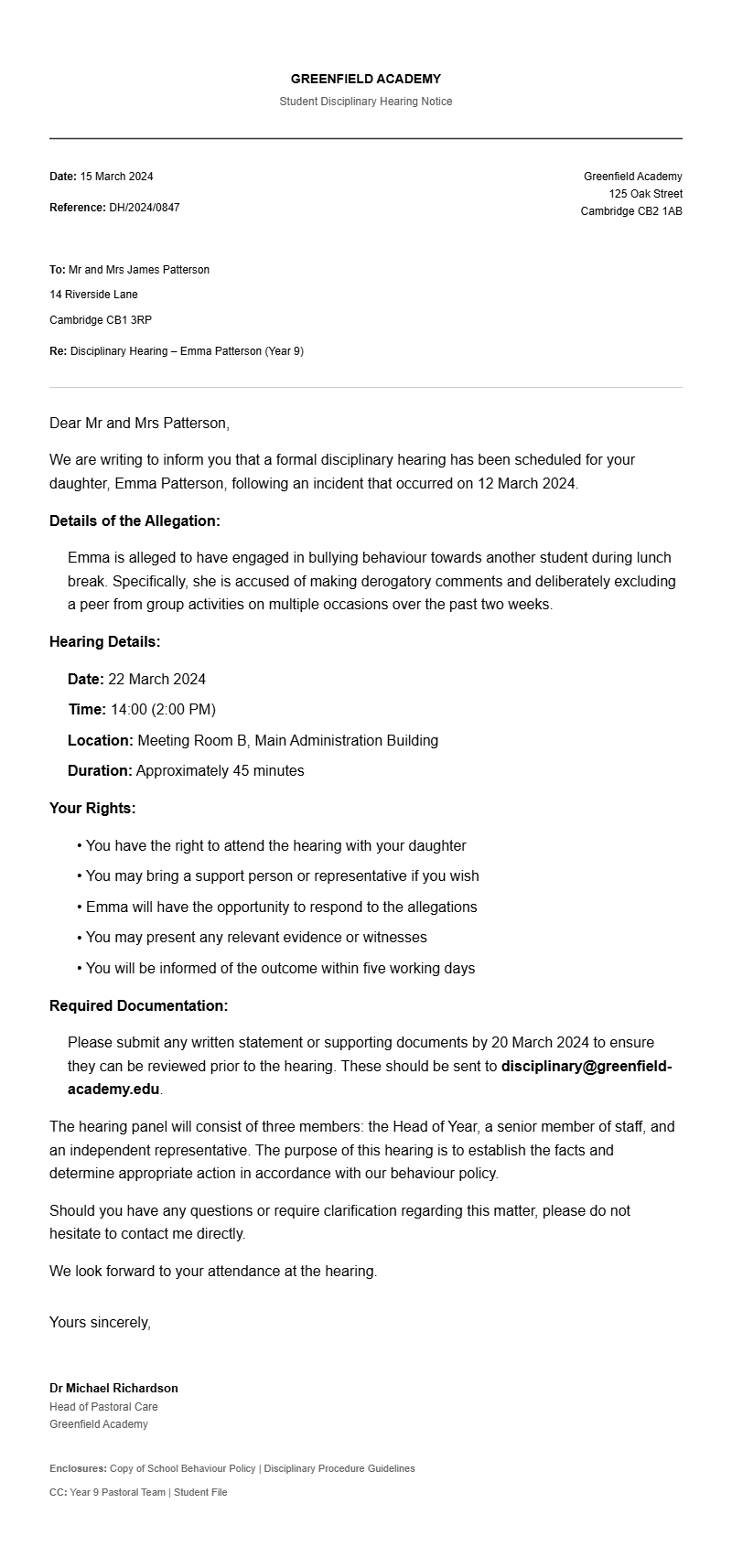
Notice of Student Disciplinary Hearing – Academic Misconduct
Date: 15 March 2024
To: James Mitchell
Student ID: 2024-08547
Programme: Bachelor of Engineering
Dear Mr Mitchell,
This letter confirms that a formal disciplinary hearing has been scheduled to address allegations of academic misconduct regarding your submission for ENGR 301 (Structural Analysis) on 8 March 2024.
Hearing Details:
- Date: 29 March 2024
- Time: 14:00–15:30 (GMT)
- Location: Student Services Building, Room 204
- Panel Chair: Dr Eleanor Hartley, Dean of Student Conduct
The allegation concerns similarity detection software findings indicating 87% textual overlap with published sources without proper attribution. You are entitled to:
- Review all evidence against you prior to the hearing
- Bring a support person or representative
- Present your account and supporting documentation
- Ask questions of the panel
Please confirm your attendance by 22 March 2024. Should you wish to request postponement, contact the Student Conduct Office immediately with documented justification.
Yours sincerely,
Dr Eleanor Hartley
Dean of Student Conduct
Disciplinary Hearing Outcome Letter – Violation Upheld
Date: 2 April 2024
Student: Sarah Chen
Student ID: 2023-12394
Hearing Date: 29 March 2024
Dear Ms Chen,
Following your disciplinary hearing held on 29 March 2024, the panel has completed its review of all evidence and submissions presented by both parties.
Findings:
The panel unanimously determined that you violated the Student Code of Conduct, specifically Article 4.2, regarding disruptive behaviour during a supervised examination. Witness statements and CCTV footage corroborated that you used an unauthorised mobile device and subsequently refused to comply with invigilator instructions.
Imposed Sanction:
- Suspension from all examinations for the current academic term
- Mandatory completion of Academic Integrity Workshop
- Written apology to the examination centre staff
- Probation status for 12 months
You have the right to appeal this decision within 14 days. Appeals must be submitted in writing to the Appeals Committee with new evidence or procedural concerns. Further information regarding the appeals process is attached.
Yours sincerely,
Dr Marcus Webb
Chair, Student Disciplinary Panel
Preliminary Investigation Notice – Alleged Code of Conduct Violation
Date: 8 February 2024
To: David Okonkwo
Student ID: 2022-09876
Dear Mr Okonkwo,
The Student Conduct Office has received a formal complaint regarding your conduct on 5 February 2024. We are writing to inform you that a preliminary investigation has commenced.
Allegation Summary:
You are alleged to have engaged in verbal harassment and threatening language directed toward another student in the library facilities, creating an intimidating environment in violation of the Student Code of Conduct, Section 3.1 (Respectful Community Standards).
What Happens Next:
During the investigation phase, we will gather statements from witnesses and involved parties. You will be given an opportunity to provide your account of events. Based on our findings, we will determine whether sufficient evidence exists to proceed to a formal disciplinary hearing.
Please contact our office by 15 February 2024 to schedule an investigative interview. Bring any documentation or witnesses that support your position. Failure to cooperate may result in the investigation proceeding without your input.
If you have questions, contact the Student Conduct Office at conduct@university.edu or extension 4521.
Yours sincerely,
Ms Patricia Gonzalez
Student Conduct Investigator
Appeal Decision Letter – Disciplinary Sanction Reduced
Date: 18 May 2024
Student: Michael Torres
Student ID: 2023-05621
Original Hearing Date: 12 April 2024
Appeal Submission Date: 20 April 2024
Dear Mr Torres,
The Appeals Committee has reviewed your appeal of the disciplinary panel’s decision dated 15 April 2024. We have considered the new evidence you submitted regarding medical circumstances and the procedural concerns you raised.
Appeal Committee Decision:
We have determined that while the original finding of misconduct remains valid, the severity of the imposed sanction warrants reconsideration. The original panel did not have access to your documented medical report from the Student Health Centre, which provides relevant context.
Revised Sanction:
- Removal of examination suspension (original sanction lifted)
- Completion of Academic Integrity Workshop (maintained)
- Probation status reduced from 12 months to 6 months
- Written reflection essay on professional responsibility (new requirement)
This revised outcome takes effect immediately. You may resume examination participation in the next available sitting. Please contact Student Services to schedule your required workshop within 30 days.
Yours sincerely,
Professor James Whitmore
Chair, Appeals Committee
Formal Hearing Adjournment Notice – Additional Evidence Required
Date: 24 March 2024
To: Amelia Richardson
Student ID: 2024-03457
Scheduled Hearing Date: 22 March 2024
Dear Ms Richardson,
Your disciplinary hearing scheduled for 22 March 2024 has been adjourned. A new hearing date will be scheduled within the next two weeks.
Reason for Adjournment:
During preliminary review, the panel identified significant documentary evidence that requires proper examination and analysis before proceeding. Additionally, a key witness has requested a brief postponement due to documented illness, which the panel has granted in the interests of procedural fairness.
What You Should Know:
- You will receive written notice of the new hearing date at least 10 working days in advance
- All evidence will be made available to you by 28 March 2024
- You retain the right to bring a support person or representative
- The adjournment does not imply any decision regarding the allegations
If you have questions or concerns about this adjournment, please contact the Student Conduct Office. We remain committed to ensuring a fair and thorough process.
Yours sincerely,
Dr Eleanor Hartley
Dean of Student Conduct
Disciplinary Hearing Outcome – No Violation Found
Date: 10 April 2024
Student: Robert Kimani
Student ID: 2023-07834
Hearing Date: 3 April 2024
Dear Mr Kimani,
Following your disciplinary hearing held on 3 April 2024, the panel has completed its thorough review of all evidence, witness statements, and submissions.
Panel Decision:
The disciplinary panel has determined that the allegations against you have not been substantiated. The evidence presented does not establish a clear and convincing case that you violated the Student Code of Conduct as alleged. Specifically, the testimony regarding the incident of 28 March 2024 contained significant inconsistencies, and documentary evidence contradicted key aspects of the complaint.
Outcome:
All charges are dismissed. Your disciplinary record will reflect this outcome. You are free to continue your studies without restriction or sanction. Any temporary measures implemented during the investigation process are hereby lifted.
Your Rights:
The complainant retains the right to appeal this decision. Should an appeal be filed, you will be notified and may be asked to provide additional information. You are not required to attend an appeal hearing unless specifically requested.
We regret any inconvenience this matter may have caused and wish you well in your continued studies.
Yours sincerely,
Dr Eleanor Hartley
Dean of Student Conduct
Conduct Violation Notice – Immediate Action Required
Date: 5 March 2024
To: Lucas Fernandes
Student ID: 2023-11209
Residence: Halls of Residence, Block C
Dear Mr Fernandes,
This letter serves as formal notice of a conduct violation requiring immediate corrective action.
Incident Details:
On 3 March 2024, Residential Life staff documented a breach of the Halls of Residence regulations regarding noise disturbances and unauthorised occupancy in your room. Specifically, a gathering of approximately 15 individuals was observed at 02:30 hours, exceeding maximum occupancy limits and creating excessive noise that disturbed neighbouring residents.
Required Actions:
- Meet with your Residential Advisor by 8 March 2024 to discuss this violation
- Provide a written response explaining the circumstances by 10 March 2024
- Attend a restorative meeting with affected residents by 15 March 2024
Potential Consequences:
Failure to comply with these requirements may result in formal disciplinary proceedings and possible removal from residential accommodation. This is a serious matter that affects community living standards.
Contact your Residential Advisor immediately to arrange the required meeting. We are committed to maintaining a safe and respectful residential environment for all students.
Yours sincerely,
Ms Keisha Thompson
Director of Residential Life
Hearing Postponement Request – Student-Initiated Adjournment
Date: 19 March 2024
To: The Student Conduct Office
From: Natasha Volkov
Student ID: 2024-02156
Scheduled Hearing Date: 25 March 2024
Dear Members of the Conduct Office,
I am writing to formally request postponement of my disciplinary hearing currently scheduled for 25 March 2024.
Reason for Request:
I have been advised by my medical practitioner that I require urgent surgical intervention scheduled for 26 March 2024. Recovery and post-operative care will require approximately two weeks. I am unable to adequately prepare for or participate in the hearing during this period, and I believe postponement is in the interests of procedural fairness for all parties.
Supporting Documentation:
I have attached a letter from the University Health Centre confirming the medical necessity of this procedure. I am also providing contact information for my nominated support person, who can discuss practical arrangements if required.
Proposed Alternative Dates:
I am available for the hearing from 15 April 2024 onwards. I am flexible regarding the specific date and time within that window.
Thank you for considering this request. I remain committed to participating fully in the disciplinary process and look forward to your response.
Yours sincerely,
Natasha Volkov
Disciplinary Hearing Outcome – Partial Violation Found
Date: 8 May 2024
Student: Christopher Liu
Student ID: 2022-08765
Hearing Date: 1 May 2024
Dear Mr Liu,
Following your disciplinary hearing on 1 May 2024, the panel has completed its assessment of the allegations presented against you.
Panel Findings:
| Allegation | Finding |
|---|---|
| Plagiarism in coursework submission | Upheld |
| Falsification of laboratory results | Not upheld |
| Failure to disclose conflict of interest | Upheld |
The panel determined that you committed academic misconduct in two areas. However, the allegation regarding falsification of laboratory results was not substantiated by the evidence presented.
Imposed Sanctions:
- Requirement to retake the affected coursework module
- Mandatory attendance at Academic Integrity and Research Ethics seminars
- Probation status for 6 months
You have 14 days to appeal this decision. Please refer to the attached Appeals Procedure document for detailed instructions.
Yours sincerely,
Dr Eleanor Hartley
Dean of Student Conduct
Final Warning Letter – Escalated Disciplinary Action
Date: 12 June 2024
To: Gregory Walsh
Student ID: 2021-04392
Dear Mr Walsh,
This letter constitutes a final written warning regarding your repeated violations of the Student Code of Conduct.
Conduct History:
Your disciplinary record reflects three substantiated violations within the past 18 months: disruptive classroom behaviour (October 2023), failure to comply with academic integrity standards (February 2024), and intimidating conduct toward staff (May 2024). Previous warnings and sanctions have not resulted in sustained behavioural improvement.
Serious Consequences:
This final warning indicates that any further violations will result in immediate expulsion proceedings. The university is committed to maintaining standards of conduct that ensure a safe and respectful environment for all community members. Your continued participation in the university community is contingent upon demonstrable compliance with all Code of Conduct provisions.
Support Available:
We encourage you to utilise available support services, including:
- Counselling and mental health services
- Academic coaching and study skills support
- Conflict resolution workshops
Please contact Student Services to arrange appropriate support. We remain willing to assist your success, but further violations will necessitate formal expulsion proceedings.
Yours sincerely,
Professor Adrian Blackwell
Vice-Principal, Student Affairs