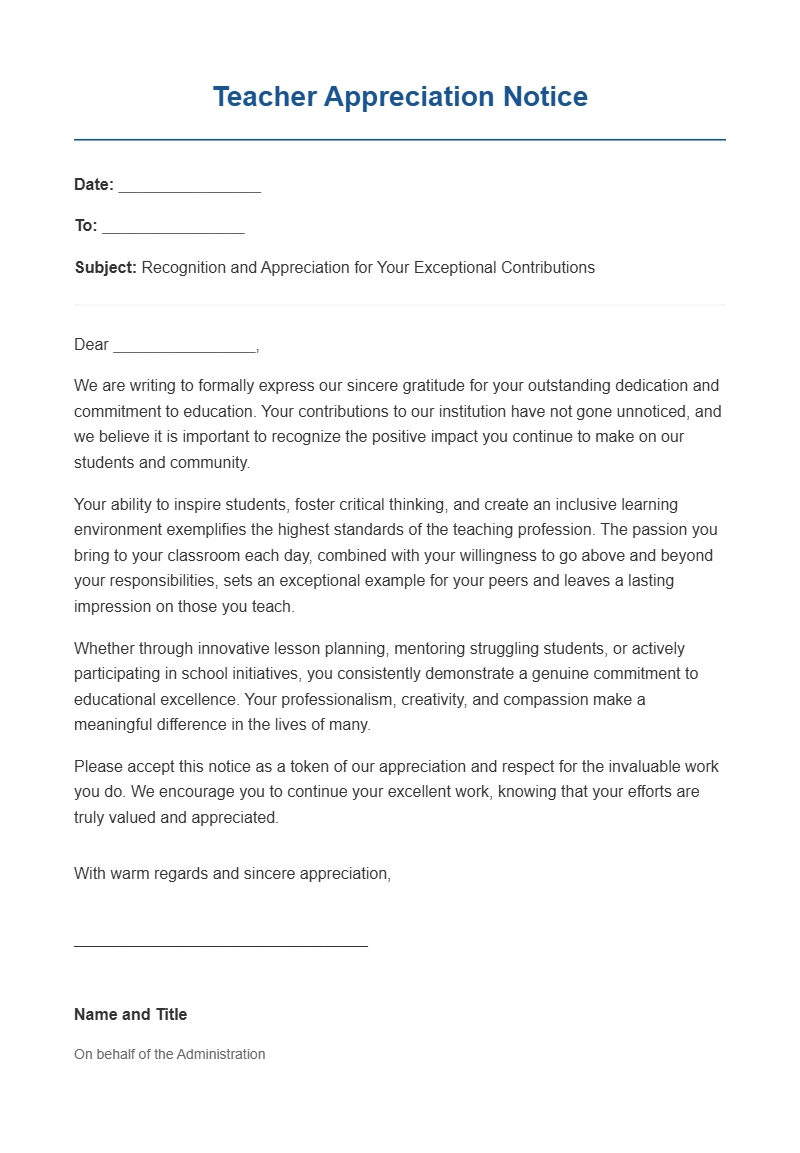
Teachers shape futures. They stay late grading papers, buy classroom supplies with their own money, and remember details about students’ lives that have nothing to do with the curriculum. When you want to acknowledge that kind of dedication—whether you’re a principal, parent, or administrator—a teacher appreciation notice letter does the job right.
But writing one that actually lands well is trickier than it sounds. A generic thank-you feels hollow. Something too formal feels distant. The sweet spot is a letter that feels specific, genuine, and actually worth the teacher’s time to read.
This guide walks you through building a teacher appreciation letter from scratch, shows you templates you can adapt, and flags the mistakes that turn good intentions into awkward letters.
What Is A Teacher Appreciation Notice Letter?
A teacher appreciation notice letter is a formal or semi-formal document that recognizes a teacher’s contributions, effort, or specific accomplishments. It’s different from a casual thank-you note because it has weight—it often gets placed in personnel files, shared with school leadership, or posted where other staff members see it.
These letters serve several purposes. They create a paper trail of recognition that matters during evaluations or promotion discussions. They boost morale in real, tangible ways. They also set a cultural tone that appreciation isn’t an afterthought—it’s built into how your school operates.
The letter can be addressed to one teacher or a group. It might highlight a specific project, recognize consistent excellence, or acknowledge going above and beyond during a difficult period.
When You Actually Use These Letters
Teacher appreciation letters work best in specific situations, not as generic annual gestures.
End-of-year recognition: Acknowledging a teacher’s full year of work, especially if they’ve led initiatives or mentored new staff.
After a major project: A teacher organized a successful field trip, ran a fundraiser, or implemented a new curriculum unit. The letter arrives while the effort is still fresh.
During challenging times: A teacher managed a difficult classroom situation, supported a student in crisis, or kept morale up during staffing changes. Recognition here matters more than people realize.
Milestone achievements: A teacher completed advanced certification, reached a service anniversary, or was nominated for an award.
Specific contributions: They mentored a struggling colleague, designed professional development, or created resources other teachers now use.
Following parent or student feedback: You received specific praise about how a teacher changed a student’s trajectory or created a welcoming classroom environment.
The key is timing. A letter that arrives weeks after the event feels performative. One that arrives within days of the accomplishment feels connected to reality.
Core Components Of An Effective Letter
Strong teacher appreciation letters follow a simple structure without being formulaic.
The opening: State why you’re writing. Be direct. “I’m writing to recognize your leadership in launching our new literacy initiative” works better than “It has come to my attention that you are a valued member of our team.”
The specific evidence: Name what the teacher did. Use concrete details. Instead of “Your classroom is inspiring,” try “You redesigned your science lab setup so students with mobility challenges could participate in hands-on experiments, and the rest of the class learned collaboration skills in the process.”
The impact: Explain what changed because of their work. Did student engagement increase? Did other teachers adopt their methods? Did a struggling student find confidence? Impact is what makes appreciation land.
The personal note: A sentence that acknowledges effort or character. “The extra hours you put in didn’t go unnoticed” or “Your patience with frustrated learners sets the tone for the whole classroom” feels human.
The close: A simple thank-you and signature. You don’t need flowery language. “Thank you for what you bring to our school every day” is enough.
How To Write A Teacher Appreciation Letter Step By Step
Step 1: Identify the specific reason. Don’t write a generic letter. Pick one teacher and one concrete thing they did. If you’re recognizing multiple teachers, send individual letters rather than one group email. It takes longer but feels infinitely better.
Step 2: Gather details. If you didn’t directly observe what they did, ask around. Talk to colleagues, check student feedback, review any documentation. You need specifics to write credibly.
Step 3: Outline the impact. Before you write, jot down: What did this teacher do? Who benefited? What changed as a result? This becomes your backbone.
Step 4: Draft the opening. Write one sentence that states exactly why you’re writing. Skip the preamble.
Step 5: Add the evidence. Describe what you observed or learned about. Use their language sometimes—if they talk about “student agency” or “differentiated instruction,” those terms belong in your letter.
Step 6: Connect to impact. Explain the ripple effect. Better classroom culture? Student confidence? Other teachers learning from their approach? Make it visible.
Step 7: Add one personal observation. One sentence that feels like it came from a real human who actually knows them.
Step 8: Close simply. Thank them. Sign it. Done.
Teacher Appreciation Letter Templates You Can Adapt
Template 1: For Classroom Excellence
Use this when a teacher has created an exceptional learning environment or made a measurable difference with students.
Dear [Teacher Name],
I’m writing to recognize the classroom culture you’ve built this year. Your classroom is one where students take risks, ask questions, and genuinely want to be there—and that doesn’t happen by accident.
I’ve noticed how you redirect frustration into curiosity, how you remember what matters to each student, and how you make struggling learners feel like capable thinkers rather than behind. The data backs this up: your students’ reading gains this quarter are significant, but the real measure is how they talk about your class.
That kind of intentional teaching is what changes trajectories. Thank you for the energy and care you bring every day.
Sincerely,
[Your Name]
Template 2: For Going Above And Beyond
Use this when a teacher took on extra work, solved a problem, or went beyond their job description.
Dear [Teacher Name],
When we faced the challenge of [specific situation], you stepped in without hesitation. You [specific action taken], which meant [what was accomplished].
That kind of initiative doesn’t go unnoticed. You could have said it wasn’t your responsibility. Instead, you saw what needed doing and did it—and you did it well. It made a real difference for [students/staff/the school].
I wanted you to know that your willingness to help carry the load is exactly what builds a strong school. Thank you.
Sincerely,
[Your Name]
Template 3: For Mentorship Or Leadership
Use this when a teacher mentored colleagues, led professional development, or influenced school culture.
Dear [Teacher Name],
I wanted to acknowledge the mentoring you’ve provided to [colleague/new staff/grade level team] this year. You’ve shared your expertise generously, answered questions patiently, and modeled what thoughtful teaching looks like in practice.
[Colleague name] specifically mentioned how your feedback on their [specific area] helped them rethink their approach. That’s leadership—not because of a title, but because you’re willing to help others grow.
Teachers like you strengthen the whole school. Thank you for investing in your colleagues.
Sincerely,
[Your Name]
Template 4: For Handling A Difficult Situation
Use this when a teacher managed a challenging moment, supported a student in crisis, or kept perspective during stress.
Dear [Teacher Name],
I wanted to reach out about how you handled [specific situation]. You remained calm, focused on what the student needed, and took action that mattered.
That kind of grace under pressure isn’t easy. It would have been simpler to escalate or step back. Instead, you showed up as the adult that student needed in that moment.
Thank you for your professionalism and your heart. It makes a difference.
Sincerely,
[Your Name]
Template 5: For Curriculum Or Program Innovation
Use this when a teacher created something new, redesigned a unit, or brought a fresh approach.
Dear [Teacher Name],
Your redesign of [program/unit/initiative] has been impressive to watch. You took [what existed] and transformed it into [what it is now], and the results are visible in [specific evidence].
What strikes me most is how you balanced [challenge 1] with [challenge 2] and still managed to keep the focus on student learning. Other teachers are already asking to see what you’re doing.
That’s the kind of thinking that moves schools forward. Thank you for your creativity and follow-through.
Sincerely,
[Your Name]
Mistakes That Undermine Your Letter
Being too vague. “You’re a wonderful teacher” means nothing. “You created a classroom where every student participates in discussions” means everything. Specificity is what makes appreciation feel real.
Making it about you. The letter is about them. Avoid “I’m proud of our school because of teachers like you.” Instead: “You’ve built something special in your classroom.”
Comparing to other teachers. Never write “You’re better than…” or even imply it. Recognition doesn’t need a hierarchy. Appreciate this teacher for what they’ve done.
Using corporate jargon. Skip “best practices,” “synergy,” “stakeholder engagement,” and “leveraging resources.” Speak like a human who actually works in schools.
Making it too long. One page. If you’re writing more than that, you’re overexplaining. Teachers are busy. Respect their time.
Waiting too long to send it. A letter that arrives six months after the event feels like a checkbox exercise. Send it while the work is still current.
Forgetting to proofread. Typos and grammatical errors send a message: you didn’t care enough to read it twice. Take two minutes to check your work.
Being patronizing. “You’re so dedicated for actually doing your job” isn’t appreciation—it’s insulting. Recognize excellence without implying the baseline is low.
How To Customize Templates For Your Situation
Replace placeholders with real names and details. Don’t leave [Teacher Name] in the letter. Don’t say “a difficult situation” when you mean “when Marcus was escalating and you sat with him for twenty minutes.” Details are what make templates personal.
Match the tone to your school culture. If your school is formal, keep the letter professional. If it’s more casual, you can be warmer. But always err slightly more formal than you’d speak—it’s a document, not a text.
Add context only they’ll understand. If the teacher led a specific initiative or worked with a particular group, name it. “Your work with the English language learner cohort” hits differently than “your commitment to all students.”
Use their language when possible. If they talk about “restorative practices” or “student-centered learning,” those terms belong in your letter. It shows you actually know what they do.
Adjust length based on what you’re recognizing. A letter for a major initiative can be longer than one recognizing a single act of kindness. But keep it under one page either way.
Consider your role. If you’re a principal, you have authority that shapes how the letter lands. If you’re a parent or community member, your perspective is different but equally valuable. Write from where you actually stand.
Where And How To Deliver The Letter
The medium matters as much as the message.
Printed and handed in person: Best for major recognition. It feels intentional. You can say a few words if you want. The teacher can keep it.
Printed and placed in their mailbox: Good middle ground. It’s formal enough to matter but doesn’t require an awkward in-person moment.
Email with a printed copy to follow: Acceptable if timing is urgent. But follow up with a physical copy. Email feels temporary.
Read aloud at a staff meeting: Only if the teacher is comfortable with public recognition. Some people appreciate it; others find it embarrassing. Ask first.
Never: Post it on social media, share it widely without permission, or use it as a performance of appreciation for other staff members to see. That’s about you, not the teacher.
Special Considerations For Different Situations
Recognizing new teachers: New teachers often feel uncertain about whether they’re doing it right. A specific appreciation letter early in the year can anchor them. Focus on what they’re building, not just effort.
Recognizing teachers in their final year: If a teacher is retiring or leaving, the letter becomes part of their legacy. Make it substantive. Reference specific contributions over time, not just recent work.
Recognizing teachers who’ve faced criticism: Sometimes a teacher has weathered complaints or difficult situations and handled it with grace. Appreciation here is powerful. Be clear about what they did right.
Recognizing during contract negotiations or budget cuts: Be careful here. A letter isn’t a substitute for fair pay or job security. If the school is cutting positions, recognition can feel hollow. Make sure your actions match your words.
Recognizing teachers from different backgrounds or departments: Make sure your recognition is distributed fairly across the school. If you only write letters for certain teachers or certain subjects, that pattern gets noticed.
Why This Matters Beyond Nice Feelings
Teacher appreciation letters aren’t just feel-good exercises. They document excellence. They create a record that matters during evaluations, tenure decisions, and promotion conversations. They also set cultural expectations: excellence gets noticed and acknowledged here.
That culture shift is real. When teachers know that good work gets seen and recognized specifically, they’re more likely to keep taking risks and investing energy. When teachers feel genuinely appreciated—not just thanked in passing—they stay longer and care more deeply.
The letter also protects institutional memory. Years from now, someone reading through files will see what this teacher accomplished and how it mattered. That’s powerful.
If you’re writing appreciation letters for staff in other contexts, similar principles apply. Whether you’re recognizing an internship acceptance or acknowledging professional growth, specificity and genuine recognition are what make the difference.
Getting Started Right Now
Pick one teacher. Think about something they did recently that actually mattered. Not something generic—something specific. Something you noticed or heard about that made a real difference.
Open one of the templates above. Fill in the blanks with real details. Read it out loud. Does it sound like something a human would write, or does it sound like a form letter? If it sounds like a form letter, add more specifics.
Print it. Sign it. Hand it to them or leave it where they’ll find it.
That’s it. You don’t need perfect words. You need honest ones. Teachers know the difference.
Document Examples & Template Samples