If you’re an academic advisor, department head, or registrar, you’ve probably faced the awkward task of documenting a student’s declining grades or attendance. An academic warning letter is the formal way to communicate this without being punitive—it’s more of a wake-up call with teeth. Getting the tone and content right matters because you’re trying to motivate change while protecting your institution’s records.
The challenge is writing something that feels serious enough to prompt action but not so harsh that it damages your relationship with the student or their family. This guide walks you through what these letters actually do, what they need to contain, and how to write one that works.
What Is An Academic Warning Letter?
An academic warning letter is a formal notice sent to a student whose academic performance has fallen below institutional standards. It documents the problem, explains the consequences, and typically outlines what the student needs to do to improve their standing.
This isn’t a disciplinary action in the traditional sense. It’s a documented intervention. The letter creates a paper trail that shows the institution took action before dismissing a student or placing them on academic probation. It also gives students clear notice that their situation is serious and requires immediate attention.
Universities and colleges issue these letters for various reasons: GPA dropping below 2.0, repeated absences, failing grades in major courses, or incomplete coursework. Some schools send them automatically when certain thresholds are crossed; others require manual review by an academic committee.
When Do Students Receive Academic Warning Letters?
Timing varies by institution, but these letters typically go out after a specific academic period—usually at the end of a semester or term when grades are finalized. Some schools send them mid-semester if a student is at risk.
Common triggers include:
- GPA falls below the minimum required (often 2.0)
- Student fails a required course or too many courses in one term
- Excessive unexcused absences in multiple classes
- Incomplete grades that remain unresolved
- Poor performance in major-specific courses
- First offense after a probation warning
The letter serves as a formal record. If a student’s performance doesn’t improve, the next step is usually academic probation, suspension, or dismissal. That progression is why the warning letter matters—it proves you gave the student fair notice.
Key Components Of An Academic Warning Letter
A solid academic warning letter includes these sections:
Header And Date
Include your institution’s letterhead, the date, and the student’s name and address. This makes it official and ensures there’s no confusion about when the letter was sent.
Clear Subject Line
Something like “Academic Warning Notice” or “Notice of Academic Standing” signals the purpose immediately.
Greeting
Use the student’s name. “Dear [Student Name]” is standard and appropriate.
Statement Of The Problem
Be specific. Don’t say “your grades are low.” Say “Your cumulative GPA is 1.85, which falls below our 2.0 minimum requirement” or “You received failing grades in MATH 101, ENG 102, and BIO 110 this term.”
Explanation Of Consequences
Explain what happens next if the student doesn’t improve. Will they move to academic probation? Lose financial aid? Face dismissal? Be direct about the stakes.
Required Actions
Tell the student exactly what they need to do. Meet with an advisor? Attend tutoring? Retake courses? Reduce course load? Make it actionable.
Support Resources
Point them toward tutoring, counseling, disability services, or writing centers. Students often don’t know these exist, and offering them shows good faith.
Timeline And Next Steps
When must they meet with an advisor? When will their progress be reviewed? Give specific dates.
Contact Information
Include the name, email, and phone number of the person they should contact with questions.
How To Write An Academic Warning Letter: Step By Step
Step 1: Gather The Facts
Before you write anything, pull the student’s transcript, attendance records, and any prior warnings. You need exact numbers and dates. “Around a 1.9 GPA” won’t hold up; “cumulative GPA of 1.87 as of [date]” will.
Step 2: Determine The Tone
Aim for firm but fair. You’re not angry; you’re concerned and serious. Avoid words like “disappointing,” “unacceptable,” or “failure” if possible. Instead, use “below our minimum standard,” “does not meet our requirement,” or “needs improvement.”
The goal is to motivate, not shame. A student who feels attacked is less likely to respond positively than one who understands the problem clearly and sees a path forward.
Step 3: Write The Opening
State the purpose in the first sentence. Don’t bury the lead. The student needs to know immediately why they’re getting this letter.
Step 4: Present The Data
Use specific metrics. Include the student’s current GPA, the grades that triggered the warning, attendance percentages, or whatever applies. Vague language creates room for argument; specifics don’t.
Step 5: Explain The Policy
Reference your institution’s academic standards policy. This shows the warning isn’t arbitrary—it’s based on established rules the student agreed to when they enrolled.
Step 6: Outline Consequences
Be clear about what happens if performance doesn’t improve. The student needs to understand the stakes. If the next step is probation, say so. If it’s dismissal, say that too.
Step 7: List Required Actions
This is the most important part. Tell the student exactly what they need to do and by when. Vague suggestions like “try harder” don’t work. Specific actions do.
Step 8: Offer Resources
Include contact information for tutoring, writing centers, disability services, mental health counseling, or academic coaching. Make it easy for the student to get help.
Step 9: Set A Review Date
When will you check in on the student’s progress? Make it clear this isn’t the end of the conversation—it’s the beginning of a monitored improvement plan.
Step 10: Close Professionally
End with something like “We are committed to your success and available to support you” or “Please contact me if you have questions or need additional resources.” Sign your name, title, and contact information.
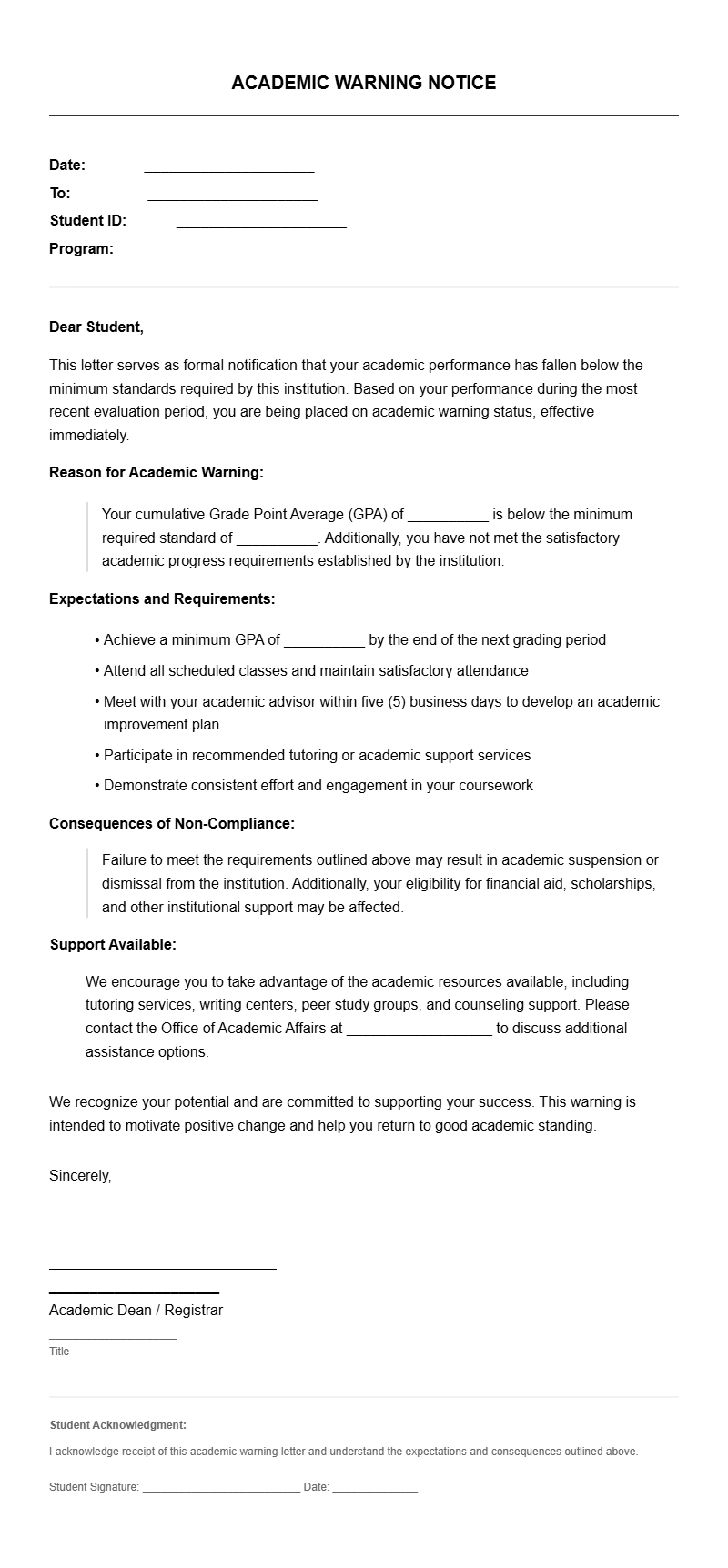
Academic Warning Letter Template
Here’s a template you can customize for your institution:
[INSTITUTION LETTERHEAD]
Date: [Date]
To: [Student Name]
[Student Address]
[City, State ZIP]
Subject: Academic Warning Notice
Dear [Student Name],
This letter is to formally notify you that your academic standing has fallen below the minimum standards required by [Institution Name]. This is a serious matter that requires your immediate attention and action.
Reason For Warning
As of [date], your cumulative grade point average is [GPA], which is below our institutional minimum of [minimum GPA]. Additionally, you received the following grades this term: [list specific grades and courses]. This performance does not meet the academic standards expected of all students at [Institution Name].
What This Means
Students on academic warning must demonstrate significant improvement in the next grading period. If your cumulative GPA does not reach [minimum GPA] by [specific date], you will be placed on academic probation. Continued poor performance may result in academic suspension or dismissal from the institution.
What You Must Do
To address this warning, you are required to:
- Schedule an appointment with your academic advisor by [date] to develop an improvement plan
- Attend at least [number] tutoring sessions per week in your areas of weakness
- Meet with your course instructors to discuss strategies for improvement
- Reduce your course load to [number] credits next term (if applicable)
- Attend a study skills workshop offered by [office/department]
Resources Available To You
We want to support your success. The following resources are available at no cost:
- Tutoring Center: [contact info] – Free one-on-one and group tutoring
- Writing Center: [contact info] – Help with essays and writing assignments
- Disability Services: [contact info] – If you have a documented disability affecting your academics
- Counseling Services: [contact info] – Mental health support and stress management
- Academic Coaching: [contact info] – Help with time management and study skills
Next Steps
Please contact [Advisor Name] at [email/phone] within three business days to schedule your required meeting. Your progress will be reviewed at the end of [next term], and we will assess whether you have met the improvement requirements outlined in this letter.
We are committed to your success and believe you can turn this situation around with focused effort and the right support. However, you must take action immediately.
Sincerely,
[Your Name]
[Your Title]
[Institution Name]
[Email]
[Phone]
Real-World Examples
Example 1: Low GPA Warning
Scenario: A first-year student’s GPA dropped to 1.78 after their first semester.
“As of December 15, 2024, your cumulative GPA is 1.78, which falls below our institutional minimum of 2.0. While we understand that the transition to college is challenging, this performance level places your academic standing at risk. To address this, you must meet with your advisor by January 10 to develop a support plan, attend a minimum of three tutoring sessions per week, and reduce your course load next semester to 12 credits. Your progress will be formally reviewed at the end of spring semester.”
Example 2: Attendance-Based Warning
Scenario: A student has missed 15 classes across three courses in one term.
“Our records show you have been absent from class 15 times this semester without documented excuse. This level of absenteeism directly impacts your ability to succeed and violates our attendance policy. Continued absences may result in course failure and academic probation. You must meet with the Dean of Students by January 8 to discuss the barriers you’re facing and develop an attendance contract. If you have a medical or personal emergency, please provide documentation to Disability Services.”
Example 3: Major-Specific Course Failure
Scenario: A nursing student failed two required courses.
“You received failing grades in NURS 210 (Pharmacology) and NURS 220 (Clinical Practice) this term. These are core courses required for progression in the nursing program. Per our program standards, you must retake both courses and achieve a minimum grade of C before advancing. You are required to meet with the Nursing Program Director by January 12 to discuss a remediation plan. Failure to successfully complete these courses will result in dismissal from the nursing program.”
Common Mistakes To Avoid
Being Too Harsh Or Emotional
Language like “your performance is unacceptable” or “you’ve disappointed us” puts students on the defensive. They shut down instead of taking action. Stick to facts and consequences.
Being Too Vague
Saying “improve your grades” doesn’t tell the student what to do. Say “attend tutoring three times per week” or “meet with your professor during office hours weekly.” Specificity drives action.
Forgetting To Include Institutional Policy
Reference your school’s academic standards policy. This shows the warning isn’t personal—it’s based on established rules. It also protects your institution if the student contests the warning.
Not Offering Resources
A warning without support feels punitive. Include contact information for tutoring, counseling, disability services, and academic coaching. Make it easy for students to get help.
Setting Unrealistic Timelines
Telling a student to improve their GPA from 1.8 to 3.0 in one semester isn’t realistic. Set achievable intermediate goals. A GPA improvement of 0.3–0.5 points per semester is reasonable.
Not Following Up
A warning letter is only effective if you actually monitor progress. Schedule a follow-up meeting. Check in with the student’s instructors. If the student isn’t improving, escalate to probation or dismissal as appropriate.
Using A One-Size-Fits-All Template Without Customization
Students can tell when they’re getting a generic letter. Take five minutes to personalize it with their name, specific grades, and relevant details. It shows you actually reviewed their case.
Tips For Customizing Your Letter
Know Your Institution’s Policy
Every school has different standards for academic warnings, probation, and dismissal. Check your student handbook and institutional policies before writing. Your letter should reference these policies by name or number.
Tailor The Required Actions To The Problem
If a student failed because of poor study habits, require study skills coaching and tutoring. If they failed because of attendance, require meetings with the Dean of Students. Match the intervention to the cause.
Consider The Student’s Circumstances
Is this a first-year student struggling with transition? A student with an undisclosed disability? Someone dealing with a family crisis? Context matters. If you know the student is facing real barriers, acknowledge them and point toward support. This doesn’t excuse poor performance, but it shows you’re human and genuinely trying to help.
Use Positive Language Where Possible
Instead of “you are failing,” try “your current performance is below our standard, but we believe you can improve with focused effort and support.” This motivates without being patronizing.
Include Specific, Measurable Goals
Don’t say “improve your grades.” Say “raise your GPA to 2.0 or higher by [date]” or “earn a grade of C or better in all courses next term.” Measurable goals are harder to argue with and easier to track.
Make The Letter Scannable
Use bold headings, short paragraphs, and bullet points. Students are stressed when they open this letter. A wall of text won’t get read. Break it into digestible chunks.
Include A Clear Call To Action
End with something specific: “Schedule an appointment with your advisor by [date]” or “Email me your improvement plan by [date].” Don’t leave it open-ended.
How Academic Warning Letters Fit Into Your Academic Support System
An academic warning letter doesn’t exist in isolation. It’s part of a larger support and accountability structure. When you’re writing one, consider how it connects to your institution’s broader academic standing policies.
Most institutions follow a progression: academic warning → academic probation → academic suspension or dismissal. The warning is the first formal step. It gives students documented notice and a chance to improve before facing more serious consequences.
Some schools also use classroom assignment letters to communicate with instructors about students who need support, or rejoining request letters from students seeking reinstatement after suspension. Understanding how these documents relate to each other helps you write warnings that fit into your institution’s larger system.
Similarly, if your institution offers workshop invitation letters to encourage student attendance at academic support events, you can reference those workshops in your warning letter as required resources.
Working With Different Student Populations
First-Year Students
First-year students often struggle with the transition to college-level work. Your warning letter should acknowledge this while still holding them accountable. Emphasize the support available and frame the warning as an opportunity to course-correct early.
Transfer Students
Transfer students may be adjusting to a new institution’s standards. If their warning is related to a transfer issue, explain how credits transferred or how your institution’s GPA calculation differs from their previous school.
Student-Athletes
Athletes often face time management challenges. If you’re warning an athlete, be specific about which courses they’re struggling in and whether their course load is realistic given their athletic commitments. Consider whether they need academic coaching or a reduced course load.
International Students
International students may face language barriers, visa complications, or cultural adjustment challenges. If relevant, reference language support services or international student services in your letter.
Part-Time Or Nontraditional Students
These students often juggle work and family responsibilities. Acknowledge their circumstances and suggest flexible support options like online tutoring or evening office hours.
Documentation And Legal Considerations
Keep copies of every warning letter you send. These letters create a documented record that protects your institution if a student later contests an academic dismissal or suspension. They prove you gave fair notice and offered support.
Use professional language and stick to facts. Avoid personal comments, assumptions about the student’s motivation, or predictions about their future. Stick to what you know: their GPA, grades, attendance, and the institution’s policies.
If a student has a documented disability or is receiving accommodations, ensure the warning letter doesn’t contradict those accommodations. Work with your disability services office if needed.
Send the letter via certified mail or through your institution’s official channels so there’s a record of delivery. This protects you if the student later claims they never received it.
What Happens After You Send The Letter
Sending the letter is just the beginning. Your follow-up matters as much as the letter itself.
Schedule a follow-up meeting. Don’t just send the letter and wait. Require the student to meet with you or their advisor within a specific timeframe. This conversation is where real support happens.
Create an improvement plan together. Work with the student to set realistic goals and identify specific actions. They’re more likely to follow through on a plan they helped create.
Monitor progress regularly. Check in with the student’s instructors. Review their grades at mid-term. Don’t wait until the end of the semester to see if they’ve improved.
Adjust support as needed. If the student is responding well, celebrate that progress. If they’re still struggling despite support, escalate to probation or dismissal as your policy requires.
Document everything. Keep notes on every conversation, every tutoring session attended, every grade update. This documentation protects you and helps you make fair decisions about the student’s future status.
Final Thoughts
An academic warning letter is a tool for intervention, not punishment. Written well, it communicates serious concern while opening a door to support and improvement. Written poorly, it can feel arbitrary or harsh.
The key is being specific about the problem, clear about the consequences, explicit about required actions, and generous with resources. Give the student a real chance to succeed, but hold them accountable for taking that chance.
Start with your institution’s policy, customize the template to fit the student’s situation, and follow up consistently. A warning letter that leads to real change is worth the effort it takes to write it right. If you’re building support systems across your institution, you might also consider how scholarship application letters or holiday greeting letters reinforce your commitment to student success—the warning letter is part of that larger institutional voice.
General Document Template Collection