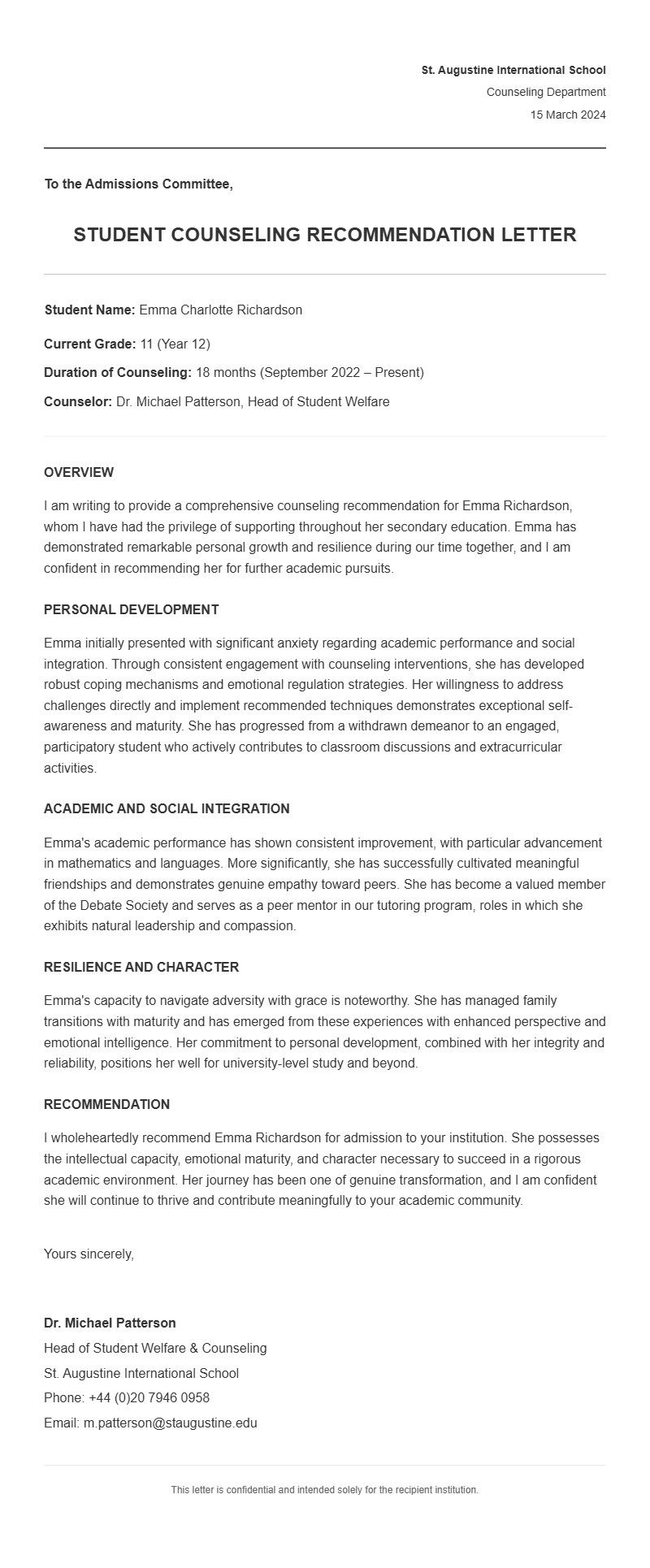
Writing a student counseling recommendation letter can feel like a high-stakes task, especially if you’re not sure what to include or how to structure it. Whether you’re a school counselor, teacher, or administrator asked to recommend a student for a program, college, scholarship, or special opportunity, the letter needs to hit specific marks. It should feel authentic, highlight real strengths, and give decision-makers a clear sense of who the student is beyond grades and test scores.
The challenge is balancing professionalism with personality. You want the letter to stand out, but it also needs to follow certain conventions so it lands well with admissions officers, program directors, or scholarship committees. That’s where having solid examples and a clear framework helps.
What Is A Student Counseling Recommendation Letter?
A student counseling recommendation letter is a formal document written by a school counselor, teacher, or administrator that vouches for a student’s character, abilities, and potential. It’s typically requested for college applications, scholarship opportunities, summer programs, leadership positions, or special academic initiatives.
The letter serves as a third-party endorsement. Unlike an application essay where the student speaks for themselves, a recommendation letter gives an outside perspective from someone who knows the student well enough to speak credibly about their strengths, work ethic, and how they interact with others.
These letters carry weight because they come from an authority figure who has no direct stake in the outcome. A counselor or teacher isn’t trying to get into college themselves—they’re genuinely assessing the student’s readiness and fit.
When Are These Letters Needed?
Recommendation letters from school counselors or teachers are commonly requested in these situations:
- College and university applications
- Scholarship and financial aid applications
- Competitive summer programs or internships
- Graduate school or professional program applications
- Leadership or honors program nominations
- Transfer applications between schools
- Special education or gifted program placements
- Job or apprenticeship applications for high school students
Timing matters. Most students ask for recommendation letters during junior or senior year of high school, but some programs request them earlier. It’s best to ask a counselor or teacher at least two to three weeks before the deadline to give them adequate time to write a thoughtful letter.
Key Components Of A Strong Recommendation Letter
A well-structured counseling recommendation letter typically includes these elements:
- Opening statement: How you know the student and for how long
- Academic performance: Grades, subject strengths, intellectual curiosity, or academic growth
- Personal qualities: Character traits like reliability, integrity, resilience, or leadership
- Specific examples: Concrete moments or projects that demonstrate the qualities mentioned
- Social and collaborative skills: How the student works with peers, handles feedback, and contributes to the school community
- Challenges overcome: Obstacles the student faced and how they responded
- Fit for the opportunity: Why this student is a good match for the program or institution
- Closing endorsement: A clear, confident recommendation without hedging language
The strongest letters move beyond listing accomplishments. They paint a picture of who the student is by grounding claims in real observations and interactions.
How To Write A Student Counseling Recommendation Letter
Here’s a practical step-by-step approach:
Step 1: Gather Information About The Student And Opportunity
Before you start writing, collect details. Ask the student for their resume, a list of accomplishments, and information about the program or opportunity they’re applying for. Understanding what the program values helps you frame your letter around their specific strengths and fit.
Review any files, transcripts, or notes you have on the student. Refresh your memory on their academic trajectory, involvement in activities, and any notable moments of growth or challenge.
Step 2: Choose Your Strongest Angle
Don’t try to cover everything. Pick two or three genuine strengths that align with what the opportunity requires. If it’s a competitive academic program, lead with intellectual curiosity and problem-solving ability. For a leadership position, emphasize collaborative skills and initiative. This focus makes the letter more compelling than trying to be comprehensive.
Step 3: Open With Context And Credibility
Start by establishing your relationship to the student. How long have you known them? In what capacity? This matters because it tells the reader why your opinion holds weight.
Example opening: “I have known Maya as her school counselor for the past three years and have worked closely with her on academic planning, college exploration, and personal development. I have also observed her growth as a peer mentor in our school’s freshman transition program.”
Step 4: Lead With A Strong, Honest Assessment
After the opening, make a clear statement about the student’s standing. This doesn’t need to be flowery. It should be direct and honest.
Examples:
- “I recommend [Student Name] without reservation for your scholarship program.”
- “In my 12 years as a school counselor, [Student Name] stands out for their intellectual maturity and genuine curiosity about the world.”
- “[Student Name] is an exceptionally conscientious student who approaches challenges with both creativity and resilience.”
Step 5: Build Your Case With Specific Examples
This is where the letter comes alive. For each quality you mention, include at least one concrete example. Generic praise reads as lazy. Specific details feel authentic.
Weak: “Jordan is a hard worker and shows leadership.”
Strong: “When Jordan took on the role of team captain for the robotics club this year, attendance had dropped to five members. Rather than accept that decline, she restructured meetings around members’ schedules, created a mentorship pairing system for new students, and organized a workshop with a local engineer. By spring, the club had grown to 18 active members, and three of the newcomers earned spots on the competition team.”
Step 6: Address Growth And Resilience
Mention a time the student faced difficulty and how they responded. This reveals character. It also makes the letter more believable because no student is perfect.
Example: “When Priya struggled with advanced calculus in the fall, she didn’t give up. She attended tutoring sessions, formed a study group, and met with her teacher regularly. By the end of the year, she had raised her grade from a C to an A and developed a genuine interest in the subject. This experience shows her ability to persist through academic challenge.”
Step 7: Connect The Student To The Opportunity
Explain why this particular student is a good fit for this particular program. Reference something specific about the program’s mission, focus, or culture, and explain how the student’s strengths align.
Example: “Given your program’s emphasis on interdisciplinary thinking and community engagement, I believe Amir is an ideal candidate. His project on urban food access combined research, community interviews, and a proposal for local policy change—exactly the kind of integrated approach your program cultivates.”
Step 8: Close With Confidence
End with a clear, unambiguous endorsement. Avoid wishy-washy language like “I think he might be” or “I believe she could possibly.” Be direct.
Examples:
- “I strongly recommend [Student Name] for your program.”
- “I am confident that [Student Name] will make meaningful contributions to your community.”
- “[Student Name] has my highest recommendation.”
Student Counseling Recommendation Letter Template
Here’s an editable template you can adapt:
[Your Name, Title]
[School Name]
[Date]
To the [Program/Scholarship/Admissions Committee]:
I am writing to recommend [Student Name] for [specific opportunity]. I have known [him/her/them] as [your role] for [time period], and I have observed [his/her/their] growth as both a student and a person.
[Student Name] is [opening assessment]. Specifically, [he/she/they] demonstrates [primary strength], as evidenced by [concrete example]. Additionally, [he/she/they] shows [secondary strength]. For instance, [another specific example].
Beyond academics, [Student Name] is known for [personal quality]. When [describe a situation], [he/she/they] responded by [describe action and outcome].
I am particularly impressed by [Student Name]’s ability to [mention relevant skill]. This quality will serve [him/her/them] well in [the program/field/environment].
I recommend [Student Name] without hesitation. I believe [he/she/they] will be an asset to your program and will continue to grow as a [leader/scholar/contributor/etc.].
Please feel free to contact me if you have questions.
Sincerely,
[Your Name]
[Title]
[Contact Information]
Real-World Example: A Complete Letter
Here’s what a finished letter might look like:
Dr. Lisa Chen, School Counselor
Lincoln High School
March 10, 2024
To the Admissions Committee:
I am writing to recommend Jamal Richardson for admission to your university’s engineering program. I have worked with Jamal as his school counselor for three years and have watched him develop into a thoughtful, persistent problem-solver with genuine passion for applied science.
Jamal’s academic record speaks for itself, but what truly sets him apart is his intellectual curiosity. In our college planning meetings, he didn’t just ask what schools to apply to—he asked what questions he wanted to explore over the next four years. He’s spent the past year exploring renewable energy through independent projects, including a solar panel efficiency study he conducted with a local contractor. This isn’t busywork for a resume. He genuinely wants to understand how energy systems work and how they can be improved.
Beyond the classroom, Jamal demonstrates remarkable resilience. During his sophomore year, he failed his first physics test—something that shook him. Rather than avoid the subject, he doubled down. He joined the physics study group, attended office hours consistently, and by junior year was earning A’s and tutoring other students. That experience revealed something important about his character: he doesn’t see failure as a stopping point.
Jamal also brings a collaborative spirit to everything he does. He served as a peer tutor in math this year and has a gift for explaining complex concepts in ways that click for other students. He listens more than he talks, asks clarifying questions, and genuinely wants to help others succeed. These qualities will make him a valuable member of your engineering community.
I am confident that Jamal has the technical skills, intellectual drive, and interpersonal maturity to thrive in your program. He will contribute meaningfully to your classroom and campus community.
I recommend Jamal without reservation. Please contact me if you have questions.
Sincerely,
Dr. Lisa Chen
School Counselor
(555) 123-4567
lchen@lincolnhigh.edu
Common Mistakes To Avoid
Writing too generically: Phrases like “hardworking,” “good student,” and “well-rounded” appear in dozens of letters. Admissions committees see these constantly and they blur together. Specificity makes your letter memorable.
Overstating or exaggerating: Don’t claim the student is “the best I’ve ever taught.” Admissions officers can tell when letters are inflated. Honest, grounded praise is more credible and ultimately more helpful.
Making it about you: The letter should focus on the student, not your teaching philosophy or your school’s programs. Keep the spotlight on them.
Leaving out challenges: A letter that glosses over any difficulty reads as incomplete. Students who’ve overcome obstacles are often more interesting than those who’ve had a smooth path.
Being vague about the fit: Don’t just say the student is great. Explain why they’re a good fit for this specific opportunity. Reference something concrete about the program or institution.
Hedging language: Phrases like “I think,” “I believe,” “in my opinion,” and “possibly” weaken your recommendation. You’re an authority figure writing on official letterhead. Be direct.
Making it too long: A strong letter is typically 250-400 words. Longer isn’t better. Respect the reader’s time and make every sentence count.
Using clichés: Avoid phrases like “bright future ahead” or “destined for greatness.” Write naturally and authentically instead.
Tips For Customizing The Letter For Different Opportunities
For college admissions: Focus on academic readiness, intellectual engagement, and how the student thinks. Mention specific interests or majors if relevant. Show how the student’s values align with the institution’s mission if you know it.
For scholarships: Emphasize financial need if appropriate, leadership, and community contribution. Scholarship committees often want to see that the student will make good use of the opportunity and give back.
For competitive programs or internships: Highlight relevant skills and experience. If it’s a leadership program, show evidence of leadership. If it’s a STEM program, demonstrate scientific thinking and problem-solving ability.
For graduate school: Dig deeper into academic strengths, research interests, and intellectual maturity. Graduate programs care about whether the student can handle rigorous, independent work.
For transfer applications: Acknowledge the student’s growth and evolution. If they’re transferring because of a specific reason (better fit, new academic focus), you can address that context.
The key is reading the prompt carefully and tailoring your emphasis to what the program actually values. A one-size-fits-all letter feels generic. A customized letter shows you took the time to understand the opportunity and match the student to it thoughtfully.
Practical Advice For Counselors And Teachers
Keep organized files on students throughout the year. Note specific moments—a project they completed, a challenge they overcame, a conversation that revealed something about their character. These details are gold when you’re writing letters months later. You won’t remember everything off the top of your head.
Ask students for a resume or brief summary of what they’re applying for. This helps you understand their goals and frame your letter accordingly. It also saves you time because you’re not guessing at relevant details.
Write the letter when you have mental space to do it well. Rushed letters often sound generic. Give yourself time to think through specific examples and craft sentences that feel natural.
If you’re uncertain about a student’s fit for a particular opportunity, that’s worth mentioning honestly. You might say something like, “While [Student Name] hasn’t taken advanced chemistry, [he/she/they] has demonstrated the analytical skills and persistence needed to succeed in rigorous coursework.” This shows judgment and credibility.
Consider keeping a template file with strong opening statements, transition phrases, and closing language. This isn’t about copying and pasting—it’s about having reliable building blocks so you can focus energy on the specific details that make each letter unique.
If a student asks you to write a letter and you genuinely don’t know them well enough, it’s okay to decline or suggest they ask someone else. A weak letter hurts more than no letter at all.
How To Request A Recommendation Letter As A Student
If you’re a student reading this to understand what to expect or how to ask effectively:
Approach the counselor or teacher in person if possible. Email works, but face-to-face shows respect for their time and makes it easier to have a real conversation about the opportunity.
Give at least two to three weeks notice. More is better if you can manage it.
Provide clear information: the deadline, where the letter should be sent, what the opportunity is, and why you’re interested in it. You can also share your resume or a brief summary of your accomplishments and goals.
Make it easy for them to say yes by handling the logistics. If it’s an online submission, provide the link. If it’s a form, fill out your part before asking them to complete theirs.
Thank them when it’s done. A simple note or email acknowledging their effort matters.
If you’re applying for multiple opportunities, you can ask one person to write a general letter you can use for several applications. Just be clear about that upfront.
When To Use Professional Letter Services Or Templates
There are online services that offer recommendation letter templates or even writing assistance. These can be helpful if you’re stuck, but use them as a starting point, not a replacement for genuine writing.
A template should help you organize your thoughts and structure your letter. It shouldn’t dictate the content. The strongest letters are written by people who actually know the student and have real examples to share.
If you’re using a template, customize it heavily. Replace generic language with specific details. Add examples from your own experience. Make it sound like you, not like a template.
Final Thoughts
A strong student counseling recommendation letter takes time and thought, but it doesn’t need to be stressful. You’re not trying to write literature. You’re trying to give decision-makers an honest, specific picture of who the student is and why they’re a good fit for the opportunity.
Start by gathering details about the student and the program. Pick your strongest angles. Build your case with concrete examples. Connect the student to the opportunity. Close with confidence. Keep it between 250-400 words, and you’re done.
The letters that stand out aren’t the most polished or the longest. They’re the ones that feel genuine, grounded in real observation, and written by someone who clearly knows and respects the student. That authenticity is what makes an admissions officer, scholarship committee, or program director pay attention.
If you’re writing letters regularly, similar principles apply to other formal endorsements. For instance, understanding how to write a strong professional reference helps you support students transitioning into the working world, much like how a teacher professional development letter supports educator growth. The core skill—providing specific, credible evidence of someone’s capabilities—remains consistent across different contexts.
Editable Document Format Examples