If you’ve found yourself in a situation where an apology is needed—whether for a mistake, miscommunication, or misunderstanding—a well-crafted employee apology letter can help mend relationships and restore trust. Knowing how to write an effective apology letter is a valuable skill in the workplace, especially when it’s important to maintain professionalism while showing genuine remorse.
What Is an Employee Apology Letter?
An employee apology letter is a formal or semi-formal message written to acknowledge a mistake or fault, express regret, and outline steps to make amends. It’s typically used when an employee has caused inconvenience, made an error, or behaved in a way that requires acknowledgment and correction.
When to Use an Employee Apology Letter
- Missed deadlines or poor performance
- Miscommunication with colleagues or clients
- Inappropriate behavior or misconduct
- Accidental damage or errors in work
- Delays in project completion or service delivery
Choosing the right tone and content depends on the context, but a clear and sincere apology always helps. For more specific situations like requesting a team transfer or explaining visa support issues, you might refer to dedicated templates such as team transfer request letters or visa support letters.
Key Components of an Effective Apology Letter
- Clear acknowledgment of what went wrong
- Sincere apology expressed plainly
- Responsibility taken without excuses
- Explanation or context (if appropriate)
- Steps to correct or prevent future issues
- Closing on a positive note
Step-by-Step Guide to Writing an Employee Apology Letter
- Start with a polite greeting. Address the recipient by name if possible.
- State the purpose clearly. Mention that you’re writing to apologize for a specific issue.
- Express remorse honestly. Use simple language to show you understand the impact.
- Accept responsibility. Avoid shifting blame or making excuses.
- Provide context or explanation briefly. Only if it adds clarity without sounding defensive.
- Describe your corrective actions. Explain what you’ve done or will do to fix the problem.
- End with a positive tone and willingness to improve.
Sample Employee Apology Letter Templates
Template 1: Basic Apology for Mistake
Dear [Recipient’s Name],
I want to sincerely apologize for [briefly describe the mistake or issue]. I understand how this may have caused inconvenience, and I take full responsibility for my actions.
I am currently working to rectify the situation by [outline steps taken], and I will ensure it doesn’t happen again. Please accept my apologies, and I appreciate your understanding.
Thank you for your patience.
Sincerely,<
employeename>
Template 2: Apology for Miscommunication
Hello [Recipient’s Name],
I realize there was some miscommunication regarding [specific situation], and I want to apologize for any confusion or frustration this caused. I value clear communication and will be more diligent moving forward.
Please let me know if there’s anything I can do to clarify or address the issue further.
Thanks for your understanding.
Best regards,<
employeename>
Common Mistakes to Avoid in an Apology Letter
- Using vague or passive language like “mistakes were made” instead of owning the error.
- Over-explaining or making excuses that diminish the sincerity.
- Failing to specify what will be done to prevent recurrence.
- Sending the apology late or after the issue has escalated.
- Using an overly formal or robotic tone that feels insincere.
Tips for Customizing Your Apology Letter
- Personalize it by including specific details about the incident.
- Use natural language that reflects your genuine feelings.
- Keep the tone respectful and professional, but approachable.
- Adjust the level of formality based on your relationship with the recipient.
- Always proofread to ensure clarity and correctness.
When the situation calls for more than just an apology, consider pairing your letter with a plan to resolve the issue. For example, if your mistake impacted a client’s order, you might include an order confirmation letter template to reassure them of steps taken to fulfill their needs promptly. For related documents, visit our order confirmation letter templates.
Remember, a sincere apology can often turn a mistake into an opportunity to strengthen your professional relationship. Use these templates as a starting point, personalize them, and communicate honestly. That approach builds trust and demonstrates your commitment to improvement.
Template Variations & Sample Formats
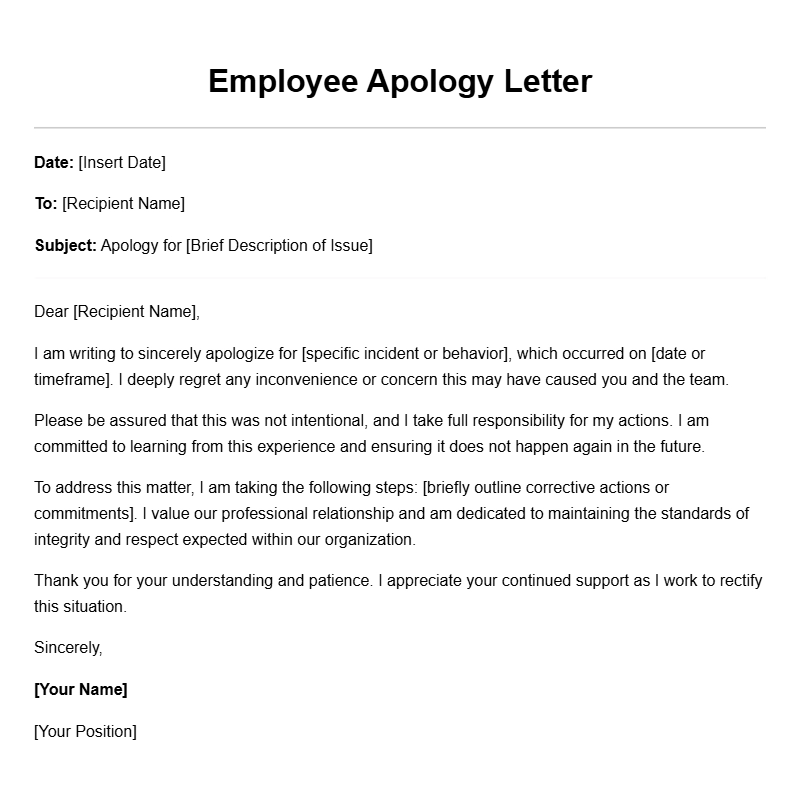
Formal Employee Apology Letter for Mistake
Dear [Manager’s Name],
I am writing to sincerely apologize for the mistake I made during the recent project. I understand the impact it may have caused and take full responsibility for my oversight.
To rectify this, I have already taken steps to correct the error and ensure it does not happen again. I value the trust placed in me and am committed to maintaining the highest standards of accuracy and professionalism moving forward.
Thank you for your understanding and support. Please let me know if there are any additional actions I should take.
Sincerely,
[Your Name]
Employee Apology Letter for Tardiness
Dear [Supervisor’s Name],
I would like to apologize for my recent tardiness on [specific date]. I understand punctuality is essential to our team’s productivity, and I regret any inconvenience caused.
Going forward, I will make a greater effort to arrive on time and adhere to the scheduled working hours. I appreciate your understanding and patience regarding this matter.
Thank you for your consideration.
Sincerely,
[Your Name]
Employee Apology Letter for Confidentiality Breach
Dear [HR Manager’s Name],
I am writing to sincerely apologize for inadvertently sharing sensitive company information with unauthorized personnel. I recognize the seriousness of this breach and deeply regret my oversight.
I am committed to following all confidentiality protocols strictly and will ensure such an incident does not recur in the future. Please let me know if there are any further steps required on my part to address this matter.
Thank you for your understanding.
Sincerely,
[Your Name]
Apology Letter for Poor Performance
Dear [Manager’s Name],
I would like to apologize for not meeting the expectations on my recent assignments. I acknowledge that my performance has not been up to the standard required and am actively working to improve my skills and productivity.
Thank you for your patience and guidance. I am committed to regaining your confidence and contributing effectively to our team’s objectives.
Sincerely,
[Your Name]
Employee Apology Letter for Absenteeism
Dear [Supervisor’s Name],
I sincerely apologize for my unexpected absence on [date(s)]. I understand that my absence may have disrupted the workflow, and I regret any inconvenience caused to the team.
Moving forward, I will ensure to inform you promptly about any future absences and follow the proper leave procedures. Thank you for your understanding and support.
Sincerely,
[Your Name]
Apology Letter for Inappropriate Conduct
Dear [Colleague’s Name],
I want to express my sincere apologies for my behavior during our recent interaction. My conduct was unprofessional, and I regret any discomfort or misunderstanding I caused.
I value a respectful and collaborative work environment, and I am committed to improving my behavior to foster positive relationships within our team.
Thank you for your understanding.
Sincerely,
[Your Name]
Employee Apology Letter for Missed Deadlines
Dear [Manager’s Name],
I apologize for not meeting the deadline for the [specific project or task] on [date]. I understand the importance of timely completion and regret any inconvenience caused by this delay.
I am currently taking steps to better manage my workload and ensure deadlines are met in the future. Your understanding is greatly appreciated.
Sincerely,
[Your Name]
Employee Apology Letter for Miscommunication
Dear [Team Lead’s Name],
I would like to apologize for any confusion caused by my recent communication regarding [specific issue]. I realize that clarity is vital in our collaborative efforts and regret any misunderstandings that may have arisen.
In the future, I will be more precise and thorough in my communications to prevent similar issues. Thank you for your patience and guidance.
Sincerely,
[Your Name]
Employee Apology Letter for Workplace Conflict
Dear [Colleague’s Name],
I want to sincerely apologize for the disagreement we had on [date]. I regret any tension or discomfort that resulted from my actions and wish to clarify that it was not my intention to cause conflict.
I value our professional relationship and am committed to working collaboratively in a respectful manner. I appreciate your understanding and hope we can move forward positively.
Sincerely,
[Your Name]