If you’re a freelance developer, having a clear, well-structured repair agreement template can save you headaches down the line. Whether you’re fixing a website bug, troubleshooting software, or making hardware adjustments, a solid agreement sets expectations and protects both parties. It’s especially helpful when you’re starting out or working with a new client, ensuring everyone’s on the same page from the get-go.
What Is a Freelance Developer Repair Agreement Template?
Think of it as a customizable contract that outlines the scope, terms, and expectations for repair work. Instead of drafting a new legal document each time, you can use a template tailored for freelance repairs. These templates typically include standard sections that you can adapt based on the specific project.
When to Use a Repair Agreement
- When fixing hardware or software for a client for the first time
- To clarify payment terms for repair services
- To define the scope of repairs and avoid scope creep
- To set timelines and delivery expectations
- To protect against liability if something goes wrong during repair
Key Components of a Freelance Repair Agreement Template
- Parties Involved: Names and contact info of both the freelancer and the client.
- Scope of Work: Clear description of what repairs will be performed.
- Payment Terms: Pricing, payment schedule, and payment methods.
- Timeline: Estimated start and completion dates.
- Materials and Tools: Who supplies parts or equipment?
- Liability and Warranties: Clarify warranties on repair work and liability limitations.
- Confidentiality and Data Security: Especially relevant if repairs involve sensitive information.
- Termination Terms: Conditions under which either party can end the agreement.
- Signatures: Space for both parties to sign and date.
Step-by-Step Guide to Writing Your Repair Agreement Template
- Start with basic details: Include full names, addresses, and contact info of both parties.
- Define the scope: Be specific about what the repair involves. For example, “Replace broken screen on iPhone 12” instead of “fix phone.”
- Set clear payment terms: Decide whether to charge a flat fee, hourly rate, or parts cost. Specify when payments are due — e.g., upfront, upon completion, or in milestones.
- Outline the timeline: Provide estimated start and finish dates, including any milestones or checkpoints.
- Address materials and warranties: Clarify if the client supplies parts, or if you’ll source them. State warranty periods if applicable, like “30-day warranty on repair quality.”
- Include legal protections: Add clauses about liability limits, data security, and confidentiality.
- Finish with signatures: Leave space for both parties to sign and date, confirming agreement.
Sample Template Snippet
Here’s an example snippet you might adapt for your own use:
Repair Agreement
This Repair Agreement is made between [Your Name], hereafter referred to as “Technician,” and [Client Name], hereafter referred to as “Client.”
Scope of Work
Technician will replace the cracked screen on the Client’s iPhone 12, model number XYZ, including testing to ensure proper functionality.
Payment
The total fee for this repair will be $150, payable upon completion.
Timeline
Work will commence on [Start Date] and is expected to be completed by [End Date].
Liability
Technician is not responsible for data loss during repair. The client is advised to back up important data prior to service.
Signatures
_________________________ Date: ________________
_________________________ Date: ________________
Common Mistakes to Avoid
- Being too vague about the scope, which can lead to misunderstandings.
- Not specifying payment terms clearly, causing delays or disputes.
- Overlooking warranty and liability clauses, leaving you unprotected if repairs fail.
- Ignoring confidentiality, especially if repairs involve sensitive data.
- Failing to include signatures, which makes the agreement less enforceable.
Tips for Customizing Your Repair Agreement Template
- Adjust the scope details based on the specific device or issue.
- Include your business policies, like cancellation or rescheduling procedures.
- Use clear, straightforward language to avoid confusion.
- Link to relevant policies or external documents if needed, like warranty policies.
- Consider adding a clause that references other agreements, such as nondisclosure or non-compete clauses if relevant.
Building your own freelance repair agreement template doesn’t have to be complicated. Start with a basic structure, customize it for each client, and keep it simple. If you need a broader set of templates, you might find value in checking out templates for related services, like travel agency repair agreements or online tutor agreements. These can serve as useful references for language and structure.
Having a clear, tailored repair agreement can make your freelance work smoother and more professional. It’s worth investing a little time upfront to draft something you can reuse and adapt, so you’re protected and your clients know exactly what to expect.
Common Document Templates & Previews
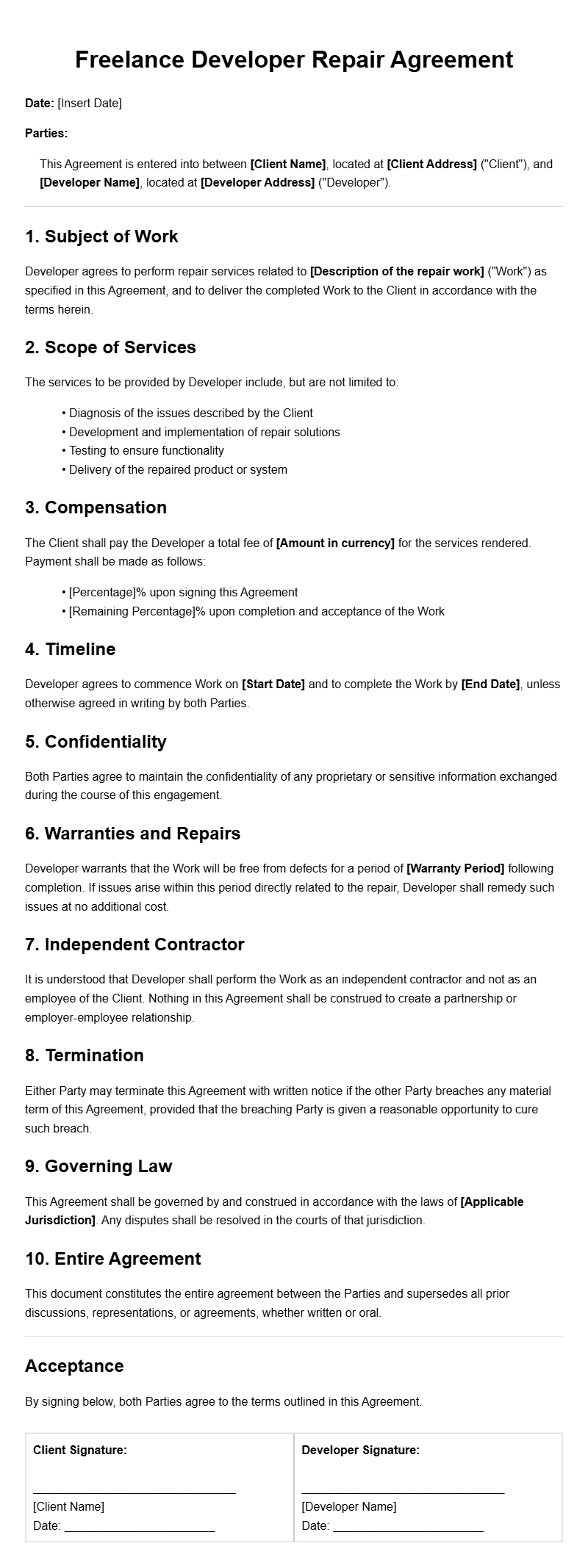
Standard Freelance Developer Repair Agreement
This Agreement is entered into between Client and Freelance Developer for the purpose of repairing and maintaining the Client’s software systems.
Scope of Work includes bug fixes, updates, and minor modifications as outlined in the project brief. The Developer agrees to complete the tasks within the timeframe specified and to deliver all code and documentation upon completion.
Payment terms are set at a fixed fee of $2,000, payable in two installments: 50% upfront and 50% upon delivery. Both parties agree to confidentiality and non-disclosure clauses to protect proprietary information.
This agreement is effective from the date signed and remains valid until project completion unless terminated earlier by either party with written notice.
Hourly Rate Repair Service Contract
This Freelance Developer Repair Agreement specifies an hourly billing rate of $50 per hour for all repair and troubleshooting services provided to Client.
The Developer will log hours worked and provide weekly reports detailing progress and hours spent. The Client reserves the right to request progress updates at any time.
Invoices will be issued bi-weekly and are payable within 7 days. The agreement includes provisions for scope adjustments, with additional work billed separately. Both parties agree to maintain confidentiality of all shared data.
This contract is valid for a period of three months, renewable upon mutual agreement.
Project-Based Freelance Repair Agreement
In this Agreement, Client hires Freelance Developer for the complete repair and optimization of their website, including bug fixes, security patches, and speed improvements.
The total fee for the project is set at $3,500, payable in three milestones: 30% upfront, 40% upon halfway completion, and 30% after final delivery. The Developer agrees to deliver the final version within six weeks.
Ownership of all code and related materials will transfer to the Client upon full payment. The Developer warrants the work against defects for 30 days post-completion.
Maintenance and Support Repair Agreement
This agreement establishes ongoing support services between Client and Freelance Developer for troubleshooting, bug fixing, and minor updates.
The Developer will provide support during business hours and respond within 24 hours to urgent issues. The monthly fee for maintenance is $500, billed at the beginning of each month.
Support includes up to 5 hours of work per month. Additional hours will be billed at $60/hour. Both parties agree to confidentiality and data security protocols.
This contract renews automatically unless either party provides 30 days’ written notice of termination.
Retainer Agreement for Repair Services
Under this Retainer Agreement, Client retains Freelance Developer for priority repair and troubleshooting services on an as-needed basis.
The Client pays a monthly retainer fee of $1,000, which covers up to 10 hours of work. Additional hours are billed at $70/hour. The Developer commits to prioritizing the Client’s requests during the retainer period.
This agreement is valid for a 12-month term, renewable upon mutual agreement. Both parties agree to confidentiality and data privacy standards.
Confidentiality and Repair Agreement
This document outlines the terms under which Freelance Developer will provide repair services to Client, including strict confidentiality obligations.
The Developer shall not disclose any sensitive information obtained during the course of the work, and all proprietary data shall remain confidential. Compensation is based on an hourly rate of $55, payable upon invoice.
Both parties agree that breach of confidentiality may result in termination of this agreement and legal action. This agreement remains in effect during and after the completion of the repair work.
Repair Service Estimate and Agreement
This document provides an estimate of repair costs for Client by Freelance Developer. The estimated fee is $1,200, covering bug fixes, security updates, and minor feature enhancements.
If additional work is required beyond the scope, the Developer will notify the Client for approval before proceeding. Payment is due within 14 days of invoice receipt.
Acceptance of this estimate constitutes agreement to these terms and conditions, including confidentiality and timely payment.
Remote Repair Agreement for Freelance Developer
This agreement authorizes Freelance Developer to perform remote repair and troubleshooting services for Client‘s digital systems.
Work will be conducted remotely, with scheduled weekly check-ins. The fee is $60 per hour, with an expected total of approximately 20 hours. Payment terms are net 10 days upon receipt of invoice.
Both parties agree to maintain communication and confidentiality throughout the project duration.
Repair and Software Update Agreement
This Agreement covers repair services and software updates for Client‘s existing systems. The scope includes fixing identified bugs and deploying the latest security patches.
The total fee is $2,500, payable in full upon completion. The Developer guarantees the work for 30 days from delivery, ensuring the system operates without the original issues.
All work performed is intellectual property of the Client upon full payment, with confidentiality maintained at all times.