If you’re working toward becoming a professional bookkeeper or trying to showcase your skills, having a well-crafted certificate sample can make all the difference. Whether you’re applying for a new job, seeking certification, or creating a portfolio, knowing what a solid bookkeeper certificate looks like can help you present your credentials more effectively. This guide will walk you through what to include in a certificate sample, how to customize it to fit your needs, and common pitfalls to avoid.
What Is a Bookkeeper Certificate Sample?
A bookkeeper certificate sample is a template or example document that demonstrates how you can present your certification credentials. It typically confirms that an individual has completed a course or met the requirements to be recognized as a qualified bookkeeper. These samples serve as a reference for creating your own certificate, ensuring it includes all necessary information in a professional format.
When Do You Need a Bookkeeper Certificate Sample?
- Applying for bookkeeping jobs or freelance projects.
- Showcasing your credentials on LinkedIn or professional portfolios.
- Substituting or supplementing official certification documents.
- Creating a formal certificate after completing a bookkeeping course or training program.
Key Components of a Bookkeeper Certificate Sample
Here’s what you should include to keep your certificate clear, credible, and professional:
- Title: Clearly state it as a “Certificate of Completion” or “Bookkeeper Certification.”
- Recipient’s Name: Full name of the individual receiving the certificate.
- Details of the Course or Program: Name of the course, institution, or organization granting the certificate.
- Date of Completion: When the certification was awarded.
- Signature and Seal: Space for signatures of authorized personnel and official seal or logo of the issuing body.
- Additional Information: Any relevant achievements, skills, or specializations (e.g., payroll, reconciliation).
Step-by-Step Guide to Writing a Bookkeeper Certificate Sample
- Start with a clear title: Use “Certificate of Completion” or “Certified Bookkeeper” at the top.
- Include recipient details: Write the full name clearly and accurately.
- Describe the course or certification: Mention the name of the program, institution, or certifying body.
- Add the completion date: Use a formal date format for clarity.
- Insert signatures and seals: Leave space for signatures from authorized personnel, such as a course instructor or organization director.
- Optional customization: Add a brief description of skills acquired or specific areas of expertise.
Example Templates for a Bookkeeper Certificate
Below is a sample template you can adapt for your own purposes:
Certificate of Completion
This certifies that
[Recipient’s Name]
has successfully completed the Bookkeeping Fundamentals Course offered by XYZ Learning Institute.
Date of Completion: [Date]
Signature
Date
Official Seal or Logo Here
Common Mistakes to Avoid
- Using vague or inaccurate course titles.
- Forgetting to include the date or signatures.
- Overloading the certificate with unnecessary information.
- Failing to proofread for typos or formatting issues.
- Not aligning the design with the professionalism expected in financial fields.
Tips for Customizing Your Certificate Sample
- Match the design to your branding or personal style, but keep it professional.
- Include your organization’s logo or signature for authenticity.
- Use clear, easy-to-read fonts and avoid cluttered layouts.
- Update the template with specific skills or modules completed, especially if the certification covers multiple areas.
- Save your template as an editable document (like Word or Google Docs) for easy updates.
Having a solid, realistic certificate sample makes it easier to showcase your skills convincingly. Whether you’re just starting out or looking to upgrade your credentials, a well-crafted certificate helps build trust and demonstrates your professionalism. If you’re exploring other types of certificates, you might find useful [here](https://example.com/web-developer-certificate-samples-certificate/) or [here](https://example.com/environmental-volunteer-certificate-templates-certificate/).
Practical Document Examples
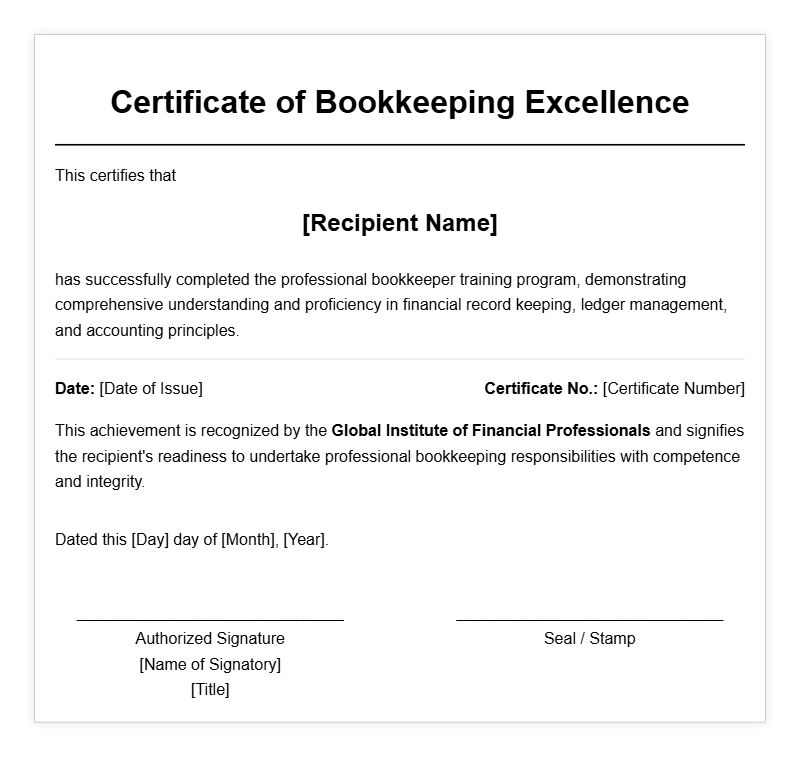
Sample Certificate for Completed Bookkeeping Course
This is to certify that [Recipient Name] has successfully completed the Fundamentals of Bookkeeping course on [Date]. The course covered essential topics including ledger management, reconciliation procedures, and financial record keeping. This certificate affirms the recipient’s proficiency in core bookkeeping skills and their readiness to undertake professional financial record-keeping responsibilities.
Professional Bookkeeper Certification Sample
Certificate of Achievement
This certifies that [Recipient Name] has demonstrated comprehensive understanding of bookkeeping principles and practices, earning the Certified Bookkeeper credential. This recognition is awarded based on successful completion of coursework and practical assessments, signifying the individual’s competence in managing accurate financial records and ensuring compliance with accounting standards.
Sample Certificate of Recognition for Bookkeeping Excellence
Presented to [Recipient Name]
In acknowledgment of outstanding performance and dedication in bookkeeping. This certificate recognizes the recipient’s commitment to precision, integrity, and professionalism in managing financial transactions and maintaining meticulous records. Awarded on [Date].
Sample Certificate of Attendance for Bookkeeping Workshop
This certifies that [Participant Name] attended and actively participated in the Advanced Bookkeeping Techniques workshop held on [Date]. The session provided practical training on ledger reconciliation, tax preparations, and software tools essential for modern bookkeeping tasks. This certificate confirms the participant’s engagement in enhancing their bookkeeping skills.
Sample Bookkeeper Certification Approval Letter
Dear [Recipient Name],
We are pleased to inform you that your application for the Bookkeeper Certification has been approved. Your demonstrated skills in managing financial records, understanding of accounting software, and adherence to ethical standards meet our certification requirements. You are now officially recognized as a certified bookkeeper.
Congratulations!
Sample Certificate of Continuing Education in Bookkeeping
This is to certify that [Recipient Name] has completed Continuing Education in Advanced Bookkeeping on [Date]. The program included modules on financial statement preparation, audit support, and regulatory compliance. This certification affirms the recipient’s ongoing commitment to professional development and excellence in financial record management.
Sample Recognition for Bookkeeping Internship
This certificate is awarded to [Intern Name] in recognition of successful completion of a bookkeeping internship at [Company Name]. During this period, the intern gained practical experience in ledger entries, bank reconciliations, and financial reporting. We commend their dedication and proficiency demonstrated during the internship period.
Sample Certificate for Bookkeeping Software Training
This certifies that [Participant Name] has completed training in QuickBooks for Bookkeepers on [Date]. The training covered software navigation, transaction entry, report generation, and data security practices. This certification confirms the participant’s ability to utilize accounting software efficiently in professional bookkeeping roles.
Sample Award for Excellence in Bookkeeping Practice
This award is presented to [Recipient Name] in recognition of exceptional accuracy and professionalism demonstrated in managing financial records at [Organization]. Their commitment to detail, ethical standards, and continuous learning significantly contributed to the integrity of our financial operations. Awarded on [Date].