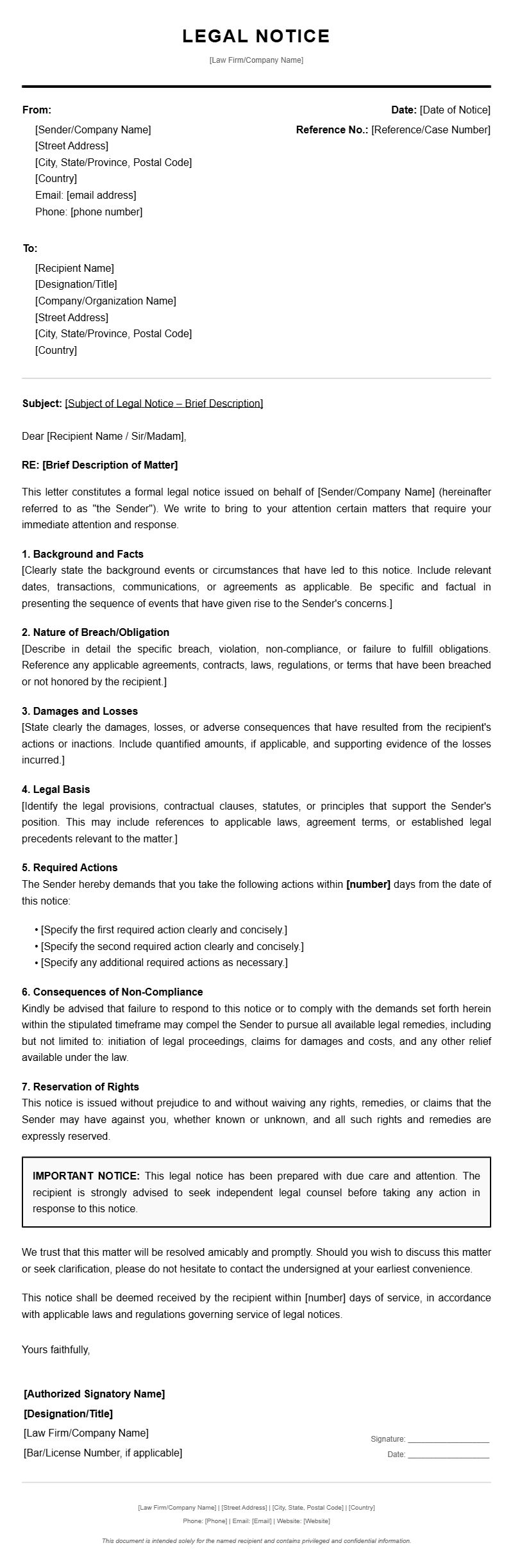
Getting a legal notice is stressful enough without worrying about whether your response is properly formatted. If you’re looking for legal notice letter templates that actually work in real situations, you’ve come to the right place. I’ve helped dozens of small business owners and individuals draft these letters over the years, and I’m going to walk you through everything you need to know — no legal degree required.
What Is a Legal Notice Letter?
A legal notice letter is a formal written communication that informs a person or business of a legal matter and demands specific action within a set timeframe. It’s not quite a lawsuit, but it’s serious — and it creates a paper trail that matters in court if things escalate.
Think of it as the middle ground between a friendly reminder and dragging someone to court. Most jurisdictions require you to send a legal notice before filing certain types of claims anyway, so getting the format right protects your interests from the start.
When Do You Actually Need to Send a Legal Notice?
Legal notices pop up more often than you’d think in everyday situations:
- Unpaid invoices — When a client or customer owes you money and regular reminders haven’t worked
- Lease disputes — Rent not paid, lease violations, or planned eviction proceedings
- Breach of contract — Someone failed to deliver goods, services, or meet agreed-upon terms
- Intellectual property violations — Someone’s using your copyrighted material or trademark without permission
- Employment matters — Formal warnings before termination or disputes over wages
- Property damage claims — When you need to formally document damage caused by another party
The key thing here is that a legal notice isn’t just “I’m upset.” It needs to state facts, point to relevant agreements or laws, and demand a specific response by a specific date.
Key Components Every Legal Notice Must Include
After looking at hundreds of these letters, the ones that actually work share a clear structure. Here’s what yours needs:
1. Header Information
Start with your full legal name or business name, address, and contact details. Then include the recipient’s information the same way. This seems obvious, but people forget this part when they’re focused on the body of the letter.
2. Date of Notice
Write the full date clearly at the top. This establishes your timeline and shows the recipient exactly when they received (or should have received) the notice.
3. Reference Number or Subject Line
Include a file reference or subject line like “Re: Unpaid Invoice #1234 dated March 15, 2024” so there’s no confusion about what this letter addresses.
4. Statement of Facts
This is the heart of your notice. Describe what happened using neutral, factual language. Stick to the who, what, when, and where. Avoid emotional language or accusations you can’t back up.
5. Legal Basis
Reference the contract, agreement, law, or statute that supports your position. You don’t need to quote entire legal documents, but you should point to specific clauses or sections.
6. Specific Demand
State exactly what you want the recipient to do. “Pay the outstanding amount of $2,450” is clear. “Please resolve this matter” is not. Be precise about the action required.
7. Deadline for Response
Give them a reasonable timeframe — typically 7 to 30 days depending on the situation and your jurisdiction. Include the exact date by which you expect a response or resolution.
8. Consequences of Non-Response
Calmly state what happens if they don’t respond. “Failure to respond within 14 days will result in referral to our legal team” is perfectly appropriate. No need for threats or aggressive language.
9. Signature Block
Sign it, print your name, and include your title if you’re representing a business. If you’re using a lawyer’s services, include their information too.
Step-by-Step: How to Write Your Legal Notice
Let’s walk through the actual process of drafting one of these letters, using a real scenario.
Scenario: A client hasn’t paid your invoice in 90 days
Step 1: Gather your documentation
Before you write anything, collect your supporting documents. In this case, that means the original invoice, any email reminders you sent, and your contract or service agreement with the client. Having these in front of you keeps your facts straight.
Step 2: Choose your tone
This is a business letter, not a rant. You’re documenting a situation and demanding action. Professionalism protects you legally and makes the recipient more likely to take you seriously.
Step 3: Draft the facts section
Write out what happened without embellishment. “Invoice #4521 for website development services in the amount of $3,200 was sent to [Client Name] on January 15, 2024. As of today’s date, no payment has been received despite three follow-up emails on February 1, February 15, and March 1.”
Step 4: Reference your contractual basis
Point to the specific payment terms. “Per Section 4.2 of our service agreement dated December 10, 2023, payment is due within 30 days of invoice date.”
Step 5: State your demand clearly
“We demand full payment of $3,200 by April 15, 2024.”
Step 6: Add the consequences
“If we do not receive payment by this date, we will have no choice but to pursue legal remedies, including filing a claim in [your local court], and we will seek reimbursement for any associated legal costs.”
Legal Notice Letter Template
Here’s a clean template you can adapt for most situations:
[Your Business Name or Full Legal Name]
[Your Address]
[City, State, ZIP]
[Phone Number]
[Email Address]
Date: [Insert Date]
[Recipient Name]
[Recipient Business Name]
[Recipient Address]
[City, State, ZIP]
Re: [Brief Description of Matter — e.g., Unpaid Invoice #1234 / Breach of Contract dated January 1, 2024]
Dear [Recipient Name],
This letter serves as formal notice regarding [state the issue clearly and concisely].
[Insert factual background: what happened, when, relevant documents or agreements, and what attempts have been made to resolve the matter]
Pursuant to [reference relevant contract clause, statute, or legal basis], you are hereby notified that [state your demand].
We require payment/resolution by [specific date — typically 14 to 30 days from the date of this letter].
Please direct all correspondence and payment to [your contact information]. Failure to respond by the specified date may result in further legal action without additional notice, including but not limited to [mention possible consequences briefly].
Sincerely,
[Your Signature]
[Your Printed Name]
[Your Title]
If you need a more formal notice format, you might also look at our attendance policy notice letter templates which cover similar formal documentation styles for employment-related matters.
Template for Demand of Payment Notice
If your situation specifically involves money owed, here’s a more targeted version:
DATE: [Current Date]
TO: [Debtor Name]
ADDRESS: [Debtor Address]
RE: Outstanding Balance — Invoice #[Number]
Dear [Name],
This is a formal demand for payment of the sum of $[Amount] currently overdue on Invoice #[Number] issued on [Date].
Despite previous communications regarding this debt, we have not received payment or a response outlining a repayment arrangement.
Payment Required By: [Date — allow minimum 14 days]
Payment Methods: [List accepted methods]
If payment is not received by the above date, we will consider this matter unresolved and will proceed with additional collection measures or legal action as appropriate.
[Your Name/Business Name]
[Signature]
Common Mistakes People Make
I’ve seen these errors repeatedly, and they can weaken your position or even invalidate your notice in some cases:
1. Vague Language
“We believe you owe us money” doesn’t cut it. Specify exactly what is owed, under what agreement, and when it was due. Vague notices get vague responses — and that’s not helpful to anyone.
2. Missing Deadlines
Not giving a specific response date is a common oversight. Without a deadline, the recipient has no urgency to act, and you have less grounds to claim they “ignored” your notice.
3. Emotional or Threatening Tone
Going off on someone might feel satisfying, but it undermines your credibility and can come back to haunt you. Keep it factual and professional. Save the drama for court if it comes to that.
4. Forgetting Supporting Documentation
Always attach copies of the relevant invoices, contracts, or correspondence. A notice that says “you owe us money” with no backup is far weaker than one with attached proof.
5. Incorrect Recipient Information
Sending a legal notice to the wrong business entity or an old address can create problems. Double-check that you’re sending it to the legal entity (LLC, Corporation, etc.) and the correct current address.
6. Not Keeping Records
Send your notice via certified mail with return receipt, or via email with read receipt. You need proof of delivery. If you later need to go to court, “we sent it” isn’t enough — “here’s the delivery confirmation” is what matters.
Tips for Customizing Your Template
Every situation is different, so your notice should be too. Here’s how to make these templates work for your specific case:
Match the Stakes to the Situation
A late invoice from a long-standing client deserves a gentler approach than discovering someone is actively using your copyrighted designs. Adjust your language and deadlines accordingly. First-time issues with a reliable customer? A softer tone preserves the relationship. Repeated non-payment or clear wrongdoing? Be firm and direct.
Know Your Jurisdiction’s Requirements
Some legal notices have specific statutory requirements — especially for things like eviction, mechanic’s liens, or debt collection. Check your local laws before sending, or consult with an attorney for situations involving significant money or property.
Include All Relevant Reference Numbers
For business disputes, reference every relevant document: contract numbers, invoice numbers, project codes, and dates. The easier you make it for the recipient to verify your claims, the faster this tends to resolve.
Decide on Delivery Method
Email works for lower-stakes matters or when you need a quick response. Certified mail with return receipt is better for anything that might end up in court. Some situations may even warrant using a process server — but that’s usually for later stages when formal service is required.
Consider Including a Proposed Resolution
Sometimes offering a path forward helps. “Pay the $5,000 owed by March 1, or contact us to discuss a payment plan by February 25” gives the recipient options and shows you’re acting in good faith.
For related business correspondence needs, our business proposal letter samples offer templates that follow similar professional formatting conventions.
When to Get a Lawyer Involved
These templates work well for straightforward situations — unpaid invoices, simple contract breaches, or clear-cut disputes where you have documentation. But some matters genuinely benefit from legal review before you send anything:
- Anything involving potential defamation or serious accusations
- Situations where the other party has already threatened to sue
- Complex contract disputes with ambiguous terms
- Matters involving significant sums of money (your call on what “significant” means for your situation)
- Any eviction-related notices, which often have strict statutory requirements
A lawyer can review your draft and make sure you’re not accidentally waiving rights, using unenforceable language, or missing legal requirements. It’s a worthwhile investment when the stakes are high.
Final Thoughts
A well-written legal notice does three things: clearly states the problem, references the basis for your demand, and gives the recipient a specific way to make it right. That’s it. You don’t need fancy legalese or aggressive posturing — you need accuracy, clarity, and a paper trail.
Use the templates above as starting points, customize them for your situation, and always keep copies of everything you send. In most cases, a professional notice is enough to prompt resolution without ever stepping into a courtroom.
Template Variations & Sample Formats