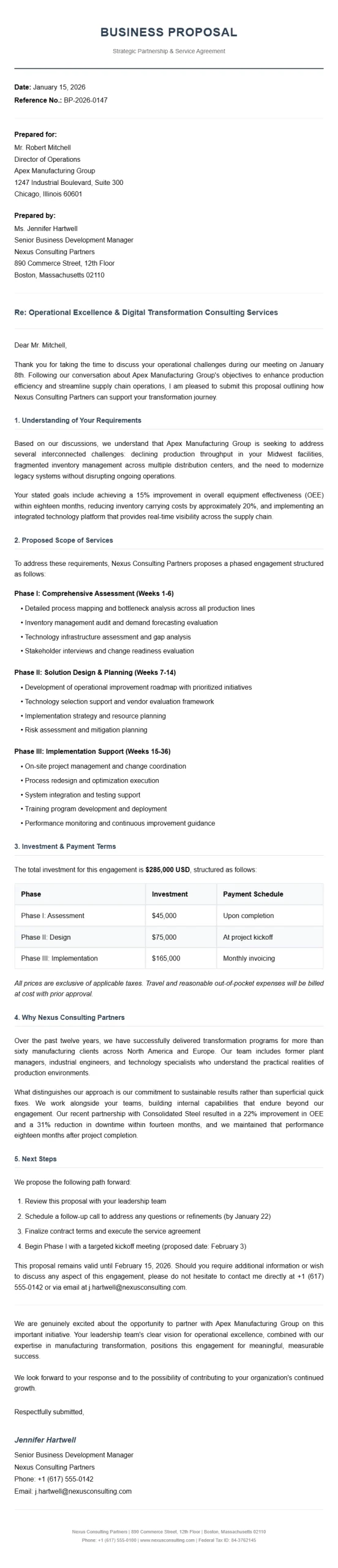
When you need to pitch your services or products to a potential client, having a solid business proposal letter can make the difference between landing that contract and watching it slip away. I’ve reviewed hundreds of these letters over the years, and the ones that work best share certain traits: they’re specific about what you’re offering, they address the client’s actual needs, and they make it easy for the reader to take the next step. This guide walks you through everything you need to write a business proposal letter that gets results, with real examples you can adapt for your own situation.
WHAT IS A BUSINESS PROPOSAL LETTER?
A business proposal letter is a formal document you send to a prospective client or partner to propose a business arrangement. Unlike a sales email that might be brief and casual, a proposal letter outlines what you’re offering, how it benefits the other party, and the terms of the engagement. Think of it as your first professional impression in writing—you’re demonstrating that you understand their situation and have a clear plan to help.
These letters typically come into play when you’re responding to a request for proposal (RFP), reaching out to a new prospect, or extending an existing business relationship into new territory. The goal is to convince the reader that working with you is the right move, without overwhelming them with information they didn’t ask for.
WHEN SHOULD YOU USE A BUSINESS PROPOSAL LETTER?
Not every business conversation needs a formal proposal letter. Here’s when this format makes sense:
- You’ve been asked to submit a formal proposal for a project or contract
- You’re introducing your services to a company you’ve identified as a good fit
- You want to expand an existing client relationship into new services
- You’re responding to a tender or procurement opportunity
- You need to outline specific terms, timelines, and pricing for a potential engagement
If you’re just starting a conversation or building rapport, a shorter introductory email might serve you better. Save the full proposal letter for moments when you’re ready to move toward a formal decision.
KEY COMPONENTS OF AN EFFECTIVE BUSINESS PROPOSAL LETTER
Most successful business proposal letters contain the same essential sections, even if they vary in length and detail. Getting these components right lays the groundwork for a persuasive document.
HEADER AND CONTACT INFORMATION
Start with your business information at the top: your company name, address, phone number, and email. Below that, include the date and the recipient’s details—their name, title, company, and address. This might seem basic, but it establishes professionalism and makes it easy for someone to contact you.
PERSONALIZED GREETING
Address the letter to a specific person whenever possible. “Dear Ms. Chen” reads much better than “To Whom It May Concern.” If you genuinely don’t know the recipient’s name, “Dear Hiring Manager” or “Dear [Company Name] Team” works, but do some digging first—checking the company website or LinkedIn often turns up a name.
CLEAR SUBJECT LINE OR OPENING STATEMENT
Get to the point immediately. Something like “Proposal for Marketing Services for Greenfield Industries” tells the reader exactly what to expect. Skip the lengthy preambles about how honored you are to submit this proposal.
BODY: UNDERSTANDING THEIR NEEDS
Demonstrate that you’ve done your homework. Reference something specific about their business—a recent project, a challenge they’ve mentioned, or a goal they’ve publicly stated. This shows you’re not sending a generic template and that you actually care about solving their particular problem.
BODY: YOUR PROPOSED SOLUTION
Describe what you’re offering in concrete terms. Instead of “I will manage your social media,” try “I will create and schedule 20 posts per month across Facebook, Instagram, and LinkedIn, along with community management and monthly performance reports.” Specificity builds trust.
BODY: TIMELINE AND DELIVERABLES
Lay out when things will happen and what the client will receive. A simple timeline or bullet list of deliverables helps the reader visualize working with you and sets clear expectations from the start.
BODY: PRICING AND TERMS
Include your fees or pricing structure clearly, even if you need to provide a range. Be upfront about what’s included and what might incur additional costs. Transparency here prevents misunderstandings later and shows confidence in your value.
PROFESSIONAL CLOSING
End with a clear next step. “I would welcome the opportunity to discuss this proposal with you further” is standard and effective. Include your contact information again so it’s easy to reach you. Close with “Sincerely” or “Best regards” followed by your signature and typed name.
STEP-BY-STEP GUIDE TO WRITING YOUR BUSINESS PROPOSAL LETTER
Follow these steps to create a proposal letter that stands out:
Step 1: Research the Recipient
Before you write a single word, learn about the company you’re approaching. What do they do? What challenges might they be facing? Have they worked with anyone similar before? Check their website, recent news mentions, and LinkedIn presence. The more you know, the more relevant your proposal becomes.
Step 2: Define Your Objective
Be clear about what you’re proposing. Are you offering a specific service? A product? A partnership? A timeline? Write down exactly what success looks like for both parties. Ambiguity here leads to confusion throughout the rest of the letter.
Step 3: Structure Your Draft
Start with a rough draft that hits all the key components listed above. Don’t worry about perfect wording at this stage—just get the information down. You can refine the language once you have all the pieces in place.
Step 4: Customize for Your Audience
Edit your draft to speak directly to this specific recipient. Replace generic statements with specific references to their business. Adjust your tone if you’re writing to a startup versus a large corporation. The more personalized, the more compelling.
Step 5: Review for Clarity and Length
Read your letter out loud. Does it flow? Is anything unclear? Can someone with no prior knowledge of your conversation understand what you’re proposing? Most business proposal letters should be one to two pages. If yours runs longer, trim the less essential details.
Step 6: Proofread Carefully
Typos and grammatical errors undermine your professionalism. Read the letter at least twice, check names and company names for correct spelling, and if possible, have someone else review it. Fresh eyes catch mistakes you might miss.
PRACTICAL EXAMPLES AND EDITABLE TEMPLATES
Seeing how these components come together in real examples helps more than any abstract explanation. Here are two scenarios with corresponding templates you can customize.
EXAMPLE 1: SERVICE PROPOSAL TO A NEW CLIENT
Imagine you run a small web development agency, and you’ve identified a local nonprofit that needs a website redesign. You’ve done some research and think your services would be a good fit. Here’s how that letter might look:
[Your Company Name]
123 Design Street, Suite 100
Portland, OR 97201
(503) 555-0142
info@yourcompany.com
March 15, 2025
Ms. Sarah Mitchell
Executive Director
Community Partners Foundation
456 Nonprofit Avenue
Portland, OR 97205
Dear Ms. Mitchell,
I am writing to propose a website redesign project for Community Partners Foundation. I noticed your current website hasn’t been updated since 2021, and with your annual fundraising gala approaching, an updated online presence could help improve donor engagement and event registration.
My team would deliver a modern, mobile-responsive website with the following features: updated homepage design reflecting your current programs, integrated event calendar, donation button with Stripe integration, and a content management system so your staff can make updates without technical knowledge.
We propose a four-week timeline: design mockups in week one, development in weeks two and three, testing and launch in week four. Our fee for this project is $4,800, which includes all design, development, and two hours of training for your team.
I would be happy to schedule a call to discuss this proposal in more detail. Please feel free to reach me at (503) 555-0142 or sarah@yourcompany.com.
Sincerely,
[Your Name]
EXAMPLE 2: PRODUCT PROPOSAL TO AN EXISTING CLIENT
Perhaps you supply office equipment and want to offer a long-standing client a new product line. Here’s a template for that scenario:
[Your Company Name]
789 Supply Road
Austin, TX 78701
(512) 555-0198
orders@yourcompany.com
April 8, 2025
Mr. David Park
Operations Manager
Sterling Medical Group
321 Health Plaza
Austin, TX 78702
Dear Mr. Park,
I wanted to reach out about an opportunity to expand our current partnership. As you know, we’ve been supplying print equipment and maintenance to Sterling Medical Group for the past three years. I’ve noticed your recent expansion into the north Austin location, and I think we can help with your new office’s supply needs.
We now carry a full line of ergonomic office furniture, including standing desks, ergonomic chairs, and monitor arms—all available with the same volume pricing you’ve enjoyed on our equipment orders. We can also provide installation services if that would be helpful for your new space.
I’d like to set up a brief meeting to walk through our furniture catalog and discuss pricing options. Would April 22nd or 23rd work for a 30-minute call?
Best regards,
[Your Name]
COMMON MISTAKES TO AVOID
Even experienced professionals stumble into these pitfalls. Watch out for:
- Using a one-size-fits-all template without customization. Recipients can tell when they’re getting the same letter you sent to ten other companies. At minimum, swap out the company name and personalize the opening paragraph.
- Focusing on yourself instead of the client. Statements like “We are the leading provider…” miss the point. The client wants to know what’s in it for them, not a list of your accolades.
- Being vague about deliverables. Words like “quality work” and “excellent service” mean nothing without specifics. Back up your claims with concrete examples of what you’ll actually deliver.
- Including every service you offer. If you’re proposing accounting services, your landscaping capabilities aren’t relevant. Stay focused on what the client needs and why you’re the right fit for that specific request.
- Forgetting a clear call to action. If you don’t tell the reader what to do next, they probably won’t do anything. End with a specific next step, whether that’s scheduling a call, visiting a website, or replying to confirm interest.
- Letting the letter drag on too long. Decision-makers are busy. Respect their time by cutting unnecessary fluff and keeping your proposal tight and focused.
TIPS FOR CUSTOMIZING YOUR BUSINESS PROPOSAL LETTER
These templates give you a starting point, but customization is where your letter becomes effective. Here’s how to adapt:
- Match the formality level of the recipient. A tech startup might appreciate a more casual, conversational tone, while a law firm or government agency expects traditional formal language.
- Reference specific details. Mention a recent article about their company, a project they completed, or a stated business goal. This shows you’ve done the research and aren’t just blasting out generic letters.
- Adjust the length based on complexity. A simple, straightforward proposal might be one page. A complex multi-phase project might need two pages plus attachments. Match the depth of your proposal to the complexity of the engagement.
- Include relevant credentials without overdoing it. A brief mention of relevant experience or past clients in a similar industry builds credibility. Save the full portfolio for a separate document if the client wants more details.
- Tailor your pricing to their context. A small nonprofit has a different budget than a Fortune 500 company. If you know their size or industry, adjust your pricing expectations or payment terms accordingly.
If you found this guide helpful, you might also want to explore our confirmation letter samples for other professional correspondence templates. For those navigating workplace transitions, our promotion request letter samples offer practical advice on making your case to management.
A well-crafted business proposal letter opens doors. It shows professionalism, demonstrates that you understand the client’s needs, and gives the reader a clear path to say yes. Use these templates as a foundation, customize them for each opportunity, and you’ll have a tool that serves you throughout your career.
Standard Format & Layout Reference