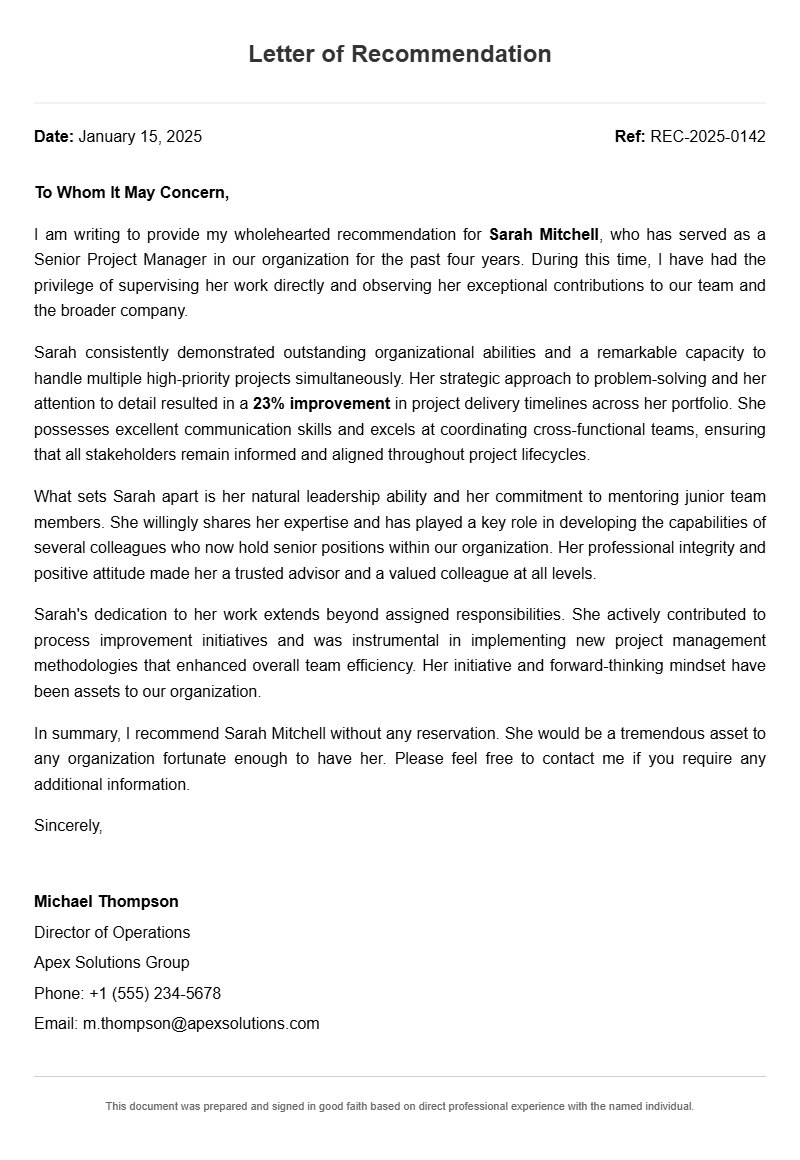
If you’ve been asked to write a recommendation letter for a former employee, you’re probably looking for a solid example to follow so you can hit the right tone, structure, and details. Below is a practical guide with a ready‑to‑use template, step‑by‑step instructions, and common pitfalls to watch out for. You’ll also find tips for tailoring the letter to different roles, plus a few related resources that might come in handy for other types of professional correspondence.
WHAT IS AN EMPLOYEE RECOMMENDATION LETTER?
A recommendation letter is a formal written endorsement from a manager, supervisor, or colleague that speaks to an individual’s work habits, skills, and achievements. It’s usually submitted with a job application, an internal promotion request, or an academic program to give the recipient a third‑party perspective on the candidate’s performance.
WHEN WOULD YOU NEED ONE?
Here are some of the most common situations where a recommendation for an employee letter becomes necessary:
- Applying for a new job at another company.
- Seeking an internal promotion or transfer.
- Enrolling in a graduate program or professional certification.
- Supporting a visa or immigration application that requires professional references.
- Providing a reference for a freelance or contract role.
If you’re also handling a partnership termination, you might find our partnership termination letter templates useful for structuring that separate correspondence.
WHAT SHOULD THE LETTER CONTAIN?
A well‑structured recommendation letter typically includes the following sections:
- Header – Your name, title, organization, and the date.
- Recipient Information – The person or committee receiving the letter (if known).
- Opening Paragraph – State your relationship to the employee and the purpose of the letter.
- Body – Specific examples of responsibilities handled, projects completed, and measurable outcomes.
- Personal Attributes – Soft skills, teamwork, leadership, and work ethic.
- Closing Statement – A clear endorsement and an offer to provide further information.
- Signature – Your handwritten signature (if printed) or a digital signature, plus typed name and contact details.
For a quick comparison with another formal note, see how a warranty claim letter sample starts with a clear header and direct purpose.
STEP-BY-STEP GUIDE TO WRITE THE LETTER
- Gather specifics from the employee. Ask for a copy of the job description, the target role, and any achievements they’d like highlighted.
- Review your own experiences. Think of 2‑3 concrete projects or situations where the employee’s performance stood out.
- Choose the right tone. Keep it professional but personable; avoid overly formal jargon.
- Draft a compelling opening. Begin with your relationship, the duration you worked together, and the role the employee held.
- Insert detailed examples. Use numbers or specific outcomes (“increased client retention by 15%”) to make the endorsement concrete.
- Highlight relevant soft skills. Mention teamwork, communication, problem‑solving, or adaptability that match the new position.
- Write a confident closing. Reiterate your recommendation and provide your contact info for follow‑up.
- Proofread and format. Keep the letter to one page, use a clean font, and double‑check names and dates.
If you’re also preparing a school workshop invitation, our school workshop invitation letter samples show how to keep the opening concise while still being engaging.
READY‑TO‑USE TEMPLATE AND EXAMPLE
Template (edit as needed):
[Your Name]
[Your Title]
[Company/Organization]
[Address]
[City, State, ZIP]
[Email] | [Phone]
[Date]
[Recipient Name] (if known)
[Recipient Title]
[Company/Organization]
[Address]
[City, State, ZIP]
Dear [Recipient],
I am writing to recommend [Employee Name] for [position/ program] at [Target Company/Institution]. During [duration] at [Your Company], I supervised [him/her/them] in the role of [Employee’s Title]. [He/She/They] consistently demonstrated [key skill], most notably by [specific achievement].
For example, [Employee] led a cross‑functional team that delivered a new customer onboarding process three weeks ahead of schedule, reducing support tickets by 22 %. [He/She/They] also mentored junior staff, fostering a collaborative environment that improved overall team morale.
Beyond technical expertise, [Employee] shows strong communication, adaptability, and integrity. [He/She/They] thrives under pressure and always keeps the bigger picture in mind.
I give [Employee] my highest recommendation. Please feel free to contact me at [phone] or [email] if you need further details.
Sincerely,
[Your Signature]
[Your Typed Name]
[Your Title]
Sample (based on the template):
“I am writing to recommend Maya Patel for the Senior Project Manager role at Bright Solutions. During her three years at Apex Tech, I supervised her as Director of Operations. She consistently demonstrated exceptional project management skills, most notably by leading a cross‑functional team that delivered a new client onboarding process three weeks ahead of schedule, reducing support tickets by 22 %. Maya also mentored junior staff, fostering a collaborative environment that improved overall team morale.”
COMMON MISTAKES TO AVOID
- Being vague. Generic statements like “hard‑working” without examples won’t convince readers.
- Overusing superlatives. Saying someone is “the best employee ever” without evidence sounds unrealistic.
- Including irrelevant info. Keep the focus on professional performance; personal details aren’t needed.
- Skipping proofreading. Typos or errors undermine credibility.
- Missing contact information. If the hiring manager can’t follow up, the letter loses impact.
- Using the same letter for every candidate. Tailor each endorsement to the specific role.
TIPS FOR CUSTOMIZING YOUR LETTER
- Match the job description. Pull key words from the posting and weave them into your examples.
- Highlight industry‑specific skills. For technical roles, mention certifications or tools; for creative roles, focus on innovative outcomes.
- Adjust tone for the audience. A corporate recruiter may appreciate a more formal voice, while a startup founder might welcome a conversational style.
- Add cultural fit points. If the new organization values diversity, mention how the employee contributed to an inclusive team.
- Reference a specific project relevant to the target company. If the new employer is expanding into a market the employee has experience with, mention that directly.
For writers seeking feedback from publishers, our publisher-to-author letter samples offer insight into tone when communicating with literary professionals.
PUTTING IT ALL TOGETHER
Writing a strong recommendation for an employee doesn’t have to feel overwhelming. Start by gathering concrete details, structure the letter around clear sections, and back up every claim with a specific example. Use the template above as a base, edit the language to fit the role, and proofread before you send. With a little effort, you’ll deliver a letter that hiring managers and committees can trust—and that truly reflects the employee’s strengths.
Common Document Templates & Previews