When you’re navigating the world of publishing, one of the key documents you’ll encounter is the letter from a publisher to an author. This letter can serve multiple purposes, from outlining a book deal to providing feedback on a manuscript. Understanding how to structure these letters can make all the difference in your communication and professional relationships.
WHAT IS A PUBLISHER TO AUTHOR LETTER?
A publisher to author letter is a formal communication that outlines important details regarding a book project. This can include acceptance of a manuscript, terms of publication, or constructive feedback. It sets the tone for the working relationship between the publisher and the author, ensuring everyone is on the same page.
WHEN IS IT USED?
- When an author’s manuscript is accepted for publication.
- To communicate revisions needed before final acceptance.
- To discuss contract details and terms of the publishing agreement.
- To offer constructive feedback on submitted work.
KEY COMPONENTS OF A PUBLISHER TO AUTHOR LETTER
Each letter will vary based on its purpose, but generally, it should include:
- Subject Line: A clear subject indicating the letter’s purpose.
- Greeting: A professional salutation addressing the author.
- Introduction: A brief overview of the letter’s purpose.
- Body: Detailed information regarding the manuscript, feedback, or contract terms.
- Conclusion: A friendly closing statement encouraging further communication.
- Signature: The publisher’s name and title, along with contact information.
STEP-BY-STEP WRITING GUIDE
Writing a letter to an author can be broken down into manageable steps:
- Define the Purpose: Clearly identify why you are writing. Is it to accept a manuscript, request revisions, or provide feedback?
- Gather Information: Collect any relevant details that need to be included, such as deadlines or specific feedback.
- Draft the Letter: Start with a clear subject line, followed by a greeting and concise introduction.
- Detail the Main Content: Use clear language to convey your message. If you’re offering feedback, be specific and constructive.
- Close Professionally: Include a friendly note inviting the author to reach out with questions or for clarification.
REALISTIC EXAMPLES AND TEMPLATES
Here are a couple of sample snippets for different scenarios:
Acceptance Letter Example
Subject: Manuscript Acceptance – [Book Title]
Dear [Author’s Name],
I am pleased to inform you that we have decided to move forward with publishing your manuscript, [Book Title]. Your work stood out due to its unique perspective and engaging narrative.
We are excited to discuss the next steps, including contract details and publication timeline. Please feel free to reach out if you have any questions.
Best regards,
[Your Name]
[Your Title]
[Publishing Company]
Feedback Letter Example
Subject: Feedback on Your Manuscript – [Book Title]
Dear [Author’s Name],
Thank you for submitting your manuscript, [Book Title]. While we appreciate your effort and creativity, we believe some revisions are necessary to enhance its impact.
We suggest focusing on [specific areas for improvement]. Please let us know if you would like to discuss this feedback further.
Looking forward to your revised draft.
Best,
[Your Name]
[Your Title]
[Publishing Company]
COMMON MISTAKES TO AVOID
Here are a few pitfalls to watch out for:
- Being too vague. Clear and specific communication helps avoid misunderstandings.
- Using overly formal language. A conversational tone can foster better relationships.
- Neglecting to proofread. Spelling and grammar errors can undermine professionalism.
TIPS FOR CUSTOMIZATION
Tailor each letter to fit the specific author and manuscript. Here are some suggestions:
- Personalize the greeting and mention the manuscript title.
- Include specific feedback or highlights from the manuscript to show genuine interest.
- Adjust the tone based on your relationship with the author; a more established author might prefer a casual tone.
Writing a publisher to author letter doesn’t have to be daunting. By following these guidelines and examples, you can create clear, effective communication that strengthens your professional relationships. Whether you’re accepting a manuscript or offering feedback, these letters are key tools in the publishing process.
Common Document Templates & Previews
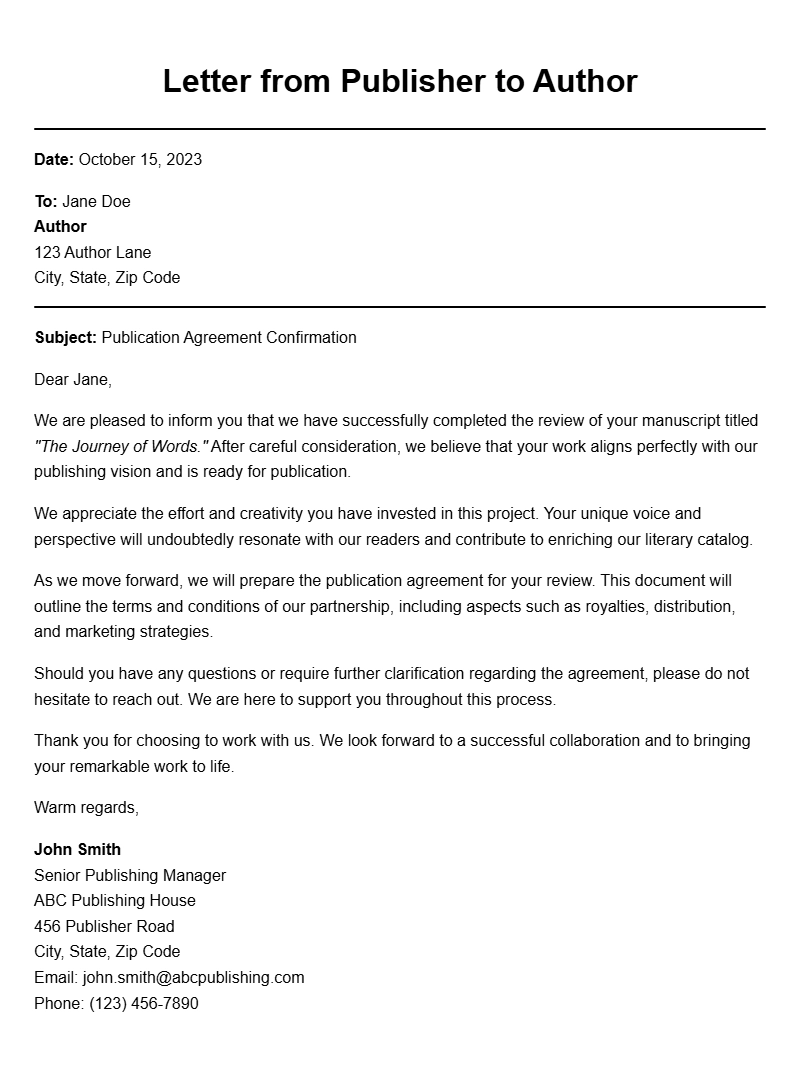
Invitation to Submit Manuscript
Dear Author,
We are pleased to invite you to submit your manuscript for consideration in our upcoming anthology titled Voices of Tomorrow. Your previous work in the genre has impressed our editorial team, and we believe your writing would be a valuable addition.
Please find the submission guidelines attached for your reference:
- Word count: 5,000 – 8,000 words
- Format: Microsoft Word or PDF
- Deadline: March 15, 2024
We look forward to your submission and are excited about the possibility of collaborating with you.
Best regards,
John Smith
Editorial Director
ABC Publishing
Acceptance of Manuscript
Dear [Author’s Name],
Congratulations! We are delighted to inform you that we have accepted your manuscript, [Title of Manuscript], for publication with our company.
We appreciate your patience throughout the review process and are excited to begin the next steps in bringing your work to readers.
To proceed, please review and sign the attached publishing agreement. Additionally, we will need the following:
- A brief author bio
- High-resolution cover image
Thank you for choosing us as your publisher. We look forward to working with you!
Sincerely,
Emily Johnson
Acquisitions Editor
XYZ Publishing
Rejection Letter for Manuscript
Dear [Author’s Name],
Thank you for submitting your manuscript, [Title of Manuscript], for our consideration. After careful review, we regret to inform you that we will not be moving forward with publication.
This decision was not easy, as we received many strong submissions. We encourage you to consider submitting your work elsewhere and wish you the best of luck in your publishing journey.
Thank you once again for considering us.
Best regards,
Rachel Green
Editor-in-Chief
Publishing House
Request for Revisions
Dear [Author’s Name],
Thank you for your submission of [Title of Manuscript]. We appreciate the effort you put into your work. After a thorough review, our editorial team has some suggestions for revisions.
Key areas for improvement include:
- Clarifying character motivations
- Enhancing the pacing in the middle chapters
- Addressing minor grammatical errors
We believe these changes will significantly strengthen your manuscript. Please submit your revised version by April 30, 2024.
Looking forward to your updated submission!
Best,
Mark Taylor
Senior Editor
Literary Press
Contract Confirmation
Dear [Author’s Name],
This letter serves as confirmation of the contract we have entered into for the publication of your work, [Title of Manuscript]. We are thrilled to partner with you on this project.
Enclosed is a checklist of important dates and deliverables:
| Task | Due Date |
|---|---|
| Manuscript Submission | June 1, 2024 |
| Final Edits | August 15, 2024 |
| Publication Date | December 1, 2024 |
Thank you for trusting us with your work. We will keep you updated throughout the process.
Sincerely,
Laura White
Contracts Manager
Publishing Company
Notification of Publication Schedule
Dear [Author’s Name],
We are excited to announce that your book, [Title of Manuscript], is scheduled for publication on [Publication Date]. As we move forward, we would like to discuss promotional strategies and book launch events.
Please consider the following options for engagement:
- Social media promotion
- Virtual book readings
- Print and online advertisements
Let us know your preferences, and we will work to ensure a successful launch!
Warm regards,
Tom Harris
Marketing Director
Book Publishers Inc.
Author Payment Notification
Dear [Author’s Name],
We are pleased to inform you that your payment for the recent sales of [Title of Manuscript] has been processed. Below are the details of your payment:
| Payment Type | Amount |
|---|---|
| Royalty Payment | $[Amount] |
This payment reflects sales from the last quarter and will be deposited to your account shortly. Thank you for your continued partnership.
Best,
Linda Brown
Finance Manager
Publishing House
Invitation to Author Event
Dear [Author’s Name],
We are thrilled to invite you to participate in our upcoming author event on [Date]. This is a wonderful opportunity to connect with readers and promote your work, [Title of Manuscript].
The event will include:
- Book signings
- Readings from your work
- Q&A sessions with the audience
Please let us know if you are available to join us. We would be honored to have you!
Sincerely,
Jessica King
Event Coordinator
Literary Events Ltd.
Feedback on Manuscript Submission
Dear [Author’s Name],
Thank you for submitting your manuscript, [Title of Manuscript], for our review. We have completed our evaluation and would like to offer you some constructive feedback.
Here are the main points from our review:
- Strong character development, particularly in the protagonist
- Engaging plot but requires tighter pacing in the latter chapters
- Inconsistencies in the timeline that need clarification
We encourage you to consider these suggestions before resubmitting. Thank you for the opportunity to read your work.
Best regards,
Sarah White
Editorial Assistant
Quality Publishing