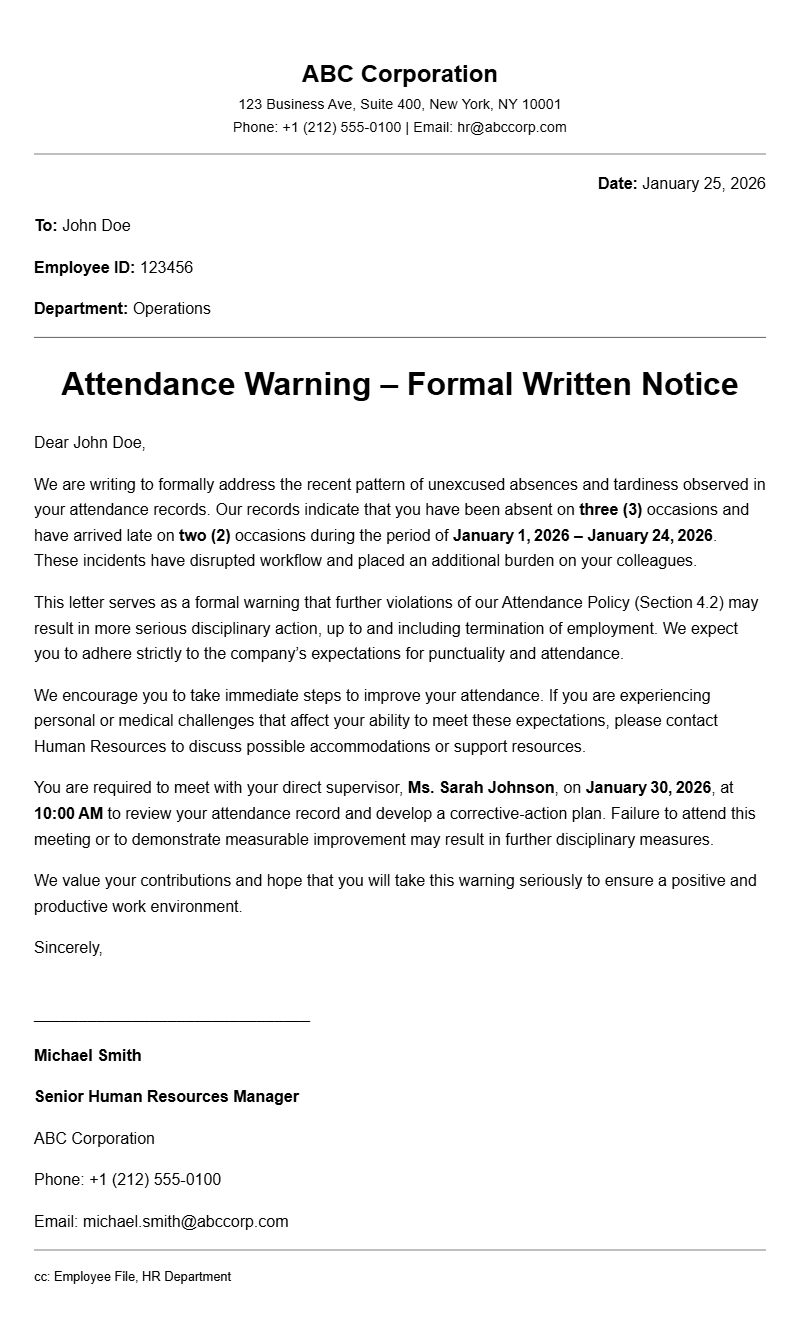
You’re probably here because you need to write an attendance warning letter, and the examples you’ve found online feel either too stiff or too vague to actually use. Maybe your HR department handed you a template that reads like it was written in the 1980s, or you’re a manager trying to figure out what to say when an employee’s attendance has become a problem. Either way, you’re looking for something practical, something that works, and something that doesn’t sound like it was generated by a robot following a checklist.
That’s exactly what this guide is for. I’ll walk you through what goes into an attendance warning letter, show you real examples you can adapt, and help you avoid the mistakes that make these letters land poorly or end up creating more problems than they solve. By the end, you’ll have a solid template and enough understanding to customize it for your specific situation.
What Is an Attendance Warning Letter?
An attendance warning letter is a formal written notice that documents an employee’s pattern of unexcused absences, tardiness, or other attendance-related issues. It serves several purposes at once: it puts the employee on record about expectations, creates a paper trail for HR and legal protection, and gives the worker a clear opportunity to improve before more serious consequences kick in.
Think of it as a formal conversation made permanent. You’re telling someone, “This has become a problem, and here’s where we stand.” The letter should be specific about what happened, fair in how it frames the issue, and clear about what happens next if things don’t change.
If you’re dealing with student attendance issues rather than workplace attendance, you might find my scholarship appeal letter templates guide useful as well, since it covers similar formal notice scenarios from the academic side.
When Do You Use an Attendance Warning Letter?
These letters typically come into play after verbal warnings haven’t worked, or when the situation is serious enough to warrant immediate documentation. Here are the most common scenarios:
- After an employee has accumulated multiple unexcused absences within a short period—usually 3 to 5 incidents over 30 to 60 days
- When tardiness has become a consistent pattern rather than an occasional slip
- Following absences that violated company policy, such as not following proper notification procedures
- When an employee’s attendance issues are affecting team productivity or customer service
- As part of a progressive discipline process where written warnings precede final warnings or termination
The key is that you’ve already tried to address the issue informally—through conversation, through verbal warnings—and the problem persists. The written letter escalates things to a formal level while still giving the employee a genuine chance to turn things around.
Key Components of an Effective Attendance Warning Letter
A strong attendance warning letter isn’t just a “you missed work again, stop it” note. It needs structure to be taken seriously and to hold up if it’s ever reviewed by HR, an employment lawyer, or a labor board. Here’s what belongs in every good template:
Header Information
This includes the date, the employee’s full name, their job title or department, and your name and title as the person writing the letter. Keep this clean and professional—it’s the letter’s identification section.
Clear Subject Line or Reference
State plainly what the letter is about. Something like “Re: Formal Warning Regarding Attendance Violations” works better than clever or vague titles. Everyone should know immediately what they’re reading.
Specific Incidents, Not General Complaints
This is where most templates fall apart. Generic letters say things like “your attendance has been unsatisfactory.” Effective letters say “you were absent on March 5, March 12, and March 19, and you did not provide advance notice or valid documentation for any of these absences.” Numbers and dates matter.
Company Policy Reference
Tie the employee’s actions to the specific policy they’ve violated. If your employee handbook says three unexcused absences trigger a written warning, reference that section. This makes the letter feel legitimate rather than arbitrary.
Expected Improvement and Timeline
State clearly what the employee needs to do going forward and by when. “You are expected to maintain regular attendance with no unexcused absences for the next 60 days” is concrete. “Please improve your attendance” is not.
Consequences of Continued Violations
Explain what happens if things don’t change. Be honest about potential outcomes—final written warning, suspension, termination—without sounding like you’re just threatening. Frame it as: “Further violations may result in additional disciplinary action, up to and including termination.”
Space for Employee Acknowledgment
Most companies require the employee to sign and date the letter to acknowledge receipt. Include a signature line at the bottom. This isn’t optional—it’s protection for everyone involved.
Step-by-Step Guide to Writing Your Letter
Now that you know what components to include, here’s how to actually put one together without sounding like you’re filling out a government form:
Step 1: Gather Your Information First
Before you start writing, pull the employee’s attendance records. Know the exact dates of absences, whether any were approved or documented, and how many verbal warnings have already been given. Vague letters get ignored. Specific letters get taken seriously.
Step 2: Choose the Right Tone
You’re not writing to punish. You’re writing to correct. Keep the tone firm but respectful. Avoid emotional language like “disappointing” or “unacceptable behavior.” Stick to factual statements about what happened and what the policy says.
Step 3: Write the Opening Paragraph
Start with the purpose immediately. Don’t waste words on long preambles. “This letter serves as a formal written warning regarding your attendance record” works fine as a first sentence.
Step 4: List the Specific Incidents
Use bullet points or a numbered list for the dates of violations. Make sure each one includes the date, whether it was an absence or tardy arrival, and whether proper notification was given. This is the section employees will argue about if you’ve been vague, so be precise.
Step 5: Reference the Policy
Name the handbook section or company policy that applies. “Per Section 4.2 of the Employee Handbook, three unexcused absences within a 30-day period constitute a attendance violation warranting formal warning.” This grounds your letter in established rules.
Step 6: State Expectations and Timeline
Be explicit about what “good attendance” looks like going forward. Set a review period—30 or 60 days is standard. Make sure the employee knows exactly what’s being measured.
Step 7: Explain Consequences
Don’t soften this part. Employees need to understand the stakes. “Failure to meet these expectations may result in further disciplinary action, up to and including termination of employment.”
Step 8: Offer an Opportunity to Respond
Include a sentence acknowledging that the employee can discuss this with you or HR if they have questions or believe there are mitigating circumstances. This keeps the letter from feeling like a one-way decree.
If you’re also managing student attendance issues, my guide on student-to-teacher letter samples covers how to frame communications in academic settings, which uses a slightly different approach than workplace letters.
Attendance Warning Letter Template (Workplace)
Here’s a template you can adapt for most standard workplace situations. I’ve used placeholder brackets [like this] where you’d plug in your specific information:
Date: [Insert Date]
To: [Employee Full Name]
Department: [Department/Job Title]
From: [Your Name], [Your Title]
Subject: Formal Written Warning — Attendance Policy Violation
This letter serves as a formal written warning regarding your attendance record. Our records indicate the following unexcused absences over the past [time period]:
- [Date 1] — Absent, no advance notice provided
- [Date 2] — Absent, no valid documentation submitted
- [Date 3] — Tardy arrival, exceeded 30-minute threshold
- [Additional incidents as applicable]
These absences have negatively impacted team operations and customer service delivery on multiple occasions.
According to Section [X.X] of the Employee Handbook, employees are expected to maintain consistent attendance and follow proper notification procedures when unable to report to work. The pattern described above constitutes a violation of this policy.
Expectation: You are required to maintain regular attendance with no unexcused absences or unapproved tardiness for the next [60 days/90 days]. If you are unable to report to work, you must notify your supervisor at least [time requirement] before your scheduled shift using the established call-in procedure.
Consequence: Failure to meet these expectations may result in further disciplinary action, up to and including termination of employment. This written warning will remain in your personnel file for [time period] as documentation of this issue.
If you believe there are circumstances that warrant discussion, or if you have questions about this warning, please contact me or HR at [contact information] within [time frame] of receiving this letter.
Employee Acknowledgment:
I acknowledge receipt of this written warning and understand the expectations and consequences described above.
_________________________ _________________________
Employee Signature Date
_________________________
Supervisor Signature
Attendance Warning Letter for Chronic Tardiness
If your main issue isn’t full absences but repeated lateness, here’s a variation focused specifically on that problem:
This letter serves as a formal warning regarding repeated tardiness. Between [start date] and [end date], you arrived after your scheduled start time on [number] occasions:
- [Date 1] — Arrived [time], scheduled start [time]
- [Date 2] — Arrived [time], scheduled start [time]
- [Date 3] — Arrived [time], scheduled start [time]
While some of these instances were brief, the consistent pattern has disrupted team meetings, delayed client-facing responsibilities, and required other staff to cover your duties.
Section [X.X] of the Employee Handbook states that employees are expected to be prepared and present at the start of their scheduled shift. Chronic tardiness, even when small, violates this expectation.
Expectation: You must arrive ready to work at your scheduled start time, without exception, for the next [30/60] days.
Consequence: Any additional tardy arrivals during the review period will result in further disciplinary action, potentially including a final written warning or suspension.
Please discuss any personal circumstances that may be affecting your punctuality with HR so we can explore whether any accommodations are available.
Common Mistakes to Avoid
I’ve seen attendance letters that do more harm than good because of these frequent errors:
Being Too Vague
“Your attendance has been inconsistent” doesn’t tell the employee anything they can act on. Specific dates and policy references make your letter defensible and serious.
Using Emotional or Judgmental Language
Phrases like “your attitude is disappointing” or “this shows a lack of commitment” invite arguments and don’t belong in a formal warning. Stick to facts and policy.
Failing to Document Verbal Warnings First
If this is your first communication about the issue, go back. A written warning without prior verbal discussions often gets challenged. Document that you’ve already talked about this.
Not Following Your Own Policy
If your handbook says verbal warning → written warning → final warning → termination, make sure your letter reflects where you are in that process. Skipping steps creates legal exposure.
Forgetting to Include Consequences
Employees sometimes treat written warnings casually because they don’t understand the stakes. Be explicit about what happens if things don’t change.
Writing and Forgetting
Don’t just file the letter and move on. Schedule a follow-up meeting to check in on the employee’s progress. A warning with no follow-up often gets ignored.
One-Size-Fits-All Language
Every situation is different. A retail employee’s attendance issues affect customers directly. An office worker’s absences might impact project deadlines. Customize your language to reflect the real-world consequences.
If you’re also dealing with payment-related communication issues, my article on late payment reminder letter samples covers how to handle another type of formal documentation with similar stakes.
Tips for Customizing Your Template
These templates work as starting points, but you’ll need to adjust them based on your specific situation and company policies:
Match Your Company Culture
If your workplace is formal and hierarchical, keep the language traditional. If your company has a more casual, direct communication style, you can be slightly less stiff while staying professional. The goal is credibility—if your letter sounds out of place in your workplace, it loses impact.
Adjust for Industry Norms
Healthcare, manufacturing, and service industries often have stricter attendance policies because coverage is critical. Office environments might be more flexible about occasional issues. Reference the policies that are actually relevant to your employee’s role.
Consider Accommodations
If an employee has mentioned medical issues, family circumstances, or disabilities that might be affecting their attendance, tread carefully. You still have the right to enforce attendance policies, but you may have obligations under employment law to engage in an interactive process. When in doubt, involve HR before sending the letter.
Keep Copies and Track Dates
Always keep a copy for your records and ensure the original goes to the employee’s file. Track when the letter was delivered—if you hand it to someone in person, note the date. If you mail it, keep proof of delivery.
Pair the Letter with a Conversation
The letter documents the issue, but you should also have a face-to-face or video conversation to deliver it. This gives the employee a chance to ask questions and shows that you’re treating the situation seriously, not just firing off paperwork.
Follow Up in Writing
After your follow-up meeting, send a brief email summarizing what was discussed and the improvement plan. This creates a complete record and keeps expectations clear on both sides.
If you’re writing this type of letter in an academic context—perhaps for a student whose attendance is affecting their grades—my guide on academic excellence letter templates covers how to frame formal communications with students and their families.
Making Attendance Documentation Work for Your Team
Attendance problems rarely solve themselves, and informal conversations only go so far. A well-written attendance warning letter gives your employee clear notice of what’s at stake, gives your organization a defensible paper trail, and creates an opportunity for genuine improvement before more serious action becomes necessary.
The templates in this guide give you a solid foundation. Customize them to reflect your actual situation, match your company voice, and always pair written documentation with direct conversation. That’s what turns a piece of paper into a real tool for managing the problem.
If you need templates for other common workplace communications, check out my attendance warning letter templates collection for additional variations and industry-specific examples.
Editable Document Format Examples