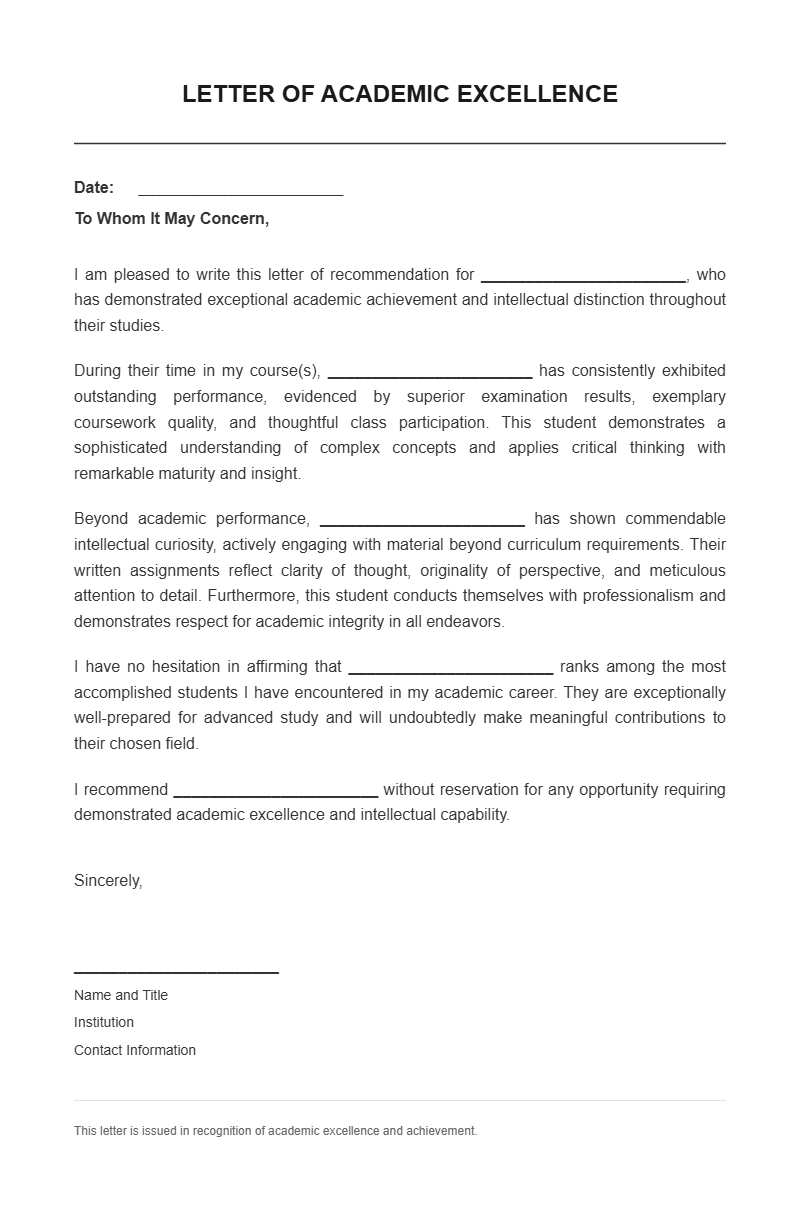
When a student earns recognition for outstanding academic performance, the right letter can capture that achievement in a way that matters—whether it’s for a scholarship application, college admission, or a permanent record. An academic excellence letter template gives you a structured starting point so you’re not staring at a blank page wondering how to phrase things professionally.
These letters come up more often than you might think. Teachers write them for students applying to advanced programs. School administrators draft them to celebrate top performers. Parents sometimes request them as documentation for homeschool portfolios or transfer applications. The core challenge is always the same: how do you communicate genuine accomplishment without sounding generic or inflated?
What Is An Academic Excellence Letter?
An academic excellence letter is a formal document that recognizes and documents a student’s outstanding academic performance. It typically comes from an educator, administrator, or mentor who has direct knowledge of the student’s work and can speak to specific achievements.
Unlike a generic recommendation letter, an academic excellence letter focuses specifically on intellectual merit, academic rigor, and scholarly accomplishment. It’s not about being a good person or a team player—though those things might be mentioned. It’s about demonstrating that a student has performed at a notably high level in their academic work.
The letter serves as third-party validation. It carries weight because it comes from someone in a position to judge academic performance, and it becomes part of a student’s record or application materials. Schools, scholarship committees, and employers value these letters because they provide concrete evidence of achievement beyond what a transcript alone can show.
When You Actually Need This Letter
Academic excellence letters appear in several common scenarios:
- Scholarship applications: Many competitive scholarships require or strongly prefer letters documenting academic achievement
- College admissions: Particularly for honors programs, early admission, or merit-based financial aid
- Transfer applications: When moving between schools or programs, schools want evidence of your academic standing
- Advanced program placement: Gifted programs, AP/IB qualification, or graduate school prerequisites often ask for these
- School records: Some families keep these on file as permanent documentation of academic standing
- Employment: Certain positions, especially in academia or research, value evidence of academic excellence
- International applications: Non-U.S. schools sometimes request formal documentation of academic performance
If you’re the one writing the letter, you’re usually doing it because someone specifically asked. If you’re requesting one, the timing matters—ask early enough that the writer has time to do it properly, typically at least two weeks before you need it.
The Core Sections Of An Academic Excellence Letter
A solid academic excellence letter follows a predictable structure that works because it delivers information in the order people expect to read it:
Header and date: Your letterhead (if you have one) or contact information at the top, followed by the date and the recipient’s details.
Opening statement: A direct sentence that names the student and states your purpose. This isn’t the place for mystery. Readers need to know immediately what they’re about to read.
Your relationship to the student: How long you’ve known them, in what capacity, and why your opinion carries weight. A teacher who taught someone for two years has more credibility than someone who’s observed them once.
Specific academic achievements: This is the meat of the letter. Not general praise, but actual evidence: grades, test scores, projects completed, research conducted, papers written, competitions entered. Numbers and specifics matter here.
Demonstrated qualities: How the student’s work reveals intellectual traits—critical thinking, intellectual curiosity, persistence, analytical skill. Show these through examples rather than just naming them.
Comparison context: Where appropriate, how this student’s performance compares to peers. “Among the hundreds of students I’ve taught” or “in a class of 30 advanced learners” gives readers a frame of reference.
Closing endorsement: A clear statement of your confidence in the student’s academic ability and a brief forward-looking comment about their potential.
Professional closing: Your signature, typed name, title, and contact information.
How To Write An Academic Excellence Letter Step By Step
Step 1: Gather specific information first. Before you write anything, collect concrete details. What grades did the student earn? What assignments stood out? Did they participate in competitions, research, or advanced coursework? What made their work distinctly strong? Write these down—you’ll reference them throughout the letter and they make the difference between a letter that feels real and one that reads like a template.
Step 2: Start with a clear, direct opening. Don’t warm up with pleasantries. Write something like: “I am writing to strongly recommend [Student Name] for [specific purpose]. I have taught [him/her/them] in [Course Name] during [timeframe] and can speak to [his/her/their] exceptional academic performance.” This tells the reader immediately what they’re evaluating and why you’re qualified to write it.
Step 3: Establish your credibility and relationship. Give enough context that the reader understands your vantage point. “In my 12 years teaching advanced mathematics, I have observed that [Student Name]’s analytical skills rank among the strongest I’ve encountered” is stronger than “I have known [Student Name] for a long time.” Specific duration and role matter.
Step 4: Present evidence, not adjectives. This is where many letters fall flat. Instead of writing “She is an excellent student,” write “She earned an A+ in Organic Chemistry, a course in which the class average was 78%, and her final project on enzyme kinetics was selected for presentation at the departmental research symposium.” The evidence speaks louder than the label.
Step 5: Connect specific work to intellectual qualities. Show how the student’s achievements reveal their thinking. For example: “His research proposal demonstrated sophisticated hypothesis design and critical evaluation of existing literature. When preliminary results contradicted his initial assumptions, rather than forcing the data to fit his theory, he reconsidered his methodology and redesigned the experiment—a level of intellectual honesty I rarely see at the high school level.”
Step 6: Provide context for comparison. Readers want to know: is this student good in absolute terms, or just good relative to their peers? You can say: “In a class of 28 honors students, [Name] consistently scored in the top 5% on assessments” or “Among the 200+ applicants I’ve taught for this program over the past five years, [Name]’s performance places them in the exceptional category.” This helps the reader calibrate their understanding.
Step 7: Close with a clear endorsement. End with a straightforward statement of your confidence. “I have no reservations in recommending [Name] for [program/opportunity]. Based on [his/her/their] demonstrated academic abilities, I am confident [he/she/they] will excel in any rigorous academic environment.” Then sign off professionally.
Academic Excellence Letter Template
Here’s a working template you can adapt to your specific situation:
[Your Letterhead or Contact Information]
[Date]
[Recipient Name]
[Recipient Title]
[Institution/Organization Name]
[Address]
Dear [Recipient Name/Selection Committee]:
I am writing to recommend [Student Name] for [specific purpose: scholarship, program admission, etc.]. I have taught [him/her/them] in [Course Name] during [semester/year], and I can speak with confidence to [his/her/their] exceptional academic performance.
In my [number] years of [teaching/working] in [subject area/field], I have observed that [Student Name] demonstrates academic abilities that place [him/her/them] among the strongest students I have encountered. [He/She/They] earned an [grade] in [course], where the class average was [average]. More significantly, [describe specific work or achievement with concrete details].
What distinguishes [Student Name]’s work is not simply the grades [he/she/they] achieves, but the quality of [his/her/their] thinking. [Provide specific example that demonstrates intellectual quality—critical analysis, creative problem-solving, research ability, etc.]. This capacity for [specific intellectual skill] is relatively rare among students at this level.
[Optional comparison context: In a class of [number] students / among the [number] applicants I have taught / relative to [specific group], [Student Name]’s performance is exceptional.]
I have no reservations in recommending [Student Name] for [specific opportunity]. Based on [his/her/their] demonstrated academic abilities and intellectual maturity, I am confident [he/she/they] will excel in [specific program/environment/opportunity].
Please feel free to contact me if you require any additional information.
Sincerely,
[Your Signature]
[Your Typed Name]
[Your Title]
[Your Contact Information]
Real-World Examples
Example 1: High School Student for College Honors Program
“I am writing to recommend Maya Chen for admission to your Honors College program. I taught Maya in AP Biology during her junior year, and she earned an A+ with a score of 5 on the AP exam—among only three students in my class of 28 to achieve this. What impressed me most was her independent research project on bacterial antibiotic resistance. Rather than following a prescribed lab protocol, Maya designed her own experiment, troubleshot unexpected results, and ultimately produced findings that differed from her initial hypothesis. Rather than viewing this as failure, she recognized it as an opportunity to refine her methodology. This intellectual flexibility and genuine curiosity are hallmarks of the kind of learner who thrives in advanced academic environments. I strongly recommend Maya for your program.”
Example 2: Teacher for Scholarship Application
“I recommend James Rodriguez for the [Scholarship Name] with enthusiasm. James has been in my English classroom for two years, completing both AP Language and AP Literature courses. He earned A grades in both, and his essays consistently demonstrated sophisticated rhetorical analysis and original thinking. In a cohort of 35 advanced students, James’s writing stood out for its clarity, precision, and ability to engage with complex texts. His final research paper on narrative perspective in postcolonial literature showed genuine scholarly engagement—he consulted primary sources, engaged with academic journals, and developed arguments that went well beyond the scope of the assignment. James is the kind of student who reads beyond what is required, thinks deeply about what he reads, and produces work that reflects intellectual maturity. He will be an asset to any academic community.”
Example 3: Academic Advisor for Graduate Program
“I have advised Dr. Aisha Patel throughout her undergraduate career in Mathematics and can attest to her exceptional academic performance. Aisha completed our most rigorous coursework with a cumulative GPA of 3.98, including advanced courses in Real Analysis, Abstract Algebra, and Topology—courses in which she earned A+ grades. She completed an honors thesis on topological invariants that demonstrated original research ability and was presented at a regional mathematics conference. Among the approximately 150 mathematics majors I have advised over 15 years, Aisha ranks in the top 1% in terms of both technical mastery and creative mathematical thinking. I strongly recommend her for your graduate program.”
Common Mistakes To Avoid
Being too vague: “She is an excellent student who works hard” tells the reader almost nothing. Replace it with specifics: “She earned an A in a course where the median grade was C+, and her final project demonstrated sophisticated analysis.” Specificity is credibility.
Inflating language without evidence: Words like “brilliant,” “exceptional,” and “outstanding” lose meaning if they’re not backed up by concrete examples. Show the excellence rather than just naming it.
Writing too long: A strong academic excellence letter is typically one page. If you’re writing more than that, you’re probably repeating yourself or including information that doesn’t directly support your main point. Edit ruthlessly.
Making it about personality instead of academics: These letters aren’t the place to discuss whether the student is friendly, cooperative, or well-liked. Focus on intellectual performance, academic rigor, and scholarly work. If you want to mention character, tie it directly to academic outcomes—like intellectual honesty or persistence in problem-solving.
Comparing to the wrong group: Saying “She’s the best student in her class” means something different if the class is a general education course versus an honors seminar. Provide context so readers understand what the comparison actually means.
Using a generic template without customization: A letter that could apply to any student feels like a letter that applies to no student. Specific details—the actual course name, the actual grade, the actual assignment—are what make a letter credible and useful.
Hedging with qualifiers: Avoid phrases like “in my opinion” or “I believe” or “it seems to me.” You’re the expert here. Write with confidence: “Maya’s research demonstrates sophisticated methodology” not “In my opinion, Maya seems to have done fairly rigorous research.”
How To Customize A Template For Your Situation
Identify your specific context: Are you writing for a scholarship, college admission, transfer application, or something else? The purpose shapes the emphasis. A scholarship letter might emphasize financial hardship overcome through academic excellence. A graduate program letter emphasizes research potential and advanced thinking.
Choose your evidence strategically: You don’t need to list everything the student has done. Choose 2-3 pieces of evidence that most directly support the purpose of the letter. If writing for a STEM program, emphasize quantitative coursework and research. If writing for a humanities program, emphasize writing quality and critical analysis.
Adjust your comparison group: Make the comparison meaningful to the reader. For a national scholarship, compare to a broader group. For a local program, a class-level comparison might be more relevant. Match the scale of comparison to the scope of the opportunity.
Reflect your authentic voice: A template is a structure, not a script. Use your own language and phrasing. If you typically write formally, write formally. If your style is more conversational, that’s fine too—as long as it remains professional. The letter should sound like it came from you.
Tailor the closing: Don’t just use a generic “I recommend this student.” If you know something about where the student is applying or what they plan to do, reference it. “I am confident Sarah will excel in your engineering program, particularly in the hands-on design projects your curriculum emphasizes” is more compelling than a generic endorsement.
Tips For Getting The Most From Your Letter
If you’re requesting an academic excellence letter, ask well in advance—at least two weeks, ideally three. Give the writer context about where the letter is going and what it’s for. Provide them with a copy of the application requirements or program description if relevant. The more specific information you give, the more tailored and useful the letter can be.
If you’re writing one, don’t try to be someone you’re not. A letter that sounds like you—grounded in your actual experience with the student and your genuine assessment of their work—will always be more credible than one that tries to match some imagined “professional” voice.
For students applying to multiple opportunities, you might request slightly different letters for different purposes. A letter for a science scholarship can emphasize research and quantitative skills. A letter for a general academic scholarship can take a broader view. Most writers are happy to adjust a letter for different contexts if you ask clearly.
Keep the letter professional but human. Readers can tell the difference between someone who has actually observed a student’s work and someone who is filling in a template. The best letters include specific moments or examples that only someone who knows the student could include.
If you’re uncertain whether you qualify to write an academic excellence letter, think about whether you can speak to the student’s academic performance based on direct observation. Have you graded their work? Taught them in a rigorous course? Supervised their research? If yes, you’re qualified. If no, the student might need to request the letter from someone else, similar to how a performance review invitation letter requires specific knowledge of someone’s work.
Connecting Academic Excellence Letters To Other Professional Documents
Academic excellence letters often work alongside other formal documents. A student applying for a scholarship might also need a leave request letter if they need time off work or school to attend program activities. A student transferring schools might request an academic excellence letter as part of a larger application package that includes transcripts and other materials.
In some cases, school administrators writing these letters draw on the same skills used in other institutional correspondence. The structure and tone you’d use in an academic excellence letter mirrors what you’d find in a principal to student letter—professional, specific, and focused on concrete information rather than vague praise.
Parents sometimes request these letters for homeschool records or when transitioning between educational settings. In those cases, the letter serves a similar documentation function to what you might see in guardian authorization letter samples—establishing official record of the student’s status and performance.
For students in temporary or transitional situations, such as those in temporary employment arrangements while studying, an academic excellence letter can help establish their primary commitment to academics and their strong performance despite other obligations.
The core principle across all these documents is the same: be specific, be professional, and be honest about what you actually know and can verify.
Final Thoughts
An academic excellence letter works because it does one job well: it provides credible, specific evidence that a student has performed at a high academic level. Whether you’re writing one or requesting one, the key is moving past generic praise to concrete, verifiable achievement. The student’s grades, coursework, projects, and demonstrated thinking are what matter. Everything else is supporting detail.
If you’re writing the letter, spend time thinking about what actually made this student’s work stand out to you. What did they do that you don’t often see? What evidence can you point to? Start with those specifics and build the letter around them. If you’re requesting one, give the writer enough context that they can write something meaningful rather than something templated.
The best academic excellence letters don’t sound like they came from a template. They sound like they came from someone who knows the student’s work and is willing to stake their reputation on an honest assessment of their ability. That’s what makes them valuable.
Common Document Templates & Previews