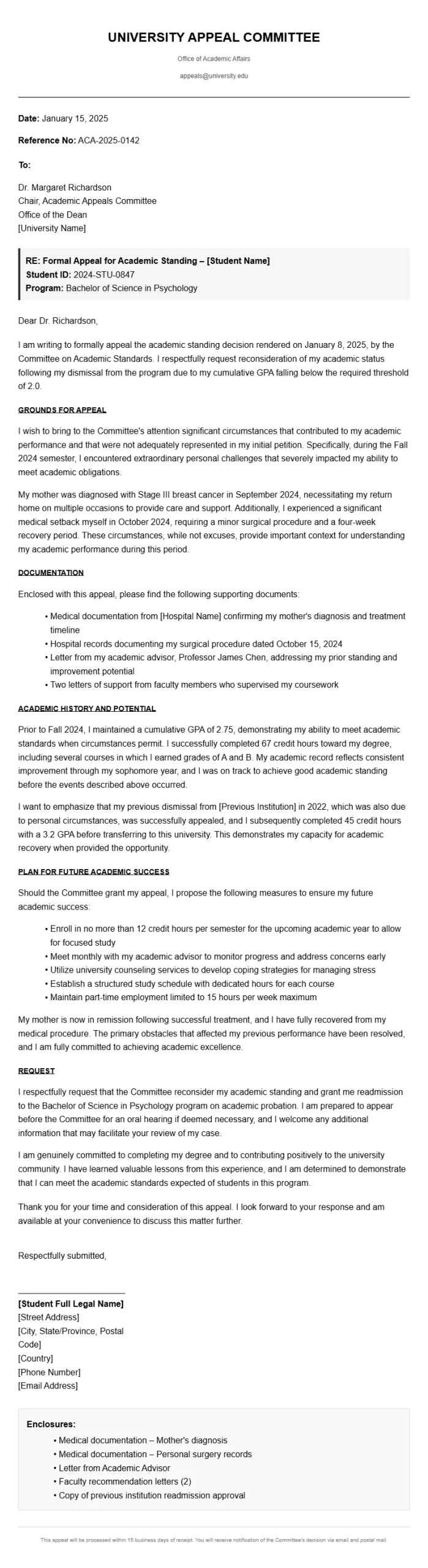
When a grade, financial aid decision, or academic standing doesn’t go your way, the first concrete step you can take is to write an academic appeal letter. It’s a formal request that explains your side of the story, outlines any extenuating circumstances, and demonstrates why a second look is warranted. Many students and parents feel overwhelmed by the blank page, which is why having a solid academic appeal letter template can cut through the confusion and help you focus on what actually matters—presenting a clear, honest case.
WHAT IS AN ACADEMIC APPEAL LETTER?
An academic appeal letter is a written document you submit to a university committee, department, or office to request reconsideration of an academic decision. It’s not just a complaint; it’s a structured argument that includes context, evidence, and a request for a specific outcome (such as a grade change, reinstatement of aid, or re‑admission after probation).
WHEN YOU MIGHT NEED ONE
You’ll typically consider this type of letter when:
- A final grade doesn’t reflect your performance due to grading errors or misapplied policies.
- Financial aid was revoked because of GPA or credit hour requirements.
- You’ve been placed on academic probation or suspension and want to present a reinstatement plan.
- A course selection or enrollment decision blocks your degree progress.
If you’re also navigating other campus communications, you might find our thank‑you letter samples useful for polishing professional tone in related correspondence.
KEY SECTIONS OF THE TEMPLATE
A well‑structured appeal letter usually contains the following parts:
- Header & Contact Info – Your name, student ID, program, and contact details, followed by the recipient’s name, title, and office address.
- Subject Line – A concise statement that identifies the purpose, e.g., “Appeal for Reinstatement – Spring 2026”.
- Opening Paragraph – State the decision you are appealing, the date it was issued, and a brief acknowledgement of the committee’s time.
- Explanation of Circumstances – Provide the relevant background, focusing on facts (medical issues, family emergencies, etc.) and how they affected your academics.
- Supporting Evidence – List any attached documents (doctor’s notes, police reports, etc.) that substantiate your claim.
- Remedial Steps Taken – Describe actions you’ve already taken to address the problem (tutoring, counseling, schedule adjustments).
- Request for Specific Action – Clearly state the outcome you want (grade revision, reinstatement, etc.).
- Closing & Signature – Thank the recipient, provide a polite sign‑off, and include your typed name.
STEP-BY-STEP GUIDE TO WRITING YOUR LETTER
Follow these steps to build a clear, persuasive appeal:
- Gather the Facts – Pull together your transcript, the official decision letter, and any supporting documents you plan to attach.
- Identify the Core Issue – Pinpoint the exact decision you’re contesting; being vague weakens your case.
- Outline Your Narrative – Write a bullet list of what happened, why it happened, and what you’ve done to prevent it from happening again.
- Draft the Opening – Start with a respectful greeting and a straightforward statement of intent.
- Write the Body – Explain circumstances, attach evidence, and list remedial actions in chronological order.
- State the Request Clearly – Be specific about what you’re asking (e.g., “I respectfully request a grade revision from C to B”).
- Proofread – Check for spelling errors, ensure the tone stays professional, and verify that all deadlines are met.
If you’re also drafting a vendor termination letter or a risk assessment letter for campus projects, our risk assessment letter templates can give you a parallel structure for documenting decisions.
EXAMPLE TEMPLATE AND EDITABLE SNIPPET
Below is a realistic, fill‑in‑the‑blank version you can adapt. Replace the bracketed items with your personal details.
Subject: Appeal for [Decision Type] – [Your Name], [Student ID]
[Your Name]
[Program/Major]
[Email] | [Phone]
[Date]
[Recipient Name]
[Title]
[Office/Department]
[University Name]
Dear [Recipient Name],
I am writing to formally appeal the [decision] dated [date] concerning [specific outcome, e.g., “my academic probation status”]. I respectfully request reconsideration of this decision based on the following circumstances and supporting documentation.
Explanation of Circumstances
[Provide a concise narrative of the events that contributed to the situation, focusing on factual details.]
Supporting Evidence
Attached you will find:
- Medical documentation from Dr. [Name], dated [date]
- A letter from [counselor/advisor] outlining the support plan
- Proof of recent grade improvement (mid‑term transcript)
Remedial Steps Taken
To address the issues, I have:
- Enrolled in tutoring sessions for [course name] (Spring 2026)
- Met with my academic advisor to adjust my course schedule
- Started counseling sessions at the campus wellness center
Request for Specific Action
I kindly ask that the committee [e.g., “reinstate my financial aid for the upcoming semester”] and consider the attached evidence in its evaluation.
Thank you for your time and consideration. I look forward to the opportunity to discuss this matter further if needed.
Sincerely,
[Your Typed Name]
[Student ID]
COMMON MISTAKES TO AVOID
- Being vague about the decision – Always reference the exact ruling (date, title) so the reviewer can locate your file quickly.
- Over‑emotional language – Stay factual; emotional pleas without evidence can appear unprofessional.
- Missing deadlines – Most institutions have a short window (often 10‑15 days) to submit appeals.
- Neglecting to attach proof – A letter without supporting documents may be dismissed outright.
- Using a generic template without customization – Tailor each section to your situation; committees notice “copy‑paste” language.
For more examples of how to format official correspondence, see our audit response letter examples.
TIPS FOR CUSTOMIZING YOUR APPEAL LETTER
- Match the institution’s tone – Some schools prefer a formal, concise style; others appreciate a more personal narrative.
- Focus on outcomes, not excuses – Show what you’ve learned and what concrete steps you’ll take to succeed.
- Limit the length – One page is often enough; extra details belong in attached documents.
- Proofread multiple times – Use tools like Grammarly, but also have a peer review the letter for readability.
- Follow up appropriately – After submitting, send a brief email confirming receipt and expressing your willingness to provide additional information.
WRAPPING UP
Creating an effective academic appeal letter boils down to clarity, honesty, and a well‑organized structure. Use a template as a scaffold, fill it with your unique facts, and make sure every claim is backed by documentation. A thoughtful, well‑presented appeal can be the difference between staying on track and facing unnecessary setbacks. If you need more inspiration for campus‑related letters, check out our office relocation notice templates for how to announce changes in a professional way.
Document Structure & Example Models