You’ve just gotten the final audit report and now you need to write a response that tells the auditors exactly what you found, what you’ll fix, and when you’ll do it. If you’re not sure how to structure that letter, you’re in the right place. Below is a practical guide with a ready‑to‑use template, step‑by‑step instructions, and common pitfalls you can avoid.
What Is an Audit Response Letter and When Do You Need One
An audit response letter is a formal document you send back to the audit team after receiving their findings. It shows that you’ve reviewed the report, understand the issues, and have a concrete plan to address them. You’ll typically send this within the deadline set by the auditors, often after an internal review or a compliance check.
If you also need to handle other time‑sensitive correspondence, such as a reschedule request letter, our templates cover the basics and can be adapted for similar situations.
Key Sections Every Audit Response Letter Should Include
- Header block – company name, date, auditor reference number.
- Opening paragraph – brief acknowledgment of the audit report and purpose of the letter.
- Summary of findings – short recap of each audit observation in your own words.
- Point‑by‑point response – explanation of the root cause, evidence you’ve gathered, and any mitigating factors.
- Corrective action plan – specific steps, responsible parties, start and completion dates.
- Supporting documentation – list of attachments (policy changes, screenshots, training records).
- Closing statement – appreciation for the audit, commitment to improvement, request for follow‑up if needed.
- Signature block – name, title, contact information.
Step‑by‑Step Guide to Writing Your Audit Response Letter
- Read the audit report carefully – highlight each finding, note the severity, and mark any deadlines mentioned.
- Gather supporting evidence – pull together policies, logs, training records, or any documents that back up your response.
- Draft the header and opening – include the auditor’s reference, your company name, and a clear statement that you’re responding to the report.
- Address each finding individually – use the same order as the audit report so reviewers can match your points to theirs.
- Outline corrective actions – for each issue, write a concise action step, assign an owner, and set a realistic completion date.
- List attachments – give a short description and file name for each supporting document you include.
- Review for tone and clarity – keep the language collaborative, avoid blame, and make sure every sentence is factual.
- Proofread and finalize – check for typos, ensure consistent formatting, and sign before sending.
When you list corrective actions, you might draw from the same clarity you would use in a sponsor to event organizer letter to make responsibilities unmistakable.
Sample Audit Response Letter (Editable Template)
Header Block
[Your Company Name]
[Street Address] | [City, State ZIP] | [Phone] | [Email]
Date: [Month Day, Year]
Auditor Reference: [Audit Report Number] – Response
Opening
Thank you for the audit report dated [Report Date]. We have reviewed each finding and prepared the following response to address the observations identified.
Response to Findings
Finding #1 – [Brief Title]
Our analysis shows that [brief root cause]. We will implement [specific action] by [new date]. Evidence is attached as “Exhibit A – Updated Policy.docx.”
Finding #2 – [Brief Title]
The issue stemmed from [explanation]. To correct this, we will [detailed step], assigned to [Owner’s Name], with completion by [date]. Supporting screenshots are in “Exhibit B – Process Logs.pdf.”
(Continue for each finding, keeping the same format.)
Corrective Action Summary
- Update training curriculum – Owner: Jane Doe – Due: June 15, 2026
- Revise access controls – Owner: John Smith – Due: July 1, 2026
- Conduct follow‑up review – Owner: Internal Audit – Scheduled: August 30, 2026
Attachments
Exhibit A – Updated Policy.docx
Exhibit B – Process Logs.pdf
Exhibit C – Training Completion Report.xlsx
Closing
We appreciate the opportunity to improve our processes and remain committed to meeting the standards set by the audit. Please let us know if you need further clarification or additional documentation.
Signature
[Your Name] – [Your Title]
[Phone] – [Email]
For phrasing suggestions in your corrective‑action section, look at how similar challenges are framed in the student academic improvement letter samples.
Common Mistakes to Avoid
- Generic responses – saying “we take the findings seriously” without explaining what you’ll actually do.
- Missing deadlines – not including target dates makes your plan look vague.
- Vague corrective actions – “improve monitoring” doesn’t give anyone a clear task.
- Not addressing all findings – leaving out even a minor point can raise red flags in the next review.
- Defensive tone – sounding like you’re blaming the auditors creates friction. Keep the language collaborative and factual.
- Forgetting attachments – if you reference a document, make sure it’s actually attached.
Avoid the defensive tone that sometimes appears in an employee to manager letter template; keep the language partnership‑focused.
Tips for Customizing the Template
- Match the auditor’s tone – if the report is highly formal, keep your letter slightly more formal; if it’s conversational, you can relax the wording.
- Use specific metrics –
Sample Documents for Multiple Use Cases
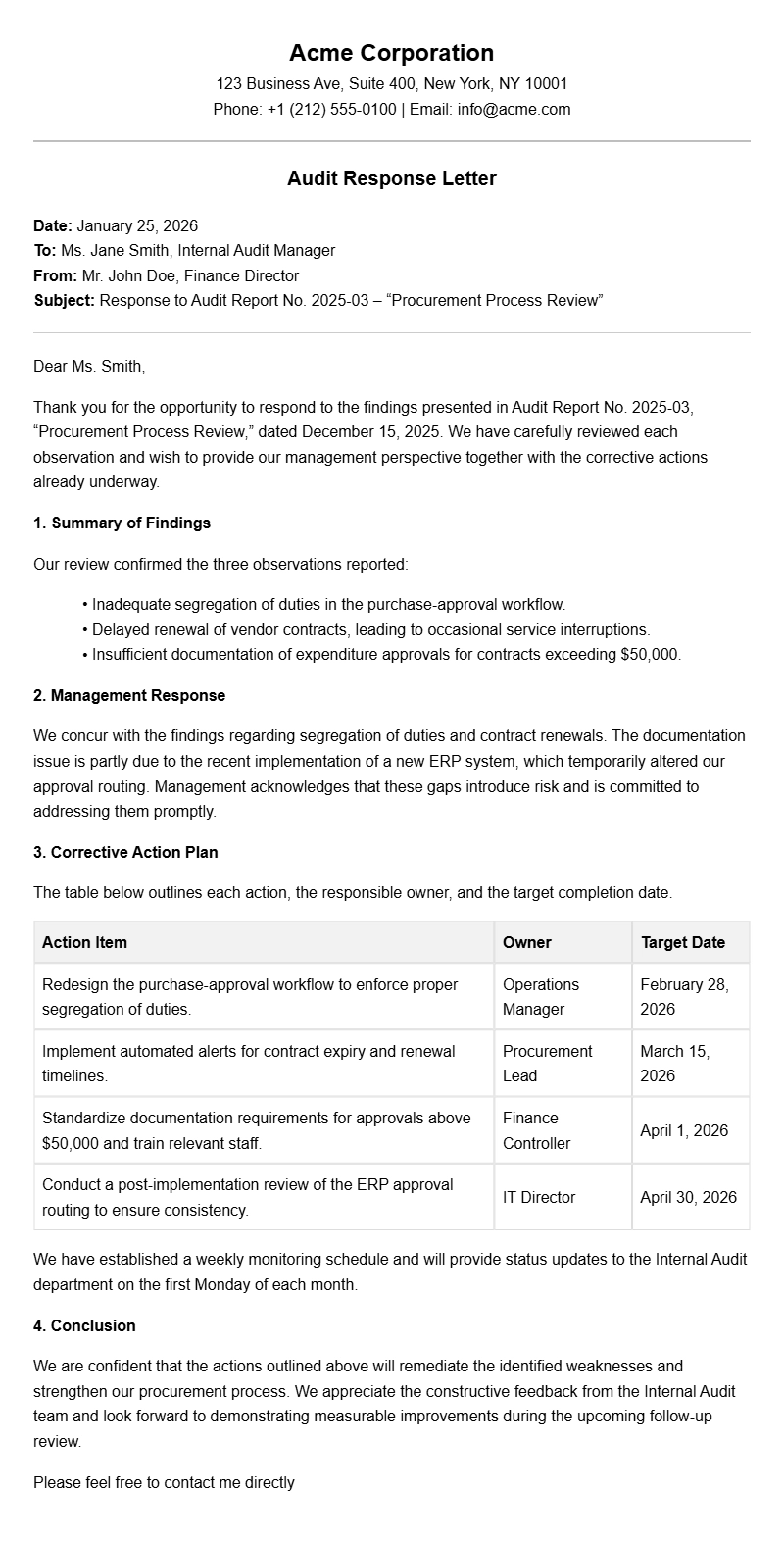
Audit Response Letter Samples Response to Financial Statement Audit Findings
…