When you need to introduce yourself or your organization to someone new, a well‑written welcome letter can set the right tone. Whether you’re onboarding an employee, greeting a new client, or confirming a new membership, the letter serves as a first impression that feels personal and professional. Below you’ll find a practical guide, editable examples, and tips to craft a welcome letter that works for any context.
What Is A Welcome Letter And Why It Matters
A welcome letter is a short, friendly document that acknowledges the recipient, shares essential information, and outlines next steps. It isn’t just a formality—it builds trust, clarifies expectations, and can reduce early‑stage confusion. A strong welcome message also reinforces your brand voice and shows the recipient that you’ve prepared for their arrival.
When To Use A Welcome Letter
- Onboarding a new employee or contractor.
- Introducing a new client or customer to your services.
- Welcoming a new member to an organization, club, or platform.
- Confirming enrollment for a course, program, or event.
- Announcing a new partnership or collaboration.
If you’re also preparing other communication pieces, you might find our farewell letter templates useful for transitions that follow a welcome.
Key Elements Of An Effective Welcome Letter
- Greeting: Use the recipient’s name to make the message feel personal.
- Introduction: Briefly explain who you are and why you’re reaching out.
- Purpose statement: Clearly state the reason for the letter and what the recipient can expect.
- Essential details: Include dates, locations, login credentials, or any required actions.
- Contact information: Provide a name, phone number, or email for follow‑up questions.
- Warm closing: End with a friendly sign‑off that encourages a positive relationship.
For a quick reference, you can also look at our product launch announcement letter samples to see how purpose statements are framed in similar outreach.
Step‑By‑Step Writing Process
- Collect the basics. Gather the recipient’s name, your role, the organization’s name, and any specific data (start date, account ID, etc.).
- Draft a friendly opening. Start with “Dear [First Name],” and a brief sentence that shows genuine enthusiasm.
- State the purpose. In one or two sentences, explain why you’re writing and what the recipient should know.
- Add practical details. Use bullet points or short paragraphs to list key information, such as schedule, resources, or next steps.
- Provide a point of contact. Include your name and the best way to reach you.
- Close warmly. End with “Best regards,” or “Looking forward to working together,” followed by your signature.
Ready‑To‑Use Templates And Examples
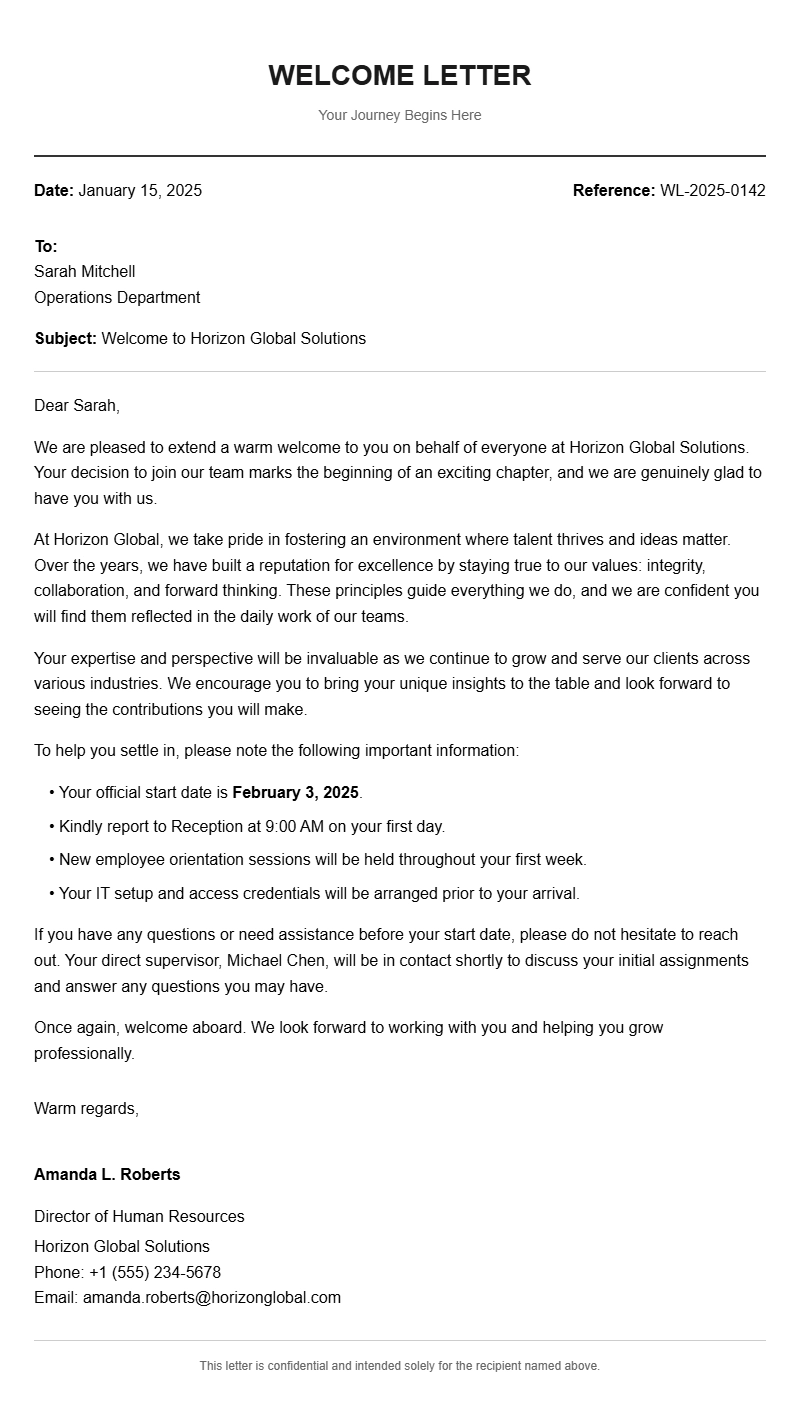
Below are two adaptable templates—one for new employees and one for new clients. You can copy the structure and fill in the placeholders.
Template For New Employees
Subject: Welcome to the Team – Your First Day Details
Dear [Employee Name],
Welcome to [Company Name]! We’re excited to have you join the [Department] team as of [Start Date]. Your role as [Job Title] will focus on [brief responsibility].
Here are the first steps you need to take:
- Arrive at [Office Address] by [Time] on [First Day].
- Bring a valid ID and any required documents listed in the attached onboarding checklist.
- You’ll receive an email with your login credentials for [Company Systems] before the end of the week.
If you have any questions before your start date, feel free to contact me at [Phone] or [Email]. We look forward to seeing you on [Day]!
Best regards,
[Your Name]
[Your Title]
[Company Name]
Template For New Clients
Subject: Welcome Aboard – Your Account Details
Dear [Client Name],
Thank you for choosing [Your Company] for [Service/Product]. We’re thrilled to start working with you on [Project/Goal].
Your account has been set up with the following details:
- Account ID: [ID]
- Portal login: https://example.com/login
- Primary contact: [Contact Name] – [Contact Email]
To get started, please review the attached guide that walks you through the first three steps. If you need assistance, reply to this email or call [Phone].
We’re looking forward to a successful partnership!
Warm regards,
[Your Name]
[Your Title]
[Your Company]
Common Mistakes To Avoid
- Sending a generic template without personalizing the recipient’s name or specific details.
- Overloading the letter with too many details; stick to the most critical points.
- Using jargon or overly formal language when a friendly tone is more appropriate.
- Forgetting to include contact information, which can leave the recipient unsure of how to get help.
- Neglecting to proofread for typos or outdated placeholders.
If you’re also handling performance reviews, consider our annual review letter templates for a consistent style across different HR communications.
Customization Tips For Different Situations
- Industry‑specific language: Adjust terminology to match the field (e.g., “student” vs. “member”).
- Channel adaptation: For email, keep it concise; for printed letters, you may add a formal header and signature block.
- Cultural considerations: Use appropriate greetings and avoid idioms that may not translate well.
- Personal touches: Mention a recent event or a shared interest to make the letter feel less transactional.
For more specialized letters, our collection includes policy cancellation letter samples and invoice follow‑up letter samples that can be adapted for different business scenarios.
Putting It All Together
Start by gathering the essential facts, then follow the step‑by‑step process to draft a clear, friendly message. Use the templates above as a base, and tweak the tone and details to fit your audience. A thoughtful welcome letter not only informs the recipient but also sets the stage for a smooth, productive relationship from day one.
General Document Template Collection
…
…\