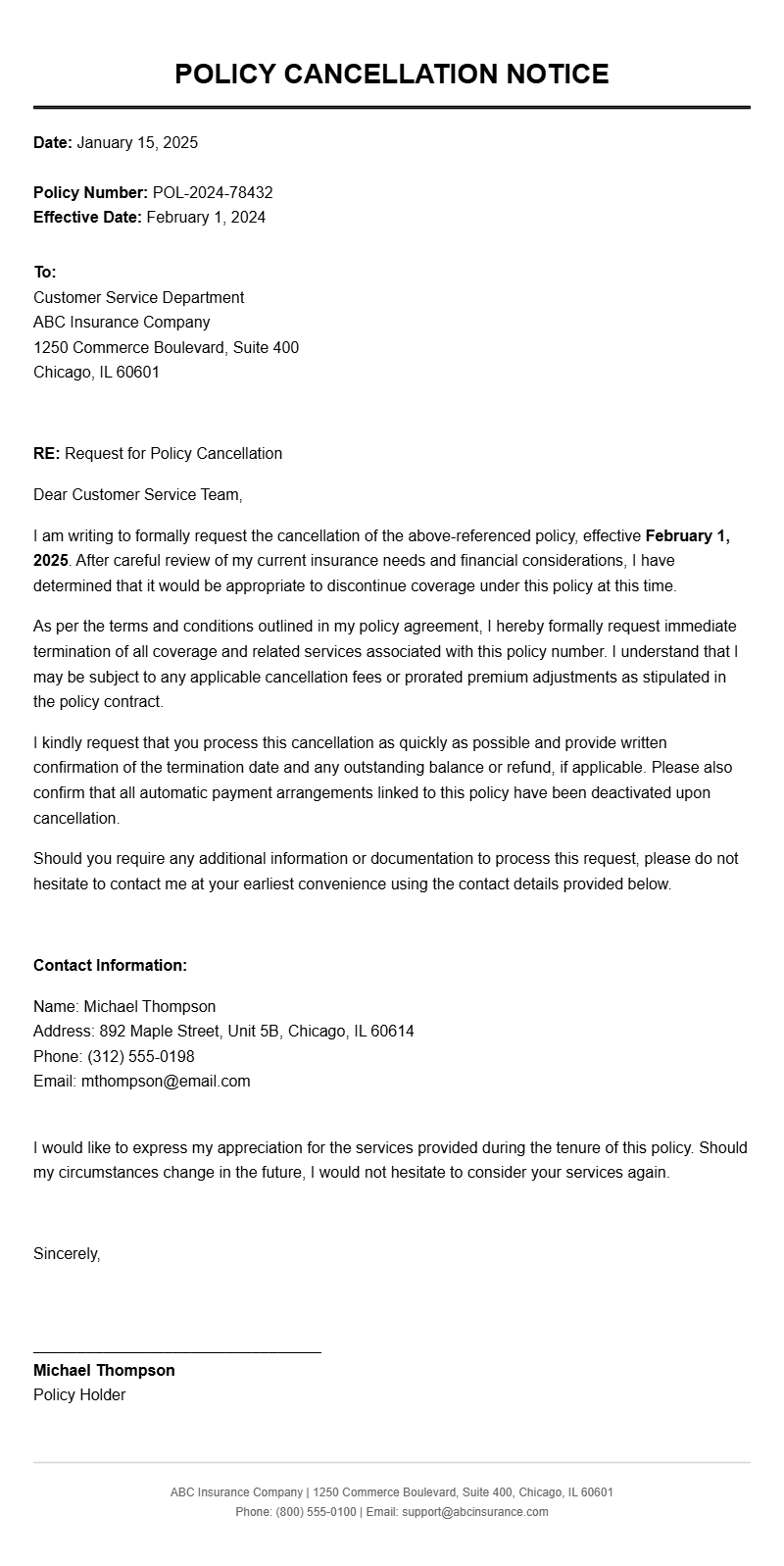
You’re staring at a policy document you no longer need, and you know you should send a cancellation letter — but the thought of writing one stops you cold. Maybe you’re canceling an insurance policy, dropping a subscription service, or ending some other formal agreement. The problem is, you don’t want to sound passive-aggressive or overly formal, and you’re not sure what format the company actually expects.
You’re not alone. Most people put off writing cancellation letters because they don’t know where to start, what to include, or how to phrase things without either sounding rude or sounding like they copied something from the internet. This guide walks you through exactly what a good policy cancellation letter looks like, when you need one, and how to write one in under twenty minutes.
What Is a Policy Cancellation Letter?
A policy cancellation letter is a written request to terminate an existing agreement, contract, or policy with a company or organization. It’s not the same as a casual phone call or email — it creates a paper trail that proves you requested the cancellation on a specific date, which matters for billing disputes, refund requests, and protecting your rights.
The term “policy” in this context usually refers to insurance policies (health, auto, home, life), but it also applies to service agreements, membership plans, and subscription contracts. If you signed a contract and want out, a written cancellation letter is almost always the right move.
For other types of cancellation letters, you might find our service cancellation letter templates useful, or if you’re dealing with travel-related cancellations, check our customer to travel agent letter templates for industry-specific examples.
When Do You Actually Need One?
Not every cancellation requires a formal letter. Here’s how to decide if you need one:
- Your contract has a notice period — most insurance policies and service agreements require 30 to 60 days’ written notice before cancellation takes effect.
- You want a refund or credit — a letter creates documentation you can reference if the company refuses or loses your request.
- The cancellation involves auto-renewal — written notice is your proof that you opted out before being charged.
- You’re disputing charges after cancellation — the letter serves as evidence in formal complaints or small claims.
- State or federal law requires written notice — some insurance cancellations legally must be submitted in writing.
If you’re simply canceling a free trial that you signed up for online, a letter is probably overkill — just use the company’s self-service portal. But for anything involving money, contracts, or ongoing billing, a letter is worth the twenty minutes it takes to write.
Key Components of a Policy Cancellation Letter
Every effective cancellation letter contains the same basic elements, regardless of the company or policy type. Think of these as your checklist:
Your Information at the Top
Include your full name, address, phone number, and email. This makes it easy for the recipient to pull up your account and verify your identity. If you’re dealing with an insurance company, also include your policy number — you can usually find it on your declarations page or any billing statement.
The Date and Recipient’s Address
Date the letter the day you plan to send it (or the actual sending date, if mailing). Address it to a specific person or department rather than “To Whom It May Concern.” Check your policy documents for a customer service address, or call the company to ask for the right department. If you’re working with an insurance agent, sending a copy to them as well helps keep everyone informed.
Clear Subject Line
Include a concise subject line like “Request for Cancellation of Policy #[your number].” This immediately signals the letter’s purpose and helps route your request to the right person faster.
Request Statement
State plainly that you want to cancel your policy. Include the effective cancellation date you’re requesting (keeping the required notice period in mind). Ambiguity here causes problems — be specific.
Reason for Cancellation
You don’t need to over-explain, but a brief reason helps the company process your request and may assist you if you later dispute charges. “Coverage no longer needed” is fine. “Found a better rate elsewhere” is also fine. You don’t owe them a long explanation.
Refund or Billing Instructions
If you expect a prorated refund or want to ensure no further charges, say so. Include your preferred payment method for any refund. For insurance policies, specify whether you want the refund issued to you or applied to your final premium.
Signature and Attachments
Sign the letter, and include copies of relevant documents (policy number confirmation, prior correspondence, payment records) if applicable. If sending electronically, a typed name works, but a scanned signature adds formality.
How to Write It Step by Step
Here’s a straightforward process for drafting your letter in under twenty minutes:
- Pull your policy documents. Find your policy number, the cancellation notice period, and the address where you should send the letter. This takes about five minutes and prevents you from guessing at important details.
- Open a blank document. Use a simple text editor or word processor. Avoid fancy formatting — plain text with clear sections is easier for the receiving department to process.
- Write your header block. Your name, address, phone, email, and policy number (if applicable). Left-align everything.
- Add the date and recipient. Below your contact info, add the date, then the company or recipient’s address.
- State your request in one sentence. “I am writing to request the cancellation of my [policy type] policy, number [number], effective [date].”
- Add two to three sentences of context. Give the reason (briefly), confirm you’ve reviewed the notice period requirements, and request any refund or final billing adjustment.
- Close professionally. “Please confirm receipt of this request and process the cancellation accordingly. I can be reached at [phone] or [email] for any follow-up.”
- Sign and send. Print the letter, sign it by hand, and send it via certified mail or courier with tracking. If emailing, send it with read receipts enabled.
The goal is clarity, not creativity. A straightforward letter gets processed faster than one with elaborate language or multiple requests bundled together.
Policy Cancellation Letter Template
Use this template as a starting point. Fill in the bracketed sections with your specific information.
[Your Name]
[Your Address]
[City, State ZIP]
[Phone Number]
[Email Address]
[Date]
[Company Name]
[Department or Attention Line]
[Company Address]
[City, State ZIP]
Subject: Request for Cancellation of [Policy Type] Policy #[Your Policy Number]
Dear [Recipient’s Name or Department],
I am writing to request the cancellation of my [policy type] policy, number [policy number], effective [requested cancellation date]. The reason for this cancellation is [brief reason — e.g., coverage no longer needed / found alternative coverage / etc.].
Please process this request in accordance with the cancellation terms outlined in my policy agreement, which requires [number] days’ written notice. I request a prorated refund of any unused premium be issued to [your preferred payment method].
Please confirm receipt of this request and provide written confirmation once the cancellation has been processed. I can be reached at [phone] or [email] for any follow-up information needed.
Thank you for your assistance.
Sincerely,
[Your Signature]
[Your Printed Name]
Email Cancellation Template
Sometimes you can cancel by email rather than mail, especially with subscription services. Here’s a shorter version:
Subject: Cancellation Request — [Policy/Account Number]
To Whom It May Concern,
I am requesting the immediate cancellation of my [account/policy] #[number], registered under my name at this email address. I request confirmation of cancellation and any applicable refund be sent to [preferred email or address].
Please process this within the required notice period specified in my agreement.
[Your Name]
[Your Phone]
Common Mistakes to Avoid
These errors cause delays, disputes, or failed cancellation attempts:
- Sending it to the wrong address. Many companies have separate addresses for billing, cancellations, and general correspondence. Using the wrong one means your letter sits in a queue for weeks. Always verify the address on your policy documents or call to confirm.
- Forgetting the notice period. If your policy requires 30 days’ notice and you send a letter two days before your renewal date, you’ll likely be charged for another term. Calculate backward from your desired effective date.
- Not keeping a copy. Print or save a copy of every letter and email you send. If a company claims they never received your request, you need proof.
- Being vague about the cancellation date. “I’d like to cancel sometime soon” doesn’t work. Specify an exact date or the last day you want coverage active.
- Ignoring final billing. Some policies have cancellation fees, administrative charges, or prorated refunds. Know what to expect so you’re not surprised by the outcome.
- Using informal channels when written notice is required. A phone call to cancel an insurance policy won’t hold up if a dispute arises. Know what your contract requires.
Tips for Customizing Your Letter
The template above works for most situations, but some cases need extra attention:
Insurance Policy Cancellations
Insurance policies often have specific state-mandated requirements for cancellation notice. Check your policy documents for the exact notice period and any forms the insurer requires. If you’re replacing one policy with another (switching car insurance providers, for example), mention the new policy effective date — this helps the company process the cancellation without a gap in coverage disputes.
If you’re canceling mid-term, ask about prorated refunds. Some insurers return the unused portion; others apply it to a final billing statement. Know which to expect.
Auto-Renewal Memberships
Many streaming services, gyms, and software subscriptions use auto-renewal. If you’re canceling before the renewal date, your letter should reference the renewal date and explicitly state you do not wish to continue. Request confirmation before the charge posts.
Lease or Rental Agreements
Cancellation letters for rental equipment or lease agreements often have very specific terms — early termination fees, minimum lease periods, return shipping requirements. Read your lease agreement before writing and reference the specific clause that allows for cancellation if applicable.
When the Company Is Resistant
If a company ignores your letter or refuses to process the cancellation, send a follow-up via certified mail with return receipt requested. Keep all correspondence. If you’re dealing with a company that refuses to honor a legitimate cancellation, you may need to escalate to your state’s insurance commissioner (for insurance policies) or file a complaint with the Better Business Bureau.
A Real Example: Canceling an Auto Insurance Policy
Let’s walk through a realistic scenario: You’ve found a better rate on car insurance and want to cancel your old policy, which has a 30-day notice requirement. Your current policy renews on March 1, and you want coverage to end on that date.
You’d write the letter around January 30 at the latest to meet the 30-day requirement. Here’s what that looks like:
Subject: Cancellation Request — Policy #[123456789]
Dear Customer Service,
I am writing to request the cancellation of my auto insurance policy, number 123456789, effective March 1, 2024. I have secured alternative coverage with a different provider and no longer require this policy.
Please confirm receipt of this request and process the cancellation so that coverage terminates on the policy renewal date. I understand I may owe a prorated premium for the days of coverage used, and I request that any refund or final billing statement be sent to my address on file.
Please contact me at (555) 123-4567 if you need any additional information.
Sincerely,
[Signature]
[Your Name]
That’s it. Short, clear, and complete.
Final Thoughts
A policy cancellation letter doesn’t need to be elaborate or long. It needs to be clear, specific, and sent through a channel that creates a record. The steps are simple: get your policy number, write a straightforward request with an effective date, keep a copy, and send it with tracking.
If you need templates for other types of cancellations or related correspondence, our collection includes insurance company to client letter templates, guardian to school letter templates, and internal promotion letter samples for workplace situations.
The most important thing you can do is act before the renewal date. Set a reminder a month before any auto-renewing policy, and you’ll never get stuck paying for another month you didn’t want.
Document Examples & Template Samples