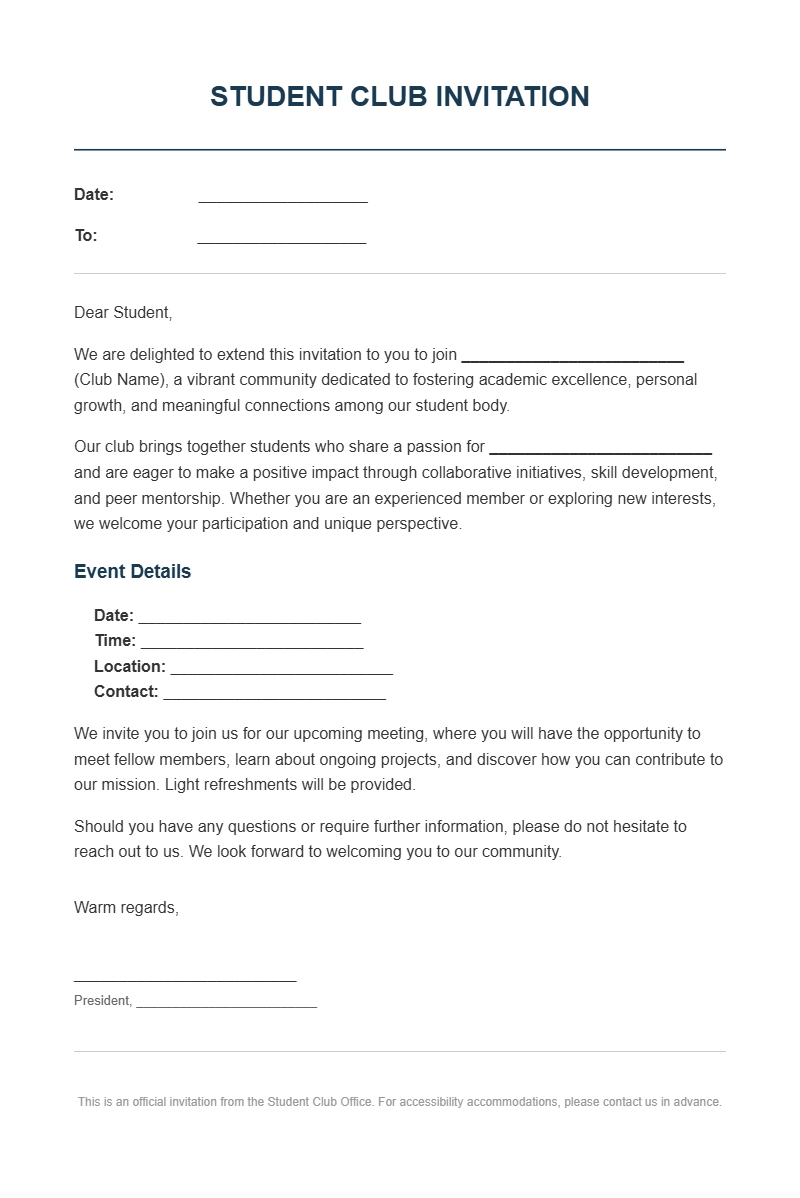
Getting people excited about joining your student club starts before the first meeting. An invitation letter sets the tone, shows you’re organized, and makes potential members feel genuinely welcome. Whether you’re launching a new club or recruiting new members for an existing one, a well-written invitation does the heavy lifting for you.
The problem most student leaders face is that generic, stiff invitations feel like obligations rather than opportunities. People respond to warmth and clarity. They want to know what the club actually does, when it meets, and why they should care. A good invitation letter delivers all of that without sounding like a corporate memo.
What A Student Club Invitation Letter Actually Is
A student club invitation letter is a written request asking someone to join your organization. It’s more formal than a text message or social media post, but it shouldn’t read like legal documentation. Think of it as a bridge between casual interest and committed membership.
These letters work because they’re personal. They show effort. Someone took time to write something specifically for the recipient, which matters psychologically. Even if you’re sending the same letter to multiple people, the format itself conveys respect for the reader’s time and decision.
You’ll typically print or email these letters. Some clubs hand them out at club fairs or tabling events. Others mail them to specific students who showed interest or fit the club’s mission. The medium depends on your audience and budget, but the content structure stays consistent.
When You Actually Need An Invitation Letter
Invitation letters work best in specific situations. You might send them after a recruitment fair when you’ve identified genuinely interested people. They’re also useful when you’re reaching out to students who match your club’s focus—like inviting STEM majors to join a robotics club or creative writers to join the literary magazine.
Some clubs use them for officer recruitment, making the letter more formal and detailed. Others send them as follow-ups after initial meetings to convert casual attendees into committed members. The timing matters. Send the letter when interest is highest, not weeks after someone expressed curiosity.
You probably don’t need an invitation letter if you’re just promoting on social media or posting flyers. But if you’re targeting specific individuals, trying to formalize membership, or making a significant ask (like asking someone to take on a leadership role), a letter is the right tool.
Core Components Of An Effective Invitation Letter
Every solid invitation letter includes these elements, though the order and emphasis can shift based on your club’s style:
- A clear subject line or opening that immediately states the purpose—you’re inviting them to join your club
- A personal touch that acknowledges why you’re reaching out to them specifically, not just a mass audience
- What the club does explained in concrete terms, not vague mission statements
- Meeting details including day, time, location, and how often you meet
- What they’ll gain from membership, whether that’s skills, community, experience, or something else
- How to join with clear next steps and contact information
- A warm closing that feels genuine, not automated
The length should be one page maximum. Most effective invitation letters run 250-400 words. Anything longer and people stop reading. Anything shorter and you haven’t given them enough reason to show up.
How To Write Your Student Club Invitation Letter Step By Step
Start With The Header
Include your club’s name, the date, and the recipient’s name if possible. If you’re sending to multiple people, you can use “Dear Club Member” or “Dear [Student Name]” if you’re personalizing. Include your club’s contact email or social media handle at the top or bottom so people know how to reach you.
Open With A Specific Reason You’re Reaching Out
Don’t say “We’re looking for members.” Instead, reference something real. “I noticed you’re in the environmental science major” or “You came to our tabling event last week” or “We’re specifically looking for people interested in documentary filmmaking.” This shows you didn’t just blast everyone with the same letter.
Explain What Your Club Actually Does
Use active language and concrete examples. Instead of “Our club promotes social awareness,” try “We meet weekly to discuss current events, host speakers on social justice topics, and organize campus activism campaigns.” The reader should immediately understand what they’d be spending their time on.
Give Them The Logistics
Be specific about when and where you meet. “Thursdays at 7 PM in Student Center Room 204” is better than “We meet regularly.” If meetings vary, explain that. If there’s a cost, mention it upfront. Surprises kill attendance.
Explain The Real Benefit
Why should someone join your club instead of the twenty others competing for their time? Are they building a portfolio? Making friends? Learning a skill? Giving back? Be honest about what members actually get out of it. Different people join for different reasons, so you might mention a few possibilities.
Tell Them Exactly What To Do Next
Don’t assume they’ll figure it out. “Reply to this email to confirm you’re coming” or “Show up Thursday at 7 PM” or “Fill out this form to join our group chat.” Remove friction from the next step.
Close Warmly But Professionally
Use “Looking forward to seeing you,” “Hope to meet you soon,” or something similar. Sign with your name and title (like “President, Debate Club”). This feels personal without being overly casual.
Ready-To-Use Invitation Letter Templates
Template 1: General Club Recruitment
Use this for standard member recruitment at club fairs or open recruitment periods.
Dear [Student Name],
I’m reaching out because you expressed interest in the Photography Club at our recent tabling event, and I think you’d be a great fit for what we’re building.
We meet every Tuesday and Thursday at 6 PM in the Arts Building, Room 312. Our club focuses on three things: learning photography techniques through hands-on workshops, critiquing each other’s work in a supportive environment, and collaborating on campus photo projects. Whether you’re using a DSLR, mirrorless camera, or just your phone, you’re welcome here.
Members get access to our shared equipment library, feedback from experienced photographers, and the chance to build a portfolio that actually impresses graduate schools and employers. We also do fun stuff like photo walks around campus and end-of-semester gallery shows where members display their best work.
Our first meeting is this Thursday. Just show up, or reply to this email if you have questions. We have snacks and a casual vibe—no experience necessary.
See you soon,
[Your Name]
President, Photography Club
photography.club@university.edu
Template 2: Targeted Recruitment For Specific Majors Or Skills
Use this when you’re reaching out to students who match specific criteria.
Dear [Student Name],
The Data Science Club is looking for students like you—people in quantitative fields who want to build real projects that matter. Your computer science background would bring exactly what we need for our upcoming competition team.
Here’s what we do: We meet Mondays and Wednesdays from 7–8:30 PM in the Engineering Building. Members work on machine learning projects, prepare for data science competitions, and collaborate with local companies on internship opportunities. Last year, three of our members landed internships directly through club connections.
You don’t need to be an expert. You need to be curious and willing to learn alongside people who are equally invested. We have members across all experience levels, and we pair experienced coders with people newer to the field.
If you’re interested, come to our next meeting or email me to learn more. We’re also looking for people interested in helping lead workshops, so let me know if you’d consider taking on a bigger role.
Best,
[Your Name]
Co-President, Data Science Club
datasci.club@university.edu
Template 3: Leadership Or Officer Recruitment
Use this when you’re asking someone to take on a specific role.
Dear [Student Name],
I’m writing because the Community Service Club is looking for a treasurer, and your name came up immediately. You’ve shown real initiative in our club over the past year, and you have exactly the organizational skills we need.
The role involves managing our budget (roughly $3,000 annually), tracking expenses, and presenting financial reports at monthly meetings. It’s not overwhelming—we’re a laid-back club—but it does require someone reliable who actually cares about doing it well. The commitment is about 3-4 hours per month.
In return, you get leadership experience that looks great on resumes and grad school applications. You also get to shape how our club allocates resources and support the causes we care about. Plus, you’d be working directly with me and our other officers, and honestly, that group is fun to be around.
No pressure if it’s not the right time, but I’d love to talk through it. Grab coffee with me this week, or we can discuss over email. Let me know what works for you.
Thanks for considering,
[Your Name]
President, Community Service Club
[Your Phone Number]
Common Mistakes To Avoid
Being too vague about what the club does. “We’re a club for people who care about the environment” doesn’t tell anyone what they’d actually do. Be specific. Do you clean beaches? Lobby for policy changes? Study environmental science? There’s a difference.
Forgetting the logistics. A great invitation falls apart if people don’t know when or where to show up. Double-check your meeting time and location before you send anything out. Nothing kills credibility like sending someone to a room that doesn’t exist or a time the club doesn’t actually meet.
Making it too formal or corporate. You’re a student club, not a Fortune 500 company. Stiff, overly professional language feels inauthentic. Write like a real person, not like you’re copying a business template.
Asking for too much too soon. Don’t demand membership fees, long-term commitments, or extensive applications in your first invitation. Let people come to a meeting, get a feel for the group, and make an informed decision. You can collect forms and fees later.
Sending it at the wrong time. If you’re inviting people after they’ve already missed the first three meetings, you’ve waited too long. Strike while interest is high. If you’re sending it weeks before the first meeting, they’ll forget. Aim for 1-2 weeks before.
Making the next step unclear. Don’t assume people know how to respond or what to do next. Be explicit. “Reply to this email,” “Show up Thursday,” “Click this link to join our group chat”—pick one and make it obvious.
Treating it like a mass email. Even if you’re sending the same letter to twenty people, personalize it somehow. Reference something specific about why you’re reaching out to them. It changes the entire feel.
How To Customize Your Invitation For Different Audiences
The core structure stays the same, but the emphasis shifts based on who you’re talking to. If you’re inviting freshmen, highlight the social and community aspects. They’re often looking to build friendships and find their people. If you’re inviting upperclassmen, focus on leadership opportunities and how the club strengthens their resume or graduate school applications.
For competitive or selective clubs, lean into the credibility and accomplishments. “Last year, our debate team placed third regionally” matters to someone considering whether to join. For casual clubs, emphasize the low-pressure, welcoming environment.
If you know someone’s specific interest within your club’s mission, mention it. “I saw you presenting on climate policy at the environmental symposium—we’d love to have you join our policy discussion group” is infinitely more compelling than a generic letter.
The tone can shift too. A letter for a comedy improv club can be funnier and more playful. A letter for a professional business club should be more polished. Match your club’s actual personality. If your club is serious and academic, your letter should reflect that. If it’s casual and fun, the letter should feel that way too.
You might also adjust the length and detail based on context. If you’re handing someone a letter at a club fair where they have thirty seconds, keep it to half a page. If you’re emailing someone specifically, you can go longer and more detailed.
Formatting Tips For Readability
Whether you’re printing or emailing, format matters. Use a readable font like Arial or Calibri in 11 or 12-point size. Leave decent margins and white space. No one wants to read a wall of text.
Break your letter into short paragraphs—three to four sentences each. This makes it feel less intimidating and easier to scan. If you’re printing copies, use decent paper. It signals that you care. If you’re emailing, use a professional email address associated with your club, not your personal Gmail account if you can help it.
Consider adding your club’s logo or a simple design element if you’re printing. Nothing fancy—just something that makes it look intentional rather than hastily thrown together. If you’re emailing, a simple signature with your club name, your role, and contact info is enough.
Following Up After You Send The Letter
The letter is just the beginning. If people don’t show up to the first meeting after receiving an invitation, a simple follow-up helps. “Hey, we missed you at our meeting Thursday. We’re meeting again next week if you want to stop by” keeps the door open without being pushy.
If someone does show up, make sure they feel welcomed. Introduce them to people, ask their name, find out what brought them in. The experience after the invitation matters as much as the invitation itself. A great letter gets them in the door; a warm welcome gets them to come back.
You might also send a brief thank-you email after the first meeting to people who attended, reminding them when you meet next and asking if they have any questions. This reinforces that you value their presence and removes barriers to returning.
When To Use Different Delivery Methods
Email works best when you have someone’s contact information and want to reach them individually. It’s fast, trackable, and feels less formal than a printed letter. Print and hand-deliver when you’re at an event or have a chance to meet someone face-to-face. It’s more memorable.
Social media posts work for general announcements but don’t feel personal enough for serious recruitment. A printed letter handed to someone at a club fair combines the personal touch with formality. If you’re recruiting multiple people at once, email is practical. If you’re targeting one or two specific people, a handwritten note or printed letter feels more genuine.
Some clubs use a combination approach: email the letter to their main contact list, but print and hand-deliver to specific people they’ve identified as particularly good fits. This maximizes reach while still maintaining personalization where it matters most.
Connecting Your Invitation Letter To Other Club Materials
Your invitation letter doesn’t exist in isolation. It should align with your club’s overall communication style. If your club is professional and formal, the letter should match. If your club is casual and fun, the letter should feel that way too.
Consider how this letter connects to your club’s other documents. If you’re also sending out a formal request for resources or support, the tone and professionalism should be consistent. If members will eventually need to provide documentation for club-related absences, your club’s communication standards should be established early through letters like this one.
Similarly, if you’re asking members to complete acknowledgment letters for club expenses or other formal processes, they should recognize your club’s communication style from the invitation they received. Consistency builds trust.
Real Examples From Actual Student Clubs
Here’s what worked for a real debate club: They sent a one-page letter to freshmen who attended their recruitment event, referencing the specific topic they’d debated that day. “You asked great questions about healthcare policy during our demo debate” made each letter feel personal. They included their meeting time, a link to their group chat, and a casual line: “No experience needed. We’ll teach you everything.” Attendance jumped 40% compared to previous years.
A film club kept their letter short and visual, including a small still from a student film. They mentioned specific genres they worked with and that members got access to equipment. The letter ended with “Bring snacks, bring ideas, bring yourself.” It felt authentic to the club’s vibe.
A volunteer club focused their letter on impact, listing specific projects and how many people they’d helped last year. They made it clear that membership was flexible—”Come to as many events as your schedule allows.” This removed the pressure that keeps some people from joining.
Adapting Your Letter For Different Club Types
Academic clubs (debate, math, engineering) should emphasize skill-building and competition opportunities. Leadership clubs should highlight personal development and networking. Social or hobby clubs should stress community and fun. Service clubs should focus on impact and making a difference.
A chess club’s letter looks different from a social justice club’s letter. A sports club’s letter is different from an arts club’s letter. The structure is the same, but the emphasis and language shift to match what actually motivates people to join that particular type of group.
If your club serves a specific demographic (first-generation students, international students, LGBTQ+ students), your letter can acknowledge that and explain how your club supports that community. This signals that you understand their needs and that the club is genuinely for them, not just in theory.
What To Do If People Don’t Respond
Not everyone will respond, and that’s normal. Some people are busy, some lose the letter, some change their minds. Don’t take it personally. A 20-30% response rate is actually solid for club recruitment.
If you’re getting almost no responses, it might be worth adjusting. Are you reaching the right people? Is your letter clear about what the club does? Are your meeting times realistic for your audience? Sometimes a small tweak in messaging or timing makes a big difference.
You can also try a different delivery method. If email isn’t working, try printing and hand-delivering. If one-on-one invitations aren’t bringing people in, try a group information session. Different approaches work for different people.
Making Your Letter Stand Out Without Trying Too Hard
The best invitation letters are genuine and specific. They don’t try to be clever or overly polished. They just clearly communicate why someone should join and make it easy for them to do so.
Specificity is your biggest advantage. Instead of “We’re a great club,” say what makes your club actually great. Instead of generic benefits, list real ones. Instead of vague next steps, tell people exactly what to do.
Personality matters too. Let your letter sound like your club. If your club is funny, be funny. If it’s serious, be serious. If it’s welcoming and inclusive, make that come through in your writing. Authenticity is more memorable than perfection.
Start Writing Your Invitation Today
You don’t need to overthink this. Pick one of the templates above, customize it for your specific club and audience, and send it out. The goal is to get interested people to your first meeting. Everything else—building community, creating lasting value, developing leaders—happens after they show up.
Remember that your invitation letter is a representation of your club. It should reflect your club’s actual values and personality. If you promise a welcoming environment, be welcoming. If you emphasize quality and rigor, deliver that. The letter is just the first impression; your club’s actual experience is what keeps people around.
Start with one audience segment. Write the letter. Send it out. See what works. Adjust for next time. Over a few recruitment cycles, you’ll develop a sense of what resonates with your target audience. That’s when your invitations become really effective—when they’re based on real experience with what actually motivates people to join your specific club.
Editable Document Format Examples