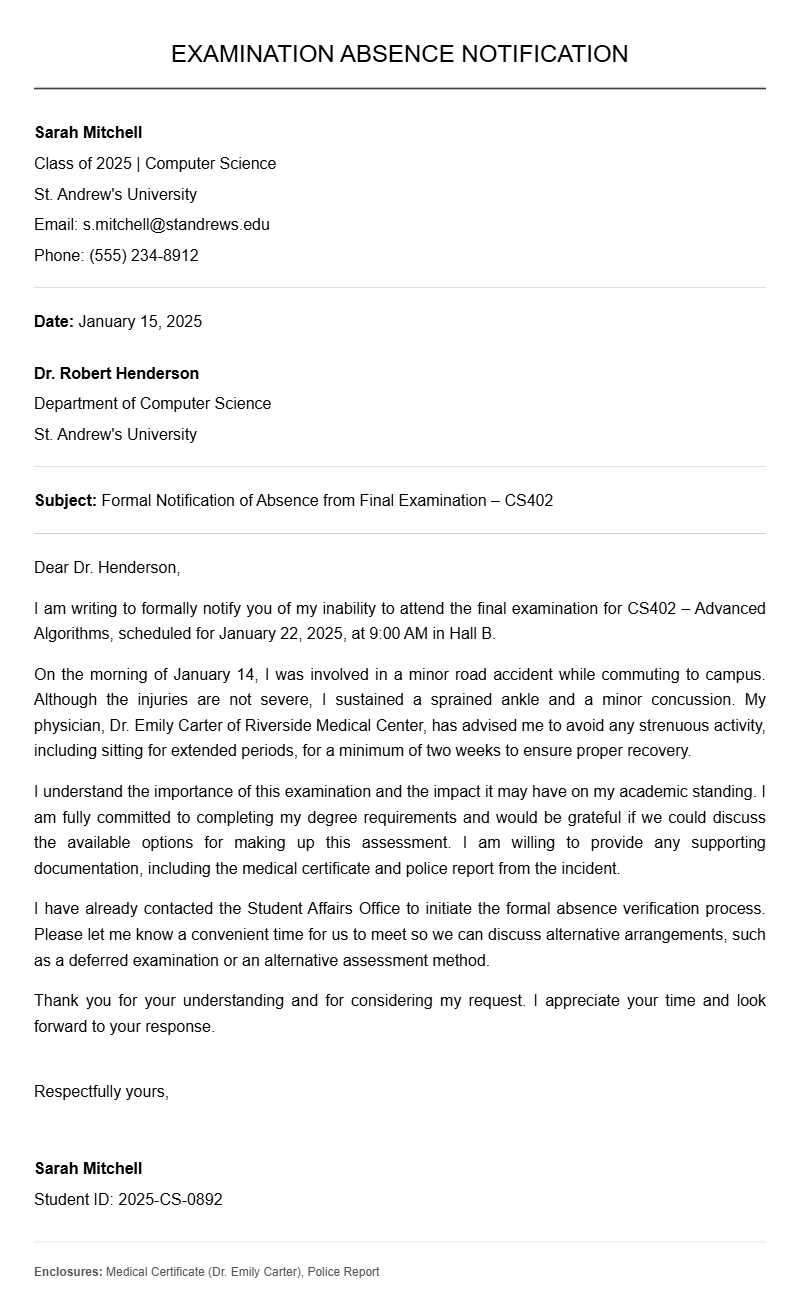
Whether you’re a parent writing for your child or a student explaining your own situation, getting an exam absence letter right matters more than most people realize. A vague or poorly structured letter can lead to rejected appeals, lost exam attempts, or awkward follow-up conversations with administration. This guide walks you through exactly what to include, how to phrase things properly, and gives you ready-to-use templates for the most common scenarios.
What Is an Exam Absence Letter?
An exam absence letter is a formal written explanation submitted to your school, college, or university when you cannot attend a scheduled examination. It serves as your official record of why you were absent and often becomes part of the documentation needed to request a retake, appeal a grade, or waive penalty fees.
The letter isn’t just about explaining your absence—it’s about giving the examination board enough context to take your situation seriously. Think of it as a professional introduction to your problem, one that needs to be clear, honest, and complete enough that someone reading it for the first time can understand exactly what happened without needing to ask follow-up questions.
When You Actually Need This Letter
Most institutions require written notification of absence before you’ll be considered for any special arrangements. You typically need to submit this letter when:
- Illness kept you from attending—ranging from a sudden fever to more serious medical conditions
- A family emergency occurred, such as a death, accident, or crisis requiring your immediate presence
- Unavoidable circumstances arose that were genuinely beyond your control
- You have pre-existing medical conditions that occasionally flare up at inconvenient times
If you’re dealing with a medical situation that requires time off, our school medical leave letter templates might provide helpful context for structuring your documentation.
Key Components That Make Your Letter Effective
Before diving into templates, let’s break down what admission offices and examination boards actually look for. Missing any of these elements can weaken your case significantly.
The Essential Information to Include
- Your full name and student ID number — Identification that matches school records exactly
- The exam details — Course name, exam date, time, and venue
- Clear reason for absence — Written honestly but professionally
- Supporting evidence mention — Reference to attached medical certificates, police reports, or other documentation
- Request for alternative arrangements — Whether you’re asking for a retake, special consideration, or grade adjustment
- Contact information — How to reach you for follow-up questions
- Professional tone throughout — Even difficult circumstances deserve respectful language
The goal is completeness without oversharing. Stick to facts relevant to your academic situation—examiners don’t need your entire medical history, just enough to understand why you couldn’t attend.
How to Write This Letter Step by Step
Writing an effective absence letter isn’t about using fancy language. It’s about structure and honesty. Here’s how to approach it:
Step 1: Start With Your Details
Open the letter by identifying yourself clearly. State your full name, student identification number, and the program or year you’re in. This helps the administrative staff route your letter to the right person immediately.
Step 2: Identify the Exam
Specify which examination you’re writing about. Include the course name, module code if available, the scheduled date, and the time slot. The easier you make it for staff to locate your records, the faster your request gets processed.
Step 3: State Your Reason Directly
Explain why you were absent in plain language. You don’t need elaborate storytelling—state the facts and move on. “I was admitted to the emergency department on [date] due to acute appendicitis and underwent surgery the following morning” tells them everything needed without unnecessary drama.
Step 4: Reference Your Supporting Documents
Mention the attached evidence by name. This could be a medical certificate, hospital discharge summary, police report, or death certificate. Number them if you have multiple documents so reviewers can match your references to the attachments.
Step 5: Make Your Request Explicit
State clearly what you’re asking for—a retake exam, exemption from the paper, or reconsideration of your standing. Vague requests get vague responses, so be specific about the outcome you’re seeking.
Step 6: Close Professionally
Thank the reader for their time and indicate you’re available to provide additional information. Include your phone number and email address. Sign the letter if submitting a physical copy.
Ready-to-Use Templates for Common Situations
These templates cover the scenarios students and parents encounter most frequently. Use them as starting points and adjust the details to match your specific situation.
Medical Emergency Template
[Your Name]
[Student ID Number]
[Program/Year of Study]
[Email Address]
[Phone Number]
[Date]
To Whom It May Concern,
I am writing to inform you that I was unable to attend my [Course Name] examination scheduled for [Date] at [Time].
On [date of incident], I experienced [brief description of medical situation, e.g., severe food poisoning requiring emergency hospital admission]. I received medical treatment at [Hospital/Clinic Name] and was under their care until [date you were discharged or cleared].
I have attached a medical certificate from [Doctor’s Name] and the hospital discharge summary as supporting documentation for my absence.
I respectfully request consideration for a supplementary examination or alternative assessment arrangement. I am keen to complete this requirement and am happy to provide any additional information needed.
Thank you for reviewing my situation. I can be reached at [phone] or [email] should you need anything further.
Sincerely,
[Your Signature]
[Your Printed Name]
Family Emergency Template
[Your Name]
[Student ID Number]
[Program/Year of Study]
[Email Address]
[Phone Number]
[Date]
Dear [Recipient’s Name/Exam Officer],
I am writing to explain my absence from the [Course Name] examination on [Date].
On [date], I received news that [brief description of family emergency, e.g., my father was involved in a serious car accident]. Due to the circumstances, I needed to travel to [location] immediately to provide support and assist my family.
Attached please find [relevant documentation such as travel receipts, hospital confirmation, police report, or death certificate depending on situation].
I understand this examination is mandatory for course completion. I would like to request information about available options, including the possibility of a retake examination or special consideration under these circumstances.
Please let me know what additional documentation would help support my request. I am available at [phone] or [email] to discuss this further.
Yours sincerely,
[Your Signature]
[Your Printed Name]
Parent Writing for Minor Student
[Parent’s Full Name]
[Relationship to Student]
[Contact Phone]
[Contact Email]
[Date]
To the Examination Board,
I am writing regarding my [son/daughter], [Student’s Full Name], who is enrolled in [Year/Grade] at [School Name].
Unfortunately, [Student’s Name] was unable to attend their examination for [Subject Name] on [Date] due to [reason].
The circumstances were as follows: [brief, factual explanation]. During this time, [he/she/they] was under my care and unable to travel or participate in academic activities.
Enclosed are supporting documents including [list attached documents].
We are requesting [specific request—whether that’s a makeup exam, exemption, or grade consideration]. We would appreciate guidance on the next steps to resolve this matter.
Please contact me at [phone] or [email] if you require further information.
Regards,
[Parent’s Signature]
[Parent’s Printed Name]
Mistakes That Undermine Your Request
Even genuine situations get rejected when the letter creates problems. Watch out for these common errors:
- Vague reasons — “I wasn’t feeling well” without specifics or documentation rarely satisfies examination boards. They need enough detail to verify your claim.
- Submitting late — Most institutions have strict deadlines for absence notifications. Check your student handbook and submit as soon as possible, even if you write a preliminary letter and follow up with details later.
- Emotional language — Expressing frustration at the institution or dwelling on how unfair the situation feels shifts focus away from your actual request.
- Missing documentation — A letter without attached evidence is often treated as insufficient, regardless of how well-written it is.
- Asking for sympathy rather than solutions — Frame your situation as context for a reasonable request, not as an appeal for leniency based on hardship alone.
- Inconsistent information — Make sure dates, names, and details match across all your documents. Discrepancies raise red flags.
Making These Templates Work for Your Situation
These samples give you structure, but your letter needs to reflect your actual circumstances. Here’s how to adapt them effectively:
Adjust the Level of Detail Appropriately
Medical situations don’t require your full diagnosis if it’s not relevant to your absence. A broken leg doesn’t need explanation of how it happened—just that it prevented mobility during the exam period. The hospital’s documentation handles verification; your letter provides context.
Match Institutional Expectations
Some schools prefer formal letters addressed to specific departments. Others accept brief emails with attached forms. If you’ve received communication from your institution about their preferred process, follow those guidelines even if they differ from these templates.
Be Honest About Timing
If circumstances prevented you from notifying the school earlier, acknowledge this in your letter. “Due to the urgent nature of the situation, I was unable to submit prior notification. I apologize for any inconvenience this may cause” shows good faith and responsible communication.
Include What You Want, Not Just What Happened
Your letter should clearly state the outcome you’re seeking. Whether it’s a makeup exam, grade adjustment, or simply an update to your attendance record, make your request explicit and reasonable.
A Quick Note on Related Documentation
An absence letter works best as part of a complete documentation package. Depending on your situation, you may also need:
- Medical certificates from qualified practitioners
- Hospital records or discharge summaries
- Police reports for accidents or emergencies
- Death certificates for bereavement-related absences
- Travel documentation for international students who needed to return home suddenly
Keep copies of everything you submit, and send documents through methods that give you proof of delivery—email with read receipts, registered post, or hand-delivery with a colleague witnessing the submission.
For related academic correspondence needs, you might find our guides on work extension letter templates or business registration letter templates helpful for other situations that arise during academic and professional life.
What Happens After You Submit
Once your letter reaches the examination board, processing times vary. Most institutions will:
- Acknowledge receipt of your documentation within a few business days
- Review your request against their policies and regulations
- Communicate their decision and available options
- Provide next steps if alternative arrangements are approved
If you don’t hear back within the timeframe mentioned in your student handbook, follow up politely. Sometimes documentation gets misplaced, and a gentle reminder keeps your request moving through administrative processes.
Final Thoughts
Writing an exam absence letter isn’t about crafting the perfect prose—it’s about clear communication that helps someone make a decision about your academic standing. Keep it factual, stay professional, attach your evidence, and make your request explicit. Those four things cover about ninety percent of what matters.
If your situation involves ongoing medical needs or recurring circumstances that affect your studies, consider speaking with your school’s student support services. They can help coordinate accommodations beyond individual examination absences and connect you with resources for managing your academic responsibilities.
Common Document Templates & Previews