Let me guess—you’ve found yourself in a situation where you want to thank someone properly, but the words won’t come out right. Whether it’s a colleague who helped you meet a deadline, a mentor who’s guided your career, or an employee who went above and beyond, saying “thank you” meaningfully matters more than most people realize. The good news? You don’t have to start from scratch every time. Having solid appreciation letter templates on hand lets you craft genuine, heartfelt messages without the stress of figuring out where to begin.
What Exactly Is an Appreciation Letter?
An appreciation letter is a written expression of gratitude directed toward someone who has contributed to your success, supported your efforts, or positively impacted your life or work. Unlike a casual thank-you note you might scribble on a sticky pad, this type of letter tends to be more formal, detailed, and intended for your personal records or even personnel files.
These letters serve dual purposes. They make the recipient feel genuinely valued, and they document positive contributions for performance reviews, promotion considerations, or official records. Think of it as your chance to create a paper trail of excellence that could matter down the road.
When Should You Write One of These Letters?
There are several occasions where these templates become especially useful:
- After someone helps you complete a significant project or solves a persistent problem for you
- During performance review cycles when highlighting team member contributions
- When acknowledging a mentor or coach who invested time in your development
- Following exceptional customer service from a vendor or service provider
- After someone goes well beyond their normal responsibilities during a crisis
- When expressing thanks for a gift, bonus, or professional opportunity
The key is timing. Write these letters while the contribution is fresh in your mind. Waiting weeks or months dilutes the impact and makes the message feel obligatory rather than sincere.
The Key Components That Make These Letters Work
Every effective appreciation letter contains a few essential elements that you can adapt based on your situation:
- A specific greeting — Using the recipient’s name immediately sets a personal tone
- An opening that names the specific contribution — Get to the point quickly
- A body that explains the impact — This is where you connect their action to outcomes
- Personal reflection when appropriate — Share what their support meant to you
- A forward-looking closing — Express continued anticipation of working together or future contributions
Skip those flowery introductions that waste the reader’s time. Something like “I am writing to express my sincere appreciation for…” gets you into the substance immediately.
A Step-By-Step Approach to Writing Your Letter
Here’s how I approach writing these letters when I’m on the clock and need to get it right:
First, identify the specific action. Vague appreciation feels hollow. Instead of saying “thanks for all your help,” pinpoint exactly what they did: “Thanks for reorganizing the client files before the audit last week.”
Second, connect the action to results. This is where your letter earns its keep. Describe measurable or observable outcomes that wouldn’t have happened without their intervention.
Third, reflect on the personal dimension. Did their effort reduce your stress? Did their expertise save you from a mistake? Let them know how it affected you as a person, not just a professional.
Fourth, keep the closing simple. A genuine “thank you” beats elaborate signatures every time.
Editable Template Snippets You Can Use Today
Here are a few templates I’ve refined over time. Feel free to copy these structures and customize them for your own situations:
Template 1: Thanking a Colleague Who Covered Your Work
Subject: Quick Note of Thanks
[Name],
I wanted to reach out and thank you for handling the Henderson account review while I was out last Thursday and Friday. Your attention to detail caught an error in the invoicing that would have resulted in a significant dispute.
Because you flagged that issue when you did, we resolved it before the client even noticed. That kind of proactive problem-solving is exactly why our team runs smoothly, even when someone is unexpectedly away.
I really appreciate you stepping in without being asked. Let’s grab coffee this week so I can thank you properly.
Template 2: Appreciating an Employee After a Major Project
Dear [Name],
This note acknowledges your exceptional work on the Morrison website redesign project that we completed last month.
Your ability to interpret our vague concept and transform it into a site that exceeded the client’s expectations demonstrated the kind of creative problem-solving that sets our team apart. The client specifically mentioned your responsiveness during the revision phase in their feedback, which directly contributed to us securing their ongoing maintenance contract.
Your dedication to getting the details right—including finding that hosting issue before launch—made a real difference for our team and our client relationship. I’m fortunate to have you on the project.
Template 3: Expressing Gratitude to a Mentor
[Name],
I wanted to take a moment to acknowledge how much your guidance has shaped my approach to this work.
When we first spoke about my career direction two years ago, your advice to focus on building client relationships before pursuing management was counterintuitive at the time. But that foundation has made all the difference. Last week, I closed the Chen account by applying the same relationship-first approach you modeled for me.
Thanks for investing your time and experience in my development. I hope I can pay that forward to someone coming up behind me the way you did for me.
Common Mistakes That Weaken These Letters
Watch out for these pitfalls that I’ve seen sabotage otherwise good intentions:
Making it too generic. If your letter could apply to anyone, it effectively thanks no one. The specificity matters.
Focusing on traits instead of actions. Saying someone is “a great team player” doesn’t tell them what they actually did well. Instead, note the specific contribution.
Over-formalizing the tone. These letters shouldn’t read like legal documents. Your natural voice comes through more effectively than corporate-speak.
Delaying too long. A letter written三个月 after the fact reads like homework, not heartfelt appreciation.
Including too much. Longer isn’t better here. Focus on one or two key contributions rather than listing everything the person has ever done for you.
Tips for Making Your Letter Feel Genuine
Customization matters more than most people realize. Here’s how to make any template feel personal:
- Include a detail that only you and the recipient would know—this signals that you were paying attention
- Reference something specific they said or did that resonated with you
- Use language that reflects how you usually communicate, not how you think a “formal” letter should sound
- Avoid the trap of treating this as homework—approach it the same way you’d write a genuine message to a friend
For instance, if you’re working with a budget request letter template as a related task, notice how those templates emphasize clarity and specificity. Apply that same principle here.
Making Your Letter Part of a Larger Strategy
Recognition letters don’t exist in isolation. In professional settings, these letters often work alongside other communication tools. If you’re building a library of professional correspondence, you might also find sales inquiry letter templates useful for prospecting, or academic appeal letter examples if you’re in an educational context.
The same principles apply across all these document types: be specific, explain impact, and write in your natural voice.
Wrapping This Up
Don’t overthink this process. The fact that you’re looking for appreciation letter templates means you’re already ahead of most people who never bother to acknowledge the contributions of others at all.
Keep a folder of templates you can customize quickly. When someone does something worth recognizing, use those templates as a starting point, add your specific details, and send it off. Your colleagues and team members will notice the difference between a template-generated form letter and a genuine expression of gratitude—and they’ll remember it.
The best appreciation letters take fifteen minutes to write and create lasting positive impressions.,没有什么能比真诚的感谢更有力量了。
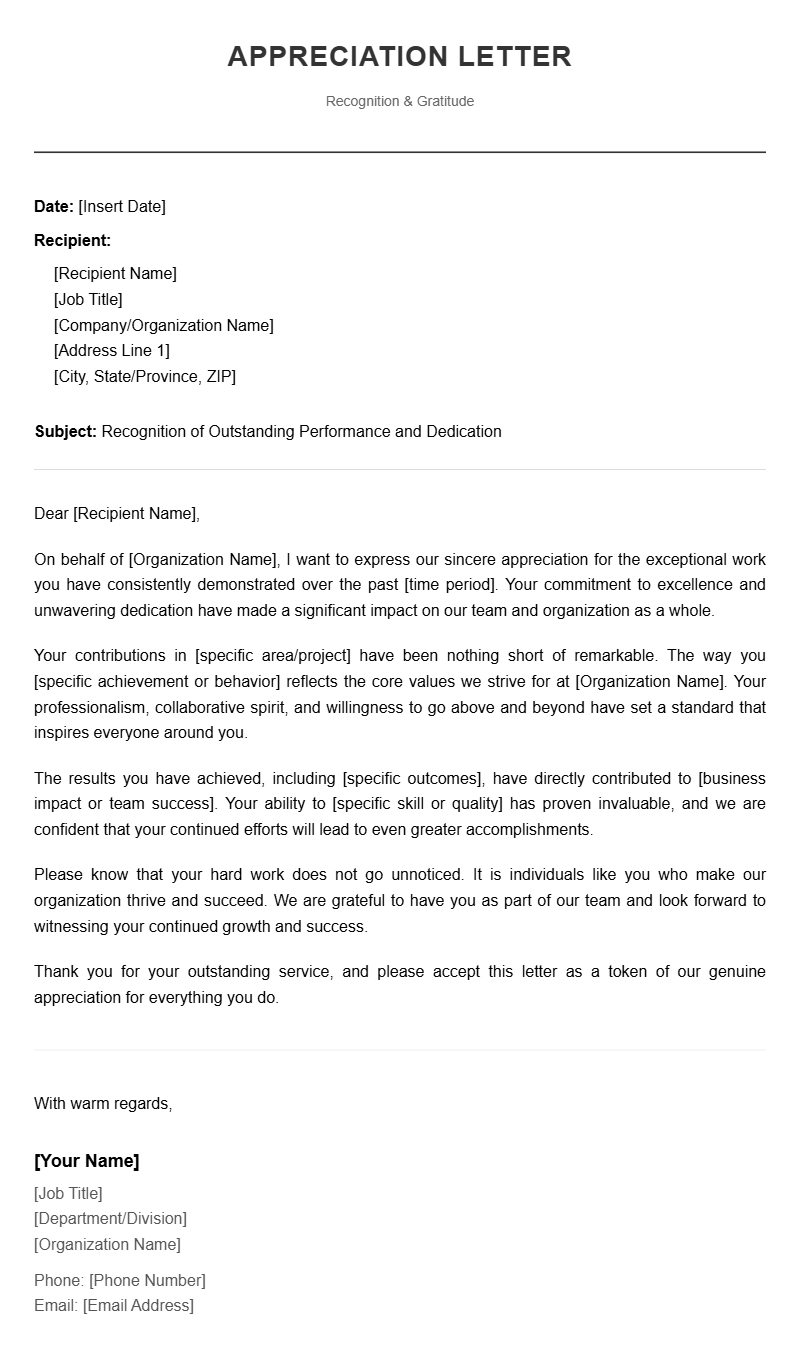
Document Structure & Example Models
…
…