If you’re a biologist looking to land your next role, having a well-crafted resume is key. Your resume not only showcases your skills and experience but also helps you stand out in a competitive job market. To make this process easier, many job seekers turn to biologist resume samples—they serve as practical guides to structure and content. In this article, you’ll find tips on how to use these samples effectively, plus a customizable template and common pitfalls to avoid.
What Are Biologist Resume Samples and Why Use Them?
Biologist resume samples are example resumes specifically tailored for professionals in biological sciences. They highlight the typical sections, language, and formats used in the field. These samples are useful whether you’re just starting out or are an experienced scientist aiming for a new position. They can help you understand what employers expect and how to present your background clearly.
When Should You Use a Biologist Resume Sample?
- You’re unsure how to organize your experience and skills effectively.
- You want to see industry-specific language and keywords to include.
- You need inspiration for formatting and section headings.
- You’re applying for various roles—research, fieldwork, laboratory technician—and want tailored approaches.
Key Components of a Biologist Resume
While the details depend on your experience, most biologist resumes should include:
- Contact Information: Name, phone number, email, LinkedIn profile (if applicable).
- Professional Summary or Objective: A brief statement highlighting your expertise and career goals.
- Skills: Laboratory techniques, research methods, data analysis, environmental assessment, etc.
- Work Experience: Roles held, responsibilities, and achievements, listed in reverse chronological order.
- Education: Degrees, certifications, relevant coursework.
- Additional Sections: Publications, conferences, awards, memberships, or volunteer work.
Step-by-Step Guide to Writing Your Biologist Resume
- Start with a strong professional summary: Summarize your experience and what you bring to the role. For example, “Experienced ecologist with over 8 years conducting field surveys and data analysis to support conservation projects.”
- Highlight relevant skills: Pick skills that match the job posting, like GIS mapping, ecological modeling, or laboratory techniques.
- Detail your work experience: Use bullet points to describe your roles. Be specific about what you did and any measurable results. For example, “Led biodiversity assessments that informed local environmental policies.”
- Include education and certifications: List your degrees, along with any specialized training or certifications like OSHA or wildlife permits.
- Add supplementary info: Publications, presentations, or memberships in professional societies can strengthen your resume.
Example Template for a Biologist Resume
Below is a simplified, editable snippet to help you start:
Professional Summary
Ecologist with 5+ years conducting field research and data analysis on wetland ecosystems. Skilled in GIS, species identification, and report writing.
Skills
- Wetland Ecology & Conservation
- GIS & Spatial Analysis
- Data Collection & Reporting
- Laboratory Techniques
Work Experience
- Environmental Scientist, Green Earth Org — June 2020–Present
Developed wetland management plans and conducted biodiversity surveys resulting in improved habitat preservation. - Research Assistant, State University — Sept 2018–May 2020
Assisted in ecological data collection and analysis for a project on invasive species.
Education
- Bachelor of Science in Biology, State University, 2018
- Certification in GIS Mapping, 2019
Common Mistakes to Avoid
- Using generic descriptions that don’t show your specific contributions.
- Overloading your resume with jargon that’s hard for HR personnel to understand.
- Neglecting to tailor your resume for each job application.
- Leaving out measurable achievements or results.
- Using inconsistent formatting or typos that undermine professionalism.
Tips for Customizing Your Resume
- Scan the job posting and mirror keywords and skills used there.
- Highlight experiences most relevant to the role—don’t list everything you’ve done.
- Include specific projects or research that demonstrate your expertise.
- Keep your resume concise—preferably one to two pages.
- Use clear headings and bullet points for easy reading.
Looking for inspiration tailored to specific roles? For instance, if you’re transitioning into a role as a veterinarian, check out some veterinarian resume templates. Similarly, if you want to emphasize laboratory work, exploring systems administrator resumes can give ideas on technical formatting.
Updating your resume with real examples and clear language can make a big difference. Keep it honest, focused, and tailored—your next opportunity could be just a few edits away.
Template Variations & Sample Formats
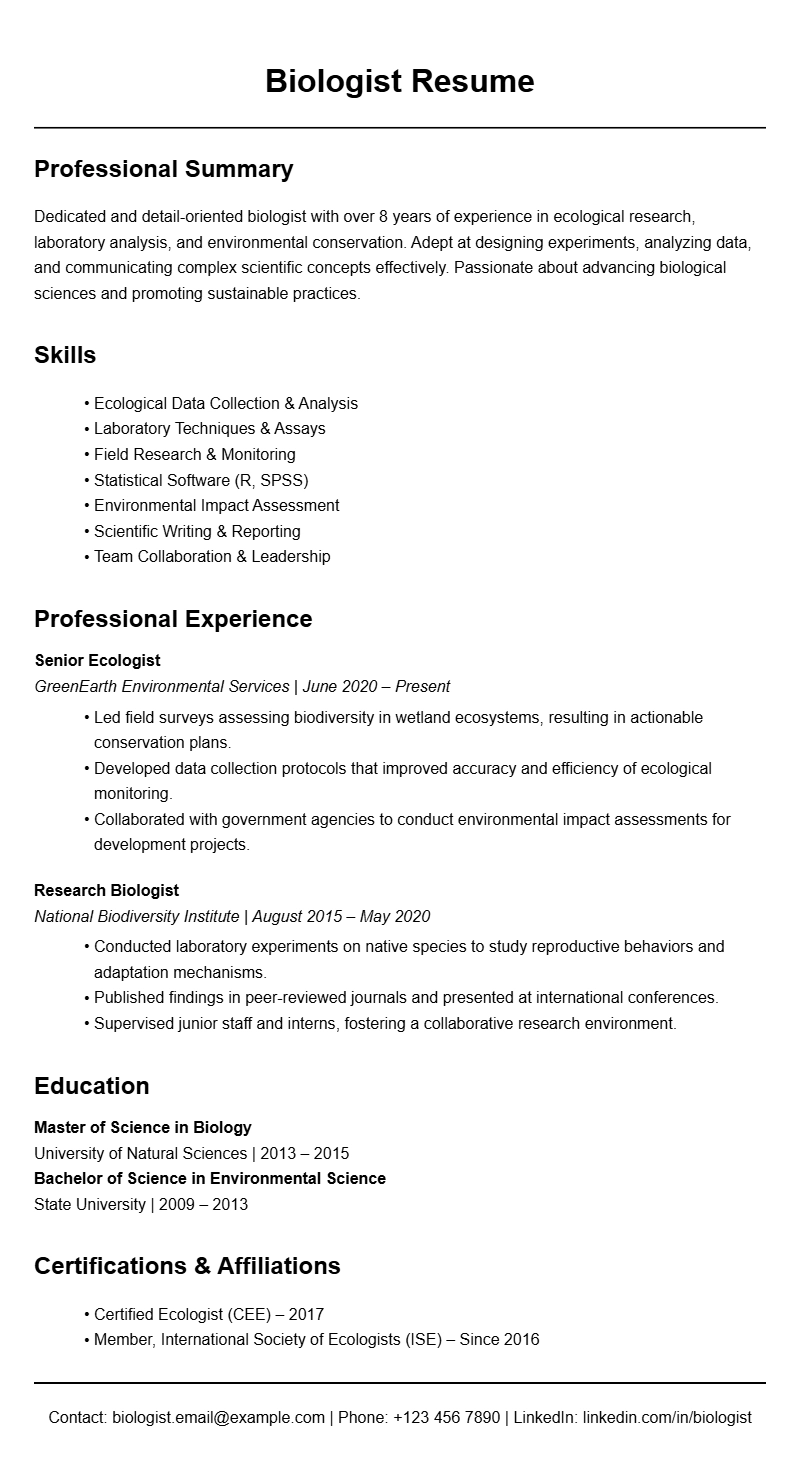
Entry-Level Biologist Resume Sample
Objective: Enthusiastic recent biology graduate seeking an entry-level biologist position to apply laboratory skills and ecological knowledge.
Education:
- B.Sc. in Biology, University of Example, 2022
Skills:
- Field sampling and data collection
- Laboratory analysis and microscopy
- Data interpretation and reporting
- Proficient in Microsoft Office and research software
Experience:
- Intern, Green Nature Research, Summer 2021
- Participated in biodiversity surveys and maintained lab records
References available upon request.
Experienced Biologist Resume Sample
Summary: Dedicated biologist with over 8 years of experience in ecological research, environmental assessment, and conservation projects.
Professional Experience:
- Senior Ecologist – BioEnviro Consulting (2019–Present)
- Lead field surveys for wetland and forest habitats
- Develop environmental impact assessments
- Manage a team of junior biologists
- Research Biologist – GreenEarth Labs (2014–2019)
- Conducted laboratory experiments on plant responses to pollutants
- Published findings in peer-reviewed journals
Skills:
- Environmental data analysis
- GIS and spatial mapping
- Report writing and project management
Educational background and references available upon request.
Biologist Resume with Focus on Research Skills
Profile: Research-oriented biologist experienced in molecular biology, genetics, and laboratory experimentation, committed to advancing scientific understanding.
Core Competencies:
- DNA/RNA extraction and PCR techniques
- Genetic sequencing and data analysis
- Laboratory protocol development
- Scientific documentation and publication
Experience Highlights:
- Research Associate at Genomic Solutions (2020–Present)
- Designed experiments on gene expression in plant species
- Collaborated with cross-disciplinary teams
Educational background and detailed publications available on request.
Biologist Resume for Conservation Projects
Professional Summary: Passionate conservation biologist with extensive experience in wildlife monitoring, habitat restoration, and community engagement.
Key Skills:
- Wildlife tracking and species identification
- Ecological data collection and analysis
- Community outreach and educational programs
- Grant writing and project funding
Experience:
- Conservation Biologist, Wildlife Protectors (2016–Present)
- Led habitat restoration initiatives in protected areas
- Worked with local communities to promote sustainable practices
References available upon request.
Academic Biologist Resume Sample
Profile: Academic researcher with a focus on marine biology and ecological systems, with multiple publications and teaching experience.
Education:
- Ph.D. in Marine Biology, Ocean University, 2015
Research Experience:
- Postdoctoral Fellow at Marine Research Institute (2015–2018)
- Investigated coral reef resilience and bleaching events
Teaching:
- Lecturer in Marine Ecology at Ocean University (2018–Present)
- Supervised graduate research projects
Publications and conference presentations available on request.
Biologist Resume Highlighting Laboratory Expertise
Summary: Skilled biologist with extensive laboratory experience specializing in microbiology, cell culture, and biochemical assays.
Skills:
- Cell culture and tissue handling
- Flow cytometry and microscopy
- Biochemical analysis and assay development
- Data analysis using statistical software
Experience:
- Laboratory Technician at BioTech Labs (2017–Present)
- Developed protocols for enzyme activity assays
- Maintained cell lines and prepared samples for analysis
Educational credentials and references available upon request.
Biologist Resume for Field Research Positions
Profile: Field biologist with hands-on experience in ecological surveys, species identification, and environmental monitoring across diverse habitats.
Core Experience:
- Conducted flora and fauna surveys in remote locations
- Collected and processed environmental samples
- Documented biodiversity and habitat conditions
- Ensured safety and compliance with research protocols
Previous Roles:
- Field Assistant at EcoField Research (2018–2022)
- Supported research teams in challenging outdoor environments
Reliable and adaptable with a passion for conservation and ecological understanding.
Biologist Resume with Emphasis on Data Analysis
Summary: Analytical biologist experienced in statistical modeling, data visualization, and bioinformatics to interpret complex biological data sets.
Technical Skills:
- R, Python, and SAS programming
- Bioinformatics pipelines and databases
- Statistical hypothesis testing
- Graphing and data presentation tools
Experience:
- Data Analyst at EcoData Solutions (2019–Present)
- Developed models predicting species distribution based on environmental variables
- Produced reports for scientific publications and stakeholders
Educational background and portfolio of projects available upon request.
Biologist Resume for Laboratory and Field Balance
Profile: Versatile biologist with a strong foundation in both laboratory research and field data collection, aiming to contribute to multidisciplinary biological projects.
Skills:
- Laboratory techniques and protocols
- Ecological survey methods
- Data management and GIS mapping
- Team collaboration and communication
Experience:
- Research Assistant at National Biodiversity Center (2016–2020)
- Supported both lab experiments and field studies
- Prepared technical reports and presentations
Educational background and references available on request.