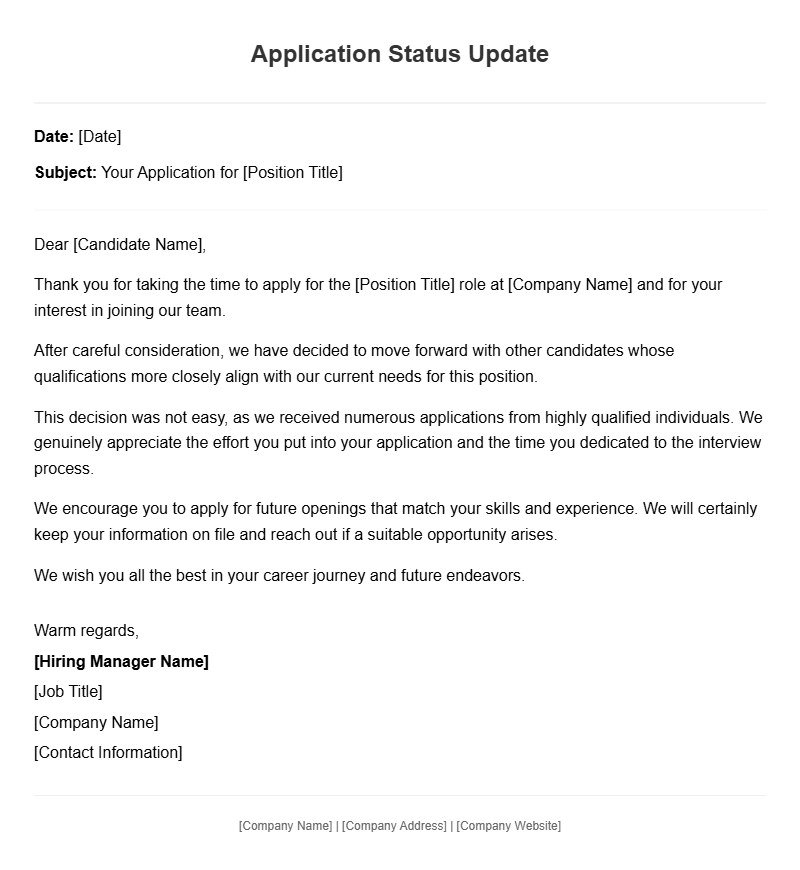
Sending a rejection letter is one of those tasks every hiring manager or recruiter faces, but it rarely gets the attention it deserves. Done well, it leaves candidates with a positive impression of your company. Done poorly, it damages your employer brand and might even cost you a good hire down the road. If you’re looking for candidate rejection letter templates that actually work in real situations, you’re in the right place.
What Is a Candidate Rejection Letter?
A candidate rejection letter is a formal communication sent to job applicants who haven’t been selected for a position. It’s not just a courtesy—it’s a strategic tool that reflects your company’s values and professionalism.
Unlike a quick email saying “we decided to move forward with another candidate,” a thoughtful rejection letter acknowledges the effort the candidate put into applying, provides closure, and keeps the door open for future opportunities. Whether you’re rejecting someone after a phone screen, a panel interview, or a final round, the template you use should match the stage of the process.
When Should You Send a Candidate Rejection Letter?
You should send a rejection letter whenever you communicate a decision to not move forward with an applicant. Here are the most common scenarios:
- After an initial application review — when you receive many applications and need to narrow the pool quickly.
- Following a phone or video screening — when candidates don’t meet your basic requirements but you want to maintain goodwill.
- After an in-person or panel interview — when you’ve completed all interviews and made your selection.
- For internal candidates — when promoting from within and rejecting other internal applicants.
The timing matters too. Aim to send rejection letters within 24 to 48 hours after making your decision. Waiting weeks creates unnecessary anxiety and frustration for candidates.
Key Components of an Effective Rejection Letter
Not all rejection letters need to be lengthy, but every effective one contains certain elements. Here’s what to include:
- Personalization — Address the candidate by name. “Dear Sarah” feels much better than “Dear Applicant.”
- Specific position — Clearly state which role they applied for, including the job title and any reference numbers if applicable.
- Acknowledgment — Briefly recognize their time, interest, or specific qualifications that stood out.
- Clear decision — State directly but kindly that they won’t be moving forward. No ambiguity.
- Reason (optional but helpful) — You can offer general feedback without being legally risky. Focus on “we found someone whose experience more closely matched our current needs” rather than criticizing specific skills.
- Future contact invitation — Leave the door open: “We encourage you to apply for future openings that match your background.”
- Professional closing — Sign with a real person’s name, title, and contact information.
Step-by-Step: How to Write a Candidate Rejection Letter
Follow these steps to craft rejection letters that are professional, human, and legally safe:
Step 1: Gather the Candidate’s Information
Before writing, confirm the candidate’s name, the exact position title, the stage of the process (application, phone screen, interview), and who will be sending the letter. This prevents embarrassing errors like wrong names or incorrect job titles.
Step 2: Choose the Right Tone
The tone should match your company culture and the depth of the relationship. A rejection after a single application can be brief and friendly. A rejection after multiple rounds of interviews deserves more warmth and specific acknowledgment of their efforts.
Step 3: Keep It Concise but Warm
Most rejection letters should be 100 to 200 words. You don’t need to explain every detail of your decision. Focus on respect and clarity. Avoid generic phrases like “we had many qualified candidates” without context—it feels dismissive.
Step 4: Personalize When Possible
If you interviewed the candidate, mention something specific you discussed. For example: “Your experience in project management and your insights during our conversation about scaling operations were impressive.” This shows you saw them as a real person, not just a resume.
Step 5: Include Next Steps or Alternatives
If you have a talent pipeline or future openings, mention it. For example: “We’ll keep your resume on file and reach out if a similar role opens up.” This transforms a dead-end message into a potential future connection.
Editable Candidate Rejection Letter Templates
Here are practical templates for different scenarios. Replace the bracketed sections with your specific information.
Template 1: Post-Application Rejection
Suitable for: High-volume hiring where you can’t personally review every applicant
Dear [Candidate First Name],
Thank you for your interest in the [Job Title] position at [Company Name] and for taking the time to apply.
After careful review, we’ve decided to move forward with candidates whose experience more closely aligns with our current needs. We received many strong applications for this role, and this was a difficult decision.
We encourage you to apply for future openings that match your background. We’ll keep your information in our candidate database.
Best regards,
[Your Name]
[Your Title]
[Company Name]
Template 2: Post-Phone Screen Rejection
Suitable for: Early-stage screening after a brief conversation
Dear [Candidate First Name],
Thank you for speaking with us about the [Job Title] role. I enjoyed learning about your background and your interest in joining [Company Name].
After further consideration, we’ve decided to proceed with other candidates whose qualifications more closely match what we’re looking for at this stage. This wasn’t an easy choice—your [specific skill or experience] was evident in our conversation.
I’ll add you to our talent network, and I’ll reach out if a suitable opportunity arises. Please feel free to apply again for future positions that align with your experience.
Warm regards,
[Your Name]
[Your Title]
[Phone Number]
Template 3: Post-Interview Rejection
Suitable for: Candidates who completed one or more interview rounds
Dear [Candidate First Name],
I want to thank you for taking the time to interview for the [Job Title] position. Meeting with you gave us valuable insight into your skills, experience, and approach to [specific topic discussed in interview].
After careful deliberation, we’ve selected another candidate for this role. This was an extremely competitive process, and your [specific strength mentioned during interview] impressed everyone on the team.
We’d genuinely like to stay in touch. Please connect with me on [LinkedIn/professional platform], and don’t hesitate to apply for future roles that interest you. We’re growing quickly and expect several new positions to open in the coming months.
Sincerely,
[Your Name]
[Your Title]
[Email Address]
Template 4: Internal Candidate Rejection
Suitable for: Internal applicants not selected for a promotion or transfer
Dear [Candidate First Name],
Thank you for your interest in the [Job Title] position and for taking the time to go through our internal interview process.
After reviewing all candidates, we’ve decided to move forward with another applicant whose experience more closely matches our immediate needs for this role. Your contributions to [current team/project] remain invaluable, and we appreciate everything you do.
I’d like to schedule a brief conversation to discuss the selection criteria and areas you might focus on for future opportunities. Your growth matters to us.
Best regards,
[Your Name]
[Your Title]
Common Mistakes to Avoid
Avoid these pitfalls when writing rejection letters:
- Being too vague — “We decided to go in a different direction” leaves candidates confused. Add a sentence acknowledging what specifically stood out about their application.
- Using copy-paste templates without personalization — It’s obvious when the same letter goes to dozens of people with only the name changed. Add one or two personalized details when possible.
- Including legal risks — Don’t mention protected characteristics (age, gender, religion, disability status) even indirectly. Focus on job-related factors only.
- Promising future contact you can’t deliver — If you won’t actually keep their resume on file, don’t say you will. Broken promises frustrate candidates.
- Sending no response at all — Silence is worse than any rejection letter. Even a brief automated message is better than nothing.
Tips for Customizing Your Rejection Letters
Generic templates are a starting point, but customization makes them effective. Here’s how to adapt them:
- Match your company voice — A startup might use a more casual, friendly tone while a law firm would maintain formal language. Read your rejection letter alongside other candidate communications to ensure consistency.
- Include specific names — If multiple people interviewed the candidate, mention who made the decision or who to contact with questions. This humanizes the process.
- Reference previous conversations — If you discussed something specific during the interview (a project, a challenge, a mutual connection), mention it briefly.
- Consider the candidate’s experience level — A new graduate applying for their first job deserves more encouragement than a senior executive. Adjust the tone accordingly.
- Add your company branding — Include your company logo, signature styling, or a brief tagline if it fits your brand guidelines.
If you’re managing multiple rejection letters across different departments, consider creating a centralized system. For instance, when you need to communicate HR-related decisions consistently, using standardized approaches similar to how organizations handle professional correspondence—like those university-to-student letter samples—can help maintain quality and compliance across all communications.
Similarly, if you’re communicating organizational changes or policy updates that affect candidates, applying consistent formatting principles—like those found in school reopening letter samples—ensures your messages are clear, professional, and well-received.
A Quick Checklist Before Sending
- Double-check the candidate’s name and the position title.
- Confirm you’re using the right template for the stage of the process.
- Add at least one personalized detail when available.
- Verify the contact information in your signature is accurate.
- Proofread for grammar and tone.
Final Thoughts
Candidate rejection letters matter more than most hiring managers realize. They’re your chance to leave a lasting impression on people who might become customers, clients, or future applicants. A well-crafted rejection letter takes less than 10 minutes to write but can protect your employer brand for years.
Save these templates, adapt them to your company’s voice, and commit to responding to every candidate who takes the time to apply. The small effort you put in today will pay dividends in reputation, relationships, and future hiring success.
Standard Format & Layout Reference