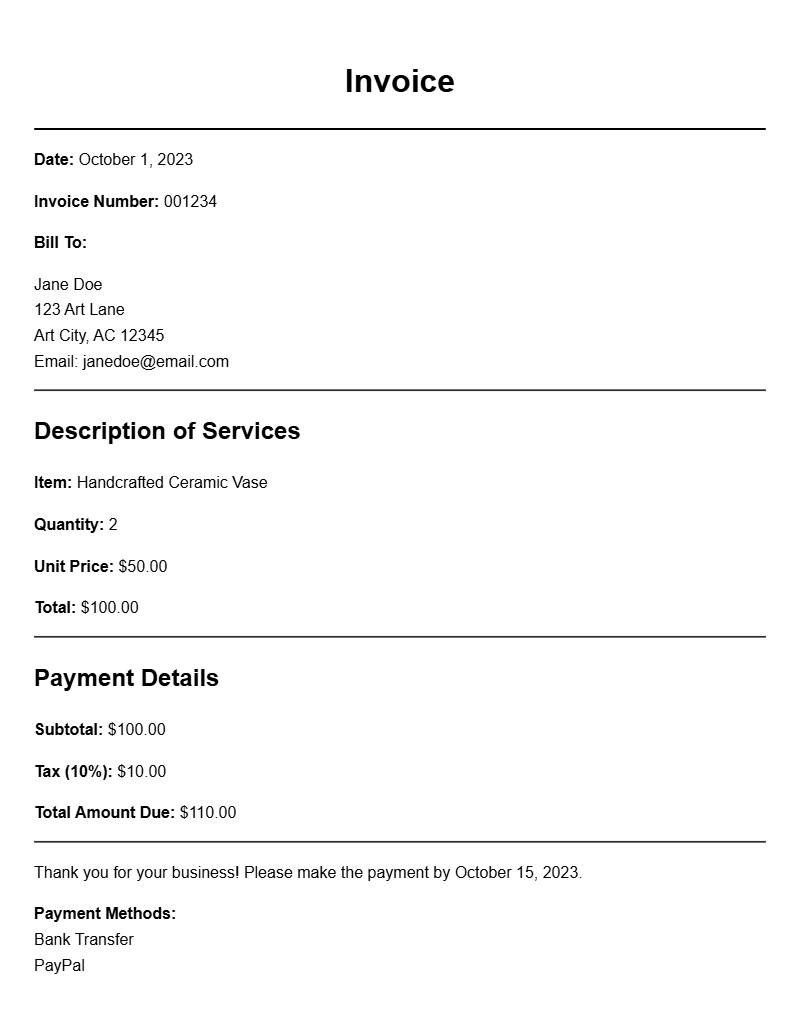
If you’re a ceramic artist, managing your business finances may not be your favorite task, but it’s essential. One critical document you’ll need is an invoice. A well-crafted invoice not only helps you get paid on time but also establishes professionalism in your work. If you’re unsure where to start, ceramic artist invoice samples can provide a solid foundation for your billing needs.
WHAT IS A CERAMIC ARTIST INVOICE?
A ceramic artist invoice is a document you send to clients after delivering your artwork or services. It outlines the products or services provided, the total amount due, payment terms, and other essential details. This document serves as a record for both you and your client, making it easier to track payments and manage your finances.
WHEN IS IT USED?
You’ll use an invoice whenever you complete a transaction, whether it’s selling a piece of pottery, providing a custom order, or offering a workshop. Sending an invoice right after the service or delivery not only prompts timely payment but also reinforces your professionalism.
KEY COMPONENTS OF A CERAMIC ARTIST INVOICE
- Your Business Information: Include your name, address, phone number, and email.
- Client Information: The name and contact details of your client.
- Invoice Number: A unique identifier for tracking purposes.
- Date of Issue: The date the invoice is created.
- Description of Services or Products: A detailed list of what you provided, including quantities and prices.
- Total Amount Due: The final amount the client owes you.
- Payment Terms: Information on how and when you expect to be paid.
STEP-BY-STEP WRITING GUIDE
Creating your invoice can be straightforward. Here’s a simple guide:
- Open with Your Information: Start at the top with your name and contact details.
- Add Client Information: Below your details, include your client’s name and address.
- Assign an Invoice Number: This helps you keep track of payments.
- Include the Date: Clearly state when the invoice is issued.
- Detail Services or Products: List each item, its price, and quantity.
- Calculate Total: Sum everything up for the total amount due.
- Set Payment Terms: Specify when and how you want to be paid.
REALISTIC EXAMPLES/TEMPLATES
Here’s a simple template you can customize for your needs:
Your Name
Your Address
Your City, State, Zip
Your Phone
Your Email
Client Name
Client Address
Client City, State, Zip
Invoice Number: 001
Date of Issue: [Insert Date]
Description of Services:
– Custom Ceramic Mug: $25.00 (Quantity: 2)
– Pottery Workshop: $150.00
Total Amount Due: $200.00
Payment Terms: Due upon receipt, payable via [Your Payment Method].
COMMON MISTAKES TO AVOID
- Neglecting Details: Missing information can lead to payment delays.
- Not Following Up: If payment isn’t received, a friendly reminder can prompt action.
- Inconsistent Formatting: Keep your invoices uniform for professional appearance.
TIPS FOR CUSTOMIZATION
Personalizing your invoice can make a difference. Consider adding:
- Your Logo: This reinforces your brand identity.
- Color Schemes: Use colors that match your artwork or style.
- A Thank You Note: A short message can enhance client relationships.
Creating a clear and professional invoice is vital for any ceramic artist. Using ceramic artist invoice samples as a guide can help simplify the process. By ensuring all necessary details are included and maintaining a consistent format, you can facilitate smoother transactions and maintain a professional image. For more templates, check out these related resources: project-based invoice templates, corporate photoshoot invoice templates, and wholesale invoice templates.
Practical Document Examples