Let me walk you through exactly how to write a church donation request letter that actually gets results. Over the years, I’ve helped dozens of churches craft letters that bring in meaningful contributions, and I can tell you right away that the difference between a letter that gets ignored and one that opens wallets comes down to a few practical elements. This guide gives you ready-to-use templates, clear structure, and real examples you can adapt today.
What Is a Church Donation Request Letter?
A church donation request letter is a formal written appeal sent to congregation members, local businesses, or community supporters asking for financial contributions to a specific church initiative. It could be for building renovations, mission trips, community outreach programs, emergency assistance funds, or general operational costs.
Unlike a casual verbal announcement during service, this letter creates a documented record that people can refer back to. It gives donors something concrete to hold onto, whether that’s a physical copy in the bulletins or an email they can forward to others who might want to give.
When Should You Send a Donation Request Letter?
Timing matters more than most church leaders realize. You want to send these letters when people are already thinking about generosity, not when fatigue has set in from multiple appeals.
- Before a building project or major renovation kicks off
- Following a natural disaster or community crisis when your church is responding
- At the start of a new ministry year when budgets are being set
- When a specific mission trip or service project needs funding
- During annual stewardship campaigns
Avoid sending donation letters right after another major church fundraising push. Space out your appeals by at least six weeks whenever possible.
Key Components Every Donation Letter Needs
Before I give you templates, you need to understand the building blocks. A strong donation letter includes five essential elements:
Personalized Greeting
Skip the “Dear valued member” approach. Use the recipient’s actual name. This small detail dramatically increases response rates because it signals that this isn’t a mass-mailed form letter.
Clear Purpose Statement
State exactly what you’re raising money for within the first two sentences. Don’t make readers dig for the point. Be specific: “We’re raising $50,000 to install wheelchair-accessible ramps and renovate our restroom facilities.”
Emotional Connection
Paint a picture of the impact. Numbers matter, but stories matter more. Explain how this project will serve real people in your community.
Concrete Ask Amount
Never leave the donation amount open-ended without guidance. Specify a range if needed, but give people a target to aim for. “Our goal is $25 per family per month” or “A contribution of $500 will cover materials for one community back-to-school backpack drive.”
Easy Response Method
Include clear instructions for how to give. Online portal links, designated drop-off times, envelope systems for mail, or contact information for your church office. Remove every possible friction point.
Step-by-Step Guide to Writing Your Letter
Here’s how I approach writing these letters with churches, broken down into actionable steps you can follow tonight.
Step 1: Define Your One Goal
Every letter should pursue exactly one fundraising objective. If you’re raising money for three different things, write three separate letters. Trying to cover everything dilutes your message and confuses readers.
Step 2: Identify Your Audience
A letter to long-time tithing members looks different from a letter to new visitors or local businesses. Know who you’re writing to and adjust your language accordingly. Long-time members don’t need explanations about your church’s mission. New visitors might.
Step 3: Tell One Story First
Before you mention money, tell a real story about someone who will benefit from this project. Keep it specific and small-scale. “Last month, the Rodriguez family came to us after losing their home to a fire. Our emergency assistance fund helped them with first month’s rent at a new apartment.” This humanizes your request.
Step 4: State the Need and the Amount
After establishing emotional connection, pivot to the practical ask. Be specific about the total goal and how contributions will be used.
Step 5: Make the Giving Process Obvious
Include explicit instructions: “Give online at [churchwebsite.org/give], drop a check in the offering basin during Sunday service, or mail contributions to [church address].”
Step 6: Express Genuine Gratitude
Thank the reader for considering your request. Even if they don’t give, you want them to feel appreciated for taking the time to read your letter.
Church Donation Request Letter Template
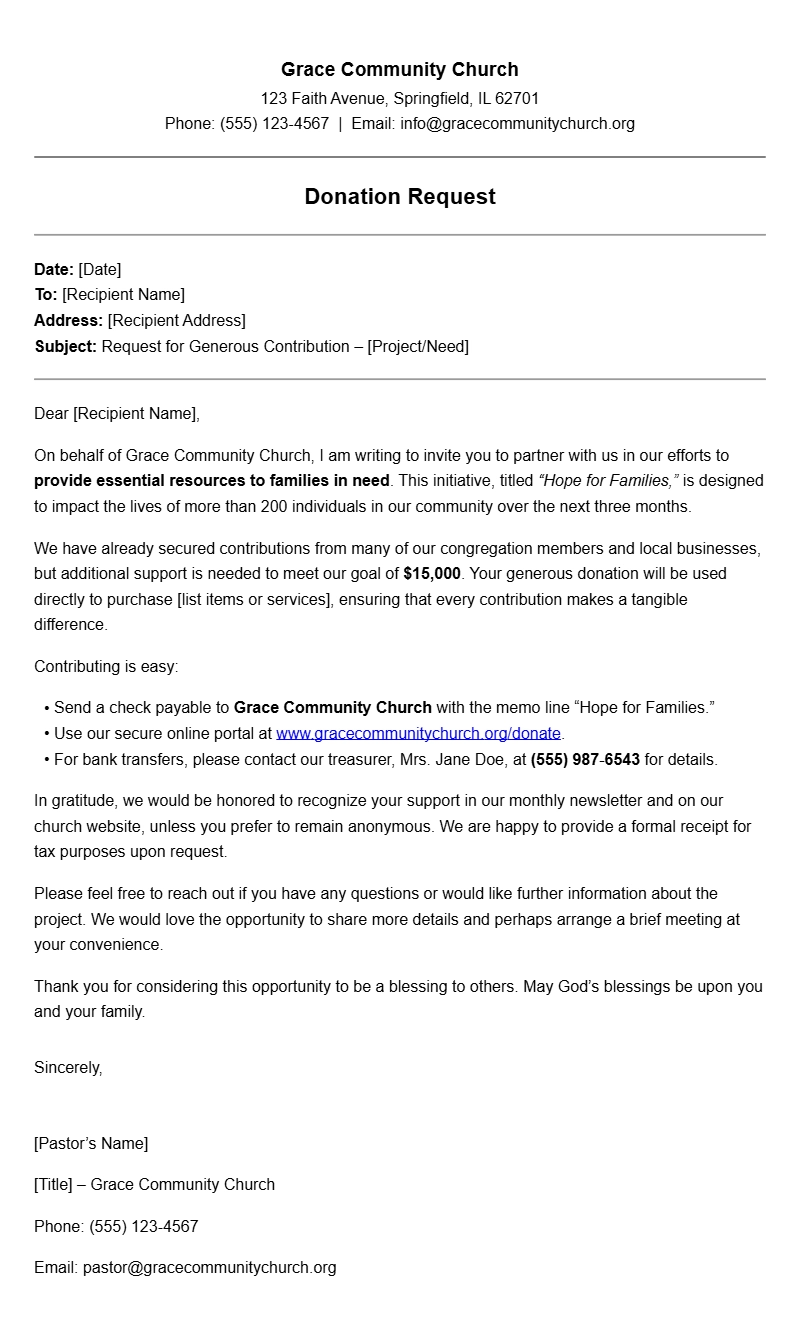
Here’s a fully editable template you can customize for your church’s needs:
[Your Church Name]
[Church Address]
[City, State ZIP]
[Email] | [Phone]
[Date]
Dear [Member Name],
I’d like to share a story with you. Last spring, we had the privilege of hosting a three-day community health screening at our church. Over 200 people came through our doors—many of them uninsured or underinsured. Our volunteer nurses caught early warning signs in seven individuals who had no idea they needed medical attention.
Moments like these remind us why our church exists. They also remind us that our building must be equipped to serve those who need us most.
We’re launching a campaign to modernize our fellowship hall into a space that can accommodate larger community events, health screenings, and neighborhood meetings. The total cost is $40,000. Every dollar you contribute goes directly toward materials and licensed contractor work.
If you’re able to give, here’s how:
- Online: Visit ourwebsite.com/fellowshipcampaign
- In person: Place your gift in the designated envelope at the offering time
- By mail: Send checks to our church address with “Fellowship Campaign” in the memo
No gift is too small, and no commitment is mandatory. We simply wanted you to know about this opportunity to be part of something that will serve our neighborhood for years to come.
Thank you for your faithful generosity and for entrusting us with your charitable giving.
With gratitude,
[Pastor Name]
[Title]
Template for Emergency or Crisis Appeals
When disaster strikes or urgent needs arise, your letter tone should shift. Here’s a template for those situations:
Dear [Name],
You may have seen news reports about the flooding that affected our county last week. Our church has been coordinating with emergency management to provide shelter, meals, and cleaning supplies to affected families in our neighborhood.
Right now, we have the infrastructure to help, but our supplies are running critically low. We’re asking for immediate financial donations to restock our emergency assistance resources.
Our immediate need: $8,000
This money will provide:
- 50 families with basic hygiene kits ($25 each)
- Emergency food boxes for 30 households ($50 each)
- Cleaning supplies and mops for 20 homes ($50 each)
- Gas cards for families traveling to disaster recovery appointments ($25 each)
Give quickly by texting [keyword] to [number] or visiting our emergency fund page at ourwebsite.com/emergency.
Time matters here. We’ll send a full accounting of all spending to anyone who requests it.
[Pastor Name]
Common Mistakes to Avoid
These errors show up constantly in church donation letters, and they cost you responses.
- Starting with the ask instead of the story. Never lead with “We need $X.” Lead with why the need exists and who it affects.
- Being vague about how funds are used. Donors want accountability. List specific budget items whenever possible.
- Using guilt or shame tactics. Nothing shuts down generosity faster than implied criticism. Trust your audience to respond generously when given clear information.
- Sending the same letter to everyone. Segment your lists. Long-time supporters deserve different language than first-time visitors.
- Including too many calls to action. One clear instruction per letter. If you ask people to give, share on social media, and forward to a friend, you’re diluting every action.
- Forgetting to proofread. Typos and grammatical errors signal carelessness. Take an extra five minutes to review before sending.
Tips for Customizing Your Letter
These templates aren’t one-size-fits-all. Here’s how to adapt them for your specific situation:
Match Your Church’s Voice
If your congregation is formal, keep the language measured. If it’s casual and relational, write like you’re talking to a friend. Read your letter aloud—if it sounds stiff coming out of your mouth, it will sound stiff on paper.
Reference Previous Giving When Appropriate
If someone has given generously before, acknowledge it. “Your contributions to last year’s mission trip made such a difference, and we’re asking you to prayerfully consider partnering with us again.”
Include Visual Reinforcement When Possible
If you’re sending a printed letter, consider including a small photo of the space being renovated or the team being served. Visual context strengthens written appeal.
Set Response Deadlines
Open-ended requests get lost. Include a target date. “We need all contributions by December 15th to ensure materials are ordered in time for January construction.”
Follow Up Personally
This doesn’t mean harassment, but a brief personal note or phone call to major donors after they’ve received the letter can dramatically increase response rates. Most people appreciate that you took the time to reach out.
Making It Easy to Respond
The difference between a good donation letter and a great one often comes down to friction. Every unnecessary step between “I want to give” and “I have given” costs you donors.
If your church uses giving platforms like Pushpay, Tithe.ly, or GivingFlow, link directly to the specific campaign page rather than your general giving portal. If you accept checks, include a pre-addressed envelope. If you want text-to-give, make that keyword prominent.
For more practical templates including school accreditation letters and employee farewell letter templates, browse our growing collection of professionally worded samples.
Your church exists to serve people. A well-crafted donation request letter simply makes it easier for people who want to support that mission to do so. Focus on clarity, authenticity, and specific impact, and you’ll likely see response rates improve within your first few send-outs.
Document Structure & Example Models
…
…