If you’re an administrator, instructional coach, or teacher leader tasked with observing classroom instruction, you already know that documenting what you see matters. A classroom observation letter—sometimes called an observation report or evaluation letter—creates a formal record of teaching performance, provides constructive feedback, and protects both the observer and the observed. But writing one from scratch takes time, and getting the tone right is trickier than it sounds.
This guide walks you through what these letters actually are, when to use them, and how to write one that’s fair, specific, and genuinely useful to teachers.
What Is A Classroom Observation Letter?
A classroom observation letter is a formal written record documenting what an administrator or evaluator witnessed during a visit to a teacher’s classroom. It captures specific teaching practices, student engagement, instructional strategies, classroom management, and alignment with curriculum standards.
Unlike casual notes or informal feedback, this letter becomes part of the teacher’s personnel file. It serves multiple purposes: it communicates expectations, documents performance, supports professional development conversations, and creates a paper trail for accountability.
The letter typically includes what happened during the observation, how it connects to teaching standards or goals, and next steps—whether that’s celebrating strong practice, addressing gaps, or setting improvement targets.
When Do You Use A Classroom Observation Letter?
These letters aren’t one-size-fits-all. Different situations call for different approaches:
- Formal evaluations: Scheduled observations tied to performance reviews or tenure decisions require detailed, comprehensive letters.
- Informal check-ins: Quick classroom visits might generate shorter observation notes or summary letters.
- Improvement plans: If a teacher is underperforming, observation letters document progress (or lack thereof) against specific goals.
- Probationary periods: New teachers or those on performance plans receive frequent observations and corresponding letters.
- Coaching and feedback: Instructional coaches use observation letters to highlight strengths and suggest refinements without formal evaluation pressure.
- Post-observation conferences: Letters often follow a face-to-face conversation and serve as a written summary of what was discussed.
The frequency and formality depend on your district’s evaluation system, the teacher’s experience level, and whether there are performance concerns.
Key Components Of A Classroom Observation Letter
A well-structured observation letter includes these essential parts:
Header And Date Information
Start with your school or district letterhead, the date of the observation, the teacher’s name, grade/subject, and the duration of the observation. This creates a clear record.
Opening Statement
A brief sentence or two stating the purpose. For example: “This letter documents the observation of your Grade 4 Language Arts instruction on March 15, 2024, from 9:00 AM to 9:45 AM.”
Instructional Context
Describe what was happening during the observation. What was the lesson objective? What standard or skill were students working on? This gives readers context for understanding the teaching decisions you observed.
Specific Observations
This is the meat of the letter. Describe what you actually saw—not your interpretation, but concrete evidence. Examples: student behaviors, teaching moves, materials used, pacing, transitions, questioning techniques, differentiation strategies, and classroom management responses.
Analysis And Connection To Standards
Link your observations to your district’s teaching standards, evaluation rubric, or professional development goals. This shows how the observed practice aligns (or doesn’t) with expectations.
Strengths And Commendations
Identify what the teacher did well. Be specific. Instead of “good classroom management,” write “You redirected off-task behavior in the back corner within seconds using proximity and a specific reminder about expectations, without disrupting instruction.”
Areas For Growth
Address gaps or opportunities for improvement. Use neutral, professional language focused on the behavior or practice, not the person. “Consider increasing wait time after asking questions” works better than “You rushed through your questioning.”
Next Steps
What happens next? Will there be a follow-up observation? A coaching conversation? A resource or professional development opportunity? Make this clear.
Closing
A professional closing that invites dialogue and reinforces your role as a supportive evaluator, not a gotcha-focused auditor.
How To Write A Classroom Observation Letter: Step-By-Step
Step 1: Prepare Before You Observe
Know what you’re looking for. Review the teacher’s evaluation goals, the lesson plan (if available), and your district’s teaching standards. Decide which domains or competencies you’ll focus on. You can’t capture everything, so being intentional helps.
Bring a notebook or digital device to record specific details in real time. Write down times, student names, exact phrases teachers use, and what students are doing. Vague memories lead to vague letters.
Step 2: Observe And Document Objectively
Your job during the observation is to see and record, not judge. Write down what happens without filtering it through your opinions. “Teacher called on three boys in a row” is observation. “Teacher favors boys” is interpretation.
Capture the sequence of events, specific instructional strategies, how many students were engaged, what materials were used, how transitions happened, and how the teacher responded to questions or confusion.
Step 3: Organize Your Notes Into Themes
After the observation, review your notes and organize them by theme: instruction, classroom management, student engagement, differentiation, assessment, etc. This prevents your letter from feeling scattered.
Step 4: Draft The Letter With Specificity
Write your opening and context. Then move through each theme, providing specific examples. Use direct quotes when they’re relevant. Avoid generalizations.
Connect each observation to your district’s standards or rubric. If your rubric includes “uses questioning to promote higher-order thinking,” and you observed the teacher asking mostly recall questions, name that connection explicitly.
Step 5: Balance Strengths And Growth Areas
Effective observation letters aren’t all positive or all critical. They’re honest and balanced. Even strong teachers have growth areas. Even struggling teachers have strengths. Reflect reality.
Step 6: Clarify Next Steps
End with concrete, actionable next steps. “We’ll meet on Friday to discuss this observation” or “Please reflect on your use of wait time and we’ll revisit this in your next observation” gives the teacher direction.
Step 7: Review For Tone And Accuracy
Read your letter aloud. Does it sound fair? Professional? Free of sarcasm or emotional language? Correct any factual errors. Remember: this document might be read by the teacher’s union rep, a superintendent, or a lawyer. Write accordingly.
Classroom Observation Letter Template
Here’s a practical template you can adapt to your district’s needs:
[SCHOOL LETTERHEAD]
Date: [Date of Observation]
Teacher: [Name]
Grade/Subject: [Grade and Subject]
Time: [Start and End Time]
Duration: [Length of Observation]
Observer: [Your Name and Title]
OBSERVATION SUMMARY
This letter documents the observation of your [subject/grade] instruction conducted on [date]. The purpose of this observation is to provide feedback on your instructional practices and progress toward [evaluation goals/professional development targets].
INSTRUCTIONAL CONTEXT
During this observation, students were engaged in [brief description of lesson objective and activity]. The lesson focused on [standard or skill], and students were working on [type of task: independent practice, small group work, whole-class discussion, etc.].
OBSERVATIONS
[Organize by theme. Example:]
Instructional Delivery and Engagement
You opened the lesson with a clear learning objective displayed on the board and verbally shared with students. During the first 10 minutes, you used [specific strategy], which resulted in [specific student outcome]. When students appeared confused during the transition to independent work, you provided a second example and clarified expectations.
Classroom Management
Students were organized into [setup]. You used [specific management technique] to maintain focus, and transitions between activities took approximately [time]. When [specific behavior] occurred, you responded by [specific action].
Differentiation and Accessibility
You provided [specific accommodations or modifications] for students with [needs]. For advanced learners, you offered [extension or challenge]. Materials were [accessible/not accessible] because [reason].
Student Engagement and Participation
Approximately [percentage] of students were actively engaged during [part of lesson]. Student questions included [examples], which you addressed by [your response]. Off-task behavior occurred [frequency and context], and you managed it by [action].
ANALYSIS AND CONNECTIONS TO STANDARDS
These practices align with [your district’s rubric domain/standard]. Specifically, [observation] demonstrates [which standard or competency]. This is evident in [specific example].
STRENGTHS
I observed several notable strengths during this lesson:
• [Specific, commendable practice with example]
• [Specific, commendable practice with example]
• [Specific, commendable practice with example]
AREAS FOR GROWTH
The following areas present opportunities for continued professional development:
• [Area for growth with specific context] — Consider [suggestion or resource].
• [Area for growth with specific context] — I recommend [suggestion or resource].
NEXT STEPS
• [Specific action, date, or follow-up]
• [Specific action, date, or follow-up]
• [Specific action, date, or follow-up]
I welcome your perspective on this observation and look forward to discussing your progress during our [post-observation conference/follow-up meeting] on [date].
Sincerely,
[Your Name]
[Your Title]
Real-World Examples
Example 1: Positive Observation Letter (Elementary)
Date: October 12, 2024
Teacher: Maria Gonzalez
Grade/Subject: Grade 2 Mathematics
Time: 10:00 AM – 10:45 AM
Observer: Principal James Chen
OBSERVATION SUMMARY
This letter documents my observation of your Grade 2 mathematics instruction on October 12, 2024. The purpose was to gather evidence of your progress toward your professional goal: increasing student discourse and mathematical reasoning.
INSTRUCTIONAL CONTEXT
Students were working on two-digit addition with regrouping. You had students working in pairs with base-ten blocks and number lines as manipulatives.
OBSERVATIONS
Instructional Delivery
You began by modeling one problem aloud, thinking aloud as you regrouped. You then released responsibility gradually by working through a second problem with student input. When you said, “Turn and talk to your partner about why we moved the ten,” students immediately engaged in mathematical conversation. This scaffolding approach moved students from guided practice to independence effectively.
Student Discourse
I heard students using mathematical language throughout the lesson. One pair said, “We made a ten, so now we have three tens and five ones.” Another pair asked each other, “Do we have enough ones to make another ten?” These conversations show students are internalizing the concept, not just following steps.
Questioning
You asked open-ended questions like “What strategy did you use?” and “How is your way the same or different from your partner’s way?” rather than yes/no questions. This pushed students to explain their thinking.
Differentiation
You circulated and provided different supports: some students used base-ten blocks, others used number lines, and one small group used a hundreds chart. Each tool matched the student’s current level.
STRENGTHS
• Your use of manipulatives and visual models is excellent. Students could see and touch the mathematics, which deepens understanding.
• Your wait time has improved noticeably. You gave students 5-10 seconds to respond, which allowed more students to participate.
• Your partnerships were purposeful and productive. Pairing a student who is still building confidence with a more confident peer created peer teaching moments.
AREAS FOR GROWTH
• Consider recording student strategies on a poster or chart to create a reference for the class. This would help students see the range of approaches and build mathematical vocabulary over time.
• A few students remained off-task during independent practice. A quick check-in system (like a hand signal for “I need help”) might reduce hand-raising and keep momentum.
NEXT STEPS
Let’s meet on October 19 to discuss this observation. I’d like to see the student strategy chart you create and hear about how students respond to it.
Sincerely,
James Chen
Principal
Example 2: Observation Letter With Improvement Needed (Secondary)
Date: September 28, 2024
Teacher: David Martinez
Grade/Subject: Grade 9 English Language Arts
Time: 1:30 PM – 2:15 PM
Observer: Instructional Coach Sarah Williams
OBSERVATION SUMMARY
This letter documents my observation of your Grade 9 English class on September 28, 2024. This observation is part of your professional development plan focused on increasing student engagement and active participation in literary discussions.
INSTRUCTIONAL CONTEXT
Students were reading Chapter 3 of “To Kill a Mockingbird.” The lesson objective was to analyze character motivation. You assigned reading and asked comprehension questions.
OBSERVATIONS
Instructional Delivery and Pacing
You read aloud for approximately 20 minutes, with students following along silently in their books. After reading, you asked questions like “What happened in this chapter?” and “Who is Atticus?” Students provided short answers. The lesson moved quickly through content coverage, but the pace didn’t allow for deeper thinking or discussion.
Student Engagement and Participation
Approximately 30% of students appeared actively engaged. Several students were not following along in their books. When you asked questions, the same 4-5 students answered. Other students did not raise their hands or contribute. One student appeared to be sleeping.
Questioning and Discussion
Questions were primarily recall-based: “What did Atticus say?” and “Where did Scout go?” There were no questions that required students to analyze, infer, or connect ideas. No wait time was given; you called on students immediately after asking questions, which may have discouraged thinking.
Use of Instructional Strategies
The lesson consisted mainly of teacher read-aloud followed by question-and-answer. There was no pair-share, small group discussion, written response, or other engagement strategies that would help students process the text or discuss character motivation (the stated objective).
ANALYSIS AND CONNECTIONS TO STANDARDS
Our district’s teaching standards emphasize “creating opportunities for all students to engage in academic discourse” and “using varied instructional strategies to support different learners.” The observation shows limited use of these practices. While content coverage is important, students need active engagement with the material to develop deep understanding and critical thinking skills.
STRENGTHS
• Your knowledge of the text is evident. Your read-aloud was clear and expressive.
• You have a calm, respectful classroom tone. Students are respectful toward you and each other.
• Your classroom is organized and routines are clear. Students know what to do.
AREAS FOR GROWTH
• Increase student talk and participation through strategies like think-pair-share, small group discussions, or written responses before whole-class discussion.
• Use higher-order questions that require analysis and inference, not just recall. For example: “Why do you think Atticus made that decision?” or “What does Scout’s reaction tell us about her character?”
• Provide wait time (at least 5 seconds) after asking questions to give all students time to think and formulate responses.
• Vary instructional strategies to include more active engagement. Consider: guided reading, literature circles, Socratic seminars, or collaborative note-taking.
NEXT STEPS
I’d like to support you in implementing these changes. Here’s what I suggest:
• We’ll meet on October 2 to discuss specific strategies you’d like to try.
• I’ll send you some resources on facilitating literature discussions and higher-order questioning.
• I’ll observe your class again on October 16 to see progress on these goals.
• We can co-plan a lesson together if that would be helpful.
This is absolutely achievable. Many teachers find that small shifts in questioning and discussion strategies dramatically increase student engagement and learning. Let’s work together on this.
Sincerely,
Sarah Williams
Instructional Coach
Common Mistakes To Avoid
Vague Language
Don’t write: “The lesson went well and students seemed engaged.”
Do write: “During the 15-minute independent practice, 18 of 20 students worked on the assigned task. Two students needed a redirect to refocus.”
Specificity is credible. Vagueness raises questions.
Mixing Observation With Interpretation
Don’t write: “The teacher didn’t care about student understanding.”
Do write: “When students asked clarifying questions, the teacher moved forward without addressing them.”
Stick to what you saw. Let the reader draw conclusions from the evidence.
Focusing Only On Negatives (Or Only On Positives)
Letters that are all praise lose credibility. Letters that are all criticism feel unfair and demoralizing. Real teaching is complex. Reflect that.
Using Emotional Or Judgmental Language
Avoid words like “lazy,” “incompetent,” “brilliant,” or “amazing.” These are opinions. Stick to professional, neutral language: “The teacher provided limited scaffolding” or “Students completed the task independently.”
Making Recommendations Without Context
Don’t just say: “Use more technology.”
Do say: “Consider using a digital exit ticket tool to quickly assess understanding and adjust tomorrow’s lesson accordingly. This would give you real-time data on which students need reteaching.”
Context and rationale make suggestions actionable.
Forgetting To Connect To Standards
Your district has teaching standards for a reason. Use them. This shows your observation is grounded in shared expectations, not personal preference. It also protects you legally.
Writing Too Long Or Too Short
A one-paragraph observation letter lacks detail. A five-page letter is overwhelming and unlikely to be read carefully. Aim for 1.5 to 3 pages, depending on the observation’s formality.
Surprising The Teacher
If you observed something concerning, don’t save it for the letter. Mention it during or immediately after the observation, or in a brief conversation. A formal letter shouldn’t be the first time a teacher hears about a problem. Letters should confirm and formalize conversations you’ve already had.
Tips For Customizing Your Template
Match Your District’s Evaluation Framework
If your district uses a specific rubric (like Danielson, Marzano, or a custom framework), organize your letter around those domains. This shows alignment and makes it clear how the teacher is progressing toward district expectations.
Adjust Formality Based On Context
A letter for a probationary teacher or performance improvement plan should be more formal and detailed. A letter for an experienced teacher with strong performance can be shorter and more conversational, while still being professional.
Include Relevant Context About The Class
If you’re observing a class with significant English language learners, significant behavioral challenges, or advanced learners, acknowledge that context. It affects how you interpret what you see.
Use Your School’s Letterhead And Format
Consistency matters. If your district has a standard observation form or template, use it. If not, create one and stick with it. This shows professionalism and makes your observations consistent across teachers.
Personalize Your Language
Don’t use the same phrases in every letter. Vary your descriptions. If you always write “The teacher used effective questioning,” that phrase loses meaning. Be specific about what made the questioning effective in this particular lesson.
Consider The Teacher’s Goals
If a teacher has a specific professional development goal (improving wait time, differentiating for advanced learners, etc.), make sure your observation and letter address that goal. This shows you’re paying attention to their growth trajectory, not just evaluating them against a generic rubric.
Add A Personal Touch Where Appropriate
If you observed something particularly creative or thoughtful, say so. A line like “Your use of student-generated examples was clever and kept students invested” feels human and genuine. Just keep it professional and grounded in what you actually observed.
Putting It Into Practice
Writing classroom observation letters gets easier with practice. Start by being clear about your purpose: Are you evaluating, coaching, documenting, or supporting? Then gather specific evidence during the observation. Finally, organize that evidence into a letter that’s honest, fair, and actionable.
A good observation letter serves everyone. It gives teachers clear feedback they can act on. It creates documentation that protects your school. It builds trust because teachers know you’re paying attention and being fair. And it contributes to a school culture where continuous improvement is expected and supported.
If you’re also managing other personnel documents, you might find it helpful to review templates for interview invitation letters or appointment cancellation letters to see how different professional correspondence is structured. Understanding how to write formal letters consistently across your role strengthens your overall communication with staff.
Start with your next observation. Use the template, be specific, balance strengths with growth areas, and give clear next steps. You’ll develop a process that works for your context and your teachers will appreciate the clarity and professionalism.
Ready-to-Use Document Samples
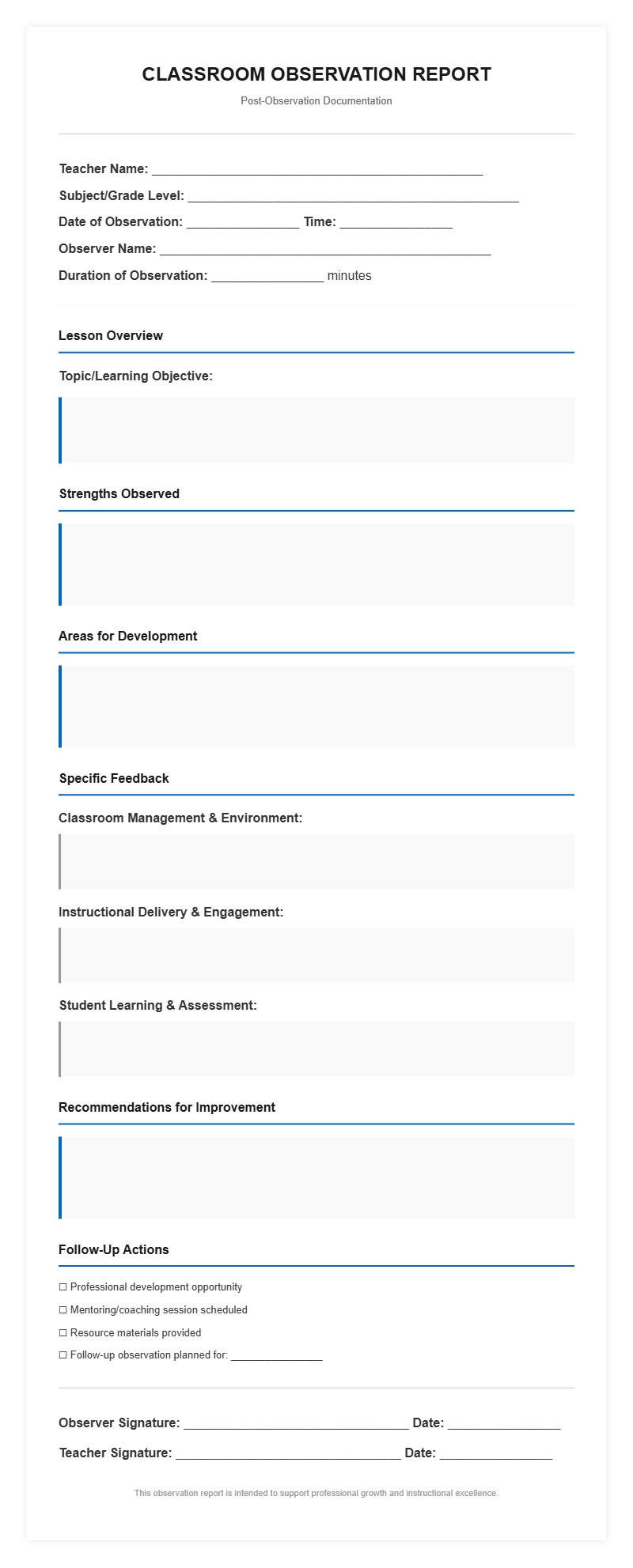
Formal Classroom Observation Letter – Initial Notice
Dear Mr. Johnson,
This letter confirms that a formal classroom observation will be conducted on Thursday, 15 March 2024 between 10:00 and 11:30 in your Year 4 Mathematics classroom. The observation is part of our routine professional development and quality assurance process.
During this visit, I will be assessing:
- Instructional delivery and lesson planning
- Student engagement and classroom management
- Use of differentiation strategies
- Assessment and feedback practices
- Integration of learning resources
Please ensure that your lesson plan and any relevant materials are available for review. The observation is not evaluative in nature and is intended to provide constructive insights for professional growth.
A post-observation meeting will be scheduled within five working days to discuss findings and identify areas for development.
Should you require any clarification or need to reschedule due to unforeseen circumstances, please contact me by 12 March.
Yours sincerely,
Dr. Elizabeth Chen
Head of Academic Affairs
Peer Observation Request Letter
Dear Ms. Rodriguez,
I am writing to request your participation in a peer observation exchange as part of our collaborative professional development initiative. This reciprocal arrangement will allow us both to observe each other’s teaching practices and share constructive feedback.
I would like to observe your English Literature class during Period 5 on Wednesday, 20 March. In return, I would welcome your observation of my Biology practical lesson on Friday, 22 March at 14:00.
The purpose of this exchange is to:
- Share effective teaching strategies and classroom management techniques
- Provide objective feedback on instructional methods
- Identify best practices that could enhance student outcomes
- Foster a culture of continuous improvement
Following each observation, we can meet briefly to discuss our observations and insights. I believe this collaborative approach will be mutually beneficial for our professional development.
Please confirm your availability at your earliest convenience.
Best regards,
Thomas Webb
Biology Department
Post-Observation Feedback Letter
Dear Mrs. Okafor,
Thank you for accommodating the classroom observation conducted on 14 March 2024. I appreciated the opportunity to visit your Year 6 Science class and witness your delivery of the photosynthesis unit.
Strengths Observed:
- Excellent use of hands-on demonstrations to reinforce abstract concepts
- Clear, structured lesson sequence with well-defined learning objectives
- Effective questioning techniques that prompted higher-order thinking
- Positive classroom rapport and student motivation
Areas for Development:
- Consider providing written scaffolding for vocabulary-heavy content
- Extend wait time after questions to allow more students to formulate responses
- Incorporate additional visual aids for students with diverse learning preferences
I recommend exploring the differentiation resources available through our professional library. A follow-up meeting has been scheduled for 28 March at 15:30 to discuss implementation strategies.
Your commitment to student learning is evident, and I look forward to supporting your continued professional growth.
Warm regards,
Karen Mitchell
Professional Development Coordinator
Unannounced Observation Notice Letter
Dear All Staff,
This letter serves as notification that unannounced classroom observations will be conducted throughout the remainder of this academic term as part of our ongoing quality assurance framework.
These informal observations are designed to capture authentic classroom practice and are not performance evaluations. They typically last 15–20 minutes and may occur at any time during the school day.
Focus Areas:
| Observation Element | Key Indicators |
|---|---|
| Learning Environment | Safety, organisation, student behaviour |
| Instruction | Clarity, pacing, engagement strategies |
| Student Progress | Task completion, participation, feedback |
Following each observation, you will receive brief written feedback within two working days. This approach enables us to maintain consistent standards across all departments while supporting professional development.
Should you have questions or concerns, please do not hesitate to contact the Quality Assurance Office.
Yours faithfully,
Principal David Hartley
Observation Letter for New Teachers
Dear Mr. Patel,
Welcome to our school community. As part of our induction programme for newly appointed staff, a series of supportive classroom observations has been scheduled to facilitate your transition and provide targeted professional support.
Observation Schedule:
- Week 2: Foundational observation and classroom setup review
- Week 4: Lesson delivery and student engagement assessment
- Week 8: Progress review and differentiation strategies
- Week 12: Comprehensive observation and development planning
These observations are formative in nature and intended to help you settle into your role effectively. Following each visit, we will meet to discuss your experiences, address any challenges, and celebrate progress.
You will be assigned a mentor teacher, Mrs. Lena Kowalski, who will provide additional classroom support and guidance. Please do not hesitate to reach out with questions or concerns at any stage.
Our induction programme includes access to professional development resources, collaborative planning time, and peer support networks.
We are delighted to have you join us and look forward to supporting your success.
Warm welcome,
Rebecca Santos
Induction and Mentoring Coordinator
Observation Letter – Subject-Specific Focus
Dear Mr. Yamamoto,
Following recent curriculum updates in Mathematics, we are conducting targeted classroom observations to assess implementation of the new mastery-based approach and problem-solving frameworks.
Your observation is scheduled for Tuesday, 19 March at 09:30 in your Year 5 Mathematics class. This observation will specifically examine:
- Integration of concrete, pictorial, and abstract representations
- Use of stem sentences and mathematical vocabulary
- Depth and challenge opportunities for all learners
- Assessment strategies aligned with mastery principles
- Connections between topics and cumulative learning
Please bring your curriculum planning documents and any assessment data you have gathered this term. This information will provide valuable context for the observation.
The findings from this observation cycle will inform our whole-school professional development sessions scheduled for April. Your insights and experiences will contribute to our collective understanding of effective mastery-based instruction.
A detailed feedback report will be provided within five working days.
Yours sincerely,
Professor Amanda Liu
Mathematics Subject Lead
Follow-Up Observation Letter – Improvement Monitoring
Dear Ms. Hassan,
Following the observation conducted on 7 February 2024 and our subsequent development meeting, this letter confirms the scheduled follow-up observation to monitor progress on the agreed action points.
Action Points from Previous Observation:
- Implement structured questioning protocols to increase student participation
- Develop visual timetables and learning objective displays
- Introduce exit tickets for formative assessment
The follow-up observation will take place on Wednesday, 27 March at 13:00. During this visit, I will focus on assessing the implementation of these strategies and their impact on student learning outcomes.
Please bring evidence of your progress, including:
- Photographs or examples of new classroom displays
- Completed exit ticket samples
- Student engagement data or observations
This observation is an opportunity to celebrate improvements and identify any additional support required. We remain committed to your professional development and success.
Yours sincerely,
James O’Connor
School Improvement Officer
Virtual Classroom Observation Letter
Dear Dr. Patel,
As our distance learning programme continues to expand, we are conducting observations of online teaching delivery to ensure quality and consistency across virtual classrooms.
Your virtual observation is scheduled for Thursday, 21 March from 10:00 to 11:00 GMT. You will receive a secure video conference link by email 24 hours prior to the observation.
Observation Focus Areas:
| Category | Assessment Points |
|---|---|
| Technical Delivery | Audio/video quality, platform navigation, screen sharing |
| Engagement | Interactive elements, student participation, pacing |
| Instruction | Content clarity, learning objectives, assessment methods |
| Accessibility | Inclusive design, closed captions, alternative formats |
Please ensure your camera is enabled and your learning environment is appropriately set up. You may have students present or teach a demonstration lesson; either approach is acceptable.
Feedback will be provided within three working days via a confidential written report.
Best regards,
Susan Mitchell
Online Learning Director
Observation Letter – Special Education Classroom
Dear Mr. Okonkwo,
This letter confirms the scheduled observation of your special education resource classroom on Monday, 25 March at 14:30. This observation is part of our commitment to ensuring high-quality, inclusive education for all learners.
The observation will assess:
- Individualised learning plan implementation and differentiation
- Behaviour support strategies and positive reinforcement techniques
- Sensory and communication accommodations
- Collaborative planning with mainstream classroom teachers
- Progress monitoring and data collection practices
- Student independence and skill development opportunities
Please have available:
- Current IEPs and progress monitoring documents
- Communication logs with mainstream staff
- Recent student work samples and assessment data
This observation recognises the specialised nature of your work and the significant impact you have on student outcomes. Your expertise in adaptive instruction is valued within our school community.
A comprehensive feedback report will follow within one week.
Yours sincerely,
Helen Fairweather
Special Education Coordinator
Observation Letter – End-of-Year Review
Dear All Teaching Staff,
As we approach the end of the academic year, a final round of classroom observations will be conducted during the week of 10–14 June 2024. These observations will serve as an end-of-year review and will inform our annual professional development planning for the next academic cycle.
Observation Schedule:
Each observation will last approximately 30 minutes and will focus on:
- Overall progress against professional development targets
- Student achievement and engagement throughout the year
- Sustainability of effective practices introduced this term
- Reflection on challenges and successes
- Planning for continued improvement
Please prepare a brief reflective statement (approximately 200 words) addressing your professional growth this year and your priorities for the next academic year. Bring this to your observation appointment.
Final feedback meetings will be scheduled for late June to discuss outcomes and jointly plan your professional development priorities for next year.
This reflective process is integral to our school’s commitment to continuous improvement and staff wellbeing.
Yours sincerely,
Catherine Reynolds
Head of Professional Development