If you’re thinking about transferring to a different college, you’ll eventually need to write a transfer letter. This document sits between your application materials and your actual conversation with admissions—it’s where you explain why you’re leaving your current school and why your target institution is the right fit. Getting it right matters because it’s often one of the few places where you can speak directly to decision-makers in your own voice.
Most students either overthink the transfer letter or rush through it without much strategy. The goal isn’t to write something fancy or overly formal. It’s to give admissions officers a clear, honest picture of your academic journey and what you’re looking for next.
What Is A College Transfer Letter?
A college transfer letter is a formal document you submit as part of your transfer application. It’s different from a cover letter in that it’s specifically about your reasons for transferring and what you hope to gain from your new school. Think of it as your chance to fill in gaps that your transcript and test scores can’t explain.
Some schools call this a “transfer essay,” others call it a “statement of purpose.” The format varies by institution, but the core function stays the same: you’re telling admissions why you’re moving and why their college is where you belong next.
This letter typically ranges from 250 to 500 words, though some schools have specific requirements. It’s one of the few required documents that’s entirely in your control—no grades, no test scores, just your explanation.
When You Need A Transfer Letter
You’ll submit a transfer letter when you apply to a new college as a transfer student. This applies whether you’re moving after your first semester, after sophomore year, or even later. The timing of when you write it depends on application deadlines, which usually fall between October and March for fall transfers.
If you’re transferring within a university system (like moving between campuses of a state school), requirements may be different—sometimes simpler, sometimes none at all. Check your target school’s transfer application instructions first. Some schools make the transfer letter optional, but submitting a strong one almost always helps your case.
You might also need a transfer-related letter if you’re appealing an admissions decision or requesting special consideration for late applications.
Key Sections Your Transfer Letter Should Include
A functional transfer letter doesn’t need fancy structure, but it should cover these areas:
- Your current academic situation. What school are you at now? What’s your major or intended major? Keep this factual and brief.
- Why you’re transferring. This is the core. Be specific about what’s missing at your current school—not enough resources in your field, poor fit with campus culture, limited program options, or a change in academic direction.
- What you’re looking for. Paint a picture of what you need in your next school. Mention specific programs, opportunities, or campus characteristics that matter to you.
- Why this school specifically. Don’t just say “it’s a good school.” Reference actual programs, professors, research opportunities, or campus features you’ve researched.
- What you’ll contribute. Briefly touch on what you bring to their campus—your work ethic, perspective, skills, or experiences.
- A clear closing. Thank them for considering your application and express genuine interest in attending.
Not every letter hits all these points with equal weight, and that’s fine. The balance depends on your specific situation.
How To Write Your Transfer Letter Step By Step
Step 1: Understand the prompt. Read the school’s instructions carefully. Some schools ask specific questions like “Why do you want to transfer?” Others give you total freedom. Work within their framework rather than against it.
Step 2: Identify your honest reason for transferring. Before you write anything, sit with this. Are you transferring because your current program is weak? Because you want a different campus culture? Because you need to be closer to home? Because you discovered a new passion? Your reason should be genuine, not something you think admissions wants to hear. Authenticity shows.
Step 3: Research your target school thoroughly. Go beyond the homepage. Look at course catalogs, professor bios, student clubs, research centers, and recent news. Find three to five specific things that genuinely appeal to you. This research makes your letter credible.
Step 4: Outline your main points. Jot down what you want to say in order. Don’t write full paragraphs yet—just ideas. This keeps you organized and prevents rambling.
Step 5: Write a rough draft without editing yourself. Get words on the page first. Worry about polish later. Your first draft will be messy, and that’s expected.
Step 6: Revise for clarity and specificity. Read it aloud. Do you sound like yourself? Are your reasons clear? Did you include specific details about the school, or did you write something generic that could apply to any college?
Step 7: Cut unnecessary words. Transfer letters are short. Every sentence should earn its place. Remove filler, vague language, and anything that doesn’t directly support your main points.
Step 8: Get feedback from someone who knows you. A counselor, advisor, or teacher can spot weak spots and help you strengthen your argument. They’ll also catch tone issues you might miss reading your own work.
Transfer Letter Template
Here’s a basic structure you can adapt to your situation:
Opening Paragraph (2-3 sentences)
“I am applying to transfer to [School Name] for the [semester/year] term. I am currently a [class year] at [Current School] majoring in [major], and I am seeking a transfer opportunity because [brief, honest reason].”
Body Paragraph 1: Why You’re Transferring (3-4 sentences)
“During my time at [Current School], I have discovered that [specific limitation or mismatch]. For example, [concrete detail]. This has made me realize that I need [what you’re looking for] to continue growing academically and professionally.”
Body Paragraph 2: Why This School (3-4 sentences)
“[School Name] stands out to me specifically because of [specific program, professor, research center, or opportunity]. I am particularly interested in [specific detail], and I believe the [specific resource] would allow me to [what you hope to accomplish].”
Body Paragraph 3: What You Bring (2-3 sentences)
“As a transfer student, I bring [relevant strength or perspective]. My experience at [Current School] has taught me [relevant lesson], and I am eager to apply this to [new school’s community or program].”
Closing Paragraph (2-3 sentences)
“I am excited about the opportunity to contribute to [School Name]’s community and to advance my education in [field/area]. Thank you for considering my transfer application.”
Real Example: Transfer Letter For A Student Changing Programs
“I am applying to transfer to State University’s engineering program for fall 2025. I am currently a sophomore at Central College majoring in general science. After two years of exploring different fields, I have decided to pursue mechanical engineering, and Central’s limited engineering offerings have made it clear that I need to transfer to a school with stronger resources in this area.
At Central, I took introductory physics and calculus courses that sparked my genuine interest in how systems work. However, the college offers only one advanced physics course per year, and there is no engineering lab or design program. I need access to hands-on learning experiences and a dedicated engineering faculty who can mentor me through design projects and internships.
State University’s engineering program is an ideal fit because of its partnership with local manufacturing companies and its senior capstone design requirement. I have reviewed course catalogs and am particularly interested in taking Professor Martinez’s Thermodynamics course and participating in the robotics club, both of which align with my career goals in sustainable energy systems.
My two years at Central have taught me how to work independently and manage my time effectively—skills I developed while juggling multiple labs and projects. I am confident these strengths will help me succeed in State’s rigorous engineering curriculum and contribute meaningfully to your engineering community.
I am excited about the opportunity to deepen my technical skills and complete my undergraduate degree at State University. Thank you for considering my transfer application.”
This example works because it’s specific, honest, and shows clear reasoning. It doesn’t make excuses—it explains a legitimate academic need and connects it directly to what the new school offers.
Common Mistakes To Avoid
Being vague about your reason for transferring. “I want a fresh start” or “I’m looking for a better school” tells admissions nothing. They need to understand what specifically isn’t working or what you specifically need. Generic reasons make your letter forgettable.
Badmouthing your current school. Never trash your current college, even if you’re frustrated. It makes you sound ungrateful and raises questions about whether you’ll do the same to their school later. Focus on what you’re moving toward, not what you’re running from.
Writing something that could apply to any school. If you removed the school name and it still made sense, you haven’t done enough research. Admissions officers read dozens of transfer applications. Specific details are what make yours stand out.
Making it too long. Transfer letters should be concise. If you’re hitting 700+ words, you’re probably repeating yourself or including information that belongs elsewhere in your application.
Focusing too much on prestige or rankings. “Your school is highly ranked” is not a reason to attend. Talk about what you’ll actually do there and what you’ll learn, not the school’s reputation.
Ignoring the prompt. If the school asks “Why do you want to transfer?” don’t write about your high school experiences. Answer the actual question being asked.
Submitting without proofreading. Spelling errors and grammatical mistakes undermine your credibility. Read your letter multiple times. Use spell-check. Have someone else read it.
Tips For Customizing Your Letter
Adjust tone based on school culture. A transfer letter to a small liberal arts college might be warmer and more personal than one to a large research university. Research the school’s voice and match it appropriately without being fake about it.
Lead with your strongest reason. If you’re transferring because your current school doesn’t have your major, lead with that. If you’re transferring for personal reasons that led to an academic shift, explain that context first. Put your most compelling reason early.
Use specific course numbers and professor names when possible. Instead of “I want to take advanced chemistry courses,” write “I want to enroll in CHM 401 Organic Chemistry II under Professor Chen, whose research on sustainable polymers aligns with my career interests.” Specificity signals genuine interest.
Connect your past experience to future goals. Show how what you’ve learned at your current school positions you for success at the new one. This demonstrates growth and intentionality, not just dissatisfaction.
Keep your voice natural. Don’t write like you’re applying for a job or imitating academic papers. Write like you’re explaining your situation to an intelligent person who cares about your success. Admissions officers appreciate authenticity.
Reference the school’s mission or values if relevant. If the school emphasizes community engagement and you have genuine interest in that, mention it. But only if it’s true. Forced connections feel hollow.
Formatting And Submission Guidelines
Most schools accept transfer letters through their application portal as a PDF or Word document. Follow these basic formatting rules:
- Use standard fonts like Times New Roman, Arial, or Calibri in 11 or 12-point size.
- Use 1-inch margins on all sides.
- Single-space your text with space between paragraphs.
- Include your name and student ID (if you have one at the current school) at the top.
- Use a professional but simple format. No colored text, fancy fonts, or graphics.
- Save your file with a clear name like “FirstName_LastName_TransferLetter.pdf”
- Check the school’s specific requirements for length, file format, and submission method.
If submitting by email, include a brief subject line like “Transfer Application Letter—[Your Name]” and keep the email body short.
How Transfer Letters Fit Into Your Larger Application
Your transfer letter works alongside other application materials. Your transcript shows your academic performance. Your test scores (if required) show standardized ability. Your transfer letter explains the why behind your numbers and tells admissions who you are as a student and person.
If you’re also submitting recommendation letters, your transfer letter should complement them rather than repeat them. Your recommenders might highlight your work ethic and classroom participation. Your letter explains your academic direction and what you’re seeking next. Together, they paint a complete picture.
Some schools also ask for essays on different topics—maybe about leadership or a challenge you’ve overcome. Your transfer letter should focus specifically on your transfer reasons and fit with that school, not broader personal narratives. If you’re writing multiple essays for different schools, keep them distinct and tailored.
When To Write Your Transfer Letter
Start writing 4-6 weeks before your application deadline. This gives you time to research the school thoroughly, draft multiple versions, get feedback, and revise without rushing. Rushed letters often feel generic or incomplete.
If you’re applying to multiple schools, you’ll need separate letters for each one. Don’t try to write one generic letter and submit it everywhere. Admissions officers notice, and it hurts your chances. Each letter should reference specific details about that specific school.
Write your letters during a time when you can think clearly and focus. Don’t write them the night before the deadline. You’ll make better decisions and catch more errors if you have distance from your draft.
Additional Resources And Related Documents
If you’re working through the transfer process, you may also need other types of formal letters. For example, if you’re coordinating with your current institution about credits transferring or academic standing, you might need to write a schedule change request letter or communicate with administrators. Some transfer students also work with teachers writing recommendation letters, which follow different guidelines than transfer letters.
If you’re transitioning to a new role or position after your transfer (like an internship or research position), you might reference documentation similar to an employee relocation letter in terms of explaining transitions and new arrangements, though the academic context is different.
Understanding how to write formal communication clearly is useful across many contexts. The skills you develop writing a transfer letter—being specific, concise, and persuasive—apply to other professional and academic writing situations you’ll encounter.
Final Thoughts
Your transfer letter is one of the few parts of your application where you control the narrative entirely. Use that opportunity strategically. Be honest about why you’re transferring, do real research on your target school, and write in your natural voice. Admissions officers read hundreds of transfer applications. The ones that stand out are specific, authentic, and show genuine interest in the institution.
Give yourself enough time to write multiple drafts, get feedback, and revise. A strong transfer letter won’t guarantee admission, but a weak one can hurt your chances. The work you put in here directly impacts how admissions sees your application. Make it count.
Common Document Templates & Previews
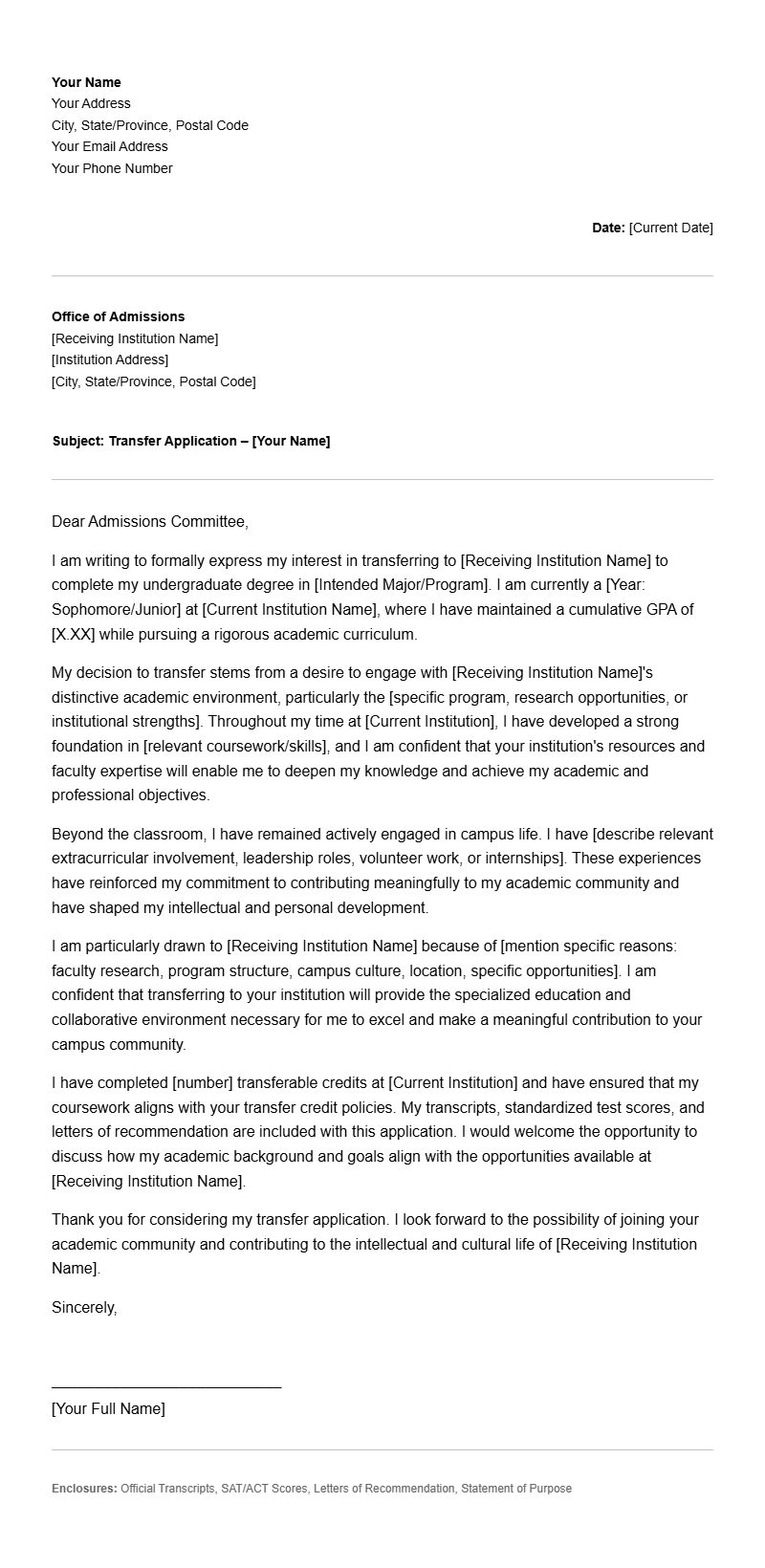
Request for Transfer Credit Evaluation
Dear Admissions Office,
I am writing to formally request an evaluation of my transfer credits from my current institution. I am a student in good academic standing with a cumulative GPA of 3.65 and have completed 54 credit hours toward my degree in Business Administration.
I have attached the following documentation for your review:
- Official transcripts from my current college
- Detailed course descriptions for all completed coursework
- A course equivalency guide comparing my credits to your institution’s curriculum
- My academic progress report
I am particularly interested in understanding how my general education requirements will transfer and whether I can apply my elective credits toward my major. I would appreciate if you could provide a preliminary credit evaluation within the next two weeks, as I am planning to submit my transfer application by the end of this month.
Thank you for your attention to this matter. Please feel free to contact me at your earliest convenience if you require any additional information.
Sincerely,
James Mitchell
Student ID: 2024-08-456
Phone: (555) 234-7890
Email: j.mitchell@email.com
Formal College Transfer Application Letter
Dear Admissions Committee,
I am writing to express my strong interest in transferring to your institution’s Bachelor of Science programme in Environmental Science, effective Fall 2024. As a dedicated student currently completing my sophomore year at Riverside Community College, I am seeking an academic environment that better aligns with my research interests and career aspirations.
During my time at Riverside, I have maintained a 3.8 GPA while completing rigorous coursework in chemistry, biology, and environmental systems. I have also gained practical experience through an internship with the State Environmental Protection Agency, where I assisted in water quality assessments and contributed to a published research paper on aquatic ecosystems.
Your institution’s cutting-edge environmental science programme, combined with your exceptional faculty and research opportunities, makes it the ideal place for me to complete my undergraduate degree. I am confident that my academic record, work ethic, and genuine passion for environmental conservation will make me a valuable addition to your campus community.
I have enclosed all required documentation, including my official transcripts, letters of recommendation, and a detailed statement of purpose. I would welcome the opportunity to discuss my transfer application further.
Respectfully,
Sarah Chen
Email: s.chen.2024@email.com
Phone: (555) 789-1234
Appeal Letter for Transfer Credit Denial
Dear Dean of Academic Affairs,
I am writing to appeal the decision to deny transfer credit for CHEM 201 (Organic Chemistry) from my previous institution. I respectfully disagree with this determination and would like to request a reconsideration of this course.
The course I completed was equivalent in content, rigor, and learning outcomes to your institution’s CHEM 201 course. The attached documentation includes:
- Original course syllabus with detailed learning objectives
- Comparative analysis of course content and textbooks
- Grade documentation (A-) and exam scores
- Letter of support from my previous instructor
I earned a strong grade in this course and successfully applied the knowledge in subsequent advanced chemistry courses at my previous institution. Denying this credit would require me to repeat material I have already mastered, which would delay my graduation timeline and increase my overall educational costs.
I believe this credit clearly meets your institution’s transfer equivalency standards. I would appreciate the opportunity to discuss this appeal with the appropriate department head. Please let me know if you require any additional information to reconsider this decision.
Thank you for your reconsideration.
Michael Torres
Student ID: TR-2024-7823
Email: m.torres@email.com
Transfer Student Welcome Acknowledgement
Dear Welcome Committee,
I am delighted to accept my admission as a transfer student to your esteemed institution, beginning in the Fall semester. I am writing to confirm my intention to enrol and to express my gratitude for the opportunity to join your academic community.
I have reviewed the transfer credit evaluation and am satisfied with the 48 credits that have been approved for transfer. I understand that I will need to complete an additional 72 credits to fulfil the requirements for my Bachelor of Arts degree in Psychology.
I am excited about the following aspects of my transfer:
- Access to your institution’s renowned psychology research laboratory
- Opportunity to work with faculty members specialising in cognitive neuroscience
- Participation in the Honours thesis programme
- Internship partnerships with leading healthcare facilities
I have submitted my housing application and completed the online orientation modules. I am looking forward to connecting with my academic advisor during the transfer student orientation week. If there are any additional steps I need to complete before arrival, please do not hesitate to contact me.
Thank you again for welcoming me to your institution.
Best regards,
Emma Richardson
Email: e.richardson@email.com
Phone: (555) 456-2109
Request for Grade Forgiveness in Transfer Process
Dear Registrar,
I am writing to request consideration for grade forgiveness regarding a course I completed during my first year at my previous institution. I earned a D grade in MATH 101 (College Algebra) during my first semester, which negatively impacted my cumulative GPA and academic standing.
Since that time, I have demonstrated significant academic improvement and personal growth. I subsequently retook a more advanced mathematics course and earned an A, demonstrating my mastery of the subject matter. My current GPA is 3.6, and I have maintained consistent academic excellence over the past three semesters.
The circumstances surrounding my poor performance in that initial course were challenging. I was adjusting to university life while managing personal difficulties that I have since resolved. This single grade does not reflect my current academic capabilities or commitment to my studies.
I understand that grade forgiveness policies vary by institution. I respectfully request that you consider applying your grade forgiveness or academic fresh start policy to this course as I transfer to your institution. This would more accurately reflect my true academic potential and current performance level.
I am happy to provide additional documentation, including letters from instructors who can attest to my academic growth. Thank you for considering my request.
Sincerely,
David Patel
Student ID: 2024-TR-5541
Email: d.patel@email.com
Confirmation Letter for Transfer Transcript Submission
Dear Admissions Office,
I am writing to confirm that I have submitted official transcripts from all institutions where I have completed coursework. This letter serves as documentation of my transcript submission for my transfer application to your institution.
Transcript Submission Summary:
| Institution | Submission Date | Tracking Number | Credits Completed |
|---|---|---|---|
| Riverside Community College | 15 March 2024 | RCC-TR-892341 | 54 |
| Summer Study Abroad Programme | 18 March 2024 | SSA-INT-756234 | 6 |
All transcripts were requested directly from the registrar offices and sent electronically to your institution’s admissions portal. I have retained copies of all submission confirmations and tracking numbers for my records.
If your office requires any additional documentation or clarification regarding my academic history, please do not hesitate to contact me. I am committed to ensuring that my application materials are complete and accurate.
Thank you for processing my transfer application.
Regards,
Jessica Wong
Application ID: TRANS-2024-3847
Email: j.wong@email.com
Phone: (555) 321-8765
Letter Requesting Major-Specific Transfer Requirements
Dear Department of Engineering,
I am an incoming transfer student with 60 completed credit hours from Northside Technical College. I am writing to request detailed information about major-specific requirements and prerequisites for the Mechanical Engineering programme at your institution.
I have completed the following coursework relevant to engineering:
- Calculus I and II (with grades of A)
- Physics I and II (with grades of A and B+)
- Chemistry I (with grade of B)
- Introduction to Engineering Design (with grade of A-)
- Computer-Aided Design (with grade of A)
I would like to understand which of these credits will transfer directly and whether any additional prerequisites are required before I can enrol in upper-level engineering courses. Additionally, I would appreciate information about the capstone project requirements and any specialisation options within the programme.
I am particularly interested in learning about the cooperative education programme and research opportunities available to transfer students. Could you also provide the contact information for the transfer student advisor within your department?
Thank you for your assistance. I look forward to joining your engineering programme and contributing to your institution’s academic community.
Best regards,
Robert Chen
Email: r.chen.transfer@email.com
Phone: (555) 678-9012
Thank You Letter to Transfer Advisor
Dear Dr. Patricia Morrison,
I wanted to take a moment to express my sincere gratitude for your exceptional guidance throughout my transfer process. Your expertise and patience were instrumental in helping me navigate the complexities of transferring institutions.
When I first met with you, I was uncertain about which credits would transfer and how my degree timeline would be affected. You took the time to carefully review my transcript, explain the equivalency process, and develop a realistic plan for completing my degree. Your clear explanations and honest feedback helped me make informed decisions about my academic future.
Beyond the administrative aspects, you also provided valuable advice about adjusting to a new campus environment and connecting with resources available to transfer students. Your recommendation to join the transfer student cohort has already helped me build meaningful relationships with peers in similar situations.
I am now confidently moving forward with my studies at your institution. I feel well-prepared for the transition and genuinely excited about the opportunities ahead. This positive experience is largely due to your dedication and support.
I will certainly recommend your advising services to other prospective transfer students. Thank you again for everything you have done to make my transition smooth and successful.
With appreciation,
Nicole Anderson
Email: n.anderson@email.com
Letter Requesting Transcript Evaluation Timeline
Dear Admissions Evaluation Team,
I submitted my transfer application and official transcripts on 5 April 2024. I am writing to inquire about the expected timeline for my transcript evaluation and transfer credit assessment.
My application details are as follows:
- Application ID: TRANS-2024-8934
- Name: Thomas Lawrence
- Transcripts Received: 8 April 2024 (confirmed via tracking number TRK-442857)
- Programme: Bachelor of Science in Information Technology
- Expected Enrolment: Fall 2024
I understand that transcript evaluations can take several weeks, and I appreciate the thorough review process your institution conducts. However, I am hoping to receive my evaluation before the end of April so that I can plan my course registration and housing arrangements accordingly.
If there are any outstanding documents needed to complete my evaluation, please let me know immediately. I am prepared to provide any additional information that would expedite the process.
Thank you for your assistance. I look forward to hearing from you soon.
Sincerely,
Thomas Lawrence
Student ID: 2024-TR-9823
Email: t.lawrence@email.com
Phone: (555) 234-5678
Letter Declining Transfer Offer and Explaining Decision
Dear Admissions Office,
I am writing to inform you that I have decided to withdraw my transfer application and decline the admission offer from your institution. This was not an easy decision, as I hold your programme in high regard and greatly appreciate the opportunity to have been considered.
After careful consideration of my personal circumstances, academic goals, and financial situation, I have determined that transferring at this time is not the best path for me. I have decided to continue my studies at my current institution for at least one more year to complete my associate degree before pursuing a bachelor’s degree.
This decision allows me to:
- Reduce my overall student debt burden
- Maintain stability while managing family responsibilities
- Strengthen my academic foundation before entering a four-year programme
- Gain additional work experience in my field
I remain deeply interested in your institution and would like to reapply in the future when my circumstances have changed. I would appreciate if you could keep my application file for a specified period should I wish to reapply.
Thank you for considering my application and for your understanding regarding my decision.
Respectfully,
Amanda Foster
Application ID: TRANS-2024-5672
Email: a.foster@email.com