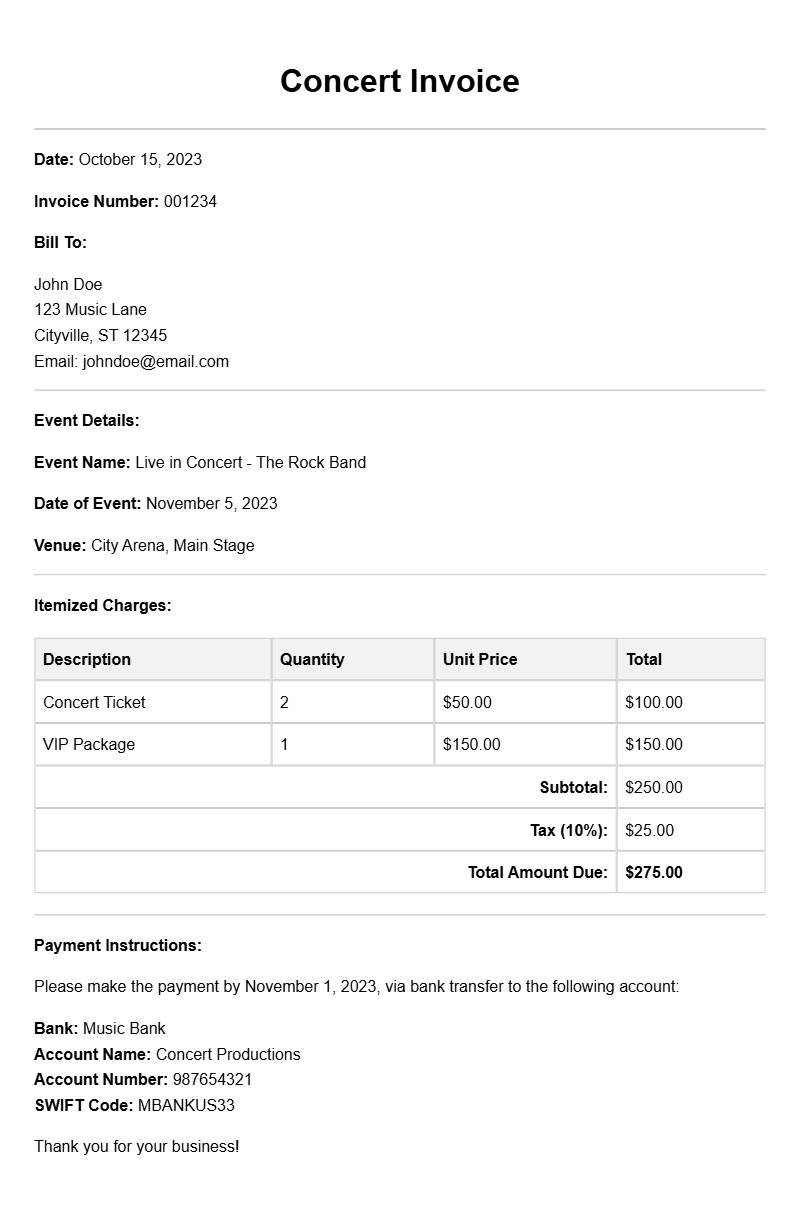
When it comes to organizing a concert, the last thing you want to worry about is the nitty-gritty of payments and invoicing. Having a solid concert invoice sample on hand can simplify this process significantly. This article will help you understand what a concert invoice is, when to use it, its key components, and how to create one effectively.
WHAT IS A CONCERT INVOICE?
A concert invoice is a document that outlines the services provided during a concert, along with the associated costs. It serves as a formal request for payment from the event organizer to the artists or service providers involved. This invoice acts not only as a record of the transaction but also as a professional courtesy to ensure everyone is on the same page regarding payment terms.
WHEN IS A CONCERT INVOICE USED?
You’ll typically use a concert invoice after the event has taken place, or sometimes before, especially if a deposit is required. It’s essential for any live performance, whether it’s a small local gig or a large festival. The invoice can cover a range of services, including:
- Performance fees for artists
- Equipment rentals
- Venue costs
- Sound and lighting services
- Marketing expenses
KEY COMPONENTS OF A CONCERT INVOICE
To make sure your invoice is clear and effective, include these key components:
- Header: Your name or business name, logo, and contact information.
- Invoice Number: A unique identifier for tracking.
- Date of Issue: When the invoice is created.
- Due Date: When payment is expected.
- Itemized List of Services: Details of what the invoice covers, including costs.
- Payment Instructions: How and where to send payment.
- Terms and Conditions: Any relevant policies regarding late payments or refunds.
STEP-BY-STEP GUIDE TO WRITING A CONCERT INVOICE
Creating a concert invoice can be straightforward if you follow these steps:
- Start with Your Information: Include your name, address, and contact details at the top.
- Add Invoice Details: Write the invoice number and date of issue.
- List the Services: Detail each service provided, the cost, and any applicable taxes.
- Specify Payment Terms: Clearly state when payment is due and how to pay.
- Include Additional Information: Add any terms and conditions that apply.
REALISTIC EXAMPLES OF CONCERT INVOICES
Here’s a simple template you can customize:
[Your Name or Business Name]
[Your Address]
[City, State, Zip]
[Phone Number]
[Email Address]
Invoice Number: [Unique Number]
Date of Issue: [Date]
Due Date: [Due Date]
Bill To:
[Client’s Name]
[Client’s Address]
Description | Quantity | Unit Price | Total
————————————————————–
Performance Fee | 1 | $2,000.00 | $2,000.00
Sound Equipment Rental | 1 | $500.00 | $500.00
Lighting Setup | 1 | $300.00 | $300.00
————————————————————–
Subtotal: | $2,800.00
Tax (5%): | $140.00
Total Due: | $2,940.00
Payment Instructions: Please make payment via bank transfer to [Your Bank Details].
Terms: Payment is due within 30 days of receipt of this invoice.
COMMON MISTAKES TO AVOID
- Omitting Details: Always provide a breakdown of services to avoid confusion.
- Incorrect Payment Information: Double-check your bank details to ensure seamless transactions.
- Missing Deadlines: Clearly state due dates to encourage timely payment.
TIPS FOR CUSTOMIZATION
Make your concert invoice stand out by personalizing it according to your brand. Use your logo, choose a color scheme that reflects your style, and consider adding a note of thanks for a more personal touch. Remember, a professional-looking invoice can enhance your reputation in the industry.
With a clear concert invoice sample and the steps outlined above, you can streamline your invoicing process, ensuring that you get paid on time and maintain good relationships with your clients. Happy concert planning!
Editable Document Format Examples