You need to write a congratulations letter and you want to make sure it actually lands right. Maybe you’re not sure what to say, or you’ve been staring at a blank screen for twenty minutes. Either way, you’re in the right place. This guide walks you through everything you need to craft a genuine, well-structured congratulations letter that sounds like you and not like a template factory produced it. Below you’ll find real scenarios, editable snippets you can adapt in minutes, and the common traps that make congratulation messages feel hollow.
What Is a Congratulations Letter?
A congratulations letter is a written message sent to acknowledge someone’s achievement, milestone, or positive life event. Unlike a quick text or social media post, a letter gives you space to be specific, personal, and thoughtful. It can be formal like a business letter or informal like a note to a friend. The format you choose depends entirely on your relationship with the recipient and the nature of the occasion.
People often confuse congratulations letters with generic praise. The difference is substance. A good congratulations letter names the specific achievement, explains why it matters, and communicates genuine sentiment. That’s what makes it feel real instead of obligatory.
When to Send a Congratulations Letter
Congratulations letters work well in situations where a quick message feels too casual but a full speech feels excessive. Here are the most common scenarios where a letter makes sense:
- New job promotion or career milestone
- Graduation from school, college, or professional program
- Business achievement like launching a company or signing a major client
- Personal milestone such as buying a home, getting engaged, or having a child
- Professional award or recognition in your field
- Retirement after years of service
If you’re writing to someone in a professional context and you’re unsure whether a letter is appropriate, consider whether the achievement warrants formality. A formal letter format signals respect and intentionality in ways that a casual message cannot.
Key Components of a Strong Congratulations Letter
A congratulations letter doesn’t need to be long, but it needs to hit a few specific notes. These are the building blocks that make the message feel complete and genuine.
Opening with Genuine Acknowledgment
Start by directly naming what you’re congratulating. Skip the vague “I heard the great news” opener. Instead, be specific: “Congratulations on your promotion to Director of Operations.” This immediately shows you paid attention and aren’t sending a mass-produced card.
Specific Recognition of the Achievement
Describe what the person did or accomplished in concrete terms. If someone earned a professional certification, mention which one and what it represents. If they launched a product, reference that product by name. Specificity signals that you care enough to know the details.
Why This Matters
Explain the significance of their achievement. This could be the hard work it represents, the doors it opens, or the positive impact it will have. You’re connecting their action to its meaning. This is where your message stops being generic and starts feeling personal.
Personal Sentiment or Reflection
Share what their success means to you or how it has affected you if appropriate. If you worked together, mention how their accomplishment reflects qualities you’ve admired in them. If you’re more distant, you can still share your genuine admiration for what they’ve achieved.
Forward-Looking Encouragement
End with genuine optimism about their future. Wish them well, express confidence in what they’ll do next, or simply reaffirm your support. This gives the letter a natural landing point and leaves a positive impression.
Step-by-Step Guide to Writing Your Letter
Follow these steps in order and you’ll have a complete, genuine congratulations letter in under fifteen minutes.
Step 1: Identify the occasion and the person. Before you write anything, clarify exactly what you’re congratulating. A promotion is different from a business launch. A personal milestone is different from a professional award. Knowing the occasion shapes everything from tone to content.
Step 2: Choose your format. If you’re writing to a colleague or boss, use a professional tone and standard business letter structure. If you’re writing to a close friend or family member, you can be more conversational and relaxed. Match your format to your relationship.
Step 3: Open with a direct statement of congratulations. Get to the point immediately. “Congratulations on your new role as Marketing Director.” No need to build up to it with long preambles.
Step 4: Name the specific achievement and what it took to get there. Mention the accomplishment clearly and, when relevant, acknowledge the effort or qualities that made it possible. “You’ve worked incredibly hard to build the expertise and relationships that positioned you for this role.”
Step 5: Connect the achievement to its broader meaning. Why does this matter? What will it enable? How does it reflect their character? This is where you add depth beyond surface-level praise.
Step 6: Add a personal note if appropriate. If you have a personal connection to the person or the achievement, share a brief reflection. This makes the letter feel like it came from a real person rather than a template.
Step 7: Close with genuine encouragement. End with a forward-looking statement that shows you’re rooting for them. “I have no doubt you’ll make an incredible impact in this new role, and I look forward to seeing what you accomplish.”
Step 8: Review and personalize. Read through your letter and ask yourself: would this sound natural coming from me? If it feels stiff, adjust the language. If it feels generic, add more specific details.
Congratulations Letter Samples for Different Situations
Use these templates as starting points. Copy them into your document, then adjust the content to match your specific situation and voice.
Professional Promotion Congratulations Letter
Dear Marcus,
Congratulations on your promotion to Senior Project Manager. This is a well-deserved recognition of everything you’ve brought to our team over the past three years.
I’ve watched you handle increasingly complex challenges with both skill and patience. Your ability to keep projects on track while keeping clients satisfied is something I’ve genuinely admired. This promotion reflects not just your results but the way you achieve them.
The team will miss your day-to-day presence in our department, but we also know you’re ready for this. I look forward to seeing how you take your leadership style to the next level.
Thank you for the work you’ve done here, and congratulations again on this milestone.
Best regards,
Sarah
Business Achievement Congratulations Letter
Hi Jonathan,
I wanted to send my sincere congratulations on officially launching Clarity Consulting. Building a company from the ground up takes a level of commitment and risk that most people only talk about. You actually did it.
I’ve known you to approach every project with the same thoroughness and integrity, and I think those qualities will serve you extremely well as you grow your client roster. The consulting space is crowded, but you’ve carved out a clear and valuable niche.
If there’s ever anything I can do to support your launch or spread the word, please don’t hesitate to ask. I believe in what you’re building.
Wishing you a strong start and sustained success.
Warmly,
Diana
Graduation Congratulations Letter
Dear Elena,
Congratulations on graduating with your master’s degree in Environmental Science. This is an enormous achievement, and I want you to know how proud I am of you.
Three years ago, you told me you wanted to build a career in sustainable policy. You didn’t just say it — you enrolled in a rigorous graduate program, took on challenging research projects, and emerged with a degree from one of the most respected programs in the country. That’s not luck. That’s sustained effort.
The work ahead of you won’t be easy, but you’ve built a foundation that will open real doors. I have no doubt you’ll find ways to make the impact you set out to make.
Celebrate this. You’ve earned it.
With admiration,
Your uncle
Retirement Congratulations Letter
Dear Patricia,
Congratulations on your retirement after twenty-two years with the company. I know these words feel both exciting and strange at once, and I want you to know how much your contributions have meant.
You built the training program that onboarded hundreds of new employees. You mentored managers who went on to build their own teams. You left fingerprints on processes and systems that still run today. The work you did here will outlast any individual, and that is a real legacy.
More than your professional contributions, you’ve been a steady presence — someone colleagues trusted and respected. That’s harder to do than any specific project or initiative.
Enjoy this next chapter. You’ve more than earned the freedom that comes with it.
With sincere gratitude,
Charles
Common Mistakes to Avoid
Even with good intentions, congratulations letters can fall flat if you stumble into these traps.
- Being too generic. “Congratulations on your success” says nothing. Name the specific achievement and explain why it stands out.
- Making it about yourself. Your letter should center the recipient. Avoid turning your message into a story about your own experiences unless it’s directly relevant.
- Using夸张语言 that feels dishonest. If someone got a small promotion, don’t call it a “revolutionary career transformation.” Match your language to the actual magnitude of the achievement.
- Writing something you’d be embarrassed to read out loud. If the phrasing feels stiff or performative in your head, it will feel worse on paper. Read it aloud before you send it.
- Forgetting to proofread. A typo in a congratulation message is awkward but avoidable. A quick review catches mistakes and lets you polish the phrasing.
Tips for Customizing Your Letter
Templates give you a structure, but personalization makes the letter meaningful. Here’s how to adapt any sample to feel specific and genuine.
Reference a specific conversation or moment you shared with the person. If you remember something they said during their job hunt or a challenge they overcame during their project, mention it. That specificity transforms a generic message into a personal one.
Adjust the tone to match your actual relationship. If you’re close friends, you don’t need to be formal. If you’re a manager writing to a direct report, you can be warm without being overly casual. The key is to sound like yourself, not like you downloaded a letter and filled in the blanks.
Match the length to the significance. A major life milestone like a retirement or business launch warrants a longer, more detailed letter. A colleague’s small promotion might warrant a shorter, more focused note. There’s no mandatory word count — just make sure you’ve said enough to feel genuine without so much that it feels performative.
If you’re writing a professional letter and want to include additional context or references to other documents, keep everything in a clear, sequential structure. Your reader should never have to guess what you’re trying to say.
Writing a Congratulations Letter When You’re Not Close to the Person
Sometimes you need to write a congratulation message for someone you know professionally but not personally. A client, a distant colleague, a mentor. In these cases, focus on the achievement itself rather than your relationship.
Be formal enough to be appropriate, but warm enough to be genuine. Reference the specific accomplishment. Explain why it matters in your professional context if you have a connection to their work. End with sincere but restrained encouragement.
These letters often work best when they’re short and direct. You don’t have the personal history to draw from, so the specificity of the achievement does the heavy lifting. If you’re unsure about the right tone, err on the side of professional warmth rather than informal familiarity.
Making Your Letter Feel Human
The biggest fear people have when writing congratulations letters is sounding stiff, overly formal, or fake. Here’s the simple fix: write the way you’d actually talk to this person if you were standing in front of them.
Imagine you’re congratulating your colleague in the hallway. What would you actually say? You’d probably start with “Hey, congratulations on the promotion!” and then you’d add something specific about what impressed you or what you noticed about their work. You’d wish them well and maybe make a light joke or reference a shared experience.
Now write that. Just on paper, with a bit more structure. That’s the core of a great congratulations letter.
If you find yourself using words like “delighted” or “tremendous” unironically, pause and rewrite in plainer language. Emotional restraint often communicates more sincerity than dramatic language.
A Quick Checklist Before You Send
- Did I name the specific achievement?
- Did I explain why this matters or what it represents?
- Does this sound like me or like a template?
- Have I proofread for typos and awkward phrasing?
- Is the tone appropriate for my relationship with this person?
- Did I avoid making this about myself when it should be about them?
If you can answer yes to most of these, your letter is ready to go. A genuine, specific congratulations message takes fifteen minutes to write and can mean more to someone than you might expect. They will remember that you took the time to acknowledge their moment, and they’ll remember that you did it well.
If you need to write other professional letters for workplace situations, explore templates for consultant agreements or student complaint letters to handle a range of formal communication needs efficiently.
Practical Document Examples
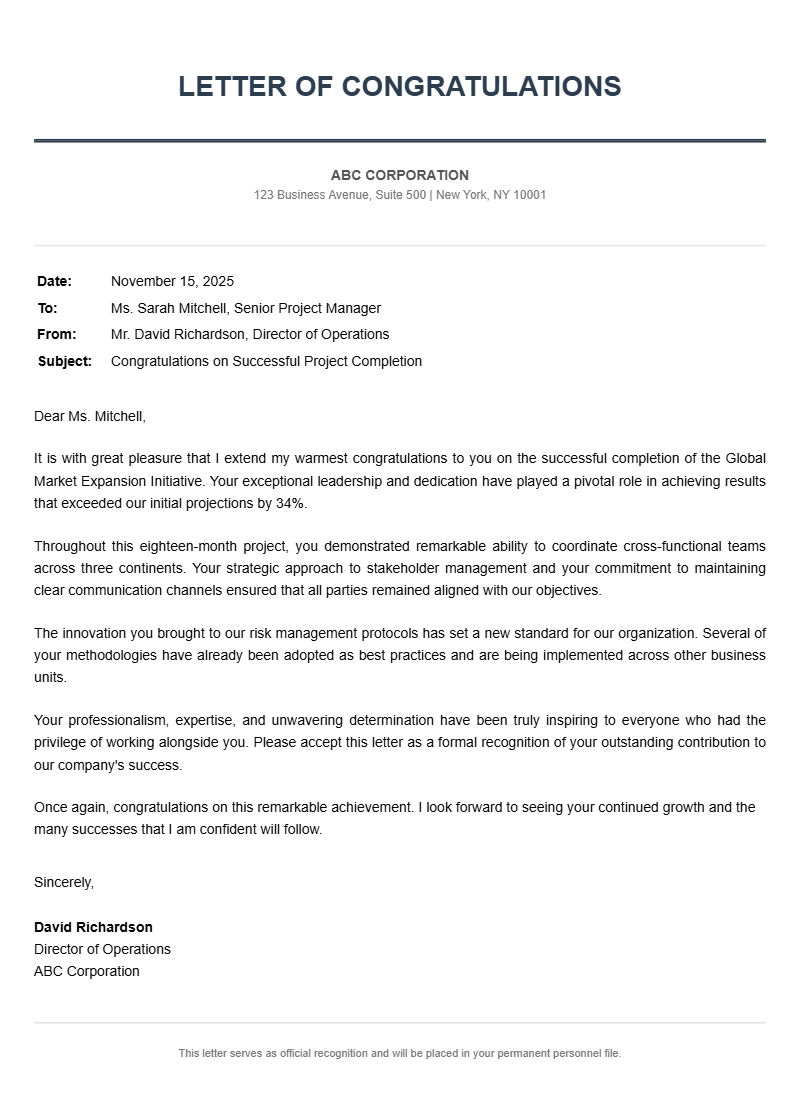
Promotion Congratulations Letter
James Thompson
Senior HR Manager
Innovative Solutions Ltd.
Date: 25 January 2026
Ms. Emily Rodriguez
Marketing Director
Creative Marketing Inc.
Subject: Congratulations on Your Promotion to Senior Marketing Manager
Dear Ms. Rodriguez,
I am writing to extend my heartfelt …