If you’ve ever had to ask someone to pay you money they owe, you know it’s a conversation most people dodge. A demand payment letter gives you a clear, written record and a professional way to request the funds without turning it into a confrontation. Below, you’ll find a practical guide to writing one that actually gets results, including editable templates you can tailor to your situation.
What Is A Demand Payment Letter?
A demand payment letter is a formal written notice that asks a debtor to pay an outstanding amount by a specific date. It outlines the amount owed, the reason for the debt, and the consequences if payment isn’t received. Think of it as your first official step before taking further action, like involving a collection agency or pursuing legal measures.
When To Use A Demand Payment Letter?
You’d typically send one of these letters when:
- An invoice is overdue by 30, 60, or 90 days.
- A client or customer refuses to pay for services rendered.
- A contractor hasn’t completed payment for materials or labor.
- You’re dealing with a former employee who owes money (like an overpayment or loan).
- You need documented proof that you attempted to recover the debt.
If you find yourself in a situation where a debtor is ignoring your calls or emails, a demand payment letter adds weight to your request. It’s also useful if you ever need to show a court that you gave the other party a chance to resolve the matter before escalating.
Key Components Of A Demand Payment Letter
A solid demand payment letter should include:
- Your contact information – Name, address, phone number, email.
- Recipient’s details – Their name, company (if applicable), and address.
- Date of the letter – Helps establish a timeline.
- Subject line – Clear and direct, e.g., “Formal Demand for Payment – Invoice #12345”.
- Amount owed – Exact figure, including any interest or late fees if applicable.
- Description of the debt – What the payment is for (e.g., services provided, products delivered).
- Payment terms – Due date, acceptable payment methods, and any consequences for non-payment.
- Signature – Your signature or that of an authorized representative.
Step-By-Step Guide To Writing A Demand Payment Letter
Follow these steps to create a letter that’s firm but professional:
- Gather all relevant details. Have the original agreement, invoice, or contract on hand so you can reference specifics.
- Choose your tone. Keep it courteous but clear. Avoid emotional language; stick to facts.
- State the purpose upfront. The first paragraph should mention the debt and the amount owed.
- Explain the context. Briefly describe what the payment is for and when it was due.
- Set a deadline. Give the debtor a realistic timeframe (e.g., 15 days from the date of the letter).
- Outline next steps. Mention what happens if payment isn’t received, such as involving a collection agency or taking legal action.
- Include your contact info. Make it easy for them to reach you or send payment.
- Proofread. Typos or vague wording can weaken your letter’s impact.
Examples And Templates
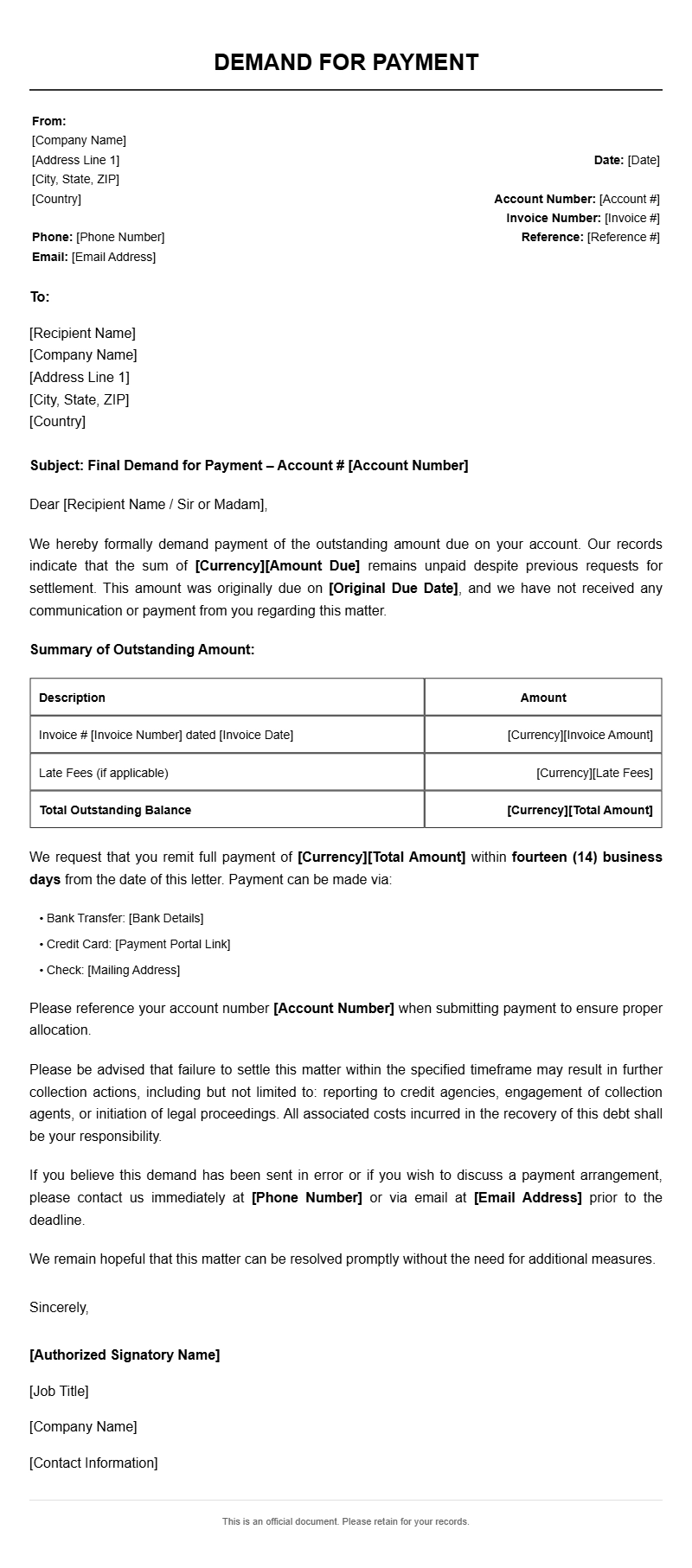
Here are two templates you can copy and customize. Replace the placeholders in brackets with your own details.
Basic Demand Payment Letter Template
[Your Name]
[Your Address]
[City, State ZIP]
[Email] | [Phone]
[Date]
[Recipient Name]
[Recipient Company (if applicable)]
[Address]
[City, State ZIP]
Subject: Demand for Payment – Invoice [#] Dated [Date]
Dear [Recipient Name],
I am writing to request immediate payment of $[Amount Owed] for [description of goods/services], which was due on [original due date]. Despite previous reminders, this amount remains unpaid.
Please remit payment by [deadline, e.g., 15 days from today] via [acceptable payment methods]. Failure to do so may result in further action, including referral to a collection agency or legal proceedings.
If you have questions or believe there is an error, contact me at [phone/email] at your earliest convenience.
Sincerely,
[Your Signature]
[Your Printed Name]
Follow-Up Demand Payment Letter Template
[Your Name]
[Your Address]
[City, State ZIP]
[Email] | [Phone]
[Date]
[Recipient Name]
[Recipient Company]
[Address]
[City, State ZIP]
Subject: Final Demand for Payment – Invoice [#] – Due [Original Due Date]
Dear [Recipient Name],
This is my second request for payment of $[Amount Owed] for [description]. The original deadline was [date], and I sent a follow-up on [previous reminder date] with no response.
I must emphasize that failure to settle this account within [e.g., 10 days] will force me to escalate the matter. This includes engaging a third-party collection service or pursuing a lawsuit to recover the debt, along with any associated costs.
I urge you to resolve this promptly to avoid further complications. Payment can be made via [methods].
Regards,
[Your Signature]
[Your Printed Name]
Common Mistakes To Avoid
- Being too vague. Always state the exact amount and what it’s for. General statements like “you owe me money” won’t hold up.
- Using aggressive language. Threats or insults can harm your case if this ends up in court. Stay factual and calm.
- Forgetting a deadline. Without a clear due date, the debtor might keep procrastinating.
- Not keeping records. Send the letter via email and postal mail, and save copies. You’ll need proof of delivery later.
- Ignoring disputes. If they claim the amount is wrong, investigate before sending a follow-up. It’s better to resolve discrepancies first.
Tips For Customization
- Match the formality to the situation. For longtime clients, a softer tone might preserve the relationship. For stubborn debtors, be more assertive.
- Add interest if allowed. If your contract or local laws permit, include a late fee or interest charge to incentivize fast payment.
- Use certified mail. When sending the final demand, use certified mail with return receipt. This creates undeniable proof the letter was received.
- Combine with phone calls. A quick call after sending the letter can prompt action—sometimes people need that human touch to get moving.
- Adapt for different industries. For example, if you’re in construction, you might reference specific line items from a bill of quantities. In freelance work, include project milestones or交付件.
If you need other formal letter formats for different scenarios, check out these resources: parent excuse letter templates for personal notes, or product launch announcement letter samples if you’re communicating new offerings to clients. For HR-related requests, rejoining request letter samples might come in handy, while school disciplinary action letter templates offer insights into structured notices. If data privacy is part of the conversation, the GDPR request letter samples provide legally aligned wording.
Final Thoughts
A demand payment letter isn’t just about asking for money—it’s about protecting your rights and creating a paper trail. Keep it clear, stay professional, and always follow through on the consequences you mention. With the templates and steps above, you’re equipped to handle overdue payments confidently.
Sample Documents for Multiple Use Cases
…
…