Facing the possibility of demotion at work can be stressful, and crafting a clear, respectful demotion letter is an important part of managing that situation professionally. Whether you’re an HR professional, a manager, or an employee needing to respond to or request a demotion, having a reliable template can make the process smoother and less awkward. This article provides practical demotion letter samples, explains when and how to use them, and offers tips for customizing your message to fit your specific context.
What Is a Demotion Letter and When Is It Used?
A demotion letter is a formal document that communicates a change in an employee’s job level, responsibilities, or salary—usually downward. It can be issued by an employer to inform an employee of their demotion or by an employee to request a change. These letters serve several purposes:
- Document the change for HR records
- Clarify new roles and expectations
- Maintain professionalism and transparency
Use a demotion letter when the change is mutual, a result of performance issues, or part of a restructuring process. It’s also common for employees to request a demotion if they feel they would be better suited to a different role or work environment.
Key Components of a Demotion Letter
Whether you’re writing or reviewing a demotion letter, certain sections should be included to ensure clarity and professionalism:
- Header and Date: Clearly state the date and recipient details.
- Introduction: Briefly explain the purpose of the letter.
- Details of the Demotion: Specify the new position, responsibilities, effective date, and any changes in compensation.
- Reason for Demotion: Provide a factual, respectful explanation, avoiding blame or negative language.
- Next Steps and Support: Outline what the employee can expect moving forward and any support available.
- Closing and Signatures: End on a respectful note, including signatures if applicable.
Step-by-Step Guide to Writing a Demotion Letter
- Start with a respectful tone: Keep your language professional but empathetic.
- State the purpose clearly: Make it obvious why you are writing the letter.
- Include specific details: Mention the new role, responsibilities, and effective date.
- Explain the reason for the demotion: Be honest but tactful, focusing on performance or organizational needs.
- Offer support and next steps: Suggest how the company or manager will assist during the transition.
- Close with respect: Thank the employee for their contributions and express confidence in their future.
Sample Demotion Letter Templates
Template 1: Mutual Demotion Agreement
[Your Company Name]
[Date]
[Employee Name]
[Employee Address]
Dear [Employee Name],
We appreciate your contributions to [Company Name] and value your dedication. After discussions, we have mutually agreed that a change in your current role is in the best interest of both parties.
Effective [date], your position will be adjusted to [New Position Title], with responsibilities including [briefly list responsibilities]. Your salary will be adjusted to [new salary, if applicable], effective immediately.
This change is part of a strategic realignment to better align our team’s skills with organizational goals. We are committed to supporting you during this transition and will provide [training, mentoring, or other support].
Please sign below to acknowledge your understanding and agreement to this change.
Thank you for your ongoing efforts.
Sincerely,
[Your Name]
[Your Position]
[Signature]
[Date]
Template 2: Employee-Initiated Demotion Request
[Your Name]
[Your Address]
[Date]
[Manager’s Name]
[Company Name]
[Company Address]
Dear [Manager’s Name],
I am writing to formally request a demotion from my current role as [Current Position] to [Desired Position]. I believe this change will allow me to better utilize my skills and contribute more effectively to the team.
Over the past months, I have reflected on my strengths and career goals, and I feel that a role with fewer responsibilities or different focus areas would be a better fit for me at this time.
I appreciate your understanding and am happy to discuss the details further. I value my position here and want to ensure a smooth transition if my request is approved.
Thank you for considering my request.
Sincerely,
[Your Name]
[Your Contact Information]
Common Mistakes to Avoid in Demotion Letters
- Using overly negative or accusatory language
- Failing to clearly specify the new role and responsibilities
- Not providing a reason for the demotion or being vague
- Ignoring the importance of a respectful tone, especially if the demotion is involuntary
- Overlooking legal considerations—ensure the letter complies with employment laws
Tips for Customizing Your Demotion Letter
- Personalize the tone based on the relationship and circumstances
- Be honest but tactful—focus on organizational needs rather than personal faults
- Include specifics about support or training offered during the transition
- Use clear, straightforward language—avoid jargon or ambiguous phrases
- For formal situations, consider consulting HR policies or legal advice
When you need a formal template, you can adapt examples like the ones above or explore other related templates such as promotion recommendation letters or permission letters to suit your needs.
Keeping a professional, respectful tone and being transparent about the reasons and support available can make a difficult conversation much easier. Use these templates as a starting point, then customize to fit your specific situation and maintain trust and clarity throughout the process.
Practical Document Examples
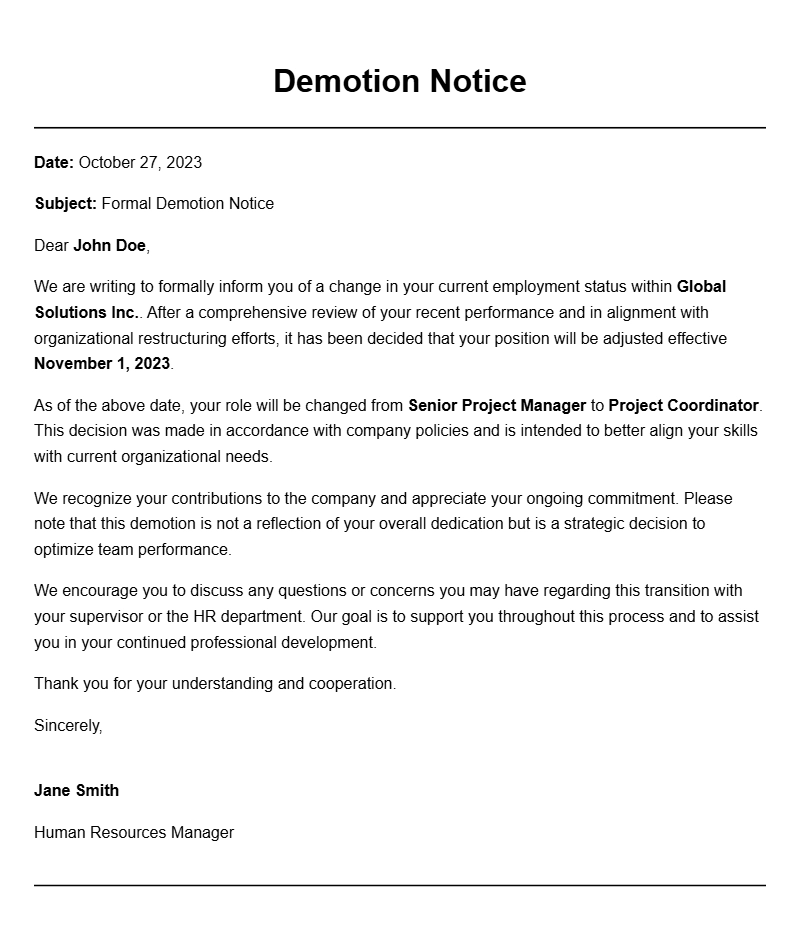
Standard Demotion Notice Template
Dear [Employee Name],
We regret to inform you that effective from [Date], your position as [Current Position] will be demoted to [New Position]. This decision was made after a comprehensive review of your recent performance and in alignment with our company policies.
The demotion reflects our commitment to maintaining high standards and ensuring team cohesion. Your new responsibilities will include [list of responsibilities], and your compensation will be adjusted accordingly.
Please acknowledge receipt of this letter and feel free to discuss any concerns with Human Resources or your supervisor.
We appreciate your understanding and look forward to your continued contributions in your new role.
Demotion Due to Performance Issues
Dear [Employee Name],
This letter serves to formally notify you of a demotion from your current position of [Current Position] to [New Position], effective [Date].
This action follows a period of performance review and feedback sessions, which indicated the need for improvement in certain areas, including [specific issues]. Despite support and guidance, the required progress has not been achieved.
We believe this change will provide an opportunity for you to focus on developing the necessary skills. Support and resources will be provided to assist in your transition.
Should you have any questions or wish to discuss this further, please contact Human Resources.
Voluntary Demotion Acceptance Letter
Dear [Manager Name],
I am writing to confirm my acceptance of the proposed voluntary demotion from [Current Position] to [New Position], effective [Date].
I understand the reasons behind this decision and am committed to fulfilling my new responsibilities to the best of my ability. I appreciate the support provided during this transition and look forward to contributing in my new role.
Please let me know if there are any further steps I should complete prior to the effective date.
Demotion Announcement to Team
Dear Team,
We wish to inform you that [Employee Name] will be transitioning from their current role as [Current Position] to a new position of [New Position], effective [Date].
This decision was made after careful consideration and aims to align our organizational structure with current business needs. [Employee Name] will continue to be an integral part of the team, and we appreciate your support during this transition.
We thank [Employee Name] for their contributions and look forward to their ongoing collaboration in their new role.
Demotion Letter for Organizational Restructuring
Dear [Employee Name],
As part of our recent organizational restructuring, we are implementing changes to better align our team with strategic goals. Consequently, your position as [Current Position] will be demoted to [New Position], effective [Date].
This decision reflects organizational needs and is not a reflection of your individual performance. We are committed to supporting you through this transition and will provide necessary training and resources.
Please contact HR if you have any questions or wish to discuss your new role further.
Performance-Based Demotion Letter
Dear [Employee Name],
Following a recent performance review, we have determined that a change in your role is necessary. Effective [Date], your position will be adjusted from [Current Position] to [New Position].
This decision is intended to help you focus on areas requiring improvement and to provide a clearer pathway for your development within the company. Support measures and performance coaching will be available to assist you during this period.
We encourage you to discuss this transition with your supervisor or HR representative.
Temporary Demotion Notice
Dear [Employee Name],
This letter confirms that, effective from [Date], you will be temporarily demoted from your current role of [Current Position] to [Temporary Position]. This adjustment is due to [reason, e.g., departmental restructuring, project reallocation].
The temporary demotion will last until [expected end date], at which point your original position will be restored unless further changes are decided.
We appreciate your cooperation and understanding during this period. Please reach out to HR for any questions or clarifications.
Demotion Letter with Transition Support
Dear [Employee Name],
In light of recent organizational changes, we are implementing a demotion from [Current Position] to [New Position], effective [Date]. We recognize this may be a challenging transition and are committed to providing support to facilitate a smooth change.
Support includes [training sessions, mentoring, counseling, etc.]. We believe this change will help you develop new skills and better align with our strategic objectives.
Thank you for your understanding and cooperation. Please contact HR for further assistance or to discuss your transition plan.
Constructive Demotion Response Letter
Dear [Manager Name],
I acknowledge receipt of the demotion letter dated [Date], which details the change from [Current Position] to [New Position]. While I am disappointed, I appreciate the clarity and the opportunity to discuss my development.
I am committed to improving my performance and contributing positively in my new role. I would welcome any feedback or additional support to help me succeed during this transition.
Thank you for your ongoing guidance.